
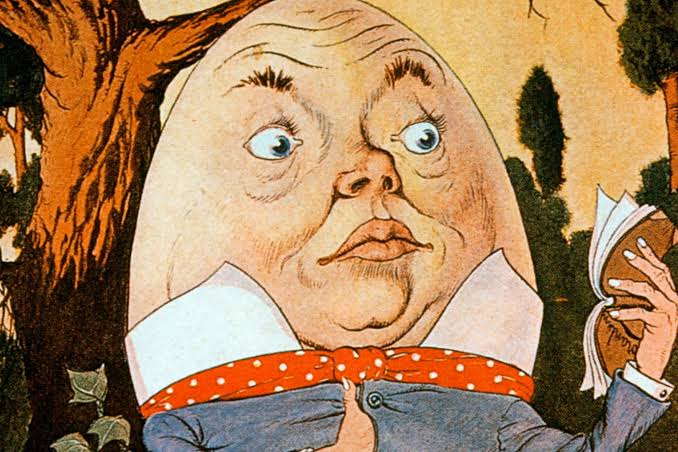
Say “Humpty Dumpty” and almost everyone pictures the same thing: a cracked egg sitting on a wall. Yet the original rhyme never once uses the word “egg.”
So why is Humpty Dumpty an egg in our collective imagination? The answer involves a 19th-century novelist, a possible cannon, and centuries of guessing games. Here’s the full story.
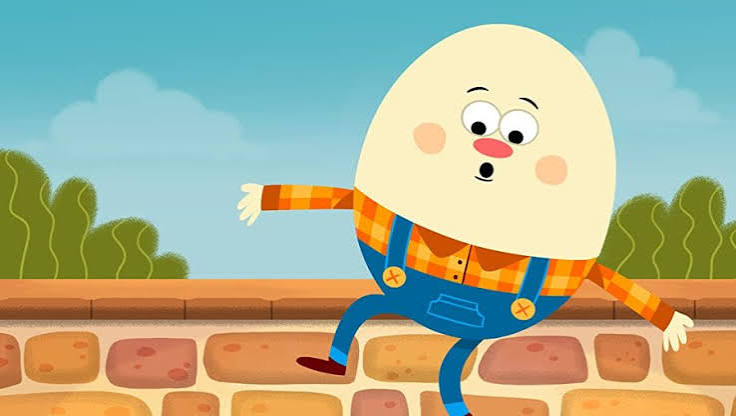
Humpty Dumpty is pictured as an egg mainly because of Lewis Carroll’s 1871 novel Through the Looking-Glass, which explicitly described him as a large, talking egg sitting on a wall.
The original 18th-century rhyme never mentions an egg at all — it was likely a riddle, and the egg was the answer readers were meant to guess.
The most familiar version of the rhyme reads simply: Humpty Dumpty sat on a wall, had a great fall, and could not be put back together by the king’s horses or men.
Nowhere in those four lines is there any mention of shells, yolks, or eggs.
This absence is exactly why the “is Humpty Dumpty an egg” question keeps coming up generation after generation.
Historians believe the rhyme began life as a riddle rather than a simple story. Early versions from around 1797 asked listeners to guess what “Humpty Dumpty” actually was.
The trick of the riddle is that almost anything broken beyond repair by a fall — something no horse or soldier could fix — points naturally to an egg.
Once broken, an egg cannot be put back together, which made it a clever and satisfying riddle answer.
The image most people know today comes from Lewis Carroll’s Through the Looking-Glass, published in December 1871. Chapter six is titled simply “Humpty Dumpty.”
In it, Alice meets a character who starts as an odd shape sitting on a wall and gradually reveals himself to be an enormous, human-faced egg.
Illustrator John Tenniel’s drawings cemented this egg image, and it has stuck in popular culture ever since.
A competing theory claims the original “Humpty Dumpty” was not a creature at all, but a large cannon used during the English Civil War.
According to this theory, the cannon sat on a fortified wall during the 1648 Siege of Colchester and fell when the wall was destroyed by enemy fire.
Because the cannon was too heavy to lift back into place, “all the king’s horses and all the king’s men” genuinely could not restore it.
Other historians argue the rhyme may simply describe a clumsy person. An 18th-century slang dictionary defines “humpty dumpty” as a short, clumsy person of either sex.
Some early printed versions replace the king’s horses and men with “threescore men and threescore more,” reading more like an ordinary tale of a fall than a riddle about an object.
Under this reading, the egg imagery was added later purely for comfort and charm, not historical accuracy.
A person falling from a wall and being permanently unable to be fixed is a fairly dark image for a children’s rhyme.
Turning Humpty into an egg softened the story, since a broken egg feels far less unsettling than a broken person.
An egg is one of the few everyday objects that truly cannot be repaired once shattered, which fits the rhyme’s ending perfectly.
This built-in logic made the egg explanation easy to remember and repeat, long before Carroll gave it a face.
Once Tenniel’s illustrations for Through the Looking-Glass became iconic, later illustrators and toy makers simply followed the same visual template.
By the early 20th century, the anthropomorphic egg had become the default image in nearly every children’s book.
| Theory | Core Claim | Supporting Evidence | Popular Today? |
|---|---|---|---|
| Riddle answer (egg) | Humpty was always meant to be guessed as an egg | Fits the “cannot be repaired” logic of a riddle | Yes, the dominant image |
| Lewis Carroll’s egg | Carroll and Tenniel first drew him as an egg in 1871 | Direct textual description in Through the Looking-Glass | Yes, the visual source |
| Siege of Colchester cannon | Humpty was a cannon on a fortified wall | Historical accounts of the 1648 siege | Popular but disputed |
| Clumsy person | Humpty was slang for a short, clumsy human | 18th-century slang dictionary definitions | Less known |
Folklorists who study riddle-rhymes note that many old English riddles use near-identical phrasing to “Humpty Dumpty,” including references to “the king’s horses.”
This pattern suggests the egg riddle format existed before Carroll, and he simply popularized and illustrated an answer people already guessed.
Today, most language and folklore scholars treat the egg as the rhyme’s most likely intended answer, even without direct proof from the earliest texts.
Humpty Dumpty has appeared far beyond nursery books, including as a Batman villain in DC Comics and as a recurring character in mystery novels like Jasper Fforde’s The Big Over Easy.
Broadway even staged a pantomime musical called Humpty Dumpty in 1868, which helped popularize the character in the United States before Carroll’s novel existed.
Each retelling has reinforced the same core image: an egg that falls, breaks, and can never be whole again.
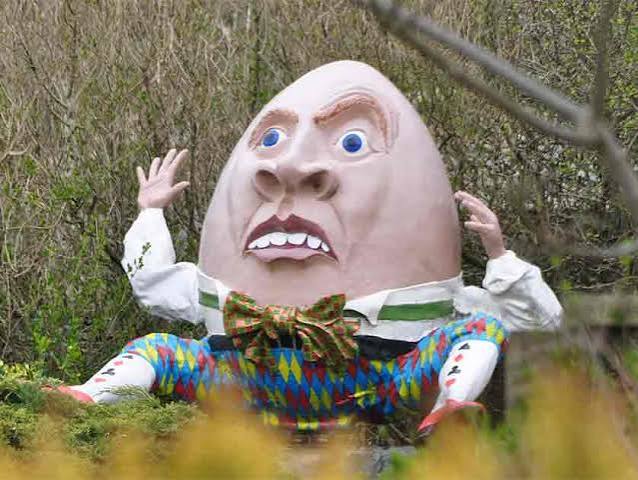
Because Lewis Carroll’s 1871 novel Through the Looking-Glass described him as an egg, and illustrator John Tenniel’s drawings made that image iconic and lasting.
No, the original four-line rhyme never mentions an egg; it only describes a fall that could not be undone.
Lewis Carroll is credited with the first clear textual description of Humpty Dumpty as an egg, in his 1871 book.
It’s a popular historical theory tied to the 1648 Siege of Colchester, but it isn’t definitively proven and remains debated among historians.
Printed versions date back to around 1797, though the rhyme may have existed orally as a riddle before that.
An 18th-century slang dictionary defined “humpty dumpty” as a short, clumsy person, suggesting the rhyme may have originally described a human.
Most folklorists believe the intended riddle answer was always an egg, since a shattered egg logically cannot be repaired by any number of helpers.
No, the character predates Carroll by decades; he simply gave the first clear egg description and made it culturally dominant.
Whether read as an egg, a cannon, or a person, the ending emphasizes something broken so severely that even royal resources cannot restore it.
Some theories tie it to the English Civil War and the Siege of Colchester, though no single event has been conclusively confirmed as the source.
He’s often used as a symbol of something fragile that, once broken or lost, can never fully return to its original state.
Its structure closely matches other 18th-century riddle-rhymes that describe an object indirectly and ask the listener to guess what it is.
No, early depictions varied, and the now-familiar smiling egg with arms and legs became standard only after Tenniel’s illustrations spread widely.
Yes, he appears in works ranging from DC Comics as a Batman villain to Jasper Fforde’s mystery novel The Big Over Easy.
This detail reinforces the riddle’s point: even the greatest resources available couldn’t fix what had broken, hinting strongly at something as fragile as an egg.
Humpty Dumpty became an egg not because the original rhyme said so, but because the riddle’s logic, Lewis Carroll’s storytelling, and decades of illustration all pointed the same direction.
Whether he began as a cannon, a clumsy man, or purely a clever riddle, the egg version won out because it perfectly captures the idea of something broken beyond repair.
That’s the real answer behind one of the most asked nursery rhyme questions in the English language.