
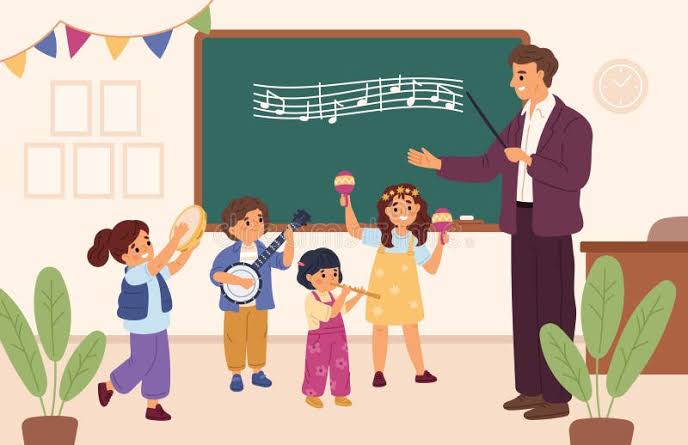
Ask anyone who has learned a second language which phrases stuck with them longest, and a surprising number will mention song lyrics. Melody and rhythm give vocabulary something to hang onto, which is why teachers have used songs for decades to teach everything from the alphabet to verb conjugations. The obstacle has always been supply: finding a song that teaches exactly the grammar point or vocabulary set you need this week is hard, and writing and recording your own is out of reach for most teachers who already have a full workload.
Commercial songs are written to entertain, not to teach. A pop track might contain one useful phrase surrounded by slang, idioms, and vocabulary far above a beginner’s level. Educational songs made for children are often too simple for teenagers and adults, and the ones written for specific textbooks rarely line up with what a given class is covering. Teachers end up adapting material that was never designed for their lesson, or skipping music altogether because the preparation time isn’t worth it.
The result is a gap between what research and classroom experience both suggest works well, learning through song, and what teachers can realistically deliver week after week.
This is where a simple ai music generator free tier becomes genuinely useful to an educator. A teacher can write a short set of lines using the target vocabulary or grammar structure, such as the days of the week, polite requests, or the past tense of common verbs, and turn that text into a finished song in a few minutes. The words are exactly what the lesson needs, and the music simply makes them easier to remember.
Teachers can also adjust the style to fit the audience. A slow, gentle folk tune suits young learners practicing greetings, while an upbeat pop arrangement works better for teenagers drilling irregular verbs. Because generating a draft costs nothing, it is easy to try two or three styles and pick the one the class responds to.
Audio alone helps, but video holds attention in a way audio can’t, especially for younger students and anyone learning to connect sounds with mouth movements. An ai singing video generator takes a still image, such as an illustrated character or a friendly cartoon mascot for the class, and animates it singing along with the track. Students can watch the lips form each word, which supports pronunciation practice in a way a plain audio file does not.
Many teachers prefer to use an illustrated character rather than their own face. A consistent class mascot who “sings” every new lesson song becomes a familiar presence, and students look forward to seeing what the character will sing next. It also means a teacher can prepare content ahead of time and share it with students for review at home without recording themselves each time.
Vocabulary songs. Short, repetitive songs built around a themed word set, such as food, clothing, or transportation, give students a hook for memorizing groups of related words.
Grammar jingles. A catchy line that captures a rule, for example how to form a question or when to use a particular tense, is much easier to recall during a test than a rule written on a worksheet.
Review videos for home practice. Students who miss a class or want extra practice can replay the singing video as often as they like, mimicking the pronunciation at their own pace.
Cultural connection. Teachers can generate songs in different musical styles that reflect the cultures where the language is spoken, giving students exposure to varied rhythms and sounds alongside the vocabulary.
Some teachers already use a well-known melody and swap in their own lyrics to teach a concept. An ai cover song generator offers another way to refresh familiar material: a classroom song a teacher has used for years can be rebuilt in a different style, such as turning a slow, dated tune into something more energetic for a new generation of students, while keeping the melody that previous classes learned. It is also useful when a recording has been lost or is of poor quality, since the melody can be recreated in a cleaner arrangement.
Keep lyrics short and repetitive. Songs for learners work best when the key phrase appears several times, and when the sentence structure is simple enough to sing at a natural pace. Test the song with a small group before rolling it out to a whole class, and ask students which version they found easiest to remember. Finally, treat these tools as a supplement to teaching rather than a replacement: the song gives students a memory hook, but the teacher’s explanation and practice activities are still what turn that hook into real understanding.
Teachers have long known that songs help learners remember, but the time cost kept music in the “nice to have” category. When a custom song and an animated singing video can be produced in the time it takes to write a short lesson summary, music stops being a special occasion and becomes something a teacher can include whenever it would help. For classrooms with limited budgets and limited preparation time, that is a meaningful change.