
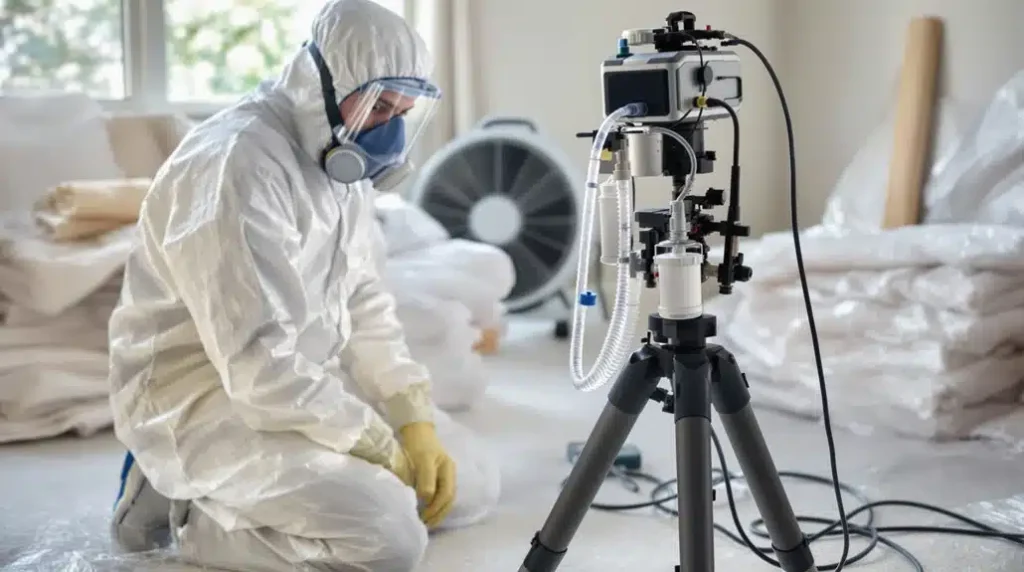
Finding asbestos in a commercial building might complicate an otherwise simple refurbishment, maintenance project, or demolition. Asbestos-containing materials (ACM) may be found in older offices, warehouses, retail establishments, industrial facilities, and other workplaces in areas such as roofing and wall linings, as well as insulation, plant, and service components.
The discovery does not imply that work must be suspended indefinitely. What important is that the substance is appropriately identified, the danger is assessed, and the appropriate management or removal technique is used. Understanding how commercial asbestos removal works, from initial discovery to final clearance, can help businesses prevent unnecessary interruption while also safeguarding workers and anyone who may be affected.
Start with Identification and Assessment
Asbestos cannot usually be identified accurately based on appearance alone. If asbestos is suspected, the material should not be damaged just to find out what it is.
Asbestos management in the workplace often begins with the creation of an asbestos registry and, if necessary, management plans. If the item is suspected but not confirmed, a competent person may need to analyse it and, if necessary, arrange for sample and laboratory analysis.
This initial step is especially critical for planned renovations or upkeep. A seemingly unimportant material can become a problem if later work requires drilling, cutting, destruction, or access to hidden building components.
According to Safe Work Australia, PCBUs are responsible for detecting and managing asbestos risks, which includes maintaining an asbestos register and management plan where relevant.
Determine Whether Removal Is Necessary
Finding asbestos does not necessarily imply that it must be removed immediately. Asbestos can occasionally be managed in place, depending on its condition, location, and risk of disruption.
Removal may become the preferred control strategy in cases when ACM is damaged, deteriorating, friable, or expected to be disturbed by scheduled construction or maintenance activities. The risk assessment should take into account the material itself, the proposed work, and the individuals who may be exposed.
This assessment might also have an impact on the timing of a business property’s rehabilitation. Removing asbestos before other trades begin may keep workers like electricians, plumbers, builders, and maintenance contractors from accidentally harming ACM.
Why Licensed Asbestos Removal Matters
Where legal work is required, finding adequately licensed asbestos removal professionals is an important step in the process.
The criteria for asbestos licensing in Australia vary by state and territory. According to the model WHS framework, Class A removalists can remove all varieties of asbestos, although Class B removalists are normally permitted to remove non-friable asbestos. Depending on the jurisdiction, certain minor quantities of non-friable asbestos may be removed without a licence.
Businesses should thus confirm the regulations that apply in the state or territory where the work is being done, rather than making assumptions based on another jurisdiction.
Before beginning work, a qualified removalist should familiarise themselves with the site’s asbestos registration, proposed scope of work, control measures, and waste needs.
Planning the Removal Work
Commercial asbestos removal entails more than just getting the material out of a structure.
Depending on the work, planning may involve:
According to Safe Work Australia guidelines, licensed asbestos removal work should be carefully planned and regulated, with access to the removal area restricted and asbestos debris properly contained and disposed of.
Communication is especially vital in populated business buildings. Workers, contractors, and other stakeholders may need to know when removal is taking place, where areas are restricted, and when normal access can be resumed.
Containment, Removal and Waste Management
During removal, the goal is to keep asbestos fibres from getting airborne and spreading outside the controlled work area. The particular restrictions vary depending on the type and state of the ACM, as well as the nature of the work.
Friable asbestos poses a higher risk of fibre release and necessitates stricter controls than non-friable products. Air monitoring may also be essential for some types of work, especially if friable asbestos is present.
Asbestos trash must also be handled cautiously. It should be properly confined, tagged, and transported in compliance with applicable regulations, and disposed of at a facility that accepts asbestos waste. Disposal requirements vary by jurisdiction and facility; therefore plans should be made before garbage is transferred.
Clearance is the Final Safety Check
Removal does not necessarily mark the end of the process. A clearance analysis may be required before an impacted commercial site may resume normal operations.
A clearance analysis checks the removal location and its surroundings for obvious asbestos contamination. Depending on the conditions, air monitoring may also be part of the clearance procedure.
For example, Queensland regulations require a written clearance certificate following permitted asbestos removal operations in the workplace. The standards for who can undertake the inspection vary depending on the type of removal operation, with independent assessment applicable in some cases.
This final stage provides a vital independent verification that the controlled area is safe for reoccupation. It should not be viewed as a paperwork exercise. If contamination persists, additional cleaning and assessment may be required before returning the space to normal use.
Avoid Treating Asbestos Removal as a Standalone Task
One of the most typical issues in commercial projects is viewing asbestos removal as a standalone task. In fact, it can have an impact on demolition timetables, contractor access, waste management, building tenants, and future construction activity.
Early detection enables asbestos-related work to be incorporated into the project design rather than being discovered suddenly midway through renovation.
The key is to approach asbestos management in stages: identify the material, assess the risk, determine the appropriate control, hire suitably qualified professionals as needed, complete the work under controlled conditions, manage waste properly, and obtain the necessary clearance before reoccupation.
This systematic method can help commercial property owners, facility managers, and project teams manage asbestos risks while offering a clearer path from initial discovery to safe completion.