
Every shop has a surface people gravitate to and one they avoid, and the difference is almost never storage capacity. It is height and reach, which is why a rolling workbench is worth judging the way a chair is judged rather than the way a cabinet is.
A rolling workbench that is slightly too low forces a permanent stoop, and one that is too high pushes the shoulders up and tires the arms within twenty minutes. Neither problem announces itself on the day it arrives, which is why so many benches quietly become shelves.
The general rule for general assembly work is a top that sits somewhere around wrist height when standing with arms relaxed at the sides. That puts the hands slightly below the elbows, which is where they can work without lifting the shoulders.
Precision work benefits from going higher, closer to the elbow, so the eyes are nearer the piece. Heavy work where force comes down through the arms benefits from going lower, since a low surface lets body weight do what shoulders otherwise have to.
Every flat surface in a shop eventually fills with the tools last used on it, and once a bench is covered the work moves somewhere else.
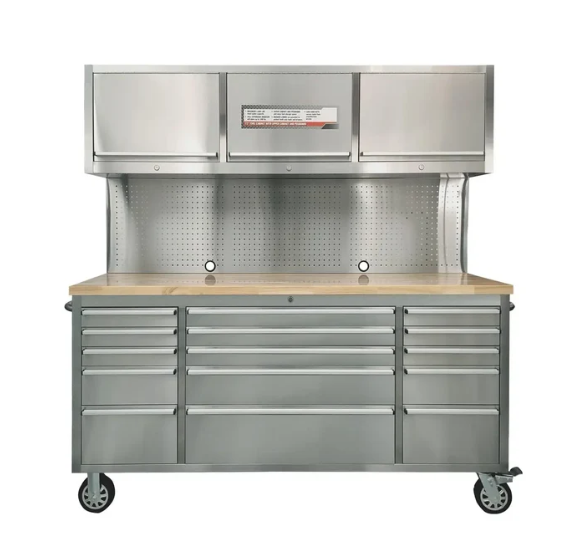
A pegboard back is the answer because it puts frequently used tools within reach without putting them on the top. Hanging what gets used constantly on the vertical surface is what keeps a rolling workbench a working surface rather than a shelf with a project on it.
The rubberwood surface is chosen deliberately over steel. Wood takes a dropped tool without transmitting the shock, holds a clamp without slipping, and does not mark a workpiece resting on it the way bare metal does.
The cabinet beneath is steel because that is what carries the weight of drawers full of tools without racking. The combination gives a surface that is kind to the work and a structure that is not.
A fixed bench dictates the shape of a shop permanently, in a way a rolling workbench never does, since everything else has to be arranged around wherever it was first put.
A rolling workbench can be pulled into the middle of the floor for a job that needs access from all sides, then pushed back against a wall when the space is needed for a vehicle. That flexibility matters most in the shops that have the least room.
A bench that moves under load is worse than one that cannot move at all, because hammering, filing, or pressing against an unlocked surface is both frustrating and unsafe.
Locking casters solve it, and using them is the habit that matters. A hobbyist near Sacramento locks his the moment it is positioned, simply so he never has to think about whether it will hold when he leans on it.
Six feet of length is what lets a long workpiece sit fully supported rather than overhanging at both ends, and it leaves room for a vise at one end without losing the middle of the surface. Depth beyond arm reach is far less useful, since anything pushed to the back simply stays there.
Weighed against a built-in bench, the mobile version gives up some rigidity for heavy pounding, and returns a shop that can be rearranged for the job at hand rather than one arranged permanently around a fixture.
As garages serve several purposes across a week, owners increasingly choose equipment that can be repositioned rather than installed, since a space that has to hold a vehicle on Monday cannot be permanently committed to a bench on Sunday.
That demand for adaptable space is why the workshop furniture that TMG Industrial supplies pairs a working surface with storage on a base that rolls.