
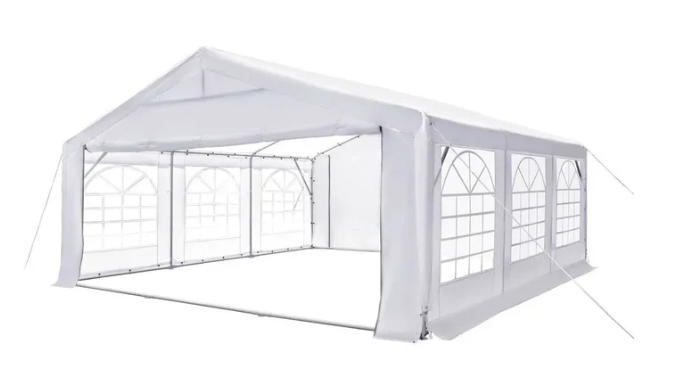
Booking an outdoor date in this country means accepting that the same afternoon can deliver sun, wind, and a downpour within a few hours. A party tent is what makes that gamble acceptable, because the event no longer depends on the forecast being right.
The decision that follows is simply one of size, and it gets made badly more often than not. Owners picture the tent standing empty in a yard rather than full of tables, chairs, people moving between them, and whatever else the day requires. A party tent is sized for the event rather than for the yard it stands in.
A twenty by twenty footprint covers four hundred square feet, which is a useful number only once it is divided by how the space is used. Standing guests at a reception need roughly six square feet each, so the same area holds a sizeable crowd.
Seat those guests at round tables and the figure changes completely, since each place needs closer to twelve square feet once chairs and circulation are counted. The same party tent that holds sixty standing comfortably seats around half that number for dinner.
Capacity charts assume the whole footprint holds guests, which is almost never true in practice. A buffet line, a bar, a cake table, a gift table, and a space for speeches all come out of the same four hundred square feet. Anyone laying out an event on paper first tends to discover this early. A host near Kingston drew her tables to scale before hiring and found she needed the seating for forty rather than the fifty she had been counting on.
The sidewalls are the feature that earns its keep on a variable day. Left off, the tent is a shade roof with air moving through it, which is what an August afternoon actually needs. Drawing the layout to scale is the cheapest hour of planning an event ever gets.
Fitted as the weather turns, the same walls block driving rain and cut a cold evening wind. Being able to change that during the event, rather than deciding at setup, is the practical advantage of a party tent with walls that clip on and off.
A tent is a large surface with air moving under it, and an unsecured one moves in a gust regardless of how heavy the frame feels when it is standing still in the yard. On grass, stakes driven at an angle away from the tent hold well. On a paved surface no stake is possible, so the legs are weighted instead, and the weights have to be substantial rather than symbolic.
A structure this size is not a one person task. Frame sections are assembled on the ground, the cover is pulled over, and the whole assembly is raised together, which takes several people and a couple of hours to do calmly. A party tent that is anchored properly is one nobody has to think about again.
Planning that for the day before an event rather than the morning of it is what separates a relaxed host from a stressed one, and it leaves time to adjust anything that does not sit right.
Weighed against hiring a hall, a tent puts the event where the host wants it and returns the cost across two or three uses, provided somebody has thought about who is raising it and where it will be stored afterward.
More gatherings now happen in yards and on acreages rather than in booked venues, and that shift has turned temporary shelter from a rental line item into equipment families increasingly buy and reuse.
That change in where people gather is why the event shelters that TMG Industrial supplies are built for repeated setup rather than a single season.