
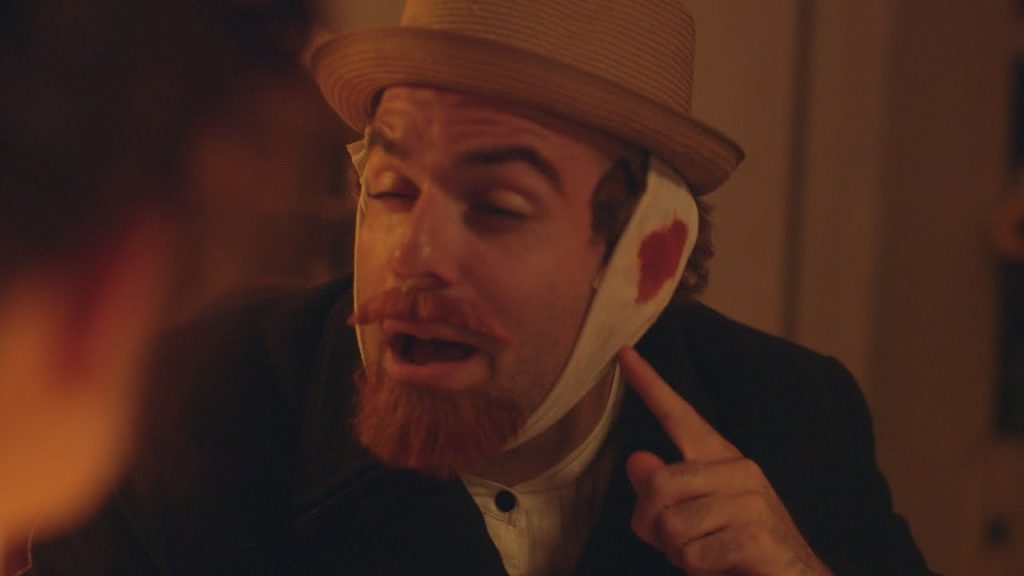
Why did Van Gogh cut off his ear is one of the most searched questions in all of art history, and more than 135 years later, no single definitive answer exists.
On the night of December 23, 1888, in a small yellow house in Arles, France, the Dutch painter Vincent van Gogh severed part of his left ear, wrapped it in paper, and delivered it to a woman at a nearby brothel.
He was found the next morning covered in blood, barely conscious, with no memory of what he had done.
Vincent Willem van Gogh was born on March 30, 1853, in the Netherlands. He did not start painting seriously until his late twenties, making his entire artistic career span only about a decade.
In that decade, he produced roughly 900 paintings and over 1,100 drawings. None of them sold during his lifetime except one, “The Red Vineyard,” sold months before his death.
He was entirely financially dependent on his younger brother, Theo van Gogh, an art dealer in Paris who sent him a monthly allowance. This dependency shaped Vincent’s psychology deeply — and played a direct role in the night he cut off his ear.
Before becoming a painter, Van Gogh tried several careers. He worked as an art dealer, a teacher, and a lay preacher in the Belgian mining district of Borinage, where he lived among the poor miners he so deeply wanted to serve.
All of these paths failed. After multiple collapses and periods of deep depression, Theo urged him to try painting as a vocation. Van Gogh threw himself into it with obsessive intensity.
By 1886, he was living with Theo in the Montmartre district of Paris, exploring Impressionism and absorbing the influence of Japanese woodblock prints. He met Paul Gauguin in Paris in 1887 through Theo, and the two struck up a friendship built on mutual admiration and artistic ambition.
In February 1888, Van Gogh left the chaos of Paris for the town of Arles in southern France. He craved sunlight, open spaces, and a calmer environment to paint.
By May 1888, he had rented a modest four-room house on Place Lamartine — a structure with bright yellow walls that he would immortalize in paint. He called it the Yellow House, and he had one grand vision for it: to turn it into a community for artists, a “Studio of the South.”
He invited several artists to join him. Only Paul Gauguin agreed, partly at Theo’s financial persuasion. Van Gogh spent months preparing the Yellow House for Gauguin’s arrival, decorating the rooms with his famous Sunflowers series as a welcoming gift.
Gauguin arrived in Arles on October 23, 1888. Van Gogh was overjoyed.
The first weeks were productive. The two painters worked side by side, visited museums together, dined together, and discussed art endlessly. Van Gogh later called these early weeks some of the best of his life.
But the cracks appeared quickly. The two men had fundamentally different temperaments and completely different approaches to painting.
Van Gogh believed in painting directly from reality, from life, from the raw world in front of him. Gauguin preferred painting from memory and imagination. What started as stimulating debate became constant argument.
Gauguin was independent, emotionally cool, and domineering. Van Gogh was emotionally intense, needy, and prone to mood swings. By December 1888, Gauguin had privately decided he wanted to leave.
What follows is the most complete reconstruction of that night based on historical records, letters, and eyewitness accounts.
During the day: Van Gogh and Gauguin had spent the day indoors, trapped by heavy rain. Tension had been building for days. Van Gogh had been erratic and difficult for weeks.
That evening: Van Gogh received a letter from Theo. The letter announced that Theo had become engaged to a woman named Johanna Bonger after a whirlwind romance. This news shook Van Gogh profoundly. Theo was his entire financial and emotional lifeline. Marriage meant Theo would have new obligations — a wife, eventually a family — that could end or reduce his support.
Later that evening: Gauguin told Van Gogh he intended to leave Arles for Paris. For Van Gogh, this was a double blow on the same night — his brother’s loyalty in question, and his only companion about to abandon him.
The confrontation: Accounts vary. In his memoir written years later, Gauguin said Van Gogh came toward him in the street with an open razor. Gauguin stared him down, Van Gogh retreated. This is the last time the two men ever saw each other face to face.
The self-mutilation: At some point that night, alone in the Yellow House in a state of complete mental collapse, Van Gogh cut off part of his left ear. The exact degree of the cut remains disputed — some accounts say just the lobe, a drawing made by his doctor years later suggests the entire ear.
The brothel visit: He wrapped the severed ear in paper and walked to a nearby brothel. He handed it to a young woman there — named Rachel in most accounts — and told her to “keep this object carefully.” She fainted. The brothel was thrown into commotion. The police were called.
The next morning: Officers went to the Yellow House and found Van Gogh unconscious in his bed, surrounded by blood-soaked sheets. He was barely alive. They transported him to the Hôtel-Dieu hospital in Arles, where Dr. Félix Rey treated him.
Christmas Day: Theo arrived by train from Paris to be at his brother’s side in hospital. Gauguin had already left Arles for Paris that same morning. He and Van Gogh never spoke again.
The severed ear was eventually brought to the hospital where Van Gogh was being treated. However, Dr. Rey determined that too much time had passed to attempt any reattachment.
Researcher Bernadette Murphy, author of the 2016 book “Van Gogh’s Ear,” spent years tracking down what actually happened to the ear. Based on a sketch made by Dr. Rey decades after the incident, Murphy concluded that Van Gogh had cut off the entire ear, not just the lobe.
Murphy also discovered that the woman who received the ear was not a prostitute named Rachel, but a young farmer’s daughter named Gabrielle Berlatier, who worked at the brothel as a servant. This claim remains debated among historians.
The ear itself was never preserved and no longer exists.
This is the question that historians, psychologists, neurologists, and art critics have been arguing about for over a century. Here are the most significant theories.
This is the most widely accepted explanation. The fight with Gauguin and Gauguin’s announcement of his departure triggered a psychological collapse in a man already on the edge.
Van Gogh had poured everything — his money, his dream, his hope for companionship — into the Yellow House and into his relationship with Gauguin. Losing Gauguin meant losing all of that at once.
The self-mutilation, in this reading, was the act of a man who had completely lost control of his mental state during a psychotic or manic episode.
Author Martin Bailey, in his 2016 book “Studio of the South,” argues that the timing of Theo’s letter announcing his engagement was the true catalyst.
Bailey established that the letter almost certainly arrived on December 23 — the same day as the confrontation with Gauguin. Theo’s engagement threatened the one relationship Van Gogh depended on most entirely.
Van Gogh had grown accustomed to spending Christmas with Theo. Now Theo would spend it with his new fiancée. The financial and emotional implications were devastating to someone with Van Gogh’s fragile mental state.
In their 2009 book “Pact of Silence,” researchers Hans Kaufmann and Rita Wildegans proposed a radically different version of events. They argued that it was Gauguin, not Van Gogh, who severed the ear — using a fencing sword during their confrontation in the street.
According to this theory, the two men then made a pact of silence. Gauguin would never confess, and Van Gogh — who remembered nothing — could not contradict the official story.
This theory has been largely rejected by mainstream scholars. The Van Gogh Museum’s own curators note there is no consistent evidence to support it, and no sword was ever found.
Research psychologist W.M. Runyan outlined 13 different hypotheses in a 1981 paper studying Van Gogh’s act. One of the more unusual ones proposes that Van Gogh was acting out a biblical scene.
Van Gogh had recently tried to paint a scene from the Gospel of John in which the apostle Simon Peter cuts off the ear of the high priest’s servant who had come to arrest Jesus. As a deeply religious man who had once trained as a preacher, this symbolic act may have carried meaning for him.
This theory remains speculative but is considered one of the more interesting fringe explanations.
Several historians have suggested that heavy absinthe consumption played a role in the events of that night. Absinthe was widely drunk in Arles, and Van Gogh was known to consume it heavily.
However, more recent research challenges this. A study of documents from that period found no evidence that Van Gogh was intoxicated on December 23. His cleaning lady reported he had not eaten or spoken all day — the behavior of severe mental distress, not intoxication.
One of Runyan’s 13 hypotheses proposes that Van Gogh deliberately mutilated himself to force Theo to come to Arles. By creating a crisis severe enough to summon his brother, Van Gogh could ensure that the engagement would not immediately sever their relationship.
Theo did indeed leave Paris and travel through the night to reach Vincent in hospital on Christmas Day — leaving his fiancée on their first planned holiday together.
Most modern scholars agree that no single theory is sufficient. The true answer is almost certainly a convergence of multiple stressors colliding on the same night.
The perfect storm of Gauguin’s departure announcement, Theo’s engagement letter, weeks of building tension, deteriorating mental health, possible alcohol use, sleep deprivation, and an underlying psychiatric condition all combined to push Van Gogh past his breaking point.
| Theory | Proposed By | Evidence Level | Mainstream Acceptance |
|---|---|---|---|
| Gauguin argument and abandonment | Van Gogh Museum, general consensus | High — multiple letters confirm | Widely accepted |
| Theo’s engagement as trigger | Martin Bailey (2016) | High — timing confirmed by research | Accepted as contributing factor |
| Gauguin as perpetrator with sword | Kaufmann and Wildegans (2009) | Low — no weapon found, no consistent evidence | Largely rejected |
| Biblical symbolism (Simon Peter) | W.M. Runyan (1981) | Low — speculative | Considered but not mainstream |
| Absinthe and intoxication | Various biographers | Low — contradicted by contemporary documents | Mostly discredited |
| Self-punishment to summon Theo | Runyan (1981) | Medium — fits behavioral pattern | Plausible contributing factor |
| Suppressed attraction to Gauguin | Psychoanalytic scholars | Very low — no primary source support | Largely dismissed |
| Multiple converging factors | Modern consensus | High — aligns with all known facts | Most accepted explanation |
Van Gogh was diagnosed with different conditions by different doctors throughout his life, and modern scholars still cannot agree on a single diagnosis. Here is what the historical record contains.
At Arles Hospital (December 1888): Dr. Félix Rey diagnosed Van Gogh with “acute mania with generalized delirium.” He prescribed bromide, a sedative widely used at the time.
At Saint-Paul-de-Mausole Asylum (May 1889): Dr. Théophile Peyron diagnosed epilepsy accompanied by “acute insanity and hallucinations.” Van Gogh checked himself in voluntarily.
Modern retrospective diagnoses proposed by researchers:
| Proposed Diagnosis | Basis | Researchers Who Proposed It |
|---|---|---|
| Temporal lobe epilepsy | Seizures, delirium, hallucinations, pattern of attacks | Leroy and Doiteau (1928), multiple modern neurologists |
| Bipolar disorder | Manic productivity phases, depressive crashes | Multiple contemporary psychiatrists |
| Borderline personality disorder | Emotional instability, fear of abandonment, self-harm | Modern psychologists |
| Acute intermittent porphyria | Physical symptoms, sensitivity to absinthe | Biochemical researchers |
| Schizophrenia | Hallucinations, paranoid thinking | Early 20th century psychiatrists |
| Ménière’s disease | Tinnitus and hearing sensitivity (some researchers suggest the ear cut was to stop the noise) | Martin Arnold (1990) |
| Alcohol use disorder with delirium | Evidence of heavy drinking, features of withdrawal delirium | Recent PMC/NIH study (2020) |
No single diagnosis has ever been officially established. The Van Gogh Museum itself states: “There are many theories, but an all-embracing diagnosis is yet to be found.”
Van Gogh was discharged from the Arles hospital on January 7, 1889. He returned to the Yellow House and immediately resumed painting, producing “Self-Portrait with Bandaged Ear” (now housed at the Courtauld Gallery in London) and other works.
He told Theo he wanted to put the whole episode behind him and move forward with his art. But the attacks continued.
In February 1889, he had another severe episode. In March, local residents of Arles signed a petition to have Van Gogh removed from the neighborhood, calling him the “redheaded madman.” The petition worked — he was temporarily removed from his home.
In May 1889, Van Gogh voluntarily admitted himself to the Saint-Paul-de-Mausole asylum in Saint-Rémy-de-Provence. He spent a full year there, continuing to paint prolifically. It was during this period that he created some of his most celebrated works, including “The Starry Night” (June 1889).
He left the asylum in May 1890 and moved to Auvers-sur-Oise, north of Paris, to be closer to Theo and under the care of Dr. Paul Gachet. On July 27, 1890, Van Gogh shot himself in the chest with a revolver in a wheat field. He died two days later on July 29, 1890, at the age of 37.
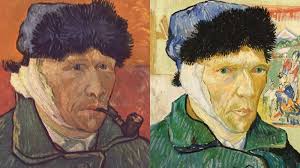
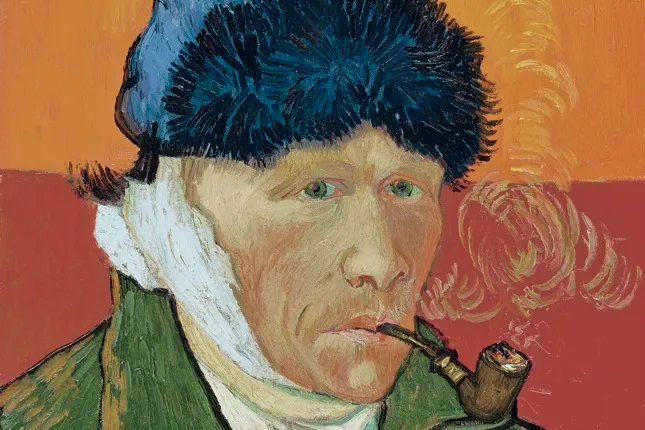
Painted just weeks after the ear incident in January 1889, the Self-Portrait with Bandaged Ear has become one of the most recognized images in Western art.
Van Gogh painted it using a mirror, which is why the bandage appears on the right side of the canvas — it was actually his left ear that was injured. He is depicted wearing a winter coat and a fur hat, standing in front of an easel with a Japanese woodblock print visible in the background.
The painting communicates something complex: not melodrama or self-pity, but a calm, direct confrontation with his own damaged face. Art historians have long noted that it projects a quiet dignity that stands in sharp contrast to the chaos of the night it commemorates.
The original hangs at the Courtauld Gallery in London. A second version of the same composition is held at the Niarchos Collection.
Understanding why did Van Gogh cut off his ear is impossible without understanding the depth of his relationship with Theo.
The two brothers exchanged over 650 letters over the course of Van Gogh’s adult life. These letters are among the most extraordinary documents in the history of art — intimate, philosophical, and deeply revealing of Van Gogh’s mental state.
Theo did not just send money. He was Van Gogh’s emotional anchor, his primary audience, and his most loyal advocate. When Theo announced his engagement to Johanna Bonger, it threatened the only stable relationship in Van Gogh’s life.
Tragically, Theo died just six months after Vincent, on January 25, 1891 — likely from syphilis and the grief of losing his brother. He was 33 years old. He is buried beside Vincent in Auvers-sur-Oise.
The ear incident has done more than almost anything else to cement Van Gogh’s image as the archetypal tortured genius — the mad artist whose suffering produced transcendent beauty.
Van Gogh himself rejected this connection. In his letters, he made clear that he saw his illness as an obstacle to his art, not a source of it. He suffered, and he painted despite that suffering — not because of it.
The romantic mythology around his life has been both his greatest posthumous gift and a significant distortion of who he actually was. He was, above all, a deeply devoted worker who cared intensely about craft, about people, and about capturing something true on canvas.
Today, his paintings routinely sell for hundreds of millions of dollars. “Portrait of Dr. Gachet” sold for $82.5 million in 1990. The Van Gogh Museum in Amsterdam receives over 2 million visitors each year.
The man who sold only one painting in his lifetime is now one of the most commercially valuable artists in history.
| Year | Event |
|---|---|
| 1853 | Born in Zundert, Netherlands |
| 1880 | Decides to become an artist at age 27 |
| 1886 | Moves to Paris, meets Gauguin through Theo |
| February 1888 | Moves to Arles, rents the Yellow House |
| May 1888 | Begins decorating the house with Sunflowers series |
| October 23, 1888 | Gauguin arrives in Arles |
| December 23, 1888 | The ear incident — self-mutilation after argument |
| January 7, 1889 | Discharged from Arles hospital, resumes painting |
| May 1889 | Voluntarily enters Saint-Paul asylum in Saint-Rémy |
| June 1889 | Paints The Starry Night |
| May 1890 | Released from asylum, moves to Auvers-sur-Oise |
| July 27, 1890 | Shoots himself in a wheat field |
| July 29, 1890 | Dies at age 37 |
| January 1891 | Theo dies, aged 33 |
The most accepted explanation is a combination of a violent argument with Paul Gauguin, news of his brother Theo’s engagement, and a severe mental health episode all converging on the same night.
This is debated. Most early accounts described the lobe only, but a sketch made by his doctor Dr. Félix Rey years later suggests the entire ear was severed.
He gave it to a woman at a local brothel in Arles. Most accounts name her as Rachel, but researcher Bernadette Murphy identified her as Gabrielle Berlatier, a young farmer’s daughter working there as a servant.
Researchers Hans Kaufmann and Rita Wildegans proposed in 2009 that Gauguin did it with a sword, but mainstream scholars have rejected this theory for lack of consistent evidence.
No definitive diagnosis has ever been established. Proposed conditions include temporal lobe epilepsy, bipolar disorder, borderline personality disorder, and acute intermittent porphyria. Van Gogh Museum states no all-embracing diagnosis has been found.
The exact reason is unknown. Some researchers believe it was a gesture of attachment or farewell to someone he knew. Others interpret it as an irrational act during a psychotic episode.
He was hospitalized, then returned to painting. After further episodes, he voluntarily entered an asylum in Saint-Rémy in May 1889, and died by suicide in July 1890 at age 37.
Almost immediately after leaving hospital in January 1889, he painted “Self-Portrait with Bandaged Ear,” now one of the most recognizable self-portraits in art history, held at the Courtauld Gallery in London.
No. He had no memory of the incident. He told doctors and Theo that he simply wanted to forget it and move forward with his art.
It marked the beginning of his final, most turbulent period. Despite escalating mental health crises, he produced some of his greatest work — including The Starry Night — in the months following the incident.
Why did Van Gogh cut off his ear will likely remain one of history’s great unanswered questions.
What the evidence shows is this: on the night of December 23, 1888, a deeply troubled man — facing the loss of his only companion, the threatened loss of his brother’s support, weeks of escalating mental instability, and an undiagnosed psychiatric condition — reached a breaking point that resulted in one of history’s most discussed acts of self-harm.
The Gauguin argument, Theo’s engagement, and Van Gogh’s fragile mental health were almost certainly all contributing factors. No single cause is sufficient on its own.
What matters beyond the mythology is the art left behind — over 2,000 works produced in a decade of extraordinary and tormented creativity. Van Gogh’s paintings outlasted his pain, and they will outlast every theory about his ear as well.