
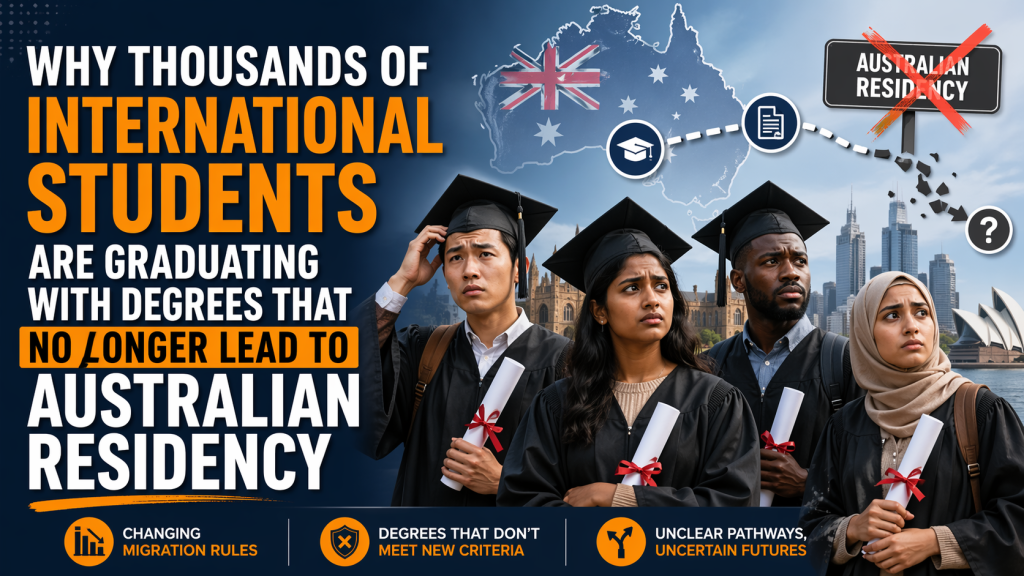
For years, many students treated an Australian degree as the first step to permanent residency. In 2026, that idea is shaky. Australia still welcomes large numbers of international students, yet residency now follows labour shortages, occupation lists, employer sponsorship, age settings, English standards, regional demand and state quotas far more than the name of a course. That gap is leaving many graduates with real qualifications, real debt and too little time to convert study into a long-term visa path. The issue is not that Australian study has lost value. The issue is that the residency promise attached to some courses no longer matches how the system works.
A lot of international students still arrive with a simple idea in mind: study in Australia, graduate, work for a bit, then move into PR. That belief was never fully accurate, but it was easier to sell when post-study work rights were longer, age rules were looser, and students had more room to stay onshore while sorting out their next step. That is no longer the setup many students are entering.
Australia’s own numbers show the scale of the mismatch. In year-to-date December 2025, 846,321 international students studied in Australia, and total enrolments reached 1,058,040. The most popular field in higher education was Management and Commerce, followed by Information Technology. In VET, Management and Commerce led again, followed by Food, Hospitality and Personal Services. At the same time, the permanent Migration Program for 2025–26 is set at 185,000 places, with a focus on skilled migration. Student visas are not capped in the same way: if an applicant meets the rules, the visa can be granted. That means the front door into study is far wider than the door into permanent residency.
This is the part many students hear too late. Australia does not hand out residency because someone completed a diploma, bachelor’s degree or master’s degree. It looks for a match between the graduate and a current skill need. That match can involve an occupation list, a skills assessment, an employer willing to sponsor, a salary threshold, state nomination rules, regional work, invitation rounds, age limits and English results. The degree helps only if it connects to those pieces.
That is why broad, heavily marketed courses can disappoint graduates. A qualification may be valid, expensive and well taught, yet still sit too far from the occupations Australia is trying to fill right now. Jobs and Skills Australia says 36% of occupations assessed were in national shortage in 2023, with shortages especially strong in trades, health, care and some professional roles. Regional shortages were more pronounced than metro shortages. In plain terms, the migration system is moving closer to shortage areas, while many student enrolments still flow into fields with weaker or less direct residency pathways.
The biggest reason this issue feels sharper in 2026 is that the post-study safety net got smaller. Under the Migration Strategy, Australia cut the age limit for the Temporary Graduate visa from 50 to 35 for most applicants and shortened post-study work rights. The old extra two-year extension for study in areas of skills need was removed, and only regional study can still bring an added extension. The stated goal was clear: graduates with fewer prospects of permanent residence would leave rather than remain in Australia on repeat temporary visas.
The current graduate visa settings show how tight the window can be. The Post-Vocational Education Work stream is tied to occupations on the Medium and Long-term Strategic Skills List and usually gives up to 18 months. The Post-Higher Education Work stream usually gives 2 to 3 years, depending on the qualification. Those are useful windows, but they are not long if a graduate still needs local work experience, a skills assessment, a higher English score, an employer sponsor or a state nomination. On top of that, from 1 July 2024, Temporary Graduate visa holders in Australia lost the option to apply for another Student visa onshore, which shut down one of the old delay tactics.
The phrase PR courses in Australia is popular because it sounds practical. It suggests there is a clean list of degrees that turn into residency. In 2026, that is the wrong way to frame the decision. There is no magic course. There are only courses that line up better with shortage occupations, employer demand and migration settings at a given moment.
A smarter question is this: does the course lead to an occupation Australia is actively trying to fill, and can the graduate realistically meet the next visa step after study? That means checking more than the college brochure. Students need to look at occupation shortages, skills assessment rules, likely starting salaries, state nomination criteria, regional demand and how much local work experience employers usually want. A course without that link can still be good for career growth. It just should not be sold as a residency plan.
If someone searches PR courses in Australia 2026, the real answer sits in sectors, not in hype. Jobs and Skills Australia points to strong shortages in health, care, trades and a range of professional roles. Its top occupations in demand include early childhood teachers, occupational therapists, physiotherapists, registered nurses, social workers, electricians, chefs, child carers and aged and disabled carers, with software programmers and motor mechanics also flagged as strong demand areas. Home Affairs has also tied skilled migration more tightly to labour market need through the Core Skills Occupation List, which now covers 456 occupations, including 70 that were not previously open under the old temporary skilled setup.
That still does not mean a student can pick any course in one of those sectors and expect PR. A nursing student and a management student are not playing the same game, yet two nursing students are not in the same position either if one studies in a regional area, gains local placement experience, meets registration rules and works in shortage settings while the other does not. Residency is not built by the course title alone. It is built by the full chain from study to occupation to employability to visa eligibility.
This is where many graduates get stuck. They finish study, move onto a graduate visa, and then realise the real challenge starts after graduation. Employers may want local experience. Skills assessments can take time. Salary thresholds for employer-sponsored routes keep rising. From 1 July 2025, the Core Skills Income Threshold sits at AUD 76,515. State nomination is competitive too: total state and territory nomination allocations for 2025–26 are 20,350, which is a small number next to the size of Australia’s international student population.
That is why so many students feel blindsided. Their degree is real. Their effort is real. Their outcome can still fall short because the bottleneck is no longer getting enrolled. The bottleneck is turning study into a shortage-linked, sponsor-ready, points-competitive profile fast enough.
Australian study can still be a strong move. It can lead to work, better pay, a global credential and, for some graduates, permanent residency. Yet it should be sold honestly. Students should not ask, “Which degree gives me PR?” They should ask, “Which course gives me a realistic shot at an occupation Australia needs, in a place where employers are hiring, under rules I can still meet by the time I graduate?”
That shift in thinking is the whole story. Thousands of international students are graduating with degrees that no longer lead to Australian residency in any reliable way, not because the degrees are worthless, but because the gap between enrolment marketing and migration reality has widened. In 2026, the students who do best will not be the ones chasing a viral list of PR courses. They will be the ones who treat course choice as a labour market decision from day one.