
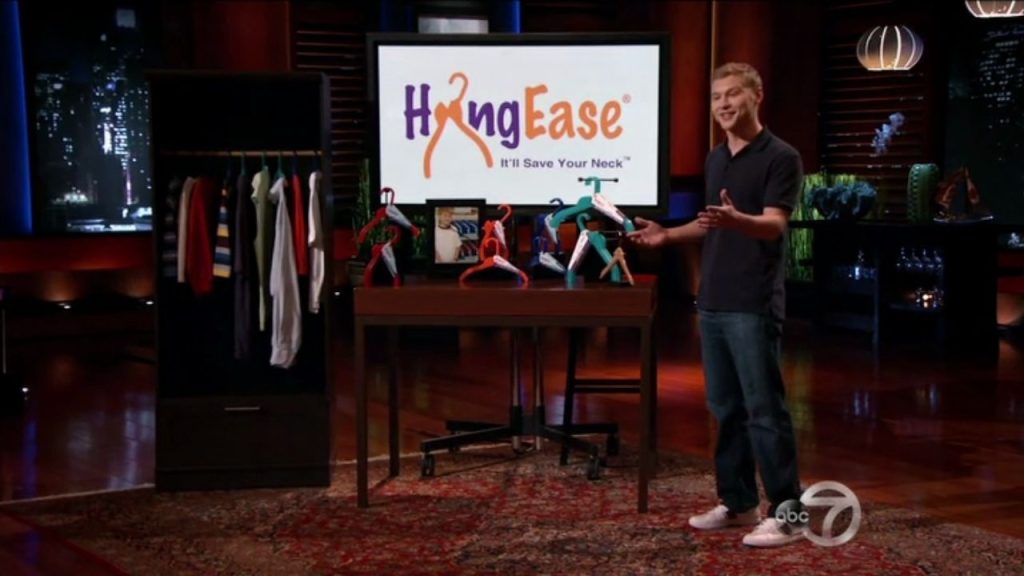
Why did Hang Ease go out of business? It is one of the most searched questions among Shark Tank fans and entrepreneurship enthusiasts alike.
HangEase was a clever collapsible hanger invented by a third-grader named Ryan Landis that made it all the way to Walmart shelves and national television.
It had a real product, real sales, and real investor interest. Yet by 2015, the website was offline, social media went silent, and the business was effectively dead.
HangEase was a collapsible clothes hanger built around a central hinge mechanism. When a user pulled a shirt downward, the hinge folded inward and the garment slid off smoothly.
No more stretched collar necks. No more broken hangers. No more awkward tugging. It was a genuinely useful product that solved a problem millions of households face every single day.
The hanger was made from reinforced plastic, supported heavy garments including winter coats, and required no tools or assembly. Its design was compact, space-saving, and intuitive enough for anyone to use immediately.
Ryan Landis invented HangEase in 2003 when he was just eight years old and living in Plano, Texas. His third-grade teacher challenged students to find an everyday household object and re-engineer it to work better.
Ryan was frustrated by traditional rigid hangers that snapped or stretched the necks of his shirts when he yanked them off. So he designed a hanger with a hinge that bent under downward pressure, releasing the garment without damage.
That classroom idea became a real product. And that product made it all the way to Walmart stores before Ryan was old enough to drive.
This is where the story becomes extraordinary. A classmate’s mother attended the school invention fair and noticed Ryan’s hanger project. She happened to be a sales broker with direct connections to major retail buyers.
She helped Ryan secure a retail contract with Walmart. By 2006, Walmart had placed an order for 400,000 units worth $200,000 in sales. Ryan, still a child, earned $70,000 in profit from that single deal.
The hangers were sold in approximately 100 Walmart stores in four-packs at $4 each. Ryan also hired a patent attorney who helped him register a fully issued utility patent in 2007, giving the product legal protection.
| HangEase Key Milestone | Year | Detail |
|---|---|---|
| Product invented at school | 2003 | Third-grade invention contest |
| Walmart contract secured | 2006 | 400,000 units, $200,000 revenue |
| Utility patent granted | 2007 | Full legal IP protection |
| Business goes dormant | 2007–2014 | Ryan focuses on education |
| Shark Tank appearance | April 2014 | Season 5, Episode 26 |
| Shark Tank deal falls through | 2014 | Due diligence failed |
| Website and social media go offline | 2015 | Business effectively closed |
| Officially confirmed out of business | 2022 | No operations of any kind |
Ryan was still a child when the Walmart deal ended. The pressures of school soon became his priority, and he made the decision to pause all business operations while he focused on his education.
Walmart stopped reordering HangEase hangers. When asked by the Sharks why Walmart did not continue, Ryan admitted he believed the product had been poorly marketed. That lack of retail strategy was an early warning sign.
For nearly seven years, boxes of unsold hangers sat in storage. The business had no active management, no marketing, and no retail relationships. The momentum built by the Walmart deal evaporated completely.
In April 2014, a now 19-year-old Ryan Landis walked onto the Shark Tank stage hoping to revive HangEase. He asked for $80,000 in exchange for 30% equity, implying a company valuation of $266,667.
His pitch was confident and charming. He demonstrated the hanger’s folding mechanism, handed out samples, and shared the impressive Walmart sales numbers. The Sharks were clearly surprised that a third-grader had managed to land a Walmart contract.
Robert Herjavec went out first. He said he did not see a strong enough need for the product in the market.
Kevin O’Leary was blunt as always. He said the product “bores the crap out of me” and dropped out over pricing concerns.
Barbara Corcoran declined because she was troubled by the seven-year gap in business operations. She felt Ryan had lost critical momentum and could not recover it.
Lori Greiner raised a significant concern. She told Ryan she had seen similar collapsible hangers already on the market, which visibly shocked him. She was skeptical about the strength of his patent protection.
Mark Cuban saw real potential. He offered $80,000 for 30% equity — but made the deal conditional on the patent being verified and confirmed as offering genuine protection against competitors. He then invited Lori to split the deal with him, and she agreed to join.
Ryan accepted. On camera, the deal looked like a done deal.
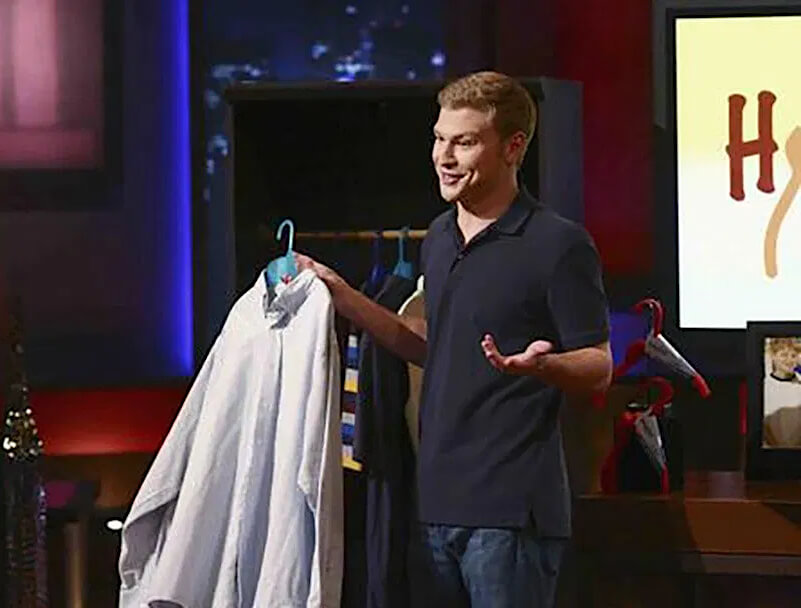
This is the critical turning point. The deal made with Mark Cuban and Lori Greiner on the Shark Tank stage never officially closed.
After the episode aired, standard post-show due diligence began. Sharks always investigate a company’s financials, legal standing, and intellectual property before wiring any money. That process uncovered serious problems.
The entire deal was contingent on the patent being legitimate and offering solid competitive protection. Lori had already expressed concern on camera that she had seen similar hangers in the market.
During due diligence, it appears the patent protection was not as robust as Ryan had presented. A utility patent that was granted in 2007 was valid — but the scope of that protection may not have covered competing designs well enough to satisfy the investors.
In the consumer products space, a patent that can be easily designed around offers very little real protection. If competitors could produce nearly identical products without infringing the patent, the core investment thesis collapsed.
HangEase hangers were significantly more expensive to manufacture than conventional hangers. Traditional plastic hangers are produced at mass scale for pennies each.
The collapsible hinge mechanism required more complex tooling, more parts, and more precise manufacturing. This drove costs up substantially. HangEase was reportedly priced at four to six times the cost of a standard hanger.
At retail, that pricing gap is devastating. A shopper browsing housewares will almost always choose the familiar, cheaper option unless the premium product offers something transformative. Hangers, however clever, are not seen as premium purchases.
The business had been dormant for seven years. There were no active customers, no active retail relationships, no updated financials, and no team in place.
Investors putting money into a startup want to see operational momentum. What they found after the show was a product that had not been actively managed in nearly a decade, with no infrastructure to scale production or rebuild retail relationships.
Scaling a consumer product from a few hundred thousand units to millions requires factory capacity, logistics networks, quality control systems, and working capital. HangEase had none of those systems in place.
Even if the Sharks had wired the money, the path from $80,000 to a nationally distributed hanger brand would have required far more capital, far more time, and far more operational expertise than the deal suggested.
The collapse of HangEase was not caused by one single mistake. It was a combination of compounding problems that each made recovery harder.
| Failure Factor | Impact Level | Explanation |
|---|---|---|
| Shark Tank deal fell apart | Critical | No investment, no revival plan |
| Patent protection too weak | Critical | Competitors could copy without infringing |
| 7-year business dormancy | High | All momentum and relationships lost |
| Pricing 4–6x higher than competitors | High | Retail shoppers chose cheaper alternatives |
| Poor marketing at Walmart | High | Led to end of retail contract |
| No scalability infrastructure | High | Could not handle post-show demand |
| No ongoing founder commitment | Moderate | Ryan focused on education, not the business |
| Saturated market competition | Moderate | IKEA, Amazon sellers, home brands undercut pricing |
Even after the episode aired and HangEase gained enormous national exposure, the company had no marketing infrastructure in place to capitalize on it.
Post-show traffic to the HangEase website was not converted into sales or leads. No social media campaigns were launched. No email list was built. No retailer negotiations were pursued immediately after the episode.
Many Shark Tank companies see their biggest sales spike in the 48 hours after an episode airs. HangEase appears to have failed to capture that window entirely, missing what may have been its last real opportunity for a commercial comeback.
The hanger market is one of the most commoditized consumer product categories in existence. Billions of hangers are manufactured globally every year, sold at extremely low prices by enormous companies.
Competitors from IKEA, Target house brands, Amazon private label sellers, and closet organization giants like ClosetMaid could produce similar products at a fraction of HangEase’s manufacturing cost. Without a truly unassailable patent, there was no sustainable competitive moat.
Lori Greiner’s comment on the show — that she had seen similar hangers — was not just a throwaway observation. It was the exact reason the deal ultimately collapsed. If competitors already existed, the patent was not protecting the market position effectively.
Some sources note that HangEase also struggled with consistent production quality. When a product relies on a mechanical hinge, that hinge must work reliably across every single unit produced.
Any variance in manufacturing quality leads to customer complaints, returns, and negative reviews. In a market where a customer’s alternative costs $0.50, a defective $3 hanger is immediately returned and never repurchased.
For a small operation with limited quality control systems, maintaining production consistency at scale is genuinely difficult and expensive.
Ryan Landis was only 19 years old when he appeared on Shark Tank. The failure of HangEase was disappointing, but it was not the end of his story by any measure.
He completed his undergraduate degree and secured a senior-level merchandising position at Neiman Marcus, one of America’s most prestigious luxury retailers. The retail knowledge he gained pitching HangEase and navigating the Walmart relationship gave him a real foundation that formal education alone could not have provided.
He then enrolled at Rice University, one of the top business schools in the country, completing his MBA in 2023.
In 2019, Ryan filed a patent for a Lytic peptide biosensor — a sophisticated biotech invention that is miles away from collapsible hangers but demonstrates the same creative problem-solving instinct that built HangEase in the first place.
As of 2026, Ryan Landis is the most genuinely successful outcome of the entire HangEase story. He turned a failed hanger company into a career in luxury retail, a top-tier MBA, and a foothold in biotech innovation.
The numbers tell a simple story.
| Period | HangEase Estimated Value |
|---|---|
| At Walmart deal (2006) | ~$70,000 in profits earned |
| At Shark Tank pitch (2014) | $266,667 (implied valuation) |
| Peak media buzz (April 2014) | ~$2.67 million (perceived, not real) |
| Post-deal collapse (2015) | Approaching $0 |
| Current status (2026) | $0 — completely out of business |
The gap between the $2.67 million media buzz valuation and the actual $0 outcome captures something important: television exposure is not the same as business health. A charming story and a national audience do not substitute for a scalable product, a protected patent, and a funded operational plan.
No. HangEase hangers are not available anywhere as of 2026. The official website is offline. Social media accounts have been inactive since approximately 2015. The product is not listed on Amazon, Walmart, Target, or any other online or physical retailer.
There is no indication from Ryan Landis or anyone connected to the business that a revival is planned. Ryan’s career focus is now squarely in technology, business education, and biotech innovation — not consumer housewares.
The HangEase story is now taught as a case study in some entrepreneurship programs and referenced in startup failure analysis discussions. The lessons it offers are genuinely useful for any founder.
Seven years is too long. A business that stops moving stops existing. Relationships with retailers, suppliers, and customers decay rapidly without consistent engagement.
Holding a patent does not mean your product is protected. The patent must cover the design broadly enough to prevent competitors from creating functionally identical products with minor modifications.
A product priced four to six times higher than its category average must deliver a dramatically superior experience. For many consumers, HangEase was clever but not transformatively better than a $0.25 plastic hanger.
The Shark Tank appearance gave HangEase national visibility. But visibility without the operational capacity to convert it into sales and customers is wasted. Marketing infrastructure must exist before the spotlight arrives.
Having a product is not the same as having a business. Manufacturing capacity, logistics networks, quality control, customer service, and working capital are all required before growth is possible.
Getting into Walmart is hard. Staying in Walmart is harder. Retail buyers need consistent sales data, regular marketing support, and proactive account management to justify keeping a product on shelves.
It is worth asking what might have saved the business. Several paths existed that were not taken.
If Ryan had maintained any level of business activity during his seven-year education period — even just managing a website and fulfilling small online orders — the momentum would not have fully collapsed.
If the patent had been structured more broadly, or if a continuation patent had been filed to extend protection, the due diligence concerns from Lori and Mark might have been resolved.
If the Shark Tank deal had closed — even on modified terms — the capital and expertise from two experienced investors might have been enough to rebuild retail relationships and address the manufacturing cost problem.
None of those paths were taken. Each missed opportunity compounded the next until closure was inevitable.
Business school faculty and entrepreneurship educators frequently reference HangEase as an example of several simultaneous startup failure modes occurring in a single company. The combination of IP weakness, pricing pressure, operational gaps, and failed investor conversion is rarely this clearly documented in a single public case.
The story is not unique. Countless consumer product startups launch with genuinely good ideas, earn early validation through one successful retail placement, and then collapse when momentum is interrupted and capital never arrives.
What makes HangEase memorable is how early and how completely it validated itself — a third-grader landing a Walmart contract — and how thoroughly it still failed when the business fundamentals were not in place.
HangEase closed because the Shark Tank deal with Mark Cuban and Lori Greiner fell apart during due diligence over patent concerns. A seven-year business gap, weak competitive pricing, and no marketing infrastructure made recovery impossible.
Mark Cuban and Lori Greiner offered $80,000 for 30% equity on camera, but the deal was contingent on patent verification. The deal never officially closed after the show aired.
Ryan completed his undergraduate degree, worked in senior merchandising at Neiman Marcus, earned an MBA from Rice University in 2023, and filed a biotech patent for a Lytic peptide biosensor in 2019.
No. HangEase is completely out of business in 2026. The website is offline, social media is inactive, and the product is not sold anywhere online or in stores.
HangEase’s implied Shark Tank valuation was $266,667. Media buzz briefly inflated perceived value to around $2.67 million in 2014. The current net worth in 2026 is $0.
The deal was conditional on patent verification. Post-show due diligence likely revealed that the patent protection was not strong enough to prevent competitors from making similar products, which broke the core investment case.
Walmart ordered 400,000 units for $200,000 in total sales. Ryan Landis earned approximately $70,000 in profit from that deal, which took place around 2006 when he was still a child.
Ryan Landis told the Sharks he believed the product was not marketed well enough during the Walmart placement. Poor retail marketing led to low sell-through rates and Walmart eventually discontinued the product.
It is extremely unlikely. Ryan’s career is now in technology and business education, not consumer products. The brand has no active operations, no capital, and no retail relationships to rebuild from.
The biggest lessons are: never let a business sit dormant for years, ensure patents are broad enough to block competitors, price products competitively against their category, and have marketing infrastructure ready before major media exposure hits.
Why did Hang Ease go out of business? The answer is not a single mistake — it is a cascade of compounding problems that ultimately made survival impossible.
A weak patent that could not withstand investor scrutiny, a seven-year dormancy that killed all retail relationships, manufacturing costs that made competitive pricing unachievable, and a Shark Tank deal that collapsed in due diligence all hit simultaneously.
What started as one of the most inspiring child inventor stories in American business history ended as one of Shark Tank’s most instructive cautionary tales. HangEase net worth stands at exactly $0 in 2026.
But the founder, Ryan Landis, went on to build a genuinely impressive career in luxury retail, earned his MBA from Rice University, and filed a biotech patent.
The hanger failed. The entrepreneur did not. That distinction is the most important lesson HangEase leaves behind for any founder paying attention.