
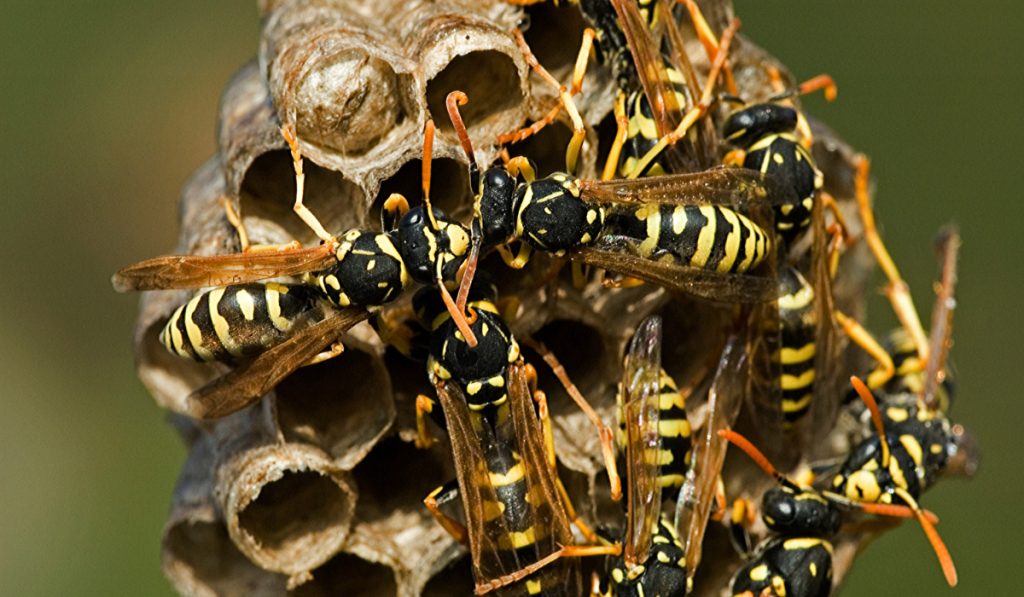
Why are wasps so aggressive — and why does it seem to get worse every late summer? It is a question almost everyone who spends time outdoors has asked. Wasps are not random attackers.
Their aggression is driven by biology, colony survival, food scarcity, and deeply programmed defense instincts.
Understanding what triggers them makes it much easier to avoid being stung.
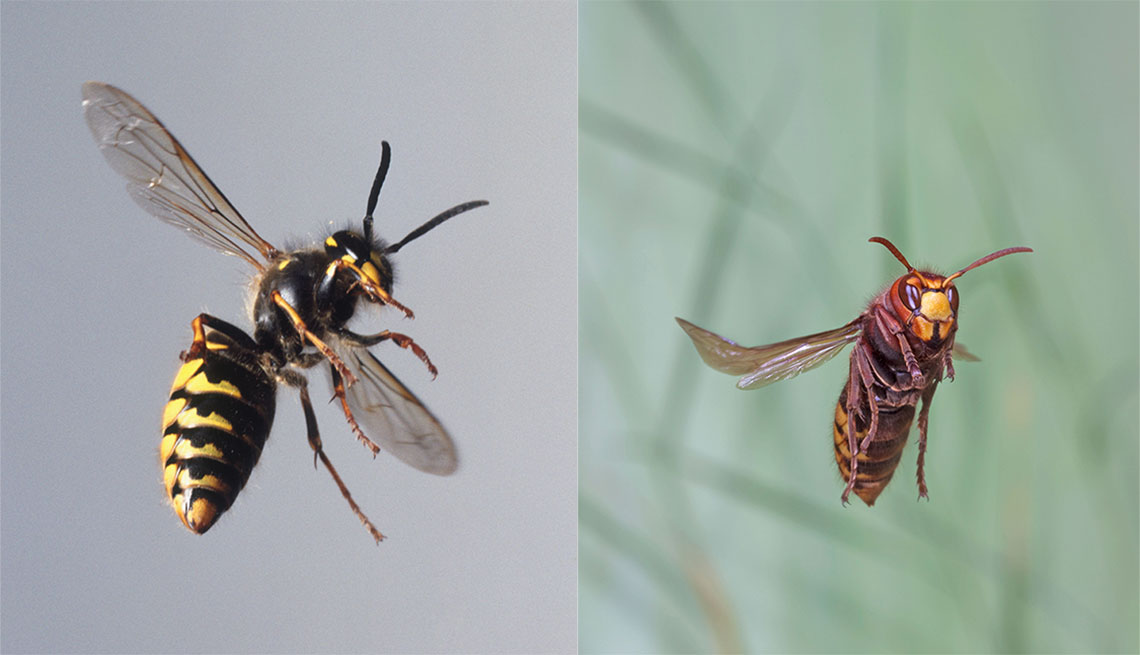
Most people assume wasps are just mean by nature. That is not accurate. Wasps do not attack without reason. Their aggression is almost always a defensive response to a perceived threat to their colony, their queen, or their food supply.
Understanding the “why” behind wasp behavior removes a lot of the fear. Once you know what triggers them, you can avoid those triggers. It is not random — it is survival logic.
Not all wasps are aggressive. This is one of the most important distinctions to understand. There are over 30,000 known species of wasps, and the vast majority of them are solitary and completely harmless to humans.
The wasps responsible for nearly all human-wasp conflict are social wasps — species that live in colonies and share a nest. These include yellow jackets, hornets, and paper wasps. Social wasps have a community to protect, and that community instinct is the core source of their aggression.
| Wasp Type | Aggressive? | Lives In Colony? | Common Sting Risk |
|---|---|---|---|
| Yellow Jacket | Very High | Yes | Very High |
| Bald-Faced Hornet | Very High | Yes | Very High |
| Paper Wasp | Moderate | Yes (small colonies) | Moderate |
| European Hornet | Moderate | Yes | Moderate |
| Mud Dauber | Very Low | No (solitary) | Very Low |
| Digger Wasp | Very Low | No (solitary) | Very Low |
If you encounter a lone wasp minding its own business, it is almost certainly solitary and will not bother you. The dangerous ones are the social species defending their nests.
The primary answer to why wasps are so aggressive is nest protection. A wasp nest contains the queen, developing larvae, eggs, and food stores. Everything the colony needs to survive is inside that structure.
When a wasp perceives a threat near the nest — even an unintentional one — it triggers an immediate defensive response. The wasp does not stop to assess whether the threat is real. It reacts first and fast.
Nest disturbances can include walking too close, vibrations from a lawn mower, loud noises, or even casting a shadow over the nest entrance. The wasp interprets all of these as potential attacks.
This is where wasp aggression becomes genuinely dangerous. When a single guard wasp feels threatened, it does not just sting — it releases alarm pheromones into the air.
These chemical signals act as an instant distress call to the rest of the colony. Other wasps detect the pheromones and immediately enter attack mode. Within seconds, one disturbed wasp can become dozens — all targeting the same perceived threat.
This pheromone communication is why disturbing a wasp nest is so dangerous. You are not just dealing with one wasp. You are activating a coordinated defense force that can include hundreds or thousands of workers.
The pheromones also mark the intruder. Other wasps are guided directly toward the person or animal that triggered the alarm. Running is a reasonable instinct — and the right one.
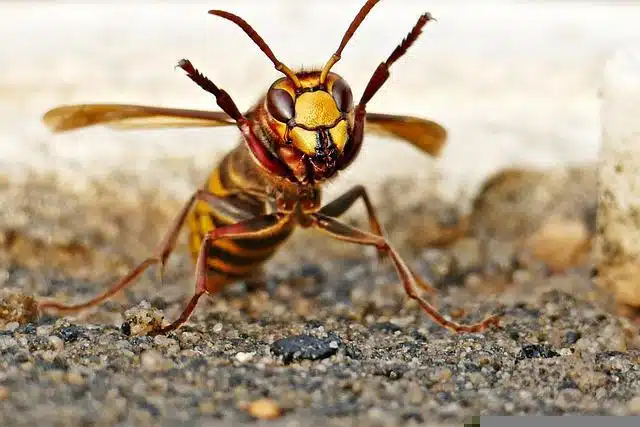
A key biological difference that makes wasps more dangerous than bees is their stinger design. Honeybees have barbed stingers that lodge into skin and detach from the bee, killing it after one sting. Wasps have smooth stingers that can be withdrawn cleanly after each sting.
This means a single wasp can sting the same target repeatedly without dying. A wasp that is motivated to attack — defending its nest, responding to pheromone signals — will keep stinging until the threat is removed or it is killed.
This smooth-stinger design is one of the main reasons why wasp encounters escalate so quickly compared to bee encounters.
Late summer is when wasp aggression peaks, and there are very specific biological reasons for this. Understanding the wasp colony lifecycle explains the pattern clearly.
In spring, a single fertilized queen emerges from winter hibernation and begins building a new nest alone. She lays eggs, cares for the first larvae, and slowly builds up a worker force. During spring and early summer, worker wasps are focused on feeding larvae and expanding the nest. They are comparatively calm during this period.
By late summer, the colony has reached its maximum population — sometimes thousands of workers. Then the colony’s purpose begins to shift. The queen stops laying eggs. The larvae mature and stop producing the sweet secretions that worker wasps had been feeding on. Suddenly, the workers have lost their primary food source.
Hungry, purposeless, and protective — that is the late summer wasp. It is the most dangerous version.
Here is exactly what happens inside a wasp colony as summer ends:
| Time of Year | Colony Status | Wasp Behavior | Aggression Level |
|---|---|---|---|
| Early Spring | Queen building alone | Calm, focused | Very Low |
| Late Spring | Small colony forming | Defensive near nest | Low |
| Early Summer | Colony growing fast | Busy foraging protein | Low to Moderate |
| Mid-Summer | Colony at large size | Active, territorial | Moderate |
| Late Summer | Colony at peak, queen stops laying | Desperate for sugar, aggressive | Very High |
| Fall | Colony declining | Erratic, unpredictable | Very High |
| Winter | Colony dead, queen hibernates | No activity | None |
As natural food sources dry up — fewer blooming flowers, fewer small insects to hunt, less nectar — wasps become opportunistic scavengers. They turn to human food: sweet drinks, fruit, open trash cans, barbecue scraps. Their desperation for sugar makes them bold and quick to sting anything that interrupts their foraging.
During late summer and fall, wasps are not just hungry — they are competing for shrinking resources. They will aggressively defend any food source they find, whether it is a piece of fruit on the ground or a soda can at a picnic.
This territorial food defense is misread by humans as unprovoked aggression. From the wasp’s perspective, it found food and is protecting it. From a human’s perspective, a wasp is dive-bombing their drink for no reason.
Avoiding sugary foods and drinks left open outdoors is one of the most effective ways to reduce wasp encounters during late summer.
Wasps are sensitive to vibrations in the air and through surfaces. This is why mowing a lawn near a hidden ground nest often ends badly. The mower’s vibration travels through the soil and registers as a large, threatening disturbance near the nest entrance.
Loud music, power tools, hammering on walls, and even weed whackers can all trigger wasp defensive behavior without the person ever seeing or touching the nest. The wasps react to the physical sensation of vibration rather than to visual cues.
This also explains why wasps sometimes seem to attack for no visible reason. If their nest is hidden inside a wall void, under decking, or in the ground, the person causing the disturbance may not even know a nest is there.
The instinctive human response to a wasp is to swat it away. This is exactly the wrong move. From the wasp’s perspective, a large fast movement directed at it is a direct attack.
A swatted wasp that is not killed will sting defensively. If it releases alarm pheromones before dying or escaping, it can summon nearby colony members. What started as one curious wasp investigating your food can escalate into a stinging incident within seconds.
The correct response is to remain calm and move away slowly. Quick, panicked movements and swatting dramatically increase sting risk.
Strong floral perfumes, sweet-smelling lotions, and heavily scented sunscreens can attract wasps. These products sometimes mimic the chemical signals of flowers or other insects, drawing curious wasps toward the wearer.
Brightly colored clothing — particularly yellows, whites, and floral patterns — can also attract wasps, as they resemble flowers. Dark colors and quick movements, on the other hand, can trigger defensive behavior in some species, as these mimic the visual profile of natural predators like bears.
Wearing neutral-colored clothing and avoiding heavy fragrances when spending time outdoors in late summer reduces the chance of an unwanted encounter.
Yellow jackets deserve special mention because they are consistently the most aggressive and the most commonly involved in human stinging incidents. They are ground nesters and cavity nesters, which means their nests are often hidden and stumbled upon accidentally.
Yellow jacket nests can grow to contain tens of thousands of workers by late summer. They are extremely fast, can chase a threat for a significant distance, and respond powerfully to alarm pheromones. They also have a particular attraction to human foods and are frequently found around garbage, picnics, and outdoor dining areas.
Yellow jackets are also not deterred easily. Unlike some species that give a warning display before attacking, yellow jackets often sting with very little warning when their nest is disturbed.
Hornets are often described as less aggressive than yellow jackets when unprovoked. However, when their nest is threatened, the response is overwhelming. Hornet stingers are powerful enough to penetrate thick clothing, and they attack in coordinated swarms that can be very difficult to escape.
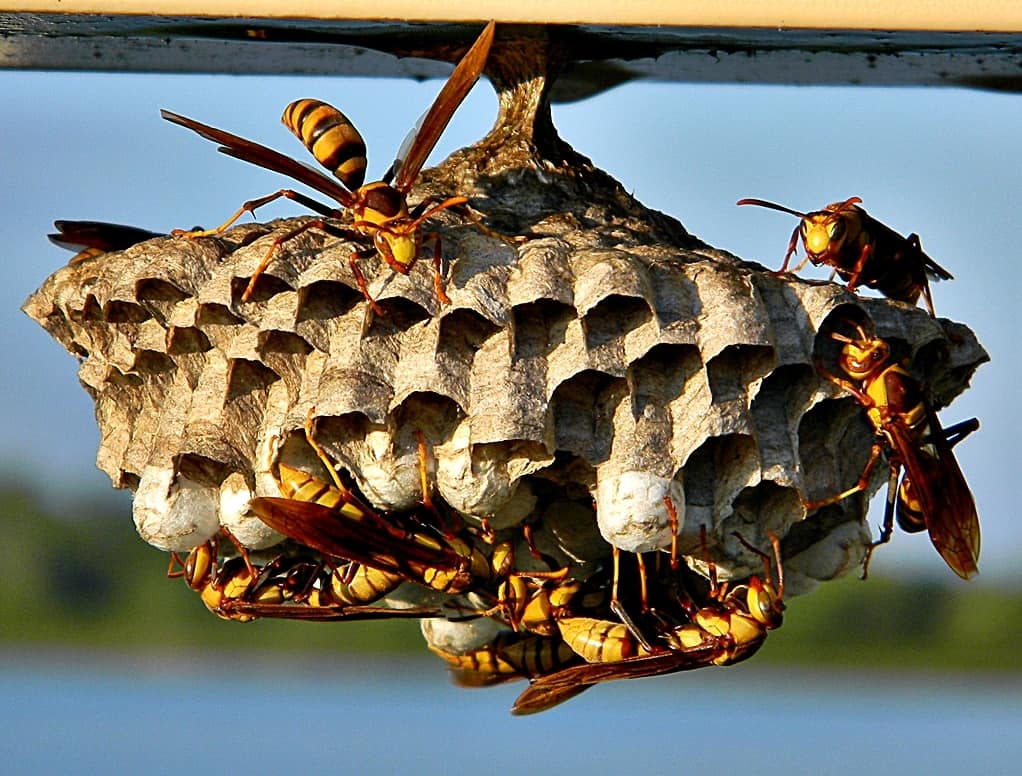
Bald-faced hornets are particularly defensive. Their aerial nests — the large gray paper structures seen hanging from trees or building eaves — are guarded constantly. Getting within a few feet of the nest entrance can trigger a defensive response even if no direct contact is made.
European hornets also respond aggressively to vibration and light at night, which is unusual among wasp species. Shining a flashlight near a European hornet nest in the evening can provoke an attack.
Paper wasps build small open-comb nests under eaves, in doorframes, under furniture, and in sheltered outdoor spots. They are not as uniformly aggressive as yellow jackets, but they will sting when their nest is disturbed or when they feel cornered.
The nests are often at eye level or in spots where humans regularly reach and grab — making unintentional disturbance very common. Many paper wasp stings happen when someone reaches toward a door frame, moves outdoor furniture, or picks up an object stored near a nest.
Paper wasps give more warning signals before attacking than yellow jackets do. Seeing them fly in a distinctive hanging, dangling flight pattern near a surface is often a sign of a nearby nest.
Environmental stress contributes to wasp aggression. Hot, dry conditions reduce insect prey populations, cause flowers to stop blooming earlier, and push fruit to ripen and rot faster. All of these factors reduce natural wasp food sources, increasing competition and desperation.
High summer temperatures also increase the metabolic demands of the colony. More energy is needed, which means more foraging is required. Overcrowded nests combined with higher food demand push wasps into broader foraging ranges — increasing the chance of conflict with humans.
During unusually hot summers, wasp aggression often starts peaking earlier than in average years.
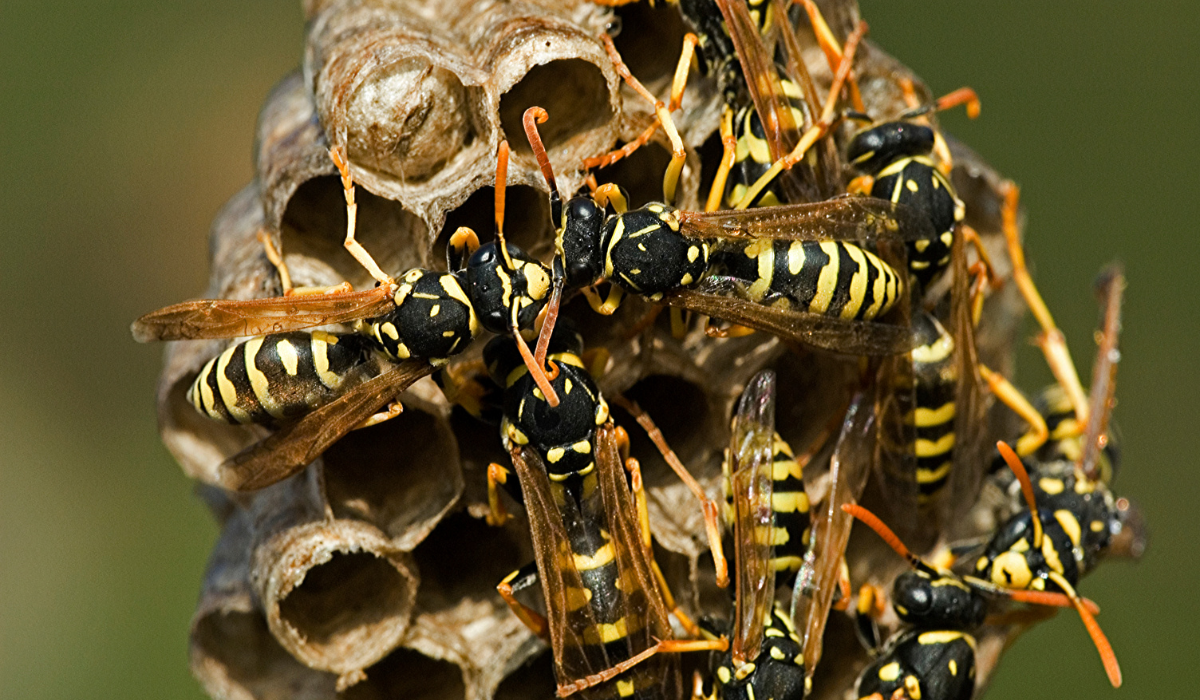
The queen is the biological center of the colony. Every worker wasp’s primary evolutionary purpose is to protect the queen and the larvae she produces. If the queen is threatened, the entire colony’s future is at stake.
Worker wasps have no ability to reproduce on their own in most species. Their genetic legacy depends entirely on the queen surviving. This biological reality makes nest defense — and therefore queen protection — an absolute priority for every worker in the colony.
This is why approaching a nest triggers such an intense response. The workers are not just defending a structure. They are defending the only reproductive individual whose survival gives their own existence meaning in evolutionary terms.
Understanding why wasps are aggressive makes avoidance much easier. Here are the most effective practical steps:
| Trigger to Avoid | Why It Causes Aggression | What to Do Instead |
|---|---|---|
| Walking near a hidden nest | Vibration and proximity triggers defense | Scan the ground and structures before walking in overgrown areas |
| Swatting at a wasp | Appears as a direct attack, may trigger pheromone release | Move away slowly and calmly |
| Leaving sweet drinks open | Attracts foraging wasps looking for sugar | Keep drinks covered, use cups with lids |
| Wearing floral perfume outdoors | Mimics flower signals that attract wasps | Use unscented products in outdoor settings |
| Running the lawn mower near a ground nest | Vibration registers as a threat | Identify and treat ground nests before mowing |
| Leaving trash bins uncovered | Provides food and attracts foraging wasps | Keep lids on all outdoor waste bins |
| Disturbing an eave nest | Direct nest disturbance triggers alarm pheromone release | Keep distance of at least 10 feet from aerial nests |
Many people wonder why wasps seem so much more aggressive than bees. The behavioral differences are real and rooted in biology.
Honeybees have a barbed stinger they lose upon stinging, which limits their aggression to situations where death is an acceptable trade-off. Bees are also primarily focused on nectar and pollen, which puts them in less conflict with human food.
Wasps are omnivorous predators and scavengers. They hunt insects, eat carrion, and seek out sugar. Their dietary range puts them in direct competition with humans at picnics, trash bins, and outdoor dining areas. Their smooth stinger allows repeated stinging without cost to the wasp. Their alarm pheromone system is highly effective at mobilizing large numbers rapidly.
All of these factors combine to make social wasps appear — and behave — as considerably more aggressive than bees in most human encounters.
Wasps are generally less active at night. Most social wasp species return to the nest at dusk and reduce activity significantly in darkness. This makes night the safest time to approach a nest if removal is necessary.
However, some species — particularly European hornets — remain active at night and are attracted to light sources. Outdoor lights can draw European hornets toward porches and doorways after dark, creating an unexpected stinging risk.
For most species, nighttime nest treatment by pest control professionals is preferred precisely because worker activity is at its lowest.
It is worth noting that wasps play an important ecological role that is frequently overlooked. During spring and early summer, worker wasps are active predators, hunting caterpillars, flies, grubs, and other insects to feed their larvae. A single colony can eliminate enormous numbers of pest insects during a season.
Wasps also serve as pollinators for certain plants, particularly those that do not produce enough nectar to attract bees. Some fig species depend entirely on wasps for pollination.
Their aggressive behavior — while disruptive and painful for humans — is a byproduct of the same instincts that make them highly effective at colony defense and environmental pest control. Understanding their ecological value does not make getting stung less unpleasant, but it does provide context.
Some wasp nest situations should never be handled without professional help. If the nest is large (basketball-sized or larger), located inside a wall void, in an attic, underground, or near an entrance that people use regularly, the risk of self-treatment is high.
Professional pest control technicians have protective equipment, the correct insecticide formulations for different nest types, and the experience to treat nests at the right time (usually at night or early morning when workers are inside). Attempting to remove a large yellow jacket or hornet nest without proper protection and training is genuinely dangerous.
Wasps have smooth stingers that allow repeated stinging, and they release alarm pheromones that summon the entire colony. Bees sting once and die, which makes them far less aggressive in most encounters.
By late summer, the colony reaches its peak size, the queen stops laying eggs, and food sources dry up. Hungry worker wasps become desperate scavengers and far more defensive than earlier in the season.
Rarely — almost all wasp attacks have a trigger. Common unprovoked-seeming attacks happen when a hidden nest is disturbed by vibration, noise, or accidental proximity without the person realizing a nest is nearby.
Yellow jackets are ground and cavity nesters whose hidden nests are frequently stumbled upon. They respond with little warning, sting repeatedly, and recruit large numbers of nestmates very quickly via alarm pheromones.
Yes. A fast swatting movement reads as a direct attack to a wasp and often triggers an immediate sting response. Remaining still or moving away slowly is a far safer reaction.
Running triggers a pursuit instinct in defensive wasps. The alarm pheromones already in the air guide wasps toward the fleeing target. Running into an enclosed space or water is the safest escape strategy.
Yes. High temperatures stress the colony, increase metabolic demand for food, and reduce natural food sources earlier in the season. Heat-driven food scarcity makes wasps bolder and quicker to defend any food they find.
Not exactly. Wasps do not detect fear itself, but they are sensitive to the carbon dioxide in rapid breathing, sudden movements, and sweat — all of which accompany a fear response and can signal perceived threat.
Many species, especially yellow jackets, return to rebuild in the same location because they use pheromone markers that persist even after the nest is gone. Thorough cleaning and sealing of the site is necessary to prevent re-nesting.
Most species are not active at night and retreat to the nest at dusk. However, European hornets remain active after dark and are drawn to light sources, making them a nighttime sting risk in some regions.
Why are wasps so aggressive? The answer is layered but logical.
Wasps are not cruel or randomly hostile — they are protecting their colony, their queen, and their food supply using the biological tools evolution gave them.
Alarm pheromones, smooth stingers, territorial instincts, and late-summer food scarcity combine to create the aggressive behavior that most people experience.
The peak danger window is late summer through fall, when colonies are largest and food is scarcest.
Knowing what triggers wasps — nest disturbance, swatting, vibration, scent, and food competition — gives you real tools to avoid conflict.
Respect their space, keep food covered, stay calm around individual wasps, and call a professional when nests need removal.
That knowledge alone will save you from most stings.