
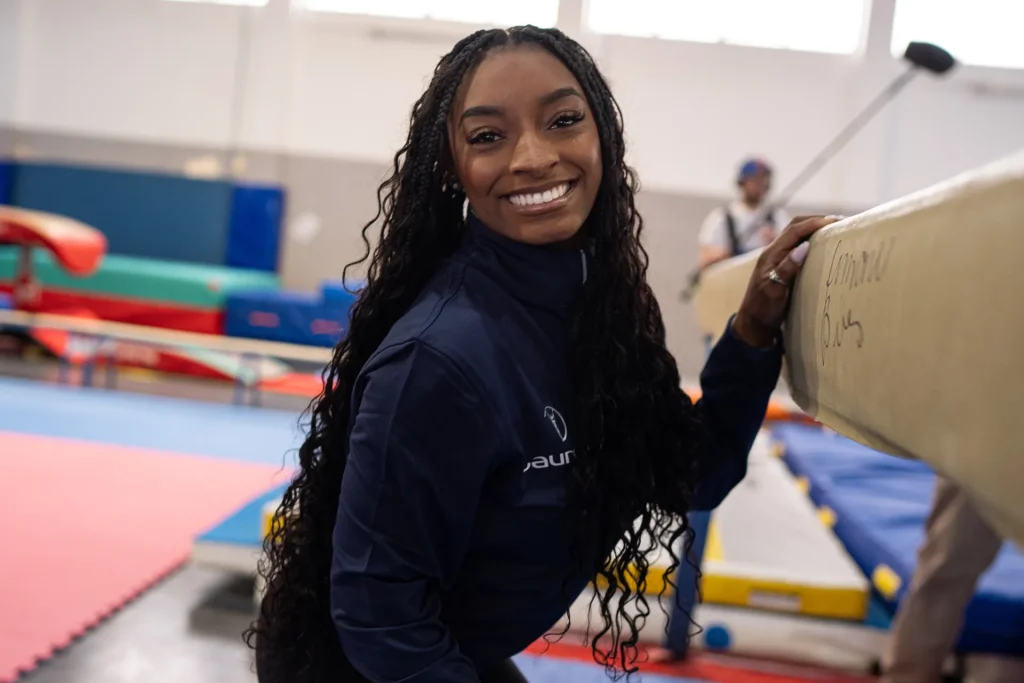
Simone Biles has fallen off a beam in front of eighty million people and got back up. She has landed a Yurchenko double pike that no other woman has ever competed. None of that scared her the way June 2026 did. Biles told followers she went through the “scariest experience of my life” after an unexpected health complication put her in a hospital bed with a heart-rate monitor clipped to her finger, a detail she shared herself rather than leaving to speculation, according to Yahoo Sports’ report on her recovery.
She is 29. She is worth an estimated $16 million built almost entirely on a body that performs under pressure most of us will never face. And for a few days this year, that body reminded her it has limits. BET’s coverage of the scare noted she described it as something she “never wants to go through again,” language that lands differently coming from someone whose entire career has been defined by pushing past what a body should reasonably survive.
Biles isn’t alone this year. Ray J, Katie Couric, and Quinton Aaron have all opened up about health scares in 2026, part of what’s shaping up to be an unusually candid stretch for celebrity disclosure. But Biles’ case cuts closer to a bigger question. When someone’s entire fortune is built on tolerating risk most people avoid, what happens when the risk stops being a metaphor?
Here’s the part that doesn’t make the headlines. Biles has spent over a decade training a nervous system to override its own alarm bells. Elite gymnasts learn to push through pain signals, fatigue signals, and fear signals that would stop most people cold. That override is exactly what makes her extraordinary. It’s also, according to peer-reviewed analysis on the pressure elite athletes like Biles face, a documented driver of long-term physical and psychological strain that compounds quietly for years before it surfaces.
Think about what that actually means in dollar terms. Every Olympic cycle, every world championship, every skill named after her, all of it depends on a body that has to keep saying yes to risk. Her net worth isn’t separate from her risk tolerance. It’s downstream of it. Take away the willingness to attempt something that could genuinely hurt her and there’s no highlight reel, no sponsorship deal, no seven-figure endorsement calendar.
Most of us don’t calculate risk that consciously. We just react.
That’s the gap Biles’ scare exposes. She’s spent her whole career doing something rare: treating risk as a number to be managed rather than a feeling to be avoided. Coaches quantify landing forces. Doctors track resting heart rate for weeks. Nutritionists model recovery windows to the day. It’s risk, but audited.
That kind of calculated risk-taking doesn’t stay locked inside elite sport. It shows up, in a much smaller and much safer form, in how people choose to unwind when the pressure of ordinary life gets loud. Poker pros talk about “variance” the same clinical way Biles’ team talks about landing torque. High-net-worth individuals who spend their weeks managing real financial exposure often want their downtime to involve risk too, just risk with a fixed, known ceiling.
Blackjack sits in an odd spot for exactly that reason. The house edge is published. The odds are fixed. You know the worst case before you sit down, which is more than Biles could say about her body this June. For readers curious what that looks like when it’s done properly, with regulated platforms, clear payout terms, and no illusions about the math, some BlackJack casinos with real money give a useful comparison point for how bounded, transparent risk is supposed to feel next to the kind that shows up uninvited.
Gambling carries real risk of its own, and it isn’t a substitute for financial planning or a coping strategy for stress. Play only what you can afford to lose.
Biles has been open before about the toll competing takes on her, including her much-discussed withdrawal from events at the Tokyo Olympics over what she called the “twisties,” a loss of spatial awareness mid-air that made continuing dangerous. That decision cost her medals in the short term. It arguably protected the career, and the net worth, that followed. She kept competing for years afterward specifically because she stopped when her body told her to.
This year’s scare reads differently precisely because it wasn’t a competition injury. It happened away from the mat, away from the cameras, in the part of life where risk isn’t supposed to be scheduled. That’s the uncomfortable truth buried in every celebrity health story this website covers. The risks people plan for, the ones with odds attached and contracts signed, are rarely the ones that catch up with them. It’s the unplanned kind that does the damage.
Biles is reportedly back to light training as of this year, according to people close to her camp, though she hasn’t confirmed a timeline for full competition. What she has confirmed is blunter than any press release. Fear and risk aren’t abstractions when your income depends on ignoring both. They’re line items.
What health complication did Simone Biles experience in 2026? Biles described a sudden, unexpected medical complication that required hospitalization, calling it the scariest experience of her life. Specific medical details haven’t been fully disclosed publicly, though she confirmed the severity herself rather than through a representative.
How much is Simone Biles worth in 2026? Estimates put her net worth around $16 million, built through Olympic prize structures, endorsement deals with major brands, and post-competition ventures including media appearances and product partnerships tied to her gymnastics legacy.
Did Simone Biles’ health scare affect her training schedule? Reports suggest she scaled back training temporarily following the incident. She hasn’t publicly confirmed a return date for full competitive training, and her team has kept most recovery details private.
Why do elite athletes push through physical risk the way Biles has? Research on elite performers shows years of conditioning can override normal pain and fatigue signals, which enables extraordinary performance but also raises long-term injury and health risk, a tradeoff documented in sports medicine literature.
Is Simone Biles still competing after the 2026 health scare? As of this year, Biles hasn’t announced retirement. She has previously stepped back from competition before returning stronger, most notably after her Tokyo Olympics withdrawal, so a similar path remains plausible.