

Ask any Dallas builder who has been around a while about foundations, and you’ll probably hear a story. A slab that cracked two summers after closing. A pier contractor who hit refusal at twice the planned depth. A bid that looked great until the soil report came back.
North Texas clay is the reason. It swells when it gets wet and shrinks when it dries out, and it moves with enough force to crack concrete and jam doors. That movement doesn’t just cause repair calls later. It shapes what the foundation has to be, and that makes it one of the biggest cost swings in a Dallas bid.
This guide explains how clay soils change foundation design, what to pull from the geotechnical report, and where estimators most often under-price the work.
Much of Dallas sits on Austin Chalk, which weathers into poorly drained, clay-rich soils that expand when wet. To the west, the Eagle Ford Shale produces clayey, waterlogged soils of its own. The shale itself is made of clay particles and breaks down easily as it swells and shrinks.
The trouble is that the ground rarely moves evenly. One side of a house gets afternoon sun, another sits next to a flower bed that gets watered every day, and a downspout dumps water at one corner. The soil under each spot swells or shrinks by a different amount. That uneven movement, called differential movement, is what cracks slabs.
Engineers measure how reactive a clay is in two main ways:
For an estimator, those two numbers matter more than almost anything else on the site plan. They drive the foundation type, the beam depth, the amount of reinforcing steel, and whether the soil has to be treated before anyone pours concrete.
In Dallas, you can’t just pull a standard foundation detail off the shelf. The city’s residential code amendments require every foundation or footing to be designed and sealed by a Texas-registered engineer. Engineers design from site soil data, so a geotechnical report comes first on nearly every new build.
Many estimators skim the report for the foundation type and move on. The cost details are usually buried in the earthwork and foundation sections. These are the items worth pulling onto one page before takeoff:
The earthwork specs are where real money hides. For example, a geotechnical report for a public project in Denton called for at least 12 inches of select fill with a plasticity index between 6 and 18, placed in 6-inch lifts and compacted to 95% of standard Proctor density. That same report required pier holes to be filled with concrete within 8 hours of drilling. Imported fill, trucking, compaction equipment, density testing, and tight pour scheduling all come straight out of a few lines like these.
Most Dallas homes and many light commercial buildings sit on stiffened slabs, either post-tensioned or conventionally reinforced. Geotechnical engineers often provide Post-Tensioning Institute (PTI) design parameters for these slabs. The more the soil can move, the deeper and closer together the stiffening beams usually get. That means more trenching, more concrete, more strand or rebar, and more labor. Two houses with the same floor plan can have noticeably different foundation budgets on two lots a mile apart.
When the clay is very active, engineers often switch to drilled piers that reach a stable layer, with grade beams or a structural slab spanning between them. On those systems, the concrete often sits on void forms, usually cardboard cartons, so the clay has room to swell without pushing up on the slab.
Each piece adds cost: the drilling rig and crew, rebar cages, pier concrete, possible casing where groundwater shows up, the void forms themselves, and inspections of each pier. Pier length is the big unknown, so price it from the boring logs and carry an allowance for extra depth.
On high-PVR sites, the report may call for treating the soil first. Common approaches include:
These are usually done by specialty subcontractors and priced by area and depth. Don’t forget the testing afterward to confirm the treatment worked, and the calendar time it takes before foundation work can start.
Select fill is imported, low-plasticity soil that caps or replaces the reactive clay. It adds material and trucking cost, plus compaction equipment, density testing, and often hauling off the native clay you dig out. On a large commercial pad, this can be one of the biggest line items in the whole sitework budget.
Water management is part of the foundation system on clay. Dallas’s residential code requires lots to be graded so the ground falls at least 6 inches within the first 10 feet away from the foundation. Budget for final grading, gutters and downspout extensions, and any French drains, root barriers, or vertical moisture barriers the report calls for.
Clay changes with the weather, so soil data can go out of date. A study of a Denton County subdivision site compared two geotechnical investigations done nine months apart. Parts of the site dried out significantly in between, which meant building pads would take substantially more cost and effort than first expected. If the report is old or the season has changed, ask whether the recommendations still hold before you lock in a price.
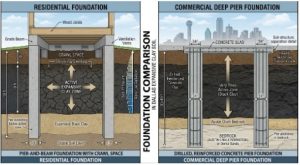
On most single-family and small multifamily jobs, the foundation is an engineered stiffened slab, with piers added on more active lots or on custom homes with long spans. The biggest estimating risk here is variability. In a subdivision, lots can sit on different soil, so a single foundation budget copied across every lot can miss on some of them. Price each lot from its own foundation plan when you can, and watch for lots that need soil treatment or deeper beams.
Remodels and additions have their own wrinkle. A new slab poured next to an older foundation will move differently, so expect the engineer to call for doweling, a separation joint, or piers at the connection.
Commercial buildings usually carry heavier column loads and have tighter movement limits. For pavements and many commercial slabs, designs commonly limit PVR to roughly 1 to 2 inches, and sites that exceed that get stabilized or capped with low-PI select fill. The Blackland Prairie clays around DFW often have PI values from 30 to 60 or more, and a PI above 35 to 40 in the active zone often leads engineers to recommend drilled piers.
That puts big money in a few places: pier drilling and concrete under every column line, building pad preparation across a large footprint, and treated subgrade under parking lots and truck courts. Movement-sensitive buildings such as data centers raise the bar further, since a PVR above 1 inch is generally treated as unacceptable for a conventional slab. With DFW’s data center and warehouse growth, those tight limits show up in more bids.
That last step protects you. If the bearing layer turns out to be 10 feet deeper than the borings showed, a written assumption turns an argument into a change order.
Foundation work on North Texas clay rewards the contractor who reads the fine print. The pier allowance, the select fill spec, and the moisture conditioning depth are what separate a profitable job from one that loses money in the first month.
Not all construction estimating companies read the soil report before starting a takeoff. At Digital Estimating, we do. Our estimators work from your drawings, specifications, and geotechnical data in PlanSwift and Bluebeam. You get an Excel estimate with material and labor quantities and pricing, organized division by division, so foundation and sitework costs are easy to review and compare against sub quotes. We sign an NDA before work begins, and most projects are delivered in 3 to 12 working days depending on size and complexity.
We work with general contractors, subcontractors, and material suppliers on residential, commercial, and public bids. Our construction estimating services Dallas page explains how we support local contractors, from single-trade concrete takeoffs to complete commercial bids. Send us your plans for a free quote, or request a sample estimate first to see the level of detail.
Much of Dallas sits on clay-rich soils formed from Austin Chalk and Eagle Ford Shale. These clays swell when wet and shrink when dry, and the uneven movement under a building is what cracks slabs and walls.
PVR stands for potential vertical rise. It is an estimate, in inches, of how much the soil could swell and lift a foundation. Engineers use it, along with the plasticity index, to choose the foundation type and decide whether the soil needs treatment.
Yes. Dallas’s residential code amendments require every foundation or footing to be designed and sealed by an engineer registered in Texas. Commercial foundations are engineered as a matter of course.
It depends on the soil and the building, but drilled pier systems with void forms and grade beams usually cost more than a stiffened slab on the same footprint. The geotechnical report and the engineer’s design decide which one a site needs.
Moisture conditioning, water injection, or chemical stabilization add specialty subcontractor costs, testing, and schedule time. Price them as separate line items so the owner can see exactly what the soil is costing.
There’s no single cutoff, but clay moisture changes with the seasons. Research on a Denton County site found meaningful drying over just nine months, which raised building pad costs. If the report is old, ask the geotechnical engineer to confirm the recommendations.
Extra pier depth, casing where groundwater appears, select fill trucking and testing, haul-off of native clay, void forms, and rain delays on clay pads. Writing assumptions for these into the bid helps avoid disputes later.
Yes. Send your drawings, specifications, and geotechnical report, and we’ll include foundation and sitework quantities and pricing in the estimate. Plan review before you order is free.