
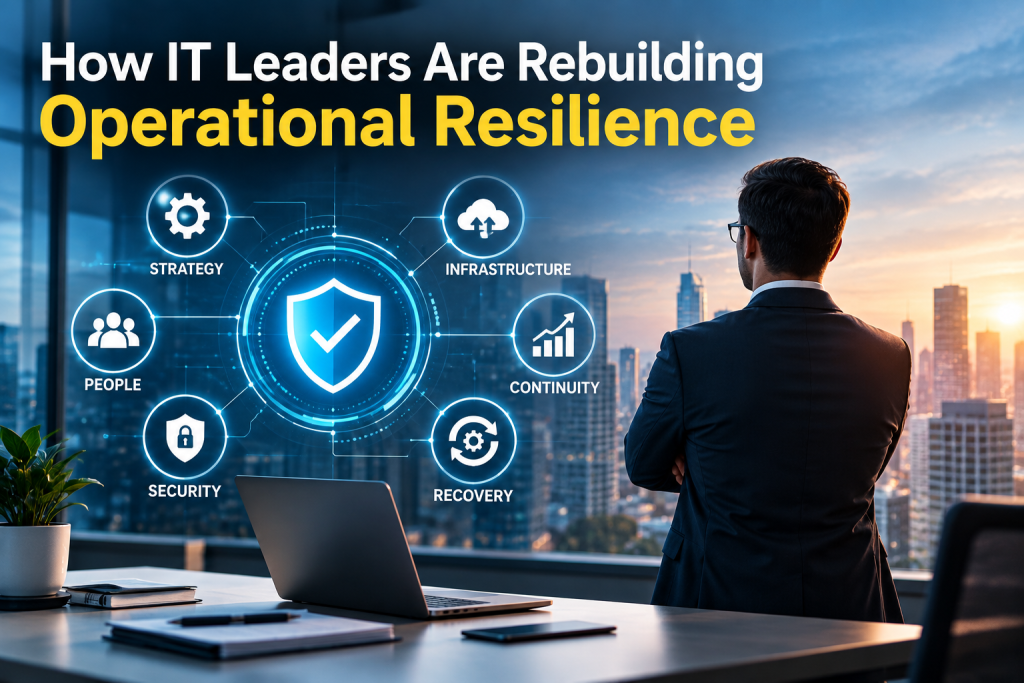
The transition period for APRA’s CPS 230 operational risk management standard officially closed in July 2026. The grace period for legacy service-provider contracts is over, and boards are now strictly accountable for any disruptions to critical operations. For Chief Information Officers and IT Directors, this shifts the entire conversation from theoretical compliance exercises to immediate, measurable resilience. You can no longer rely on point-in-time audits or isolated technical tasks to satisfy regulators.
Threat actors are moving faster than most organizations can patch their systems, and automated reconnaissance across Australian IP ranges is the baseline reality. Internal IT teams are feeling the pressure. They are expected to maintain an airtight security posture, map complex downstream dependencies, and keep daily operations running smoothly. The math simply does not work without a structural change in how technology executives allocate their resources and govern their environments.
Here is how forward-looking operations directors are restructuring their IT frameworks to handle modern regulatory mandates, mitigate third-party exposure, and survive continuous threat activity.
By 2026, the Australian Cyber Security Centre (ACSC) Essential Eight is no longer just a technical guideline; it is the national benchmark for operational maturity. Regulators, insurers, and commercial supply-chain partners increasingly expect organizations to hit Maturity Level 2 or 3 as a mandatory baseline. Claiming that controls are “implemented” is useless if they are not consistently enforced, maintained, and monitored across every system.
To build a defensible architecture, you must eliminate easy entry points and prove that your defenses actually work during a disruption. This requires active, continuous management of core controls:
Critically, these strategies work best as a unified framework. Because these controls rely on each other, weakening even one control compromises the effectiveness of the entire system.
CPS 230 requires regulated entities to understand their end-to-end critical operations and the specific resources that support them. You have to define the maximum tolerable disruption for each operation—whether measured in time, scale, or volume—and prove that your business continuity plans can keep you within those limits.
This obligation exposes the hidden risks in stacked dependencies. Process maps are the only medium that ties these requirements together. Every critical operation needs a live process diagram showing exactly which internal systems, people, and external providers support it. Impact tolerances must live on the same diagram so they do not drift from the operation they govern.
Maintaining this level of operational visibility is exhausting for internal service desks. When your team is consumed by password resets, legacy system failures, and urgent patching, they simply do not have the bandwidth to run severe-but-plausible scenario tests or accurately track fourth-party supplier risks.
The regulatory pressure is forcing IT leaders to stop treating their internal teams as catch-all utility workers. To meet the demands of continuous validation and resilience testing, you have to offload the heavy lifting of routine infrastructure management.
Many Queensland-based organizations are rethinking their operational models entirely. By partnering with specialized managed IT services Brisbane, technology executives ensure their core environments are monitored 24/7 and patched systematically. This structural shift allows internal operations directors to focus on high-value governance: mapping critical operations, conducting regular scenario testing, and reporting directly to the board on impact tolerances.
You cannot secure a modern enterprise if your most skilled people are buried in maintenance tickets. Delegating operational hygiene to a dedicated partner provides the breathing room required to build actual resilience. Furthermore, relying on experts ensures that your foundational controls—like daily backups and macro settings—are maintained at the strict levels expected by regulators.
The supply chain remains the soft underbelly of enterprise IT. Managing direct vendors is difficult enough, but the 2026 regulatory environment demands that you also track fourth or nth-party dependencies.
This risk is compounding rapidly with the adoption of artificial intelligence. In April 2026, APRA issued an industry letter calling for a step-change in AI-related risk management, making it clear that traditional, point-in-time assurance methods are ill-suited for probabilistic models that adapt and degrade over time.
Many AI vendors rely on a small number of frontier foundation models, creating massive concentration risk. If a single provider or model underpins multiple critical operations, a disruption at the foundation level could breach your impact tolerances simultaneously across different business units.
To mitigate this substitution friction and manage third-party exposure, you must:
Resilience is ultimately measured by what happens when things break. The end of the CPS 230 transition period means the board expects hard evidence that your infrastructure can absorb a severe shock. Organizations that fail to meet expected maturity levels are now seen not just as “less secure,” but as higher-risk entities across commercial partnerships, leading to missed tender opportunities and higher insurance premiums.
By enforcing the Essential Eight, actively mapping your critical operations, and moving routine maintenance to capable external partners, you can build a security posture that withstands scrutiny. You have to stop reacting to the last incident and start engineering systems that survive the next one.
How confident are you in your organization’s ability to swap out a compromised material service provider within your impact tolerances? Share your approach to vendor concentration risk and continuous validation in the comments below.