

10 reasons why students should wear uniforms go far beyond just matching outfits on school grounds.
From reducing bullying and boosting academic focus to saving parents money and preparing kids for professional life, school uniforms shape better students and stronger school communities.
The debate about school uniforms has gone on for decades, but the data in 2026 is clearer than ever.

The percentage of US public schools requiring uniforms jumped from 11.8% in 1999 to over 21% by the mid-2010s, and the conversation is growing again.
Parents, educators, and policymakers are revisiting the school uniform debate as schools search for practical tools to improve safety, equity, and academic outcomes.
Understanding the real reasons why students should wear uniforms helps everyone make a more informed decision.
| Statistic | Source |
|---|---|
| 64% of school leaders believe uniforms reduce bullying | School Leader Survey, 2026 |
| 36% drop in overall school crime after uniform rollout | Long Beach Unified School District |
| 93% of principals say uniforms make it easier to spot intruders | Safety Survey, 2026 |
| 92% of parents say uniforms make mornings easier | NAESP Study |
| 5% increase in student attendance in uniform schools | University of Houston |
| 70% of schools with uniforms saw a decrease in bullying | NAESP Study |
One of the strongest reasons why students should wear uniforms is the power to level the social playing field. When every student wears the same outfit, clothing stops being a marker of wealth, status, or family income.
Kids from lower-income households no longer walk into school feeling visually different from peers who wear expensive brand names. The pressure to own the latest sneakers or designer jeans disappears entirely.
A study by the National Association of Elementary School Principals found that uniform policies create an environment where students are judged by their character and work, not by what they wear.
Bullying based on appearance and clothing is one of the most common forms of school harassment. Uniforms directly attack this problem at the root.
Research from Long Beach Unified School District found a 91% decrease in bullying incidents within the first year of mandatory uniforms. A 2015 meta-analysis in the Educational Policy journal reviewed 20 studies and found an average 25% drop in bullying across uniform schools.
When every student looks the same, there is less to target, less to mock, and less competition over clothing brands. The result is a measurably safer social environment.
Key bullying reduction stats:
| Study / Source | Finding |
|---|---|
| Long Beach USD (1998) | 91% decrease in bullying in year one |
| University of Nevada (2003) | 45% reduction in bullying through uniform policy |
| Journal of School Violence (2012) | 28% lower bullying rates in uniform schools |
| National Education Association Survey | 72% of teachers saw fewer bullying incidents post-uniforms |
| Educational Policy Meta-Analysis (2015) | Average 25% drop across 20 studies |
School safety is a top priority for every parent and administrator. Uniforms contribute to a more secure campus in concrete, measurable ways.
When all students wear a standard uniform, unauthorized visitors or intruders are immediately visible. A survey in 2026 found that 93% of principals agree uniforms make it significantly easier to spot someone who does not belong on campus.
In Long Beach Unified School District, overall school crime dropped by 36% after uniforms were introduced. Sparks Middle School in Nevada reported a 63% drop in police log reports just one year after implementing a uniform policy.
Gangs use specific clothing, colors, and insignia to identify members and signal affiliation. Schools without uniforms can become spaces where gang culture is visibly displayed and reinforced.
When uniforms are required, students cannot wear gang colors or gang-related symbols. This removes a critical tool of gang recruitment and intimidation from the school environment.
Osceola County, Florida reported a 46% drop in gang activity after introducing a mandatory K-12 uniform policy. The US Department of Education has recognized uniform policies as a practical tool for reducing gang presence on school property.
Without the daily stress of choosing outfits or worrying about how classmates will judge their clothes, students arrive at school with their mental energy already freed up for learning.
A study by the University of Houston found that schools with uniform policies experienced a 5% increase in student attendance and a 10% improvement in test scores. Research by Baumann and Krskova published in the International Journal of Educational Management found that students in uniform schools listen more attentively and teachers spend less time managing distractions.
Fewer fashion distractions mean a calmer classroom, quicker lesson starts, and more engaged learning time throughout the day.
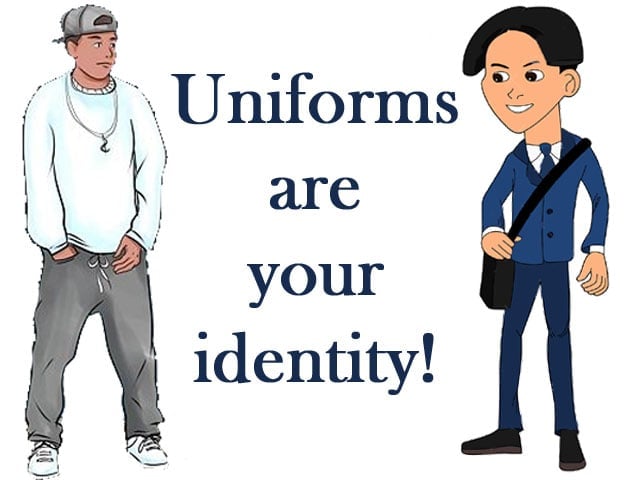
When students wear the same colors every day, they develop a shared identity and a genuine sense of belonging to something larger than themselves.
This is the same principle behind sports team uniforms, military uniforms, and professional dress codes. The uniform signals membership in a community with shared values and goals.
Schools that introduced uniform policies reported a 15% increase in student participation in school events and activities, according to Education Week. Students who feel proud of their school are more likely to attend, more likely to participate, and less likely to act out.

The upfront cost of a school uniform can feel like a burden, but the long-term savings are significant.
Parents no longer need to buy trendy seasonal wardrobes or keep up with rotating fashion trends. A 2026 analysis found that a standard uniform set averages between $100 and $500 annually, compared to the $418 that many families spend on non-uniform school clothing alone, without counting the social pressure for additional fashion items.
Families in uniform school districts save an average of $80 per year, and many schools offer second-hand uniform programs, swaps, or financial assistance that reduce costs even further.
Cost comparison:
| Clothing Type | Estimated Annual Cost |
|---|---|
| Full trendy school wardrobe (with brand pressure) | $600–$1,200+ |
| Standard school uniform set (2026 average) | $100–$500 |
| Estimated annual savings in uniform districts | $80–$700+ |
One of the most practical and underappreciated benefits of school uniforms is the time they save every single morning.
With a set uniform, there are no decisions to make, no arguments between children and parents about what is appropriate, and no last-minute outfit changes that cause delays. An NAESP study found that 92% of parents believe mornings are easier with a school uniform, and 93% say uniforms save time before school.
Less morning stress means students arrive at school calmer, more prepared, and in a better headspace for the day ahead.
The real world has dress codes. Offices, hospitals, restaurants, law firms, and dozens of other workplaces require employees to follow rules about how they dress and present themselves.
Students who grow up wearing school uniforms learn early that how you show up matters. They develop an understanding of professional presentation, the habit of maintaining a neat appearance, and the discipline of following institutional dress standards.
These are life skills that have value far beyond the classroom. Students who are accustomed to uniforms often adapt more easily to workplace dress codes and professional expectations as adults.
Social pressure around clothing and appearance is one of the most stressful and invisible burdens that students carry every day.
For teenagers especially, the fear of being judged for wearing the wrong brand, the wrong style, or the wrong color can be crippling. It can affect confidence, attendance, and willingness to participate in school activities.
When uniforms are standard, that entire layer of social competition disappears. Students no longer define themselves or each other by their wardrobes. Research shows that 22% of students in uniform schools report improved self-esteem, and 20% feel more confident in their social environment.
Beyond the top 10, school uniforms deliver several additional advantages that researchers and educators have documented.
Environmental impact: Uniform programs reduce fast fashion consumption. Durable uniforms designed for daily wear are often passed down to younger siblings or donated to school clothing programs.
Teacher retention: Elementary schools with uniform policies experience higher teacher retention rates, creating a more stable learning environment for students year over year.
Improved punctuality: Schools with uniforms saw a 10% improvement in student punctuality, since the morning routine is simpler and faster with a predetermined outfit.
Better field trip management: When every student wears the same uniform on outings, teachers can quickly count, identify, and manage their group, improving safety outside the classroom.
Many parents confuse uniforms with dress codes. They are not the same thing and the distinction matters.
| Factor | School Uniform | Dress Code |
|---|---|---|
| Specificity | Exact outfit is required | General guidelines only |
| Brand control | Usually standardized | Varies by student |
| Cost predictability | High | Low |
| Enforcement ease | Very easy | More complex |
| Equity impact | Strong | Moderate |
| Identity benefits | Strong | Moderate |
A school uniform is a specific outfit — same shirt, same pants, same shoes. A dress code is a general rule about what is appropriate, like no logos or collared shirts only. Uniforms are more effective at delivering the equality and safety benefits described in this guide.
The link between uniforms and academic performance is real but nuanced. Not every study shows dramatic test score improvements, but the indirect effects are well-documented.
Uniforms reduce classroom distractions, improve attendance, and create a calmer learning environment. All three of these factors are well-established drivers of better academic outcomes.
A University of Houston study showed a 5% attendance boost and a 10% test score improvement in uniform schools. A study in the International Journal of Educational Management found that uniform schools had lower noise levels, faster class start times, and more attentive students — all conditions where learning improves.
The most honest conclusion is that uniforms do not directly raise test scores, but they create the conditions in which students are far more likely to learn effectively.
Some parents and students argue that uniforms suppress individuality and self-expression. This is a fair concern but a narrow one.
Students can still express their personality through how they speak, how they engage with others, what clubs they join, what sports they play, and what creative work they produce. Clothing is one channel of expression, but it is not the only one, and it is not the most meaningful one.
Critics also argue that uniforms can be expensive for low-income families. This is a real issue, but most schools address it through second-hand programs, grants, and assistance. The net long-term cost is typically lower than buying a full seasonal wardrobe.
If your child’s school has or is considering uniforms, there are practical steps parents can take to make the transition smooth.
Talk to your child about the reasons behind the policy rather than simply enforcing it. When students understand the why behind a rule, they are more likely to accept it without resentment.
Look for second-hand uniform options, school swaps, or local programs that offer financial assistance. Many districts have programs specifically designed to make uniform costs accessible to all families.
Involve your child in small choices, like which style of shoes or what bag they carry, to preserve a sense of personal identity within the uniform framework.
School uniforms are not just an American debate. Many countries around the world have made them a standard and largely unquestioned part of education.
Japan, South Korea, the United Kingdom, Australia, India, and most countries in Africa and Southeast Asia all have longstanding uniform cultures in their schools. Students in these countries rarely debate whether to wear uniforms. The focus is entirely on learning.
This global context is worth noting. In many of the world’s highest-performing education systems, uniforms are simply part of the culture, not a controversy.
Uniforms deliver the strongest results in specific contexts. Understanding these helps schools implement policies that actually work.
Uniforms are most effective when the entire school participates, when the policy is clearly communicated, when enforcement is consistent, and when the school also addresses the underlying causes of issues like bullying and gang activity alongside the dress code.
A uniform alone is not a magic solution. It works best as one tool within a broader culture of safety, respect, and academic commitment.
The impact of school uniforms is not the same across all grade levels. Research shows that the benefits are strong throughout, but they show up differently depending on the age of the student.
Elementary school students benefit most from the routine and simplicity uniforms provide. Young children are less aware of brand status, so uniforms reinforce early habits of discipline and focus rather than addressing a pre-existing social hierarchy.
Middle school students experience the strongest social benefits. Early adolescence is when peer pressure, fashion competition, and bullying based on appearance peak. Uniforms directly reduce these stressors at the most vulnerable stage of development.
High school students benefit most from the professional preparation and identity aspects. Wearing a uniform daily builds habits of discipline and appearance standards that translate directly to the workplace.
School uniforms play an often-overlooked role in supporting students with learning differences, disabilities, or social challenges.
Students on the autism spectrum or with sensory processing differences can find the social complexity of fashion and peer judgment particularly overwhelming. Uniforms remove one layer of that complexity, making the social environment slightly more predictable and manageable.
Students who struggle socially often feel more included when visible differences in clothing are removed. The uniform signals belonging by default, which is especially meaningful for students who otherwise feel like outsiders.
Modern school uniform policies have evolved significantly. Many schools now offer gender-neutral uniform options, allowing students to choose between different styles regardless of gender identity.
This shift makes uniforms more inclusive rather than less. A flexible uniform policy can actually support gender-diverse students by removing the binary pressure of gendered civilian clothing while still maintaining the equity and safety benefits of a shared dress code.
Schools that update their uniform policies to be gender-inclusive report higher student satisfaction and fewer dress code disputes overall.
Students should wear uniforms because they promote equality, reduce bullying, improve safety, and help students focus on academics rather than fashion or social competition.
Yes. Multiple studies confirm that uniforms reduce appearance-based bullying. Long Beach USD saw a 91% drop in bullying in the first year, and a 2015 meta-analysis found an average 25% reduction across 20 studies.
Yes. A standard uniform set costs between $100 and $500 annually, while a trendy school wardrobe can cost $600 to $1,200 or more when brand pressure is factored in.
Uniforms improve the conditions for learning by reducing distractions, improving attendance, and creating calmer classrooms. A University of Houston study found a 5% attendance increase and a 10% test score improvement in uniform schools.
Yes. Uniforms remove gang colors and insignia from the school environment. Osceola County, Florida reported a 46% drop in gang activity after introducing mandatory uniforms.
Uniforms limit clothing choices but do not suppress individuality. Students still express themselves through academics, sports, arts, friendships, and personality. Clothing is just one of many channels of self-expression.
Uniforms make unauthorized visitors immediately visible, prevent weapon concealment under baggy clothes, and make it easier to identify students on field trips. Long Beach USD saw a 36% drop in overall school crime after implementing uniforms.
Yes. With a set uniform, there are no outfit decisions to make. An NAESP study found that 92% of parents say mornings are easier with uniforms, and 93% report time savings before school.
Most schools introduce uniforms at the elementary level. NCES data shows 23% of elementary schools require uniforms, compared to 18% of middle schools and 12% of high schools, suggesting earlier introduction is more common.
Yes. Research shows that 22% of students in uniform schools report improved self-esteem, and 20% feel more confident socially, partly because the pressure around clothing and appearance is removed.
10 reasons why students should wear uniforms come down to one central idea: when students stop competing over what they wear, they start competing over what they achieve.
Uniforms create safer schools, stronger communities, more equal classrooms, and more focused learners. The data from Long Beach, Nevada, Florida, and research institutions around the world all point in the same direction. Uniforms reduce bullying, lower crime, cut costs for families, simplify mornings, and prepare students for a professional future.
No policy is perfect, and uniforms work best when paired with strong school culture, consistent enforcement, and accessible pricing programs.
But as a single, practical tool for improving school life for students, parents, and teachers alike, school uniforms have proven their worth many times over. In 2026 and beyond, the case for uniforms is stronger than ever.