
Why should college athletes be paid is one of the most debated questions in American sports today, and in 2026, the answer has never been more urgent or more relevant.
College athletes generate billions of dollars in revenue for universities, conferences, and the NCAA while receiving little direct financial compensation in return.
Scholarships help, but they rarely cover the full cost of living.
The gap between what athletes produce and what they receive has become impossible to ignore.
College sports is not a hobby. It is a multi-billion-dollar commercial industry built almost entirely on the labor of unpaid or underpaid student-athletes.
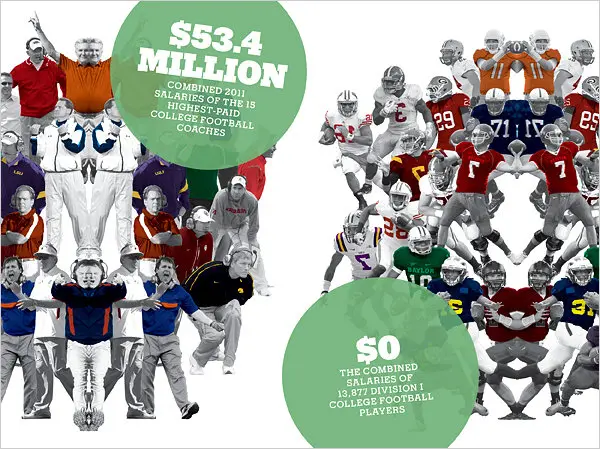
The NCAA generated approximately $18.9 billion in revenue in recent years, fueled by ticket sales, broadcasting rights, merchandise, and corporate sponsorships. Coaches at major programs routinely earn between $5 million and $10 million per year.
Meanwhile, the athletes whose performances drive all of that revenue historically received nothing beyond scholarships. This economic gap is the foundation of the entire debate over whether college athletes should be paid.
The legal landscape shifted dramatically in June 2025 when U.S. District Judge Claudia Wilken granted final approval to the $2.8 billion House v. NCAA settlement. This was a landmark ruling that effectively ended the NCAA’s long-standing amateurism model.
Under the settlement, schools can now directly share revenue with athletes. The cap for the 2025–26 academic year was set at approximately $20.5 million per institution, with a projected 4 percent annual increase and an estimated rise to $33 million by 2035.
Every Power 4 school opted into the revenue-sharing arrangement. Total athlete compensation across college sports is projected to reach $2.4 billion in 2026 and continue climbing year over year.
| Compensation Type | Description | Availability |
|---|---|---|
| Athletic Scholarship | Tuition, housing, meals, fees | Available pre-2021 |
| NIL Deals | Endorsements, sponsorships, appearances | Available since 2021 |
| Revenue Sharing | Direct school payments up to $20.5M/school | Available since July 1, 2025 |
| Back Damages | $2.8B to athletes from 2016–2024 | One-time settlement |
This legal shift proves that the old arguments against paying college athletes have already been rejected by the courts. The debate has moved from “whether” to pay them to “how much” and “how fairly.”
The most straightforward argument for paying college athletes is basic economic fairness. Athletes are the product. Without them, there is no game, no ticket revenue, no television deal, and no merchandise sale.
College football and men’s basketball alone generate the vast majority of athletic department revenue at major universities. Football players and basketball players at Power 4 schools have historically received compensation equal to less than 7 percent of the revenue their sports produce.
By comparison, professional athletes in the NFL and NBA typically receive around 50 percent of league revenues through collective bargaining agreements. The gap between 7 percent and 50 percent represents one of the most glaring pay inequities in the entire American economy.
Student-athletes at Division I schools do not simply play a sport on weekends. Their athletic commitment functions as a second full-time job layered on top of academic requirements.
University studies have found that athletes spend 32 to 44 hours per week on their sport during the season. A Pac-12 study found some athletes spending up to 50 hours per week on athletics alone.
When academic workload is factored in, many Division I athletes are committing close to 60 hours per week between school and sport. This leaves virtually no time for part-time employment to cover personal expenses not included in a scholarship.
The most common counterargument against paying college athletes is that scholarships are sufficient compensation. The data tells a different story.
Athletic scholarships typically cover tuition, housing, meals, and fees. They do not cover personal expenses, transportation, clothing, technology, entertainment, or the many incidental costs of daily student life.
Many athletes, particularly those from lower-income backgrounds, struggle with basic financial needs even while holding a full scholarship. Rules have historically prevented athletes from taking outside jobs to supplement their income while also spending 40-plus hours per week on athletics.
| Scholarship Covers | Scholarship Does NOT Cover |
|---|---|
| Tuition and fees | Personal spending money |
| On-campus housing | Transportation costs |
| Meal plan | Clothing and equipment |
| Required textbooks | Medical costs beyond basics |
| Academic support | Family financial support |
This coverage gap is not theoretical. Real athletes from lower-income families have faced genuine financial hardship while generating millions for their universities.

College athletes, especially those in contact sports like football, wrestling, and basketball, accept enormous physical risks every time they compete. These risks are rarely matched by adequate financial protection.
Athletic scholarships are typically awarded on a year-to-year basis. If an athlete suffers a serious injury and cannot play, the scholarship can be reduced or revoked entirely. The athlete loses both their compensation and potentially their entire athletic future in a single moment.
Some injuries cause permanent disability. An athlete who suffers a career-ending injury in their sophomore year may leave college with no degree, no scholarship, no professional contract, and a lifelong physical limitation. Compensation before an injury occurs is the only way to ensure athletes have some financial security when that happens.
The conversation about paying college athletes cannot be separated from the conversation about race and economic inequality in the United States.
Black athletes are significantly overrepresented in the two most lucrative college sports, football and men’s basketball. These are also the athletes who historically received the lowest return on the revenue their labor generated while their universities and predominantly white coaching staffs and administrators profited most from the system.
In California, Black athletes were found to be overrepresented in revenue-producing sports while also suffering the lowest graduation rates, partly because the time demands of high-revenue sports make academic success structurally difficult.
Paying athletes fairly is an economic justice issue as much as a sports policy issue. A system that extracts maximum labor from athletes from disadvantaged backgrounds while withholding fair compensation has a racial dimension that deserves direct acknowledgment.
The pay disparity between coaches and athletes is one of the most difficult aspects of the college sports model to defend.
College football head coaches at major programs earn between $5 million and $10 million annually. Athletic directors, conference commissioners, and NCAA executives earn multi-million-dollar salaries. Television broadcasters covering college games earn high six-figure or seven-figure salaries.
Data from 2022 shows that coach and staff salaries totaled approximately 35 percent of college sports revenues. Athlete scholarships totaled just 15 percent of revenues in the same period. The athletes at the center of the entire enterprise received the smallest share.
If everyone else in the college sports ecosystem earns market-rate compensation, denying market-rate pay to the athletes themselves is not amateurism. It is exploitation.
Since 2021, college athletes have been allowed to earn money through name, image, and likeness deals. NIL was presented as a major reform, but the reality is more uneven than the headline suggests.
NIL earnings are not distributed equally. A small number of highly visible athletes at major programs, typically quarterbacks and star basketball players, earn substantial NIL income. The majority of college athletes across all sports earn very little or nothing from NIL opportunities.
Booster collectives, which raised and distributed the majority of NIL money, were functioning as unofficial pay-for-play systems that lacked transparency or consistent oversight. The House settlement was partly a response to the chaos that the unregulated NIL system created.
True fair compensation requires a structural revenue-sharing model, not a market-access system that only rewards athletes who already have significant public visibility.
One of the most overlooked injustices in the college athlete compensation debate is the practical impossibility of outside employment for most Division I athletes.
Between practice, travel, games, team meetings, film study, strength and conditioning sessions, and required academic commitments, most Division I athletes have no realistic window in which to hold a part-time job.
NCAA rules have historically capped countable athletic activities at 20 hours per week during the season. But actual total time commitments regularly far exceed that number when voluntary workouts, travel time, and unofficial obligations are included.
Prohibiting athletes from earning outside income while simultaneously preventing them from having enough free time to actually earn that income is a structural contradiction that fair compensation would resolve.
The idea that athletes are receiving a full and enriching college education in exchange for their athletic labor does not reflect the lived experience of many Division I athletes.
Approximately 40 percent of NCAA Division I and Division II athletes report not having enough time to keep up with academics during their playing season. Many say athletics prevent them from taking classes they need or want.
Scholarships offered in exchange for athletic labor often restrict athletes to schedules that make genuine academic engagement difficult. An athlete who graduates with a degree obtained under enormous time pressure and limited course flexibility has not received the full educational value that other students experience.
College athletics is not optional for most athletes who want a professional career. For football players in particular, the NCAA system is the only functional pipeline to the NFL. There is no meaningful alternative professional league for 18-to-22-year-old football players in the United States.
This captive-market dynamic means athletes have no alternative to the NCAA system and no ability to negotiate their compensation with rival leagues. They must accept whatever the system offers or give up their professional ambitions entirely.
When athletes have no other viable option and cannot negotiate, the power imbalance between the athlete and the institution becomes absolute. Compensation requirements are the only structural remedy for that imbalance.
It is important to address the main counterarguments honestly. The debate is not entirely one-sided, even if the weight of evidence clearly favors compensation.
Scholarships are already compensation. This argument is the most common. Scholarships have real monetary value, sometimes exceeding $60,000 per year at private universities. But as detailed above, scholarships do not cover the full cost of living, can be revoked due to injury, and are not proportional to the revenue athletes generate.
Paying athletes would eliminate minor sports. This concern has merit in that funding redistribution could affect non-revenue sports. However, the House settlement model, which caps total payments per school rather than requiring equal pay for all athletes, addresses this concern by keeping the financial structure manageable.
It would destroy amateurism. The House v. NCAA settlement of 2025 effectively ended amateurism as a legal and practical framework for college sports. This argument is now largely historical rather than forward-looking.
Not all schools can afford it. This is true for smaller Division II and Division III programs. But the debate primarily focuses on Power 4 schools with eight- and nine-figure athletic budgets where the revenue to pay athletes clearly exists.
The House settlement created a concrete framework for how direct athlete compensation operates at the school level.
Each participating institution can distribute up to 22 percent of the average revenue from Power 4 conference schools, derived from media rights, ticket sales, and sponsorships. For 2025–26, the annual cap is approximately $20.5 million per school.
Schools have discretion over how to allocate their compensation pool. Some schools may concentrate payments on revenue-sport athletes. Others may distribute payments more broadly across all roster athletes. The result is that individual athlete payments vary significantly by school and sport.
Athletes now receive compensation from three potential sources: revenue sharing from their institution, NIL deals with commercial partners, and athletic scholarships. This three-layer model represents the most comprehensive compensation structure in the history of college sports.
Beyond fairness to individual athletes, paying college athletes has broader economic implications that deserve consideration.
Athletes who receive fair compensation are better positioned to complete their education without the financial stress that drives some to leave school early for professional opportunities. Financial stability during college years can improve academic outcomes and long-term career prospects.
Compensation also increases transparency. When athlete payments are formalized and regulated, the underground economy of booster collectives and unofficial recruiting payments that plagued the pre-settlement era is replaced by a structured and accountable system.
Athletes with access to financial literacy resources and proper compensation are also less vulnerable to financial exploitation by agents, family members, or informal advisors who historically preyed on athletes from low-income backgrounds.

Even with the House settlement in place, significant issues remain unresolved in the college athlete compensation landscape.
The question of whether college athletes qualify as employees under labor law remains actively litigated. Employee status would entitle athletes to additional protections including the right to unionize and negotiate collectively.
The College Sports Commission, created by the settlement to oversee NIL and revenue-sharing rules, is a new entity whose long-term effectiveness and independence remain to be proven.
Title IX implications of revenue-sharing arrangements are being challenged in the courts. How schools balance compensation between men’s and women’s sports under Title IX requirements is still evolving.
The gap between Power 4 schools and lower-division programs also remains wide. Athletes at smaller schools with limited budgets still operate without meaningful compensation beyond scholarships.
| Year | Event |
|---|---|
| 1906 | NCAA founded to regulate amateur collegiate competition |
| 2014 | O’Bannon v. NCAA challenges athlete likeness rights |
| 2021 | Supreme Court rules against NCAA benefit restrictions |
| 2021 | NCAA permits NIL earnings from third parties |
| 2025 | House v. NCAA settlement approved; revenue sharing begins |
| 2025–26 | First direct revenue-sharing payments to athletes, up to $20.5M per school |
| 2026 | Total athlete compensation projected at $2.4 billion across college sports |
This timeline shows that the shift toward paying athletes has been decades in the making, driven by legal pressure, economic realities, and growing public recognition of the fundamental unfairness of the original system.
College athletes generate billions in revenue for universities and the NCAA while dedicating 40 or more hours per week to their sport. Fair compensation reflects the real economic value of their labor.
Yes. Since July 1, 2025, schools can directly share revenue with athletes under the House v. NCAA settlement, capped at approximately $20.5 million per school for the 2025–26 year.
Scholarships cover tuition, housing, and meals but not personal expenses, and they can be revoked due to injury. They do not proportionally reflect the revenue athletes generate.
It is a landmark 2025 legal settlement that approved direct revenue sharing between schools and athletes, ending the NCAA’s historical ban on compensating college athletes beyond scholarships.
Studies show Division I athletes spend between 32 and 50 hours per week on athletics during the season, leaving little time for part-time work or full academic engagement.
NIL stands for name, image, and likeness. Since 2021, athletes have been allowed to earn money from endorsements, sponsorships, and public appearances using their personal brand.
This question is still being litigated. Employee status would give athletes the right to unionize and negotiate collectively, which remains a major unresolved issue beyond the 2025 settlement.
The revenue-sharing cap model addresses this concern by limiting total per-school payouts rather than requiring equal pay for all athletes, allowing schools to manage their broader athletic budgets.
Football and men’s basketball players at Power 4 schools earn the most through a combination of revenue sharing and NIL deals. Visibility and sport revenue are the two biggest factors in individual earnings.
Less than 2 percent of college athletes go on to play professionally. This makes fair compensation during the college years even more important, since most athletes will never earn a professional salary.
Why should college athletes be paid comes down to fairness, economics, and the basic principle that labor deserves compensation.
College athletes work between 32 and 50 hours per week on their sport, generate billions of dollars in revenue for universities and the NCAA, face real risks of career-ending injury with limited financial protection, and are largely prevented from earning outside income by the structure of their commitment.
The House v. NCAA settlement of 2025 recognized these realities and created a framework for direct compensation.
But the settlement is a starting point, not a finish line.
True fairness for college athletes requires ongoing reform, honest conversations about racial and economic equity, and a long-term commitment to ensuring that the people who make college sports possible are treated as valued participants rather than free labor.
The era of unpaid college athletes is ending. The question now is whether it will end completely and equitably.