
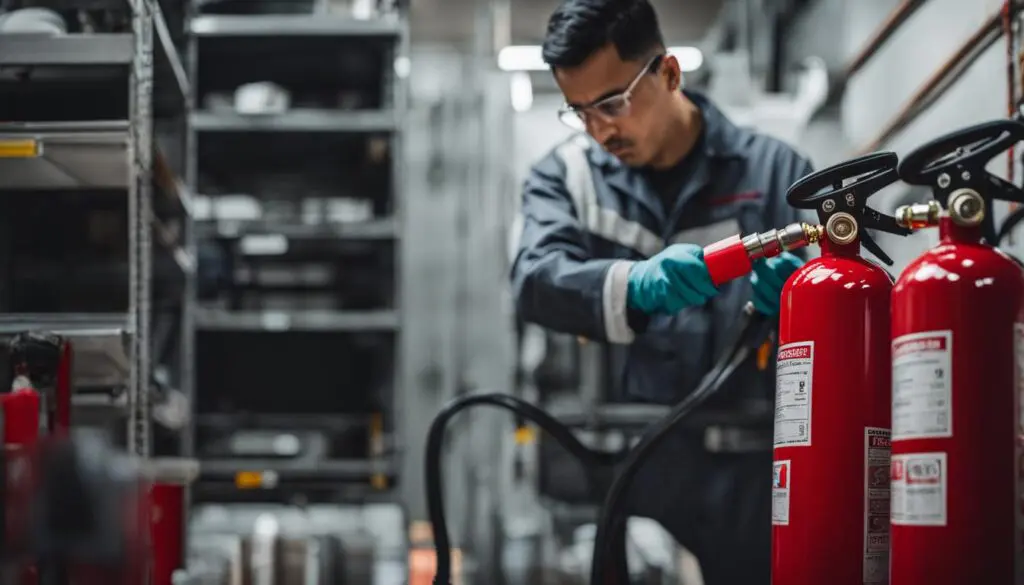
Why must fire extinguishers be routinely maintained is not just a compliance question — it is a matter of life and death. A fire extinguisher hanging on a wall may look ready at a glance, but without regular inspection and servicing, it can fail silently and completely when it is needed most.
Pressure can drop, hoses can clog, agents can degrade, and corrosion can weaken the cylinder — all without any visible warning signs.
Regular maintenance ensures every unit remains fully operational, legally compliant, and capable of stopping a fire before it becomes a catastrophe.
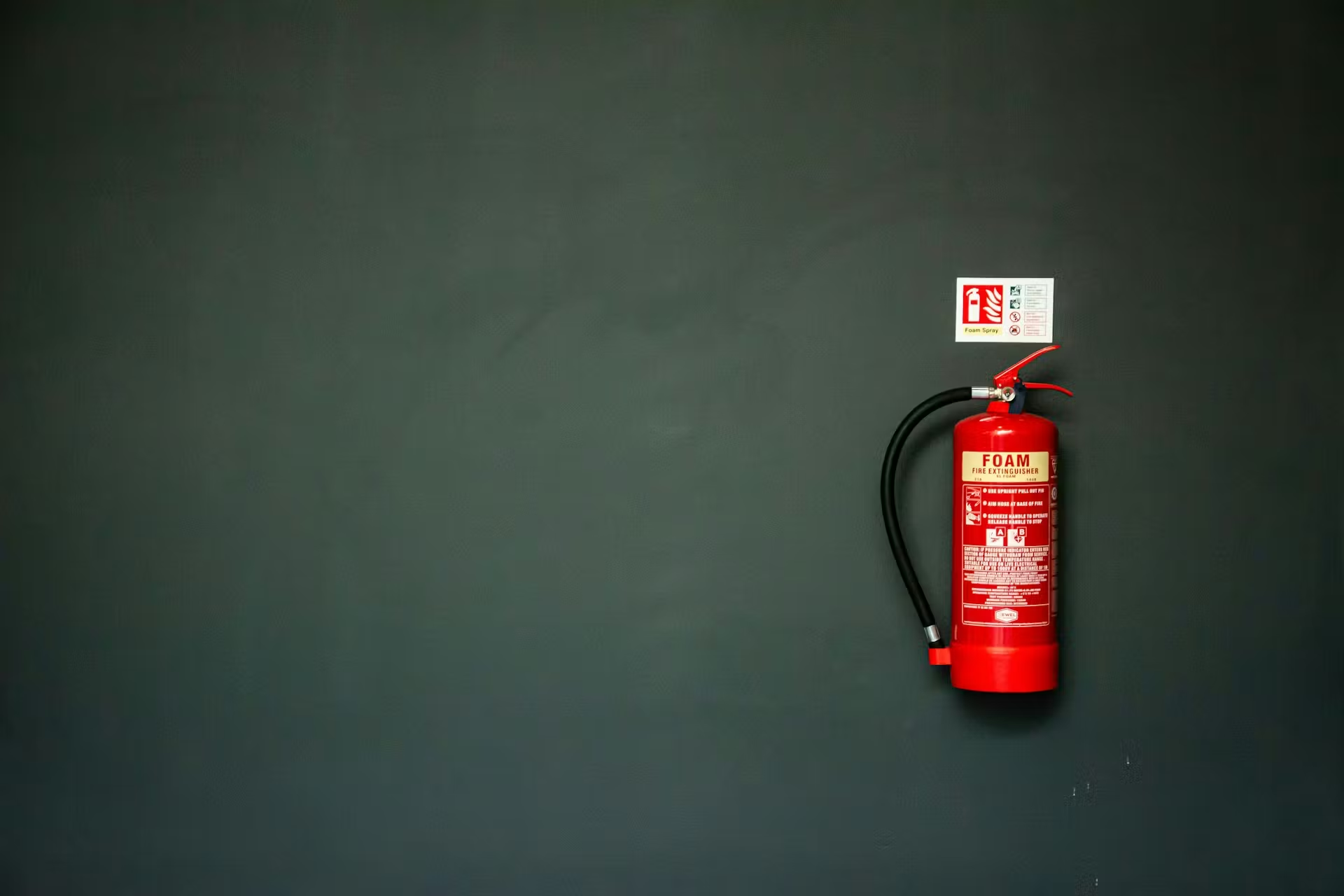
A fire extinguisher is a pressurized device with internal components that degrade over time. Unlike most tools, it sits unused for years between potential emergencies.
That long idle period is exactly what makes maintenance so critical. Without regular checks, pressure leaks go undetected, dry chemical agents clump together, discharge hoses develop blockages, and safety seals deteriorate. By the time a fire occurs, the unit may be completely non-functional.
The entire purpose of a fire extinguisher is to work in the most critical moment. Routine maintenance is the only way to guarantee it will.
The most fundamental reason fire extinguishers must be routinely maintained is to guarantee they function when lives are at stake.
A fire can start and spread within seconds. The window to use a portable extinguisher is extremely narrow — typically 30 to 60 seconds before a small fire becomes uncontrollable. If the extinguisher fails to discharge, that window closes immediately.
Routine maintenance identifies problems before they become emergencies. A technician who finds low pressure during an annual inspection can correct the issue that same day. Without that inspection, the defect remains invisible until it is too late.
Fire extinguishers rely on pressurized agents to function. Pressure can be lost gradually through pinhole leaks, valve wear, or faulty seals — none of which are visible from the outside.
A pressure gauge reading in the green zone may appear normal during a casual glance, but slow leaks can reduce the actual internal pressure significantly without moving the needle immediately. Some older gauges are not precise enough to catch early-stage pressure loss.
Regular maintenance includes weighing the extinguisher, pressure-testing the cylinder, and checking valve integrity. These procedures catch pressure problems long before they cause operational failure.
Fire extinguishers are typically constructed from steel or aluminum, both of which are vulnerable to corrosion over time. Internal moisture, especially in water-based or foam extinguishers, accelerates this process dramatically.
Corrosion inside the cylinder weakens its structural integrity. In worst-case scenarios, a severely corroded cylinder can rupture under pressure, creating a dangerous projectile hazard rather than a fire safety tool.
Annual inspections and the required six-year internal examination detect corrosion at an early stage. Corroded units can be removed from service before they become hazardous themselves.
The discharge hose and nozzle of a fire extinguisher can accumulate debris, dried agent residue, and even insect nests over time. A blocked hose means the extinguishing agent cannot reach the fire regardless of how much pressure remains in the cylinder.
O-rings within the hose connections also degrade with age. Deteriorated O-rings allow pressure to escape around the hose rather than directing it through the nozzle, reducing discharge force and effectiveness.
Routine maintenance includes a thorough inspection and clearing of the discharge hose, nozzle, and all connection points to ensure the full discharge path is clear and functional.
The chemical agents inside fire extinguishers are not permanent. They change physical form, lose potency, and can become completely ineffective over time even without any external visible damage.
Dry chemical powder, the most common agent in ABC extinguishers, is particularly prone to caking and clumping when exposed to temperature fluctuations or humidity. Caked powder cannot flow freely through the nozzle and will either fail to discharge at all or discharge in ineffective clumps.
CO2 extinguishers lose mass through slow gas permeation even without a visible leak. These units must be weighed during inspection because a standard gauge cannot detect CO2 level loss. Without regular weighing checks, a CO2 extinguisher may contain far less agent than required.
Routine fire extinguisher maintenance is not optional in the workplace. The Occupational Safety and Health Administration mandates it under 29 CFR 1910.157, making compliance a legal obligation for all employers who provide portable fire extinguishers for employee use.
Under OSHA standards, employers must perform monthly visual inspections of all portable extinguishers, arrange a formal annual professional maintenance check, maintain records of all inspections and maintenance activities, and ensure hydrostatic testing occurs at the intervals specified in NFPA 10.
Failure to comply with these requirements can result in OSHA citations and significant financial penalties. More critically, non-compliance leaves workers unprotected and creates serious liability exposure if a fire occurs.
The National Fire Protection Association’s NFPA 10: Standard for Portable Fire Extinguishers is the primary national standard governing the selection, installation, inspection, maintenance, and testing of portable fire extinguishers in the United States.
NFPA 10 is adopted by authorities having jurisdiction across virtually every state and is referenced in building codes, insurance requirements, and OSHA regulations. The 2022 edition, widely enforced in 2026, includes updated protocols for electronic monitoring, new extinguishing agents, and refined hydrostatic testing definitions.
The 2026 edition of NFPA 10 introduces performance-based inspection programs that can adjust inspection frequency based on monitored conditions, along with new disposal requirements for condemned non-DOT cylinders. Staying current with NFPA 10 requirements is essential for both compliance and genuine fire safety.
NFPA 10 requires four distinct levels of fire extinguisher inspection and maintenance, each performed at different intervals. Many building owners only know about the annual inspection, but all four levels are required for full compliance.
| Inspection Level | Frequency | Who Performs It | What It Covers |
|---|---|---|---|
| Monthly Visual Inspection | Every 30 days | Designated building employee | Location, pressure gauge, seal, physical condition, access |
| Annual Maintenance | Once per year | Certified fire protection technician | Full mechanical check, seals, pressure, labels, agent condition |
| Internal Examination | Every 6 years (most types) | Certified technician | Internal corrosion, powder condition, internal components |
| Hydrostatic Testing | Every 5 or 12 years (type dependent) | Certified testing specialist | Cylinder structural integrity and pressure vessel safety |
Missing any level of this maintenance schedule means operating out of compliance — and in a real fire emergency, it means risk of equipment failure.
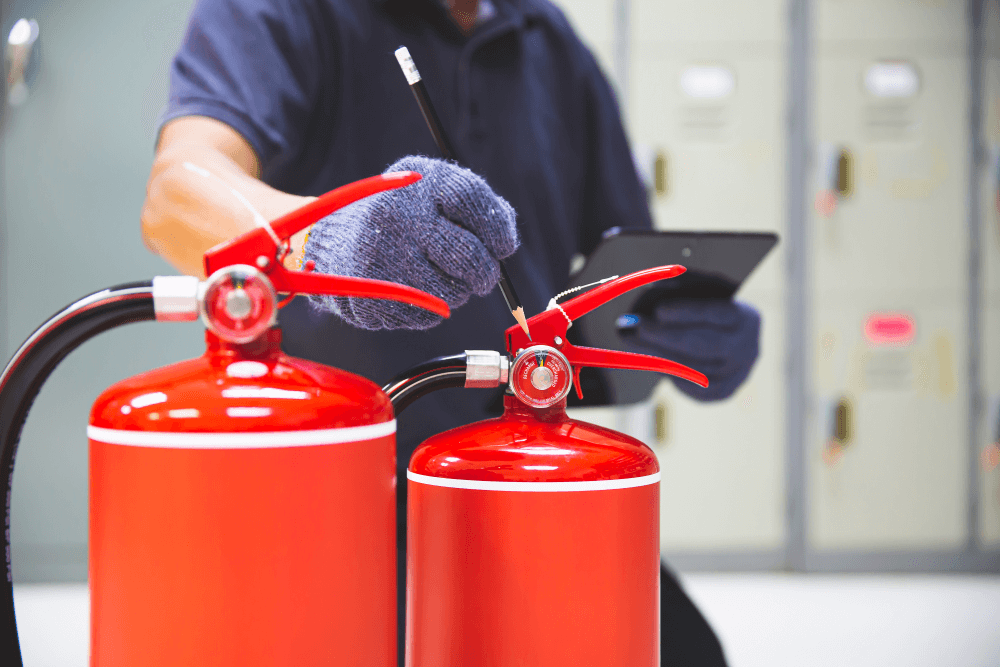
Monthly inspections are the building owner or manager’s responsibility and take only a few minutes per unit. They are the first line of defense against obvious problems developing between professional service visits.
During a monthly inspection, the person responsible must confirm that the extinguisher is in its designated location and has not been moved or removed. They must check that the pressure gauge needle is in the green zone and that the tamper seal and safety pin are intact. They should also visually inspect the unit for physical damage, corrosion, leaking, and ensure the instruction label is fully legible. Any unit showing abnormal conditions during a monthly check must be removed from service and inspected by a professional immediately.
NFPA 10 Section 7.2.4 requires that a record of every monthly inspection be maintained, including the date and the initials of the person who performed the check.
Annual maintenance is significantly more thorough than a monthly visual check and must be performed by a trained and certified fire protection technician.
The annual maintenance examination includes testing all mechanical parts including the valve, handle, and trigger mechanism. Technicians verify that the internal pressure matches specifications using calibrated instruments, not just the external gauge.
They inspect and test seals, gaskets, and O-rings, replace tamper seals after service, and verify that the extinguishing agent is in proper condition and correct quantity.
They also confirm that all labels, including the classification label, instructions, and inspection tag, are complete, legible, and properly attached. NFPA 10 Section 7.3 requires this annual service and mandates that the date and technician name be recorded on a tag attached to each extinguisher.
Every six years, stored-pressure extinguishers that require a 12-year hydrostatic test must be emptied and subjected to a full internal examination. This is far more invasive than an annual check and requires the unit to be taken apart.
During the six-year internal examination, the cylinder is fully depressurized and opened. Technicians inspect all internal surfaces for corrosion, pitting, and physical damage.
Dry chemical agents are removed and assessed for caking, clumping, or contamination. Internal components including the siphon tube, valve stem, and discharge mechanism are examined, cleaned, and replaced as necessary. After the internal examination is completed satisfactorily, the unit is refilled, re-pressurized, and returned to service with a new maintenance tag.
Non-rechargeable disposable extinguishers are exempt from the six-year internal examination because they cannot be opened — but they must be removed from service entirely at 12 years from their manufacture date.
Hydrostatic testing verifies that the fire extinguisher’s pressure cylinder can safely withstand its rated operating pressure without risk of rupture. This test requires specialized equipment and must be performed by certified testing professionals only.
The frequency of required hydrostatic testing varies by extinguisher type. Understanding which schedule applies to each unit in a facility is essential for maintaining full compliance.
| Extinguisher Type | Hydrostatic Test Interval |
|---|---|
| Pressurized water | Every 5 years |
| Water mist | Every 5 years |
| Carbon dioxide (CO2) | Every 5 years |
| Wet chemical (Class K) | Every 5 years |
| Dry chemical with stainless steel shell | Every 5 years |
| Dry chemical (standard ABC) | Every 12 years |
| Clean agent (halon replacement) | Every 12 years |
| Non-rechargeable disposable | Remove from service at 12 years; no hydrostatic test |
Facilities with multiple extinguisher types, such as restaurants using both ABC dry chemical units and Class K wet chemical units in kitchens, must track two completely separate maintenance timelines simultaneously. The ABC units follow a 12-year hydrostatic cycle while the Class K units follow a 5-year cycle. Missing this distinction is one of the most common compliance errors in multi-extinguisher facilities.
The legal and financial consequences of failing to maintain fire extinguishers extend well beyond an OSHA citation.
Insurance policies for commercial properties frequently require documented fire extinguisher maintenance as a condition of coverage. If a fire occurs and inspection records cannot be produced, insurance companies may dispute or deny claims related to fire damage. The financial exposure from a single denied claim can far exceed years of professional maintenance costs.
In negligence litigation following a fire injury, one of the first questions investigators ask is whether fire safety equipment was maintained per applicable standards. If inspection tags are expired, records are missing, or a unit is found to have been defective, the facility owner faces severe liability exposure. Documented, current maintenance records are the primary evidence that a building owner met their legal duty of care to occupants.
A fire extinguisher does not exist in a controlled environment. It hangs on a wall or sits in a cabinet exposed to temperature fluctuations, humidity, vibration, and dust — all of which accelerate equipment degradation.
In high-humidity environments such as coastal areas, food processing facilities, or outdoor locations, corrosion develops faster. In environments with extreme temperature swings, such as warehouses or parking garages, pressure fluctuations stress the cylinder and seals more aggressively. In dusty or particle-heavy environments such as construction sites or manufacturing floors, nozzles and hoses clog more quickly.
Miami and other coastal cities face particular challenges from salt air and heat, which can accelerate corrosion and pressure loss significantly faster than inland environments at moderate temperatures. Regional climate conditions should influence how frequently inspections are scheduled, with more challenging environments potentially requiring more frequent visual checks.
Routine maintenance is significantly more cost-effective than emergency replacement or, worse, dealing with the consequences of extinguisher failure during an actual fire.
A professional annual service for a standard ABC extinguisher typically costs between $25 and $75. A replacement extinguisher of the same type costs between $50 and $150. Addressing minor issues like low pressure or a faulty seal during a routine service visit costs a fraction of emergency replacement.
The far larger cost, however, is fire damage. U.S. fire departments respond to an estimated 13,570 fires in commercial mercantile properties each year. A functioning fire extinguisher used in the first 30 seconds can contain a fire that would otherwise cause tens of thousands of dollars in property damage and business interruption. The cost of routine maintenance is trivial compared to the financial and human cost of a fire that could have been suppressed.
Fire extinguishers in accessible public areas are occasionally tampered with, intentionally or accidentally. Safety pins can be removed out of curiosity, especially by children. Extinguishers can be partially discharged by accident and returned to their bracket without anyone realizing the agent is depleted.
Tamper seals are specifically designed to show evidence of any access to the handle or trigger mechanism. A broken or missing tamper seal during a monthly inspection is an immediate red flag that the unit may have been discharged or compromised.
Without regular inspections, a partially discharged extinguisher can hang in place for months or years — appearing fully functional until it is needed and fails to deliver adequate agent to suppress a fire.
A properly maintained fire extinguisher can remain in service for 20 years or more. Without maintenance, the same unit may become unusable within five years due to undetected corrosion, pressure loss, or agent degradation.
Proactive maintenance protects the investment made in fire safety equipment. Components that are inspected, cleaned, and replaced as needed at routine service intervals last far longer than those left to deteriorate unattended.
For businesses managing large inventories of fire extinguishers across multiple locations, extending the service life of each unit through consistent maintenance translates directly into significant capital expenditure savings over time.
NFPA 10 and OSHA both require that fire extinguisher maintenance be documented in specific ways. Proper documentation is not just paperwork — it is legal evidence that maintenance was performed.
Each extinguisher must have a service tag physically attached to the unit showing the date of the most recent annual maintenance and the name of the technician who performed it. Records of monthly inspections must be maintained on file showing the date and initials of the inspector. Records of hydrostatic testing must be kept and available for review, including the date of the test and the signature of the person who performed it. For facilities using electronic monitoring, an event log must be accessible at the control panel. All records must be retained for at least one year after the last entry or for the life of the extinguisher shell, whichever is less.
During a fire marshal inspection or OSHA audit, inspectors check inspection tags first. An expired tag or missing records is an immediate compliance violation regardless of the physical condition of the equipment.
Different types of fire extinguishers have different maintenance requirements based on their agent type, pressure system, and construction materials. Understanding these differences is essential for facilities that use multiple extinguisher types.
| Extinguisher Type | Common Use | Key Maintenance Concern |
|---|---|---|
| ABC Dry Chemical | General commercial use | Powder caking, 6-year internal check |
| CO2 | Electronics, server rooms | Weight check required (no gauge), hose conductivity test |
| Class K Wet Chemical | Commercial kitchens | 5-year internal and hydrostatic cycle |
| Water/Water Mist | Class A fires only | Corrosion check, freeze protection in cold climates |
| Clean Agent | Data centers, archives | Pressure stabilization, leak testing |
| Foam (AFFF/FFFP) | Flammable liquid fires | 3-year internal examination interval |
CO2 extinguishers deserve special attention because they have no pressure gauge. The only way to verify CO2 charge level is by weighing the unit and comparing it to the full-weight specification on the label. A CO2 extinguisher that has lost significant charge looks identical to a fully charged one — making regular professional inspection absolutely essential for this type.
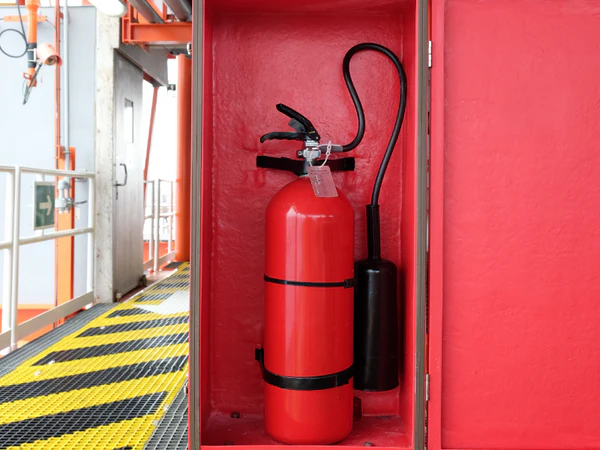
For businesses and facility managers, establishing a structured maintenance program eliminates the risk of missed inspections and compliance gaps. A well-designed program should include the following elements.
Assign a specific individual to perform monthly visual inspections and document the results on an inspection checklist hung near or attached to each extinguisher. Set automated calendar reminders for annual professional service 30 to 45 days before each unit’s service date.
Maintain a central log or spreadsheet tracking each extinguisher’s location, type, manufacture date, last annual service date, six-year internal examination date, and hydrostatic test date.
For facilities with more than 20 extinguishers, consider fire protection management software that tracks all maintenance intervals automatically and generates compliance reports.
Partner with a licensed fire protection company that provides automatic service reminders, comprehensive documentation, and certified technicians for all levels of inspection from annual maintenance through hydrostatic testing.
Between scheduled inspections, certain signs indicate that a fire extinguisher needs professional evaluation immediately rather than waiting for the next scheduled service.
The pressure gauge needle is in the red zone on either side, indicating either over-pressurization or under-pressurization. The tamper seal is broken or the safety pin is missing. The unit is visibly dented, cracked, or shows signs of rust or corrosion on the exterior.
The discharge hose is cracked, kinked, or blocked. The label is missing, unreadable, or the most recent service tag shows a date more than 12 months ago. The unit feels significantly lighter than expected, suggesting agent has been lost or the unit was partially discharged.
Any extinguisher showing these conditions must be taken out of service immediately and either professionally serviced or replaced. Leaving a compromised extinguisher in place creates a false sense of security that can have fatal consequences.
| Reason | What It Prevents |
|---|---|
| Ensure operational readiness | Equipment failure during a fire emergency |
| Detect pressure loss | Silent depressurization and discharge failure |
| Prevent corrosion | Cylinder weakening and rupture risk |
| Clear hose blockages | Discharge obstruction in emergencies |
| Maintain agent quality | Caking, clumping, and reduced effectiveness |
| OSHA compliance | Legal citations, fines, and workplace liability |
| NFPA 10 adherence | Standard violations and insurance issues |
| Insurance compliance | Denied claims after fire damage |
| Environmental damage control | Accelerated degradation in harsh conditions |
| Early issue detection | Costly emergency replacement |
| Tamper detection | Unknowingly compromised equipment |
| Extended service life | Premature retirement of serviceable units |
Fire extinguishers must be routinely maintained to ensure they function correctly during an emergency. Pressure loss, internal corrosion, clogged hoses, and degraded agents can all cause failure without any visible warning signs.
NFPA 10 requires monthly visual inspections by building staff, annual professional maintenance, a six-year internal examination, and hydrostatic pressure testing every 5 or 12 years depending on extinguisher type.
OSHA regulation 29 CFR 1910.157 requires employers to perform monthly visual inspections, arrange annual professional maintenance, and maintain written records of all inspection and maintenance activities for all workplace portable extinguishers.
An unmaintained extinguisher can fail completely during a fire due to pressure loss, blocked discharge path, or degraded agent. This leaves occupants without a critical first-response tool and exposes the building owner to legal and financial liability.
Monthly visual inspections can be performed by any trained building employee. Annual maintenance, six-year internal examinations, and hydrostatic testing must be performed by certified fire protection technicians with proper tools and manufacturer-approved procedures.
Hydrostatic testing is a pressure test that verifies the structural integrity of the fire extinguisher cylinder. It confirms the vessel can safely hold its rated pressure without risk of rupture and must be performed every 5 or 12 years depending on the extinguisher type.
A properly maintained and regularly serviced fire extinguisher can remain in service for 20 years or more. Non-rechargeable disposable models must be removed from service 12 years from their manufacture date regardless of condition.
Yes. Pressure gauges on older or lower-quality units may not detect early-stage slow leaks accurately. CO2 extinguishers have no gauge at all and must be weighed to verify charge level. Only professional inspection using calibrated tools provides reliable confirmation of readiness.
NFPA 10 and OSHA require a service tag on each unit showing the annual maintenance date and technician name, monthly inspection logs showing date and inspector initials, and hydrostatic testing certification records. All records must be available for inspection on request.
In most cases, yes. Fire extinguisher inspection, maintenance, and replacement costs qualify as ordinary and necessary business safety expenses. Consult a qualified tax professional for guidance specific to your business structure and jurisdiction.
Why must fire extinguishers be routinely maintained comes down to one non-negotiable truth: a fire extinguisher that fails during an emergency is worse than no fire extinguisher at all, because it creates false confidence.
Routine maintenance — from monthly visual checks through annual professional service, six-year internal examinations, and hydrostatic testing — is the only way to guarantee that every unit will perform at full capacity when it is needed most.
OSHA and NFPA 10 mandate these requirements because the evidence is clear: maintained extinguishers save lives, prevent property loss, and protect businesses from devastating legal and financial consequences.
In 2026, fire extinguisher maintenance is not a checklist item to overlook. It is a fundamental pillar of any serious fire safety program, whether for a single business location or a large multi-facility operation.