
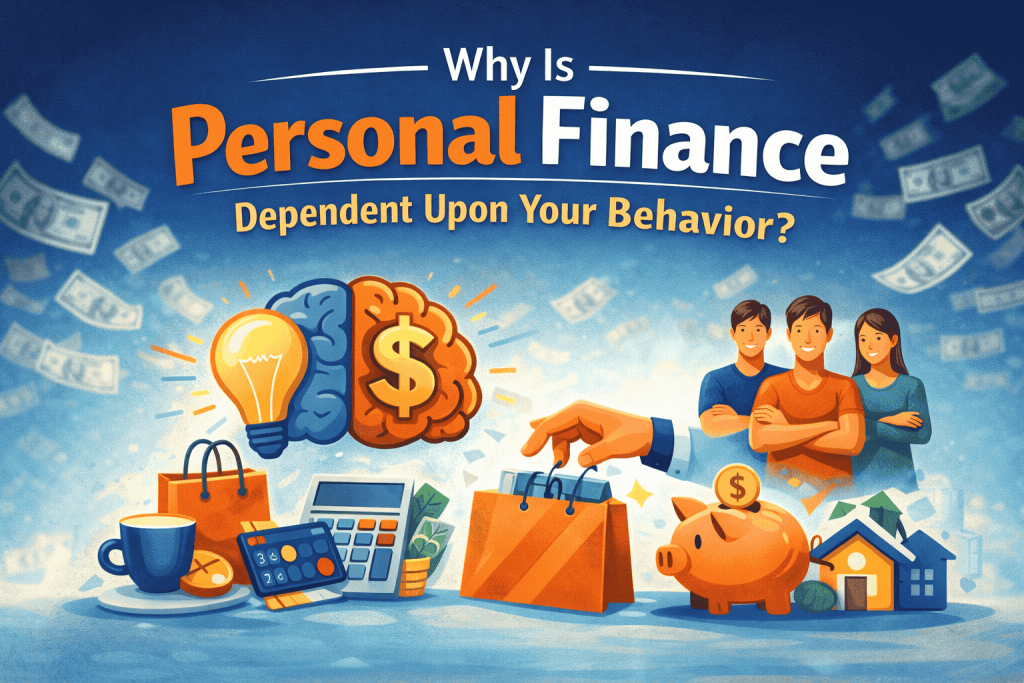
Why is personal finance dependent upon your behavior? Because no spreadsheet, salary raise, or financial app can fix poor money habits on its own.
Personal finance is not a math problem — it is a behavior problem.
Every financial outcome in your life, from debt to wealth, is the result of repeated daily decisions shaped by your psychology, emotions, and habits. Knowing what to do is not enough.
You have to consistently do it. That gap between knowing and doing is entirely behavioral.

Most people already know the basics of good money management. Spend less than you earn. Save regularly. Avoid high-interest debt. Invest early.
Yet most people still struggle financially. The reason is not a lack of information — it is a failure of consistent behavior. Behavioral finance studies confirm that emotions, habits, and psychological biases drive financial decisions far more than logic or numbers ever do.
Understanding why personal finance is dependent upon your behavior is the first real step toward fixing it.
Behavioral finance is the field that combines psychology and economics to explain why people make irrational money decisions.
It was developed by researchers including Daniel Kahneman and Amos Tversky, whose work showed that humans are not the rational economic actors traditional finance theory assumed. We are emotional, biased, and deeply influenced by our environment, upbringing, and social circles.
In short, behavioral finance explains the gap between what we should do with money and what we actually do.
A widespread myth is that earning more money automatically solves financial problems. It does not.
Research consistently shows that high-income earners can and do end up broke. When income rises without a corresponding change in behavior, spending simply rises to match it — a pattern called lifestyle inflation. The money evaporates just as fast as it arrives.
Couples with moderate incomes but disciplined financial habits often build more wealth than high earners with poor money behaviors. Income matters, but behavior matters more.
Every financial outcome you experience today is the product of thousands of small behavioral decisions made over time.
The choice to brew coffee at home instead of buying it daily, the habit of reviewing your budget weekly, the instinct to save before spending — none of these feel significant in isolation. Together, they compound into dramatically different financial realities over years and decades.
Behavioral economists have documented that small, consistent behaviors outperform large, occasional efforts in personal finance.
Automating a $50 monthly transfer to savings is more effective than resolving to save $600 in December. The behavior is built into the system, removing the need for daily willpower.
Wealth is not built through a single brilliant financial decision. It is built through the repetition of good habits over time — budgeting, saving, investing, and resisting unnecessary spending — done consistently, month after month and year after year.
The habit loop of cue, routine, and reward applies directly to money. When saving becomes automatic and rewarding, it sustains itself without constant effort.
Understanding why we spend impulsively is central to understanding why personal finance is dependent upon your behavior.
Emotional spending occurs when purchases are driven by feelings rather than need. Common triggers include stress, boredom, sadness, celebration, anxiety, and loneliness.
Retail therapy is a real psychological phenomenon. A temporary mood boost from a purchase can feel rewarding in the moment, but the financial damage accumulates over time and often creates more stress — the very feeling that triggered the spending in the first place.

Social comparison is one of the most powerful behavioral drivers of spending. The pressure to match the lifestyle of neighbors, coworkers, or social media contacts pushes people into spending beyond their actual means.
This “keeping up with the Joneses” effect has been amplified significantly by social media in the 2020s. People compare their everyday lives to the curated highlight reels of others and spend to close a gap that does not actually exist.
Present bias causes people to overvalue immediate rewards and undervalue future benefits. This is why it feels easier to spend money now than to save it for retirement decades away.
The brain registers a future reward as less real than an immediate one. Overcoming present bias requires building systems — like automatic savings — that remove the choice from the moment entirely.
| Emotional Trigger | Typical Financial Behavior | Long-Term Impact |
|---|---|---|
| Stress | Impulse purchases, retail therapy | Debt, reduced savings |
| Boredom | Online shopping, subscriptions | Budget leakage |
| Fear (market crash) | Panic selling investments | Missed recovery gains |
| Excitement | Overinvesting in trendy assets | Portfolio imbalance |
| Social pressure | Lifestyle inflation, overspending | Slower wealth building |
| Celebration | Splurging beyond means | Short-term debt |
Cognitive biases are mental shortcuts the brain uses to process information quickly. In finance, they almost always lead to worse decisions.
Loss aversion is the tendency to feel the pain of a loss roughly twice as intensely as the pleasure of an equivalent gain. This makes people hold onto losing investments far too long, hoping for a rebound rather than cutting losses and moving on.
It also leads to avoiding smart financial risks — like investing — out of fear of loss, even when the expected long-term gain is clear.
Confirmation bias causes people to seek out information that confirms what they already believe and ignore information that contradicts it.
In investing, this leads people to keep money in poor-performing assets because they selectively consume media that validates the choice. In budgeting, it causes people to underestimate their true spending because they look for evidence that they are doing fine.
Anchoring occurs when the first piece of information encountered becomes the reference point for all future judgments. In finance, the price you paid for a stock becomes your anchor — making it hard to sell at a loss even when the fundamentals have changed completely.
It also affects salary negotiation, major purchases, and debt repayment decisions in ways that consistently cost people money.
Mental accounting is the habit of treating money differently depending on its source or mental category. People tend to spend “windfall” money like tax refunds or bonuses more freely than regular income, even though the dollars are identical.
This leads to irrational financial choices where bonus money is wasted on luxuries while credit card debt goes unpaid at 20% interest.
Overconfidence causes people to overestimate their own financial knowledge and ability. High-income professionals are particularly vulnerable — success in their career creates a false sense of competence in investment decisions.
This leads to underdiversified portfolios, excessive trading, and losses from chasing complex investments that were never well understood.
Present bias makes the future feel abstract and the present feel urgent. It is the reason people choose to spend today rather than save for tomorrow, even when they genuinely intend to save eventually.
Without systems that automate savings before spending can occur, present bias wins almost every time.
| Cognitive Bias | What It Does | Financial Damage |
|---|---|---|
| Loss aversion | Overweights fear of loss | Holds bad investments too long |
| Confirmation bias | Seeks agreeable information | Ignores red flags in finances |
| Anchoring | Fixates on first number seen | Poor sell/buy decisions |
| Mental accounting | Treats money differently by source | Spends windfalls irrationally |
| Overconfidence | Overestimates own skill | Risky, underdiversified investing |
| Present bias | Values now over later | Under-saves, over-spends today |
| Herd mentality | Follows the crowd | Buys high, sells low |
| Recency bias | Judges future by recent past | Panic sells after market dips |
Lifestyle inflation is the pattern of increasing spending as income increases, leaving savings stagnant regardless of how much more money comes in.
A person earning $40,000 a year struggles to save. They tell themselves they will save when they earn $60,000. At $60,000, a bigger apartment and a newer car feel earned. Savings remain a future intention.
This cycle repeats at every income level unless interrupted by deliberate behavioral change. The behavior — not the income — is the variable that needs to change.
The most effective way to stop lifestyle inflation is to automate savings before lifestyle spending can absorb new income. When a raise arrives, immediately increase the automatic savings contribution by at least 50% of the raise.
This keeps lifestyle growth moderate while steadily accelerating wealth accumulation.
Habits automate decisions. Good financial habits automate good decisions. Bad financial habits automate bad ones.
The goal of behavioral personal finance is to design habits that make the right choice the default choice — so that saving, investing, and avoiding debt happen automatically without requiring willpower every single day.
A budget is not just a financial document. It is a behavioral contract with yourself. It defines in advance how you will behave with your money each month before emotions, impulses, or social pressure can intervene.
People who budget consistently build wealth at higher rates than those who do not, regardless of income level. The act of budgeting itself changes spending behavior by creating awareness and accountability.
| Category | Percentage of Net Income | Examples |
|---|---|---|
| Needs | 50% | Rent, utilities, groceries, transport |
| Wants | 30% | Dining out, entertainment, subscriptions |
| Savings and Debt Repayment | 20% | Emergency fund, retirement, loan payments |
This simple framework works because it is easy to remember and apply consistently. Behavioral simplicity leads to behavioral consistency.
Saving before spending — often called “paying yourself first” — is one of the most effective behavioral finance strategies ever documented.
When savings are deducted from income before you see or touch the money, present bias cannot intervene. The money is simply gone from the spending pool. Over time, people adjust their lifestyle to the remaining amount without feeling deprived.
Willpower is a limited resource. Behavioral research has shown that people make worse decisions when mentally fatigued — a phenomenon called decision fatigue.
Automating savings contributions, bill payments, and investment deposits removes those decisions from the daily mental load entirely. The behavior happens consistently without requiring conscious effort every month.
Debt is not just a financial condition. It is a behavioral one. The way people approach, accumulate, and manage debt reflects deep psychological patterns about self-worth, instant gratification, and avoidance.
Many people avoid looking at their bank balances, opening bills, or reviewing their credit card statements because the anxiety is too uncomfortable. This avoidance behavior is extremely common and extremely costly.
Ignoring debt does not reduce it. It compounds it. The behavioral antidote is not willpower — it is creating structured, regular check-ins that normalize engaging with financial reality.
Financial stress impairs decision-making, which leads to worse financial choices, which creates more financial stress. This cycle is well documented in behavioral economics research.
Breaking it requires addressing both the financial mechanics — interest rates, balances, payment plans — and the psychological patterns that prevent consistent follow-through.
Understanding the problem is the beginning. Changing behavior is the work. Here are the most evidence-backed behavioral strategies for improving personal financial outcomes.
Goals tell you where you want to go. Systems determine whether you get there. A goal of saving $10,000 this year is meaningless without a system — an automatic monthly transfer, a budget that reflects the goal, and a regular review process.
Behavioral finance consistently shows that people who build systems outperform people who set goals without structures to support them.
Nudge theory — developed by behavioral economists Richard Thaler and Cass Sunstein — describes how small changes in the choice environment can dramatically alter behavior without removing freedom.
In personal finance, nudges include enrolling in automatic 401(k) contributions by default, placing savings goals prominently in banking apps, and using visual reminders of financial goals to counteract impulse spending.
Before making any non-essential purchase above a set threshold — say $50 or $100 — impose a mandatory 24 to 48 hour waiting period.
This breaks the immediate emotional momentum of impulse buying. In most cases, the urge to buy fades significantly once the emotional trigger has passed. The purchases that survive the waiting period are more likely to be genuinely wanted rather than emotionally reactive.
The most sustainable approach to behavioral financial change is values-based financial planning — aligning every spending and saving decision with what genuinely matters to you.
When your financial behavior reflects your values, good money choices feel fulfilling rather than restrictive. The psychology shifts from “I cannot spend” to “I am choosing what matters most to me.” That shift is the foundation of lasting financial behavior change.
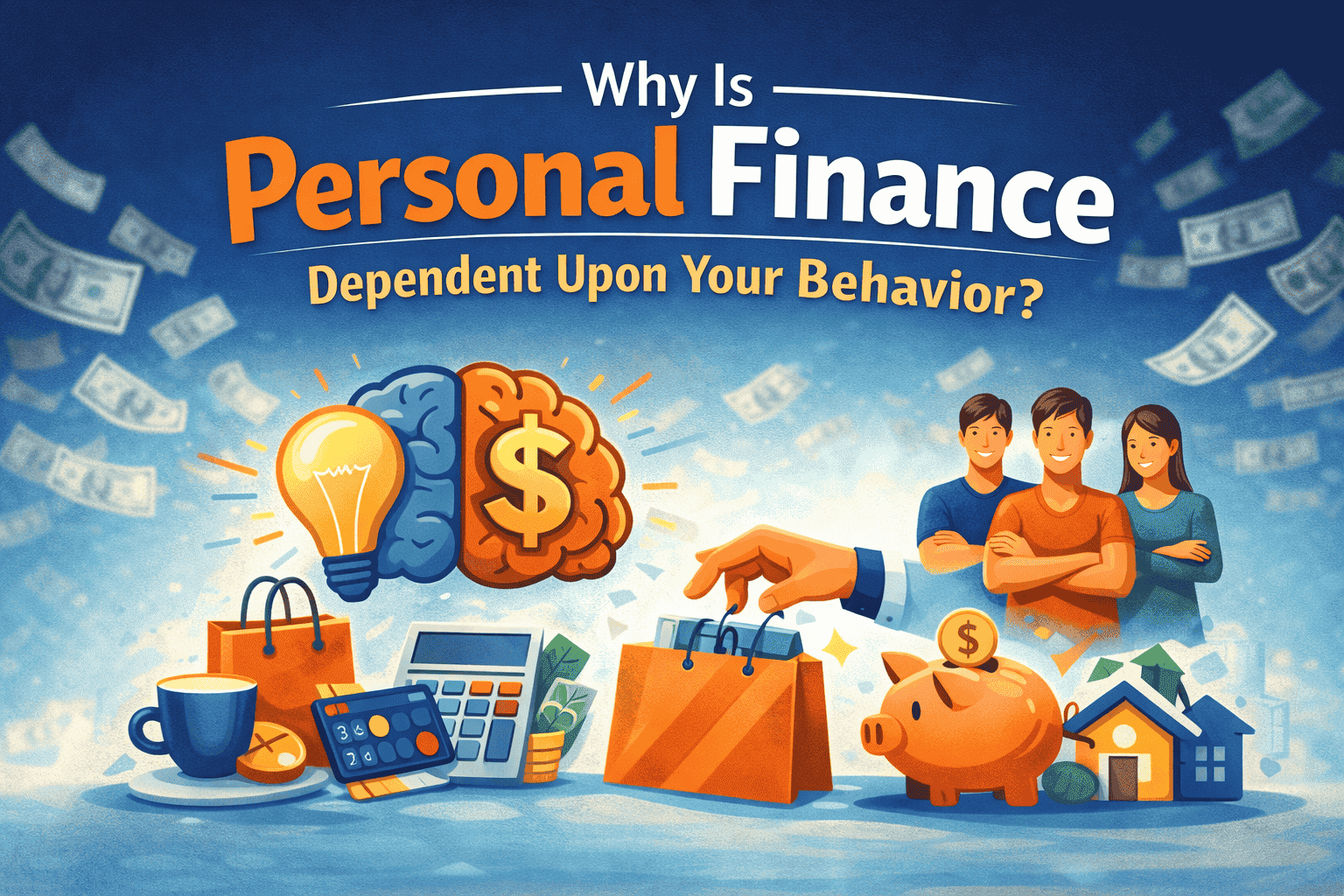
What gets measured gets managed. Regular financial tracking — reviewing income, expenses, savings rates, and net worth monthly — creates the feedback loop necessary for behavioral adjustment.
People who track their spending consistently spend less on discretionary categories simply because awareness changes behavior. The act of recording a purchase activates reflection that impulse spending bypasses entirely.
The relationship between money behavior and mental health runs in both directions. Poor financial habits increase stress, anxiety, and depression. Mental health struggles impair the decision-making capacity needed for good financial behavior.
Financial stress is consistently ranked among the top sources of anxiety for adults globally. In 2025, with elevated inflation, housing costs, and economic uncertainty, this stress is particularly acute.
Addressing financial behavior is therefore not just a practical matter — it is a mental health matter. Small wins in financial behavior create real psychological relief, building confidence and momentum for further improvement.
Financial behavior is not formed in isolation. It is shaped by family, culture, peer groups, and the media environment we inhabit.
Research by financial psychologists Dr. Brad Klontz and Ted Klontz identified four core money scripts — deeply held beliefs about money formed in childhood — that drive adult financial behavior.
These include money avoidance (money is bad or corrupting), money worship (more money will solve all problems), money status (worth equals net worth), and money vigilance (saving is a moral virtue). Each script creates specific behavioral patterns, some helpful and some financially destructive.
Social media has dramatically amplified social comparison effects on spending behavior in the 2020s. Platforms curate aspirational content — luxury travel, premium products, affluent lifestyles — that creates persistent pressure to spend beyond actual financial capacity.
Behavioral finance researchers note that social media finance influencers also amplify confirmation bias by providing a constant stream of content validating whatever financial beliefs their audience already holds.
Heading Patterns Used by Top-Ranking Pages:
Pages that ranked highest answered the core question directly in the opening paragraph, followed by a section on behavioral finance as a concept, then specific biases, habit-based strategies, and an FAQ section. Pages using tables and comparison charts consistently captured featured snippets and People Also Ask placements.
A behavior-first financial plan starts not with numbers but with self-awareness. Before building a budget, ask: What are my emotional spending triggers? What cognitive biases have cost me money in the past? What money scripts did I inherit from my family?
The answers shape a financial plan that works with your psychology rather than against it.
| Step | Action | Behavioral Purpose |
|---|---|---|
| 1 | Identify your money scripts and emotional triggers | Build self-awareness |
| 2 | Automate savings before lifestyle spending | Defeat present bias |
| 3 | Create a budget aligned with core values | Reduce decision fatigue |
| 4 | Apply the 24-hour rule for non-essential purchases | Interrupt impulse spending |
| 5 | Review finances weekly for 10 minutes | Create accountability loop |
| 6 | Increase savings rate with every income increase | Prevent lifestyle inflation |
| 7 | Diversify investments systematically, not emotionally | Counteract overconfidence |
| 8 | Seek accountability — partner, coach, or advisor | Reinforce behavioral change |
Because income without behavioral discipline leads to lifestyle inflation, not wealth. How you handle money consistently over time matters far more than how much you earn.
Behavioral finance is the study of how psychology and emotion influence financial decisions. It matters because it explains why people make irrational money choices even when they know better.
Loss aversion, confirmation bias, overconfidence, present bias, anchoring, and mental accounting are the most financially damaging. Each leads to decisions that reduce wealth over time.
Emotional spending drains budgets, creates debt, and derails savings goals. It provides short-term mood relief but compounds financial stress over the long term.
Lifestyle inflation is when spending rises in proportion to income, preventing wealth accumulation. Avoid it by automating savings increases every time your income goes up.
Start by identifying the trigger behind the habit, replace the routine with a better behavior, and build a system that automates the better choice so it does not depend on daily willpower.
Yes. Budgeting creates awareness and accountability, which directly reduce unnecessary spending. People who budget consistently save more and carry less consumer debt over time.
It means directing money to savings or investments immediately when income arrives, before any other spending occurs. This removes present bias from the equation entirely.
Social media amplifies social comparison and lifestyle aspiration, pressuring people to spend beyond their means. It also strengthens confirmation bias by feeding users content that validates existing spending beliefs.
Yes. A financial advisor or behavioral money coach provides accountability, challenges cognitive biases, and helps design systems that align your financial behavior with your actual long-term goals.
Why is personal finance dependent upon your behavior? Because money is not math — it is psychology in action.
Every savings account balance, every debt total, every investment decision is the direct output of behavioral patterns operating day after day, year after year. Financial literacy tells you what to do.
Behavioral awareness gives you the power to actually do it. The most important shift anyone can make is from believing that more income will fix their finances to understanding that better behavior is the real solution.
Identify your emotional triggers, name your cognitive biases, automate your savings, and align your spending with your genuine values.
Those behavioral changes will do more for your financial future than any salary increase or investment tip ever could. Start with one behavior today.