
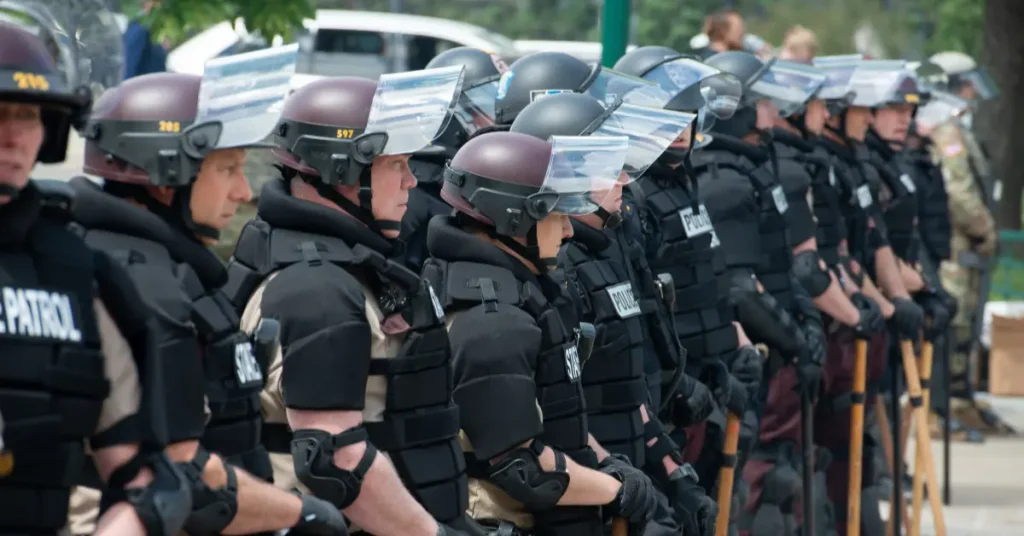
Why do people call cops 12 is one of the most searched slang questions in American culture today. The term pops up in rap lyrics, protest chants, social media captions, and everyday street conversations across the United States.
Most people who use it or hear it have no clear idea where it actually came from.
 i
i
“12” is slang for police officers or law enforcement. When someone shouts “12!” or says “watch out for 12,” they are warning others that cops are nearby.
It functions as a fast, coded alert — a short signal passed between people to communicate police presence without spelling it out openly. The term is used both neutrally and with hostility depending on the situation and the speaker.
The term “12” most likely comes from the police radio code 10-12, which means “visitors are present” or “stand by.” Over time, the “10” was dropped and just “12” remained as a street warning that law enforcement was close.
It may also trace back to the 1960s TV show Adam-12, the Atlanta narcotics unit, or an anti-police acronym. The honest truth is that no single origin is confirmed. Multiple sources fed into the same slang word, and it grew from all of them together.
The strongest and most widely cited theory connects “12” to the 10-code system used in law enforcement radio communication.
In this system, the code 10-12 means “visitors present” or “stand by — bystanders are in the area.” Officers used it to signal each other that civilians were nearby when they arrived at a scene.
Street communities in the South picked up on this code and flipped its meaning. Instead of police using it to warn each other about civilians, people began shouting “12!” to warn each other about police. The “10” was dropped over time and “12” became the standalone term.
This theory is supported by the fact that other numeric police slang also comes from radio codes. “187” is California’s penal code for homicide and is widely used in rap. The 10-code origin fits a recognizable pattern.
One important caveat: police radio codes are not standardized across the United States. The meaning of 10-12 varies by department and region. This is why the theory is strong but not fully confirmed everywhere.
A widely discussed second theory traces “12” to a television show called Adam-12, which aired on NBC from 1968 to 1975.
The show followed two LAPD officers whose patrol unit was called 1-Adam-12. The opening of every episode opened with a radio dispatcher calling out that unit designation, making the number deeply familiar to anyone who watched it during its run.
The parallel to “5-0” is hard to ignore. “5-0” comes directly from the TV show Hawaii Five-O, which ran at almost exactly the same time as Adam-12. Both shows were cop dramas from the same era, and both produced lasting police slang. That is not a coincidence.
The TV show theory has a timing problem, though. Adam-12 ended in 1975, but “12” as widespread slang for police did not peak until the 2010s. That is a 40-year gap. The show likely planted the seed, but something else made the slang grow.
This is the theory with the strongest geographic and cultural evidence, and it is the one most directly tied to how the term spread through hip-hop.
According to this explanation, the Atlanta Police Department’s narcotics enforcement unit in the 1970s and 1980s wore badge or unit numbers beginning with “12.” When drug dealers in Atlanta spotted these officers approaching, they shouted “12!” to warn others to get rid of anything illegal.
The Atlanta connection carries real weight. Migos, one of the most famous rap groups in history, are from Gwinnett County just outside Atlanta. Their 2013 song on the mixtape Y.R.N. (Young Rich Niggas) used “12” specifically in the context of a narcotics raid — warning to throw drugs away because the cops were outside.
The fact that Atlanta rappers used “12” in that specific, narcotics-related context strongly supports the idea that the term came from the city’s drug enforcement history.
The slang is also densest in the South, particularly in Georgia, and thinner the further you go from the region. Geographic concentration of slang almost always points toward its place of origin.
A more politically charged theory links “12” to the protest-era phrase ACAB, which stands for “All Cops Are Bastards.”
The phrase originated in British protest and punk culture in the 1970s and 1980s before reaching the United States. Activists sometimes encode it numerically as 1-3-1-2, where 1 = A, 3 = C, 2 = B. Some believe the “1312” was further shortened to just “12.”
This theory is the least linguistically convincing. If you were shortening ACAB to a number, 1312 encodes all four letters — you would more logically shorten it to “13” (All Cops) rather than “12.” Still, the ACAB interpretation circulates widely online and cannot be entirely dismissed.
One theory you will occasionally see online claims that “12” comes from the numbers in 911 adding up to 12.
This one is easy to dismiss. 9 + 1 + 1 = 11, not 12. The math does not work, and there is no cultural or historical evidence supporting it. It is a false etymology that circulates mainly as a joke.
| Theory | Origin Era | Strength of Evidence | Geographic Focus |
|---|---|---|---|
| 10-12 Police Radio Code | 1960s–present | Strong | Nationwide, strongest in South |
| Adam-12 TV Show | 1968–1975 | Moderate | Nationwide |
| Atlanta Narcotics Unit | 1970s–1980s | Strong | Atlanta, Georgia, South |
| ACAB / 1312 | 1970s–present | Weak | Protest communities |
| 9+1+1 = 12 | Unknown | None | Internet myth |
Whatever the original source, there is no debate about what turned “12” from regional street talk into a nationally recognized term: hip-hop music, and specifically Southern rap.
Atlanta became the center of trap music in the 1990s and early 2000s. Artists from the region built their music around the realities of street life, including constant police presence and narcotics enforcement. The word “12” was already embedded in Atlanta street culture, and when those artists broke into the national mainstream, the word traveled with them.
By the late 1990s and early 2000s, “12” was appearing in Southern rap lyrics as insider shorthand, immediately understood by listeners familiar with Atlanta street culture.
Lil Wayne used the term as early as 2010 in “6 Foot 7 Foot,” with lines connecting “Feds” and “12” in the same breath. By that point, listeners across the country were already familiar with the usage.
The single biggest moment in “12” slang history happened in 2013.
Atlanta rap group Migos released their mixtape Y.R.N. (Young Rich Niggas). The project included a track using “12” in the direct context of a narcotics raid — warning to throw drugs away because the police were outside.
The song went viral. Millions of listeners outside Atlanta who had never heard the term got immediate, vivid context for it. The meaning was crystal clear from the lyrics alone.
Listeners across the country adopted “12” as police slang almost overnight after that release. Other Southern artists reinforced it throughout their own discographies in the same period.
Artists who helped cement “12” in mainstream rap vocabulary:
| Artist | Region | Relevance |
|---|---|---|
| Migos | Atlanta, GA | Most direct popularization (2013) |
| Future | Atlanta, GA | Referenced “12” across multiple projects |
| Gucci Mane | Atlanta, GA | Early Atlanta trap usage |
| Quavo | Atlanta, GA | Continued through Migos-related work |
| Lil Wayne | New Orleans, LA | Early mainstream crossover usage |
“Fuck 12” as a slang phrase made its biggest cultural leap in August 2014.
Following the killing of Michael Brown in Ferguson, Missouri, protests erupted across the United States. Demonstrators painted “Fuck 12” on vehicles, walls, and signs. The phrase appeared on social media millions of times within days of the protests starting.
This moment transformed “12” from regional hip-hop slang into a national protest term. It was no longer limited to Southern cities or rap fans. Anyone who watched news coverage of Ferguson encountered it.
From 2014 onward, “12” became permanently embedded in American social and political language. The Migos song had primed the audience. Ferguson activated it at a national scale.
American English has produced dozens of police nicknames over more than two centuries. “12” is one of the newer major entries.
| Slang Term | Most Likely Origin | Era |
|---|---|---|
| Cop | Dutch “kapen” (to steal) or “copper” | 1800s |
| Pig | British protest slang | 1800s |
| Fuzz | Unknown, possibly from police radio static | 1920s–1940s |
| Boys in Blue | Police uniform color | 1800s |
| 5-0 | Hawaii Five-O TV show | 1968–present |
| Po-Po | Reduplication of “police” | 1980s–1990s |
| The Heat | General law enforcement pressure | 1950s–1960s |
| 12 | 10-12 radio code / Adam-12 / Atlanta | 1960s–present |
| One Time | Unknown, possibly one patrol car | 1970s–1980s |
| The Feds | Federal law enforcement agencies | 1920s–present |
“12” stands out in this list for one specific reason: it is a number, not a word. Most police nicknames come from physical descriptions, insults, or cultural references. “12” compresses meaning into a single digit, making it faster and more coded than almost anything else on the list.
“12” is not used equally across the country. Its usage is strongest in specific areas.
| Region | Usage Strength | Notes |
|---|---|---|
| Atlanta, Georgia | Very High | Likely origin point |
| Georgia statewide | High | Strong Atlanta cultural influence |
| Southeast US (Alabama, Mississippi, Louisiana) | High | Southern hip-hop influence |
| Texas | Moderate | Houston rap scene contributes |
| Midwest | Moderate | Post-Ferguson protest spread |
| West Coast | Moderate | “5-0” remains stronger here |
| Northeast | Lower | “Po-po” and local terms more common |
| International | Growing | Spread through social media and rap |
The geographic concentration of “12” usage in the South, and specifically in Georgia, is strong evidence for the Atlanta narcotics theory. Slang is densest where it was born.
The answer depends entirely on context and who is using it.
In hip-hop and everyday street culture, “12” often functions as a neutral warning term — similar to shouting “cops!” It carries no stronger charge than calling police “5-0.”
In protest settings, particularly those connected to the Ferguson movement or Black Lives Matter, “Fuck 12” carries explicit anti-police sentiment. The phrase is deliberately confrontational.
Many police officers treat “12” as ordinary slang similar to “5-0” or “the heat.” Others find it more pointed, depending on the context in which they hear it.
Using “12” in conversation is protected free speech in the United States. Only using it in a way that actively obstructs an ongoing police operation could potentially create legal issues, and that would apply to any communication, not just this specific slang term.
From a linguistics standpoint, the use of numbers for police slang is a recognizable pattern across cultures.
Numbers are fast. A single syllable like “twelve” or “five-oh” carries a complete, understood message. No long phrase needed.
Numbers are coded. Someone who does not know the meaning has no idea what is being communicated. This is the practical value of coded language in communities where police presence is frequent.
Numbers are culturally neutral on the surface. Unlike “pig,” which is an obvious insult, a number sounds less like an attack to outside ears. This makes it more versatile.
African American Vernacular English (AAVE) has a long tradition of this kind of coded communication. Numbers, acronyms, and repurposed terms have served as linguistic tools for communities who needed to communicate without being understood by authority figures.
Police slang does not appear randomly. It emerges from specific communities and specific relationships with law enforcement.
Communities where police presence is frequent, enforcement is aggressive, and mistrust runs high have always developed their own vocabularies around law enforcement. This is true across history and across cultures.
“Pig” came from communities in the 1800s who saw police as enforcers of class power. “The fuzz” came from urban communities in the mid-20th century. “12” came from Southern Black communities where narcotics enforcement was a constant reality.
Each term carries the weight of the era and community that created it. Understanding where “12” comes from means understanding something real about the relationship between certain American communities and law enforcement across more than fifty years of history.
| Year | Event |
|---|---|
| 1968 | Adam-12 premieres on NBC |
| 1968–1975 | Adam-12 runs for 7 seasons, embeds number 12 in police pop culture |
| 1970s–1980s | Atlanta Police Department narcotics units allegedly use “12” designations |
| 1990s–2000s | “12” circulates in Southern rap and Atlanta street culture |
| 2010 | Lil Wayne references “12” in mainstream lyrics |
| June 2013 | Migos releases Y.R.N. mixtape; “12” explodes into mainstream awareness |
| August 2014 | Ferguson protests; “Fuck 12” becomes national protest phrase |
| 2014–2020 | Term spreads globally through social media and music |
| 2020 | Widespread use during George Floyd protests across the US |
| 2026 | “12” is fully established American slang for police nationwide |
Slang for authority figures is a form of social commentary. When communities coin nicknames for police, they are doing something beyond just finding a shortcut word.
They are creating solidarity. Using “12” is a marker of shared knowledge and shared experience. Saying it signals that you belong to a community that has a certain relationship with law enforcement.
They are asserting power over language. Being controlled or monitored by an authority does not mean being silenced. Creating coded language is one way communities maintain private communication in spaces where they feel surveilled.
They are recording history. “12” is a linguistic artifact. Fifty years from now, language historians will look at this term and learn something about the era that produced it — the Southern hip-hop scene, Atlanta trap music, the Ferguson protests, and the national conversation about policing in America.
Language experts consistently note that slang is not trivial. It is powerful, loaded with meaning, and always connected to the real conditions of the people who create it.
No. This is worth being completely clear about.
Using the word “12” to refer to police is protected free speech. Shouting “12!” to warn friends that police are nearby is not illegal in the United States, even if it is intended to allow someone to hide illegal activity.
Courts have addressed related situations and consistently found that verbal warnings about police presence — even when intended to help people avoid detection — do not rise to the level of criminal obstruction unless they involve physical interference or specific direct actions.
The term itself carries no legal weight. It is a word.
People call cops 12 most likely because of the police radio code 10-12, meaning “visitors present.” The term was adopted as a street warning that police were nearby, popularized through Atlanta hip-hop and the 2013 Migos song.
In slang, 12 means police officers or law enforcement. It is used as a fast verbal warning — shouting “12!” tells people that cops are in the area.
The most supported origins are the 10-12 police radio code and the 1960s TV show Adam-12. Atlanta’s street culture and narcotics unit history also strongly contributed to the term.
It depends on context. In hip-hop culture it is often neutral and used as a warning. In protest settings like Ferguson 2014, it carries a sharper anti-police meaning.
No. Migos popularized it nationally with their 2013 song, but the term was already in circulation in Atlanta street culture before they used it.
The 10-12 police code means “visitors present” or “stand by — civilians are in the area.” Street communities flipped it into a warning that cops were approaching.
Both mean police. “5-0” comes from the TV show Hawaii Five-O from the same late 1960s era as Adam-12. “12” is rooted more specifically in Southern US culture, while “5-0” is stronger on the West Coast.
No. Using “12” as slang for police is protected free speech. Only physically obstructing law enforcement operations creates legal risk, not the use of slang terms.
Because the term’s strongest cultural roots are in Atlanta’s street and hip-hop culture. Geographic concentration of slang almost always points toward where a term was born.
After the killing of Michael Brown in August 2014, protesters across the US painted “Fuck 12” on signs and cars. That moment transformed the term from regional hip-hop slang into a national protest phrase.
Why do people call cops 12 comes down to a few layered explanations that feed into each other. The 10-12 police radio code signaling that visitors or bystanders were present gave the number its law enforcement connection.
The TV show Adam-12 embedded that number into pop culture during the same era. Atlanta’s narcotics enforcement culture in the 1970s and 1980s turned it into a specific street warning, used by communities who needed coded language around aggressive drug enforcement.
Southern hip-hop, especially Migos in 2013, carried that warning out of Atlanta and into the national vocabulary. The Ferguson protests of 2014 pushed it even further into American consciousness as an anti-police statement.
No single origin is confirmed, but together these sources explain how a plain number became one of the most recognized, most loaded, and most widely used police nicknames in modern America.