
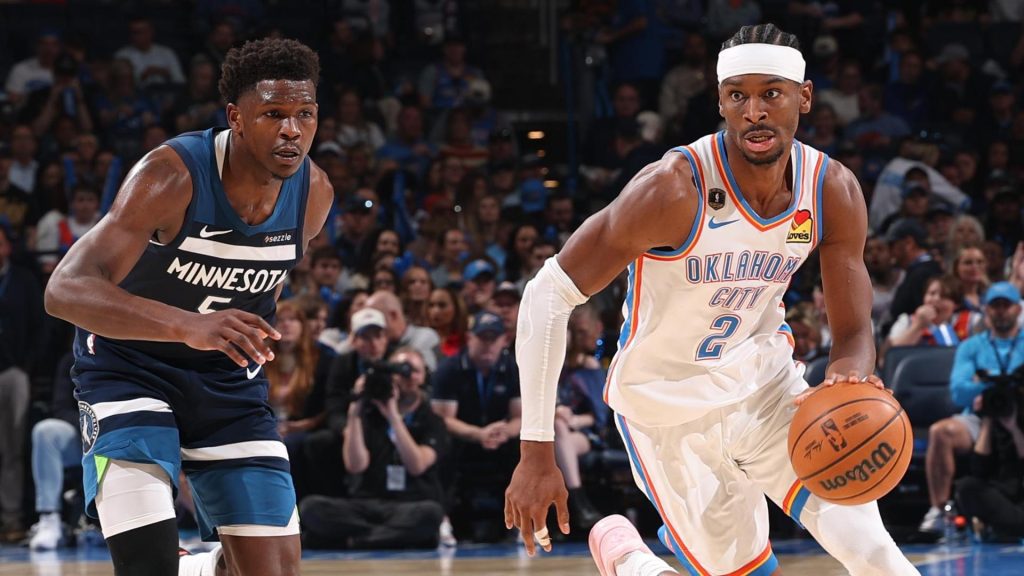
Oklahoma City Thunder vs Timberwolves Match player stats from their March 15, 2026 regular season clash tell a story of elite defense, historic bench production, and a Chet Holmgren masterclass.
Oklahoma City dominated from the third quarter onward to win 116-103 at Paycom Center. Shai Gilgeous-Alexander recorded a 20-point, 10-assist double-double. Holmgren shot 69.2% from the field and posted 21 points on just 13 shots.
Julius Randle kept Minnesota alive with 32 points, but Anthony Edwards struggled at 35.3% shooting. OKC’s bench outscored Minnesota’s 61-32 — a difference that decided the game before the fourth quarter was even half over.
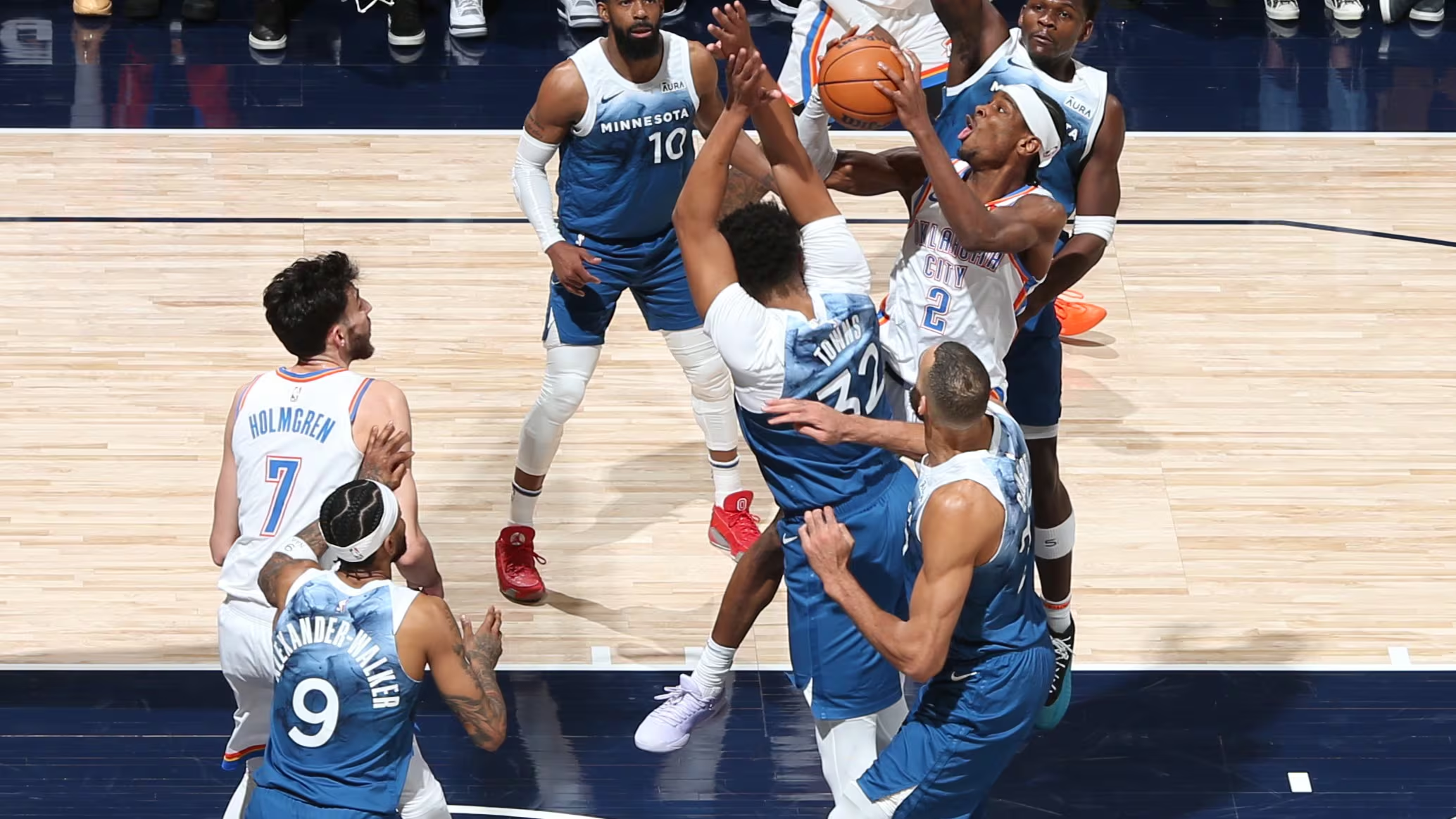
The Oklahoma City Thunder vs Timberwolves matchup on March 15, 2026 was a pivotal Western Conference regular-season game with playoff seeding implications for both franchises.
OKC entered the game as the No. 1 seed in the Western Conference. Minnesota came in sitting at No. 4, with both teams needing wins to secure positioning with roughly a month left in the regular season.
Oklahoma City pulled away in the second half to win 116-103 at Paycom Center in Oklahoma City. The Thunder’s biggest lead was 18 points, and they never trailed after the third quarter began.
| Quarter | OKC Thunder | MIN Timberwolves |
|---|---|---|
| Q1 | 23 | 22 |
| Q2 | 24 | 31 |
| Q3 | 33 | 23 |
| Q4 | 36 | 27 |
| Final | 116 | 103 |
Minnesota actually led at halftime, outscoring OKC 31-24 in the second quarter to take a slim advantage into the break. Oklahoma City flipped the game completely in the third quarter, outscoring the Wolves 33-23, and then poured it on with a dominant 36-27 fourth quarter to seal the win.
| Stat | OKC Thunder | MIN Timberwolves |
|---|---|---|
| Points | 116 | 103 |
| Field Goals Made/Att | 42/101 | 36/77 |
| FG Percentage | 41.6% | 46.8% |
| Three-Pointers Made/Att | 15/40 | 15/33 |
| Three-Point % | 37.5% | 45.5% |
| Free Throws Made/Att | 17/19 | 16/22 |
| Free Throw % | 89.5% | 72.7% |
| Offensive Rebounds | 15 | 8 |
| Defensive Rebounds | 29 | 38 |
| Total Rebounds | 51 | 58 |
| Assists | 28 | 18 |
| Steals | 16 | 5 |
| Blocks | 6 | 5 |
| Turnovers | 7 | 25 |
| Points in Paint | 46 | 32 |
| Bench Points | 61 | 32 |
| Fast Break Points | 17 | 10 |
| Second Chance Points | 20 | 7 |
| Points Off Turnovers | 29 | 6 |
| Biggest Lead | 18 | 9 |
| Offensive Rating | 114.4 | 99.3 |
| Defensive Rating | 99.3 | 114.4 |
The numbers tell a complete story. Minnesota shot the ball better from the field (46.8% vs 41.6%) and hit a higher percentage of threes (45.5% vs 37.5%), yet still lost by 13 points.
The reason is turnovers. Minnesota committed 25 turnovers to OKC’s 7. That 18-turnover differential produced 23 extra OKC possessions and directly generated 29 points off turnovers for the Thunder compared to only 6 for Minnesota.
OKC’s 15 steals — one of the most extraordinary single-game steal totals in recent NBA history — was the catalyst for the entire second-half blitz.
| Stat | Number |
|---|---|
| Points | 20 |
| Field Goals | 7/22 (31.8%) |
| Three-Pointers | 2/4 (50.0%) |
| Free Throws | 4/5 (80.0%) |
| Rebounds | 3 |
| Assists | 10 |
| Steals | 2 |
| Blocks | 1 |
| Turnovers | 1 |
| +/- | +3 |
| Assists/Turnover Ratio | 10.0 |
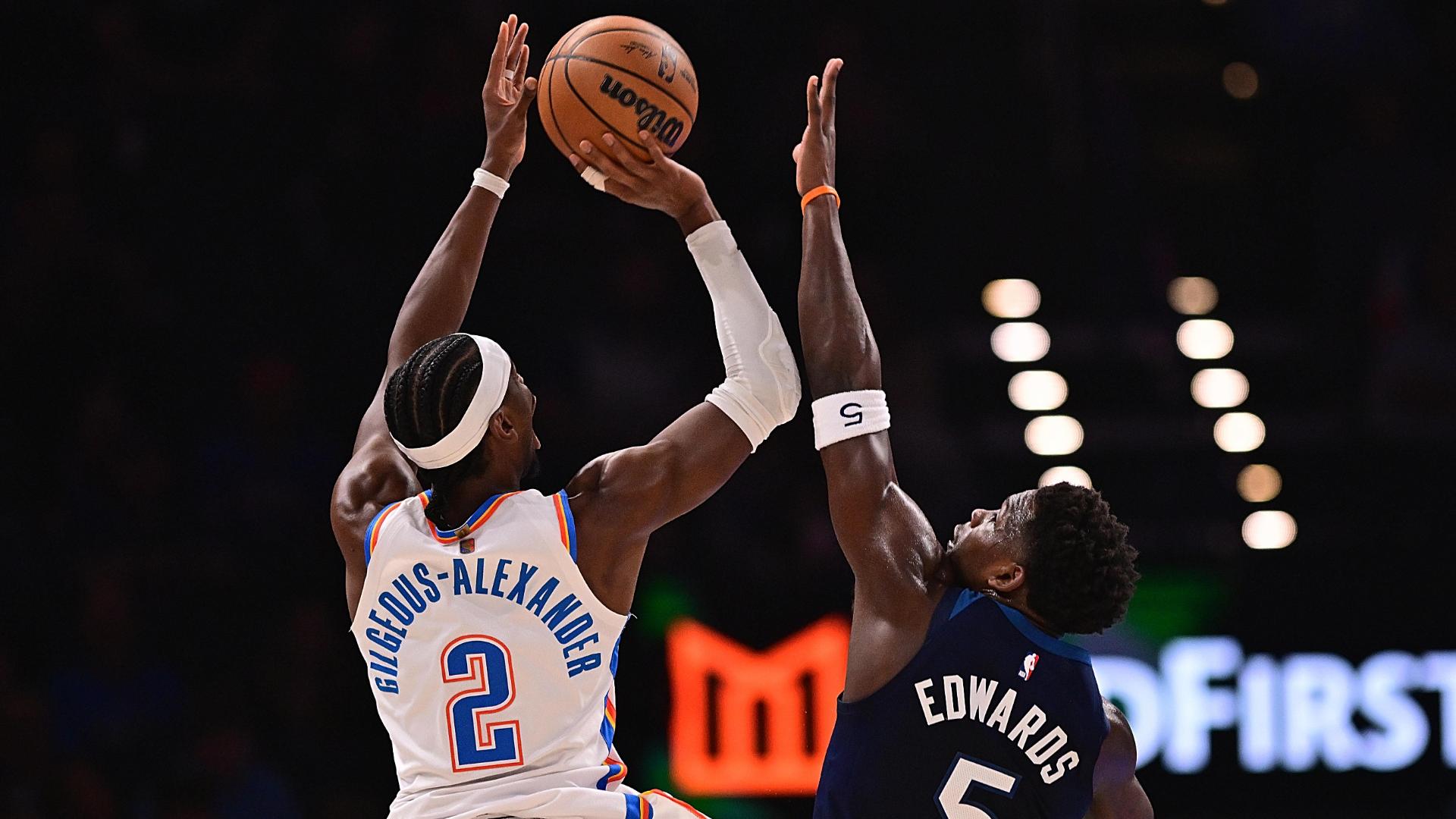
Shai Gilgeous-Alexander recorded a double-double on a night when his shooting wasn’t at its sharpest. He finished 7-of-22 from the field but orchestrated the offense brilliantly, posting a 10-assist, 1-turnover ratio that is elite by any standard.
His 10.0 assist-to-turnover ratio in this game reflects exactly why he is considered one of the two or three best point guards in the NBA. Even on off shooting nights, SGA controls the game through decision-making, court vision, and pressure defense.
He had two steals in the fourth quarter that led directly to transition points and helped OKC salt away the game.
| Stat | Number |
|---|---|
| Points | 21 |
| Field Goals | 9/13 (69.2%) |
| Three-Pointers | 1/4 (25.0%) |
| Free Throws | 2/2 (100%) |
| Rebounds | 9 (3 OFF, 6 DEF) |
| Assists | 2 |
| Steals | 3 |
| Blocks | 1 |
| Second Chance Points | 7 |
| +/- | +23 |
| True Shooting % | 75.6% |
| Efficiency Score | 36 |
Chet Holmgren was the best player on the floor in this game by efficiency metrics. He shot 69.2% from the field, posted a +23 plus-minus (highest on both teams), recorded a 75.6% true shooting percentage, and scored 7 of OKC’s 20 second-chance points.
His 9 rebounds on just 32 minutes of floor time was also exceptional. Three of those were offensive rebounds, and two came in critical third-quarter sequences that extended Thunder possessions and led directly to points.
The 36 efficiency score was the highest individual game score of the night by a wide margin.
| Stat | Number |
|---|---|
| Points | 17 |
| Field Goals | 6/10 (60.0%) |
| Three-Pointers | 1/3 (33.3%) |
| Free Throws | 4/4 (100%) |
| Rebounds | 2 |
| Steals | 3 |
| Points in Paint | 10 |
| True Shooting % | 72.3% |
| +/- | -3 |
Alex Caruso came off the bench and delivered one of his most impactful performances of the season. His 60% field goal shooting, 3 steals, and 10 points in the paint were crucial to OKC’s second-half run.
Caruso is the engine of the Thunder’s bench unit and a core piece of what makes their defense historically elite. His three steals all came in transition-triggering situations, two of which led to fast-break buckets on the other end.
| Stat | Number |
|---|---|
| Points | 15 |
| Field Goals | 5/10 (50.0%) |
| Three-Pointers | 5/9 (55.6%) |
| Steals | 1 |
| True Shooting % | 75.0% |
| +/- | +13 |
Jared McCain continued his breakout season by going 5-for-9 from three-point range, providing exactly the floor spacing that OKC’s offense demands from its bench wings.
His 55.6% three-point shooting in this game is elite. McCain has become one of the most reliable perimeter weapons in the Western Conference off the bench, and his presence forces opposing defenses to stay honest on the perimeter — which opens driving lanes for Holmgren and SGA.
| Stat | Number |
|---|---|
| Points | 4 |
| Field Goals | 1/4 (25.0%) |
| Rebounds | 6 (2 OFF, 4 DEF) |
| Assists | 7 |
| Steals | 3 |
| Blocks | 2 |
| +/- | +11 |
| Offensive Rating | 148.0 |
Cason Wallace’s stat line looks modest on the scoring column, but the impact jumps off the page everywhere else. Seven assists. Three steals. Two blocks. A +11 plus-minus.
Wallace is the connector in OKC’s system — the player who keeps the ball moving and disrupts the opposing ball-handler without giving up fouls. His 7 assists tied SGA for the team lead, making him a genuinely two-headed playmaking threat on the night.
| Stat | Number |
|---|---|
| Points | 0 |
| Field Goals | 0/3 |
| Rebounds | 12 (4 OFF, 8 DEF) |
| Assists | 3 |
| Blocks | 2 |
| +/- | +13 |
Isaiah Hartenstein didn’t score, but his 12-rebound performance — including 4 offensive boards — was quietly one of the best performances of the night in terms of positional impact.
He controlled the paint defensively and provided multiple second-chance opportunities. His +13 plus-minus further underscores how dominant OKC’s lineup was when he was on the floor.
| Player | POS | PTS | REB | AST | STL | BLK | FG% | +/- |
|---|---|---|---|---|---|---|---|---|
| Shai Gilgeous-Alexander | G | 20 | 3 | 10 | 2 | 1 | 31.8% | +3 |
| Chet Holmgren | F | 21 | 9 | 2 | 3 | 1 | 69.2% | +23 |
| Alex Caruso | G | 17 | 2 | 1 | 3 | 0 | 60.0% | -3 |
| Jared McCain | G | 15 | 0 | 0 | 1 | 0 | 50.0% | +13 |
| Cason Wallace | G | 4 | 6 | 7 | 3 | 2 | 25.0% | +11 |
| Isaiah Hartenstein | C | 0 | 12 | 3 | 0 | 2 | 0.0% | +13 |
| Jaylin Williams | F | 5 | 3 | 2 | 1 | 0 | 28.6% | -2 |
| Aaron Wiggins | G | 0 | 0 | 0 | 0 | 0 | 0.0% | -11 |
| Stat | Number |
|---|---|
| Points | 32 |
| Field Goals | 11/18 (61.1%) |
| Three-Pointers | 3/5 (60.0%) |
| Free Throws | 7/8 (87.5%) |
| Rebounds | 7 (2 OFF, 5 DEF) |
| Assists | 6 |
| Blocks | 1 |
| Turnovers | 1 |
| Second Chance Points | 5 |
| True Shooting % | 74.3% |
| Efficiency Score | 35 |
| +/- | -5 |
Julius Randle was the clear standout for Minnesota. His 32-point, 7-rebound, 6-assist performance was statistically remarkable — 61.1% from the field, 60% from three, 87.5% from the line.
Despite the team’s 25 turnovers, Randle committed only one. His assist-to-turnover ratio of 6.0 was elite. On any other night, a 32-8-6 line at that shooting efficiency would have been a winning performance.
The problem was everyone around him. While Randle was putting up a near-masterpiece, his teammates were coughing the ball up 24 more times.
| Stat | Number |
|---|---|
| Points | 19 |
| Field Goals | 6/17 (35.3%) |
| Three-Pointers | 2/5 (40.0%) |
| Free Throws | 5/10 (50.0%) |
| Rebounds | 6 |
| Assists | 5 |
| Steals | 1 |
| Turnovers | 6 |
| Personal Fouls | 5 |
| +/- | -7 |
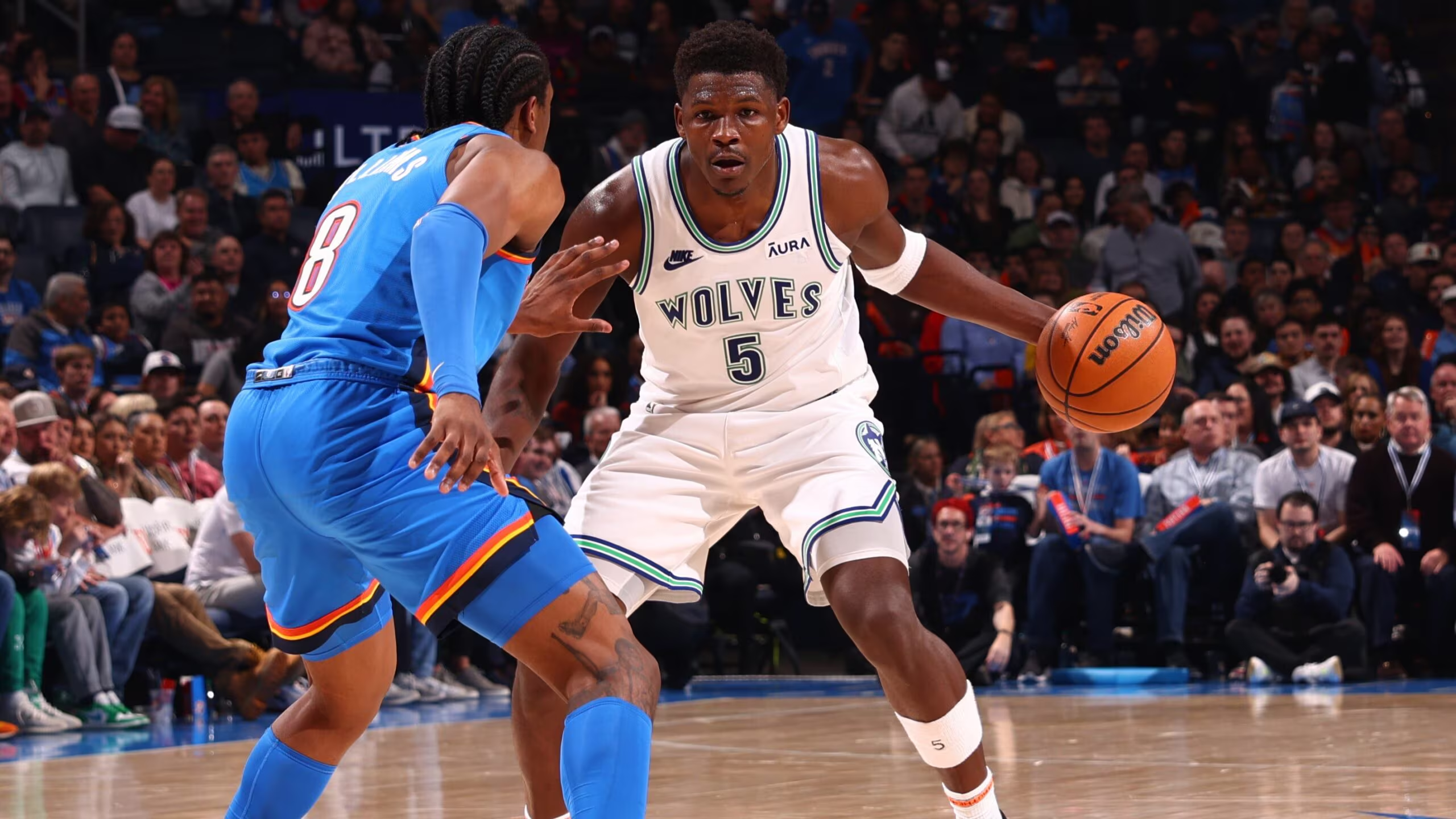
Anthony Edwards had a rough night against OKC’s aggressive defense. He finished 6-of-17 from the field and shot just 50% from the free throw line — well below his season average.
His 6 turnovers were the most on the team and a significant factor in OKC’s 29 points off turnovers total. OKC specifically targeted Edwards on the ball and dared him to create off the dribble, a strategy that worked far better than the Wolves’ coaching staff would have liked.
His 5 fouls limited his aggressiveness in the second half. Edwards was the best player on the court in terms of star power, but OKC’s system neutralized him as a primary scoring threat.
| Stat | Number |
|---|---|
| Points | 16 |
| Field Goals | 6/9 (66.7%) |
| Three-Pointers | 4/7 (57.1%) |
| Rebounds | 9 |
| Assists | 1 |
| Turnovers | 1 |
| True Shooting % | 88.9% |
| +/- | -7 |
Donte DiVincenzo was Minnesota’s second-best performer, connecting on 4 of 7 three-point attempts and pulling in 9 rebounds. His 88.9% true shooting percentage was the highest of any player in the game.
Despite shooting efficiently, DiVincenzo was not able to flip the game’s momentum. His production came in spurts rather than sustained runs, and the +/- of -7 reflects that Minnesota’s lineup still got outscored when he was on the floor.
| Stat | Number |
|---|---|
| Points | 2 |
| Field Goals | 1/4 (25.0%) |
| Rebounds | 7 (1 OFF, 6 DEF) |
| Assists | 2 |
| Steals | 1 |
| Turnovers | 4 |
| +/- | -23 |
Rudy Gobert had one of his worst individual performances of the season. His -23 plus-minus was the worst on the floor for either team, and his 4 turnovers in limited offensive involvement were damaging.
The Holmgren matchup exposed Gobert’s offensive limitations. Holmgren’s mobility and shooting range pulled Gobert away from his preferred defensive position in the paint, reducing his effectiveness on both ends.
Gobert’s 1-of-4 shooting and 4 turnovers were not isolated issues — they reflect a broader strategic problem for Minnesota when they face a perimeter-skilled center like Holmgren.
| Stat | Number |
|---|---|
| Points | 2 |
| Field Goals | 1/3 (33.3%) |
| Rebounds | 1 |
| Assists | 1 |
| Turnovers | 2 |
| Personal Fouls | 4 |
| +/- | -17 |
Jaden McDaniels had an extremely limited impact with 4 personal fouls restricting his ability to play aggressively. His -17 plus-minus was the worst on the Timberwolves and made him an anchor in the lineup whenever he was on the court.
McDaniels is typically one of Minnesota’s key defensive stoppers. His foul trouble completely disrupted the coaching staff’s defensive rotations.
| Stat | Number |
|---|---|
| Points | 6 |
| Field Goals | 1/5 (20.0%) |
| Free Throws | 4/4 (100%) |
| Rebounds | 4 |
| Steals | 2 |
| Turnovers | 4 |
| +/- | -4 |
Naz Reid contributed 4 steals in the half-court but also coughed the ball up 4 times — a wash that prevented Minnesota from capitalizing on any defensive good fortune.
His 20% field goal shooting was not enough to keep the second unit competitive against OKC’s experienced bench lineup.
| Player | POS | PTS | REB | AST | STL | BLK | FG% | TOV | +/- |
|---|---|---|---|---|---|---|---|---|---|
| Julius Randle | F | 32 | 7 | 6 | 0 | 1 | 61.1% | 1 | -5 |
| Anthony Edwards | G | 19 | 6 | 5 | 1 | 1 | 35.3% | 6 | -7 |
| Donte DiVincenzo | G | 16 | 9 | 1 | 0 | 0 | 66.7% | 1 | -7 |
| Naz Reid | C-F | 6 | 4 | 0 | 2 | 0 | 20.0% | 4 | -4 |
| Rudy Gobert | C | 2 | 7 | 2 | 1 | 0 | 25.0% | 4 | -23 |
| Jaden McDaniels | F | 2 | 1 | 1 | 0 | 0 | 33.3% | 2 | -17 |
| Kyle Anderson | F-G | 0 | 5 | 0 | 1 | 0 | 0.0% | 2 | -2 |
| Terrence Shannon Jr. | G-F | 3 | 0 | 1 | 0 | 0 | 50.0% | 0 | +3 |
The story of this game cannot be told without addressing Minnesota’s 25 turnovers in full.
Oklahoma City recorded 16 steals in this game — a number that ranks among the most in a single game by any team this entire NBA season. Sixteen steals. Against a team that entered as the No. 4 seed in the West.
Those 16 steals alone generated dozens of secondary effects beyond the immediate fast-break points. They disrupted Minnesota’s offensive rhythm, forced Anthony Edwards into inefficient shot selection, and completely eliminated the Timberwolves’ ability to push pace in the second half.
OKC converted the 25 Minnesota turnovers into 29 points. That is a 29-6 advantage in points off turnovers — a margin that alone nearly accounts for the entire 13-point final deficit.
The Thunder also collected 15 offensive rebounds versus Minnesota’s 8, producing 20 second-chance points compared to just 7 for the Wolves.
Together, those two categories — turnovers and offensive rebounding — explain almost the entire game.
| Category | OKC Bench | MIN Bench |
|---|---|---|
| Bench Points | 61 | 32 |
| Bench Players Used | 4 | 5 |
| Bench FG% | ~52% | ~35% |
Oklahoma City’s bench outscored Minnesota’s 61-32. That is a 29-point advantage from reserve players alone.
Alex Caruso (17 pts), Jared McCain (15 pts), Cason Wallace (4 pts, 7 ast, 3 stl), and Jaylin Williams (5 pts) combined for 41 bench points along with Hartenstein’s non-scoring contributions.
Minnesota’s bench managed 32 points. Naz Reid had 6, Terrence Shannon Jr. had 3, and supporting players contributed minimally.
This depth gap is why Oklahoma City is the No. 1 seed in the West. No team in the conference can match their bench output on a consistent basis.
The most consequential individual matchup of the game was Chet Holmgren versus Rudy Gobert at the center position.
Holmgren shot 9-of-13 (69.2%) and scored 21 points with 9 rebounds and a +23 plus-minus. Gobert shot 1-of-4 (25.0%) and scored 2 points with 7 rebounds and a -23 plus-minus.
The swing from that single matchup was 46 plus-minus points between the two centers. That number alone represents the game.
Holmgren’s perimeter shooting ability forces Gobert out of the paint on defense — where Gobert is dominant — and into a catch-up game at the three-point line where he is not equipped to guard. Offensively, Gobert struggled to catch clean passes against OKC’s switching defense and committed 4 turnovers.
This matchup plays out the same way every time these teams meet. OKC’s modern center construction defeats Minnesota’s traditional anchor.
Oklahoma City recorded 16 steals in this game. To put that in context:
The NBA record for steals in a single game by one team is 22, set by the Golden State Warriors in 1991. Most elite defensive performances land between 10 and 14.
A 16-steal game is genuinely remarkable. Distributed across the roster — SGA with 2, Caruso with 3, Wallace with 3, Holmgren with 3, and supporting bench players adding more — this was a total team defensive effort that reflected weeks of preparation specifically for how Minnesota handles the ball.
OKC head coach Mark Daigneault runs one of the most organized trap-and-recover defensive systems in the NBA. This game was the most complete execution of that system all season.
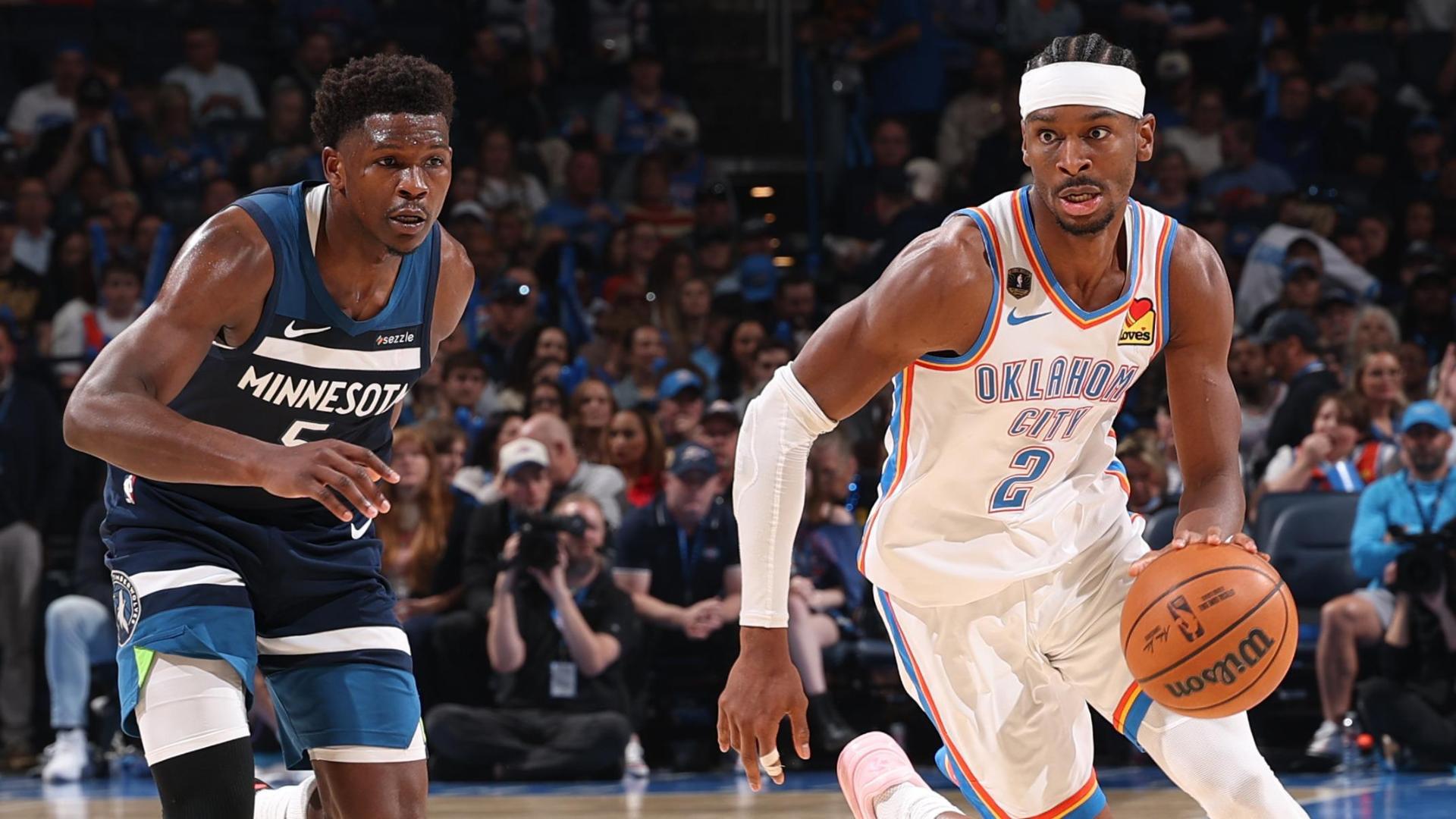
This Oklahoma City Thunder vs Timberwolves result had direct playoff seeding implications for both franchises.
With the win, OKC extended their lead as the No. 1 seed in the Western Conference. At 47-18 heading into the week of March 15, they are on pace for one of the best regular-season records in franchise history — which includes the Kevin Durant era.
For Minnesota, the loss stings beyond just the standings drop. The 25-turnover performance exposed a fragility in their ball security that opposing playoff teams will specifically gameplan to exploit.
If these two teams meet in the playoffs — which is a genuine possibility given current seedings — Rudy Gobert’s ability to guard Holmgren and Anthony Edwards’ turnover management will be the two defining storylines of the series.
| Date | Location | Winner | Score |
|---|---|---|---|
| March 15, 2026 | Paycom Center (OKC) | OKC Thunder | 116-103 |
This was the most recent meeting between the two franchises in the 2025-26 season. Both teams are likely to meet again — either in the regular season finale weeks or in the Western Conference Playoffs.
Oklahoma City’s record against Western Conference playoff teams this season is dominant. Minnesota has now lost two straight games after a five-game winning streak that had them as one of the hottest teams in the West heading into March.
The Oklahoma City Thunder defeated the Minnesota Timberwolves 116-103 at Paycom Center. OKC outscored Minnesota 33-23 in Q3 and 36-27 in Q4 to pull away after trailing at halftime.
SGA scored 20 points on 7-of-22 shooting with 10 assists, 3 rebounds, 2 steals, 1 block, and only 1 turnover, recording a double-double in the Thunder’s 116-103 victory.
Holmgren posted 21 points on 9-of-13 shooting (69.2%), 9 rebounds, 2 assists, 3 steals, and a +23 plus-minus — the highest efficiency score of any player in the game at 36.
Edwards had a tough night, scoring 19 points on 6-of-17 shooting (35.3%) with 6 rebounds, 5 assists, and 6 turnovers. His 5 fouls limited his impact in the second half.
Julius Randle was Minnesota’s clear standout with 32 points on 61.1% shooting, 7 rebounds, 6 assists, and only 1 turnover — a near-masterpiece performance in a losing effort.
Minnesota committed 25 turnovers compared to OKC’s 7. The Thunder converted those 25 turnovers into 29 points, which was the single biggest factor in determining the outcome.
Oklahoma City’s bench outscored Minnesota’s reserves 61-32. Caruso (17 pts), McCain (15 pts), and Wallace (7 ast, 3 stl) led a bench unit that dominated the entire game.
Oklahoma City recorded 16 steals in the game — an elite single-game defensive performance. Holmgren, Caruso, and Wallace each recorded 3 steals individually.
Gobert had 2 points on 1-of-4 shooting, 7 rebounds, 2 assists, and 4 turnovers with a -23 plus-minus — his worst plus-minus performance of the season in a brutal matchup with Holmgren.
Chet Holmgren led all players with a +23 plus-minus for OKC, while Rudy Gobert had the worst at -23 for Minnesota. The 46-point swing between those two centers effectively summarizes the entire game.
The Oklahoma City Thunder vs Timberwolves player stats from March 15, 2026 deliver one clear verdict: OKC is in a class of their own in the Western Conference.
Chet Holmgren’s 69.2% shooting performance and 16 combined team steals defined the night. Shai Gilgeous-Alexander ran the offense with precision, posting a 10.0 assist-to-turnover ratio.
Julius Randle gave Minnesota everything he had with 32 points on 61% shooting, but 25 team turnovers made his efforts impossible to build on.
OKC’s bench advantage of 61-32 sealed a dominant win and sent a clear message to the rest of the West: the Thunder are a different level heading into the 2026 playoffs.