
The Oklahoma City Thunder vs Minnesota Timberwolves match player stats from March 15, 2026, tell the story of a dominant Thunder performance on their home floor.
OKC defeated Minnesota 116–103 in a hard-fought NBA regular season clash at Paycom Center.
Whether you follow SGA, Ant Edwards, or Chet Holmgren, this in-depth breakdown gives you every number you need from one of the most compelling Western Conference matchups of the 2026 NBA season.
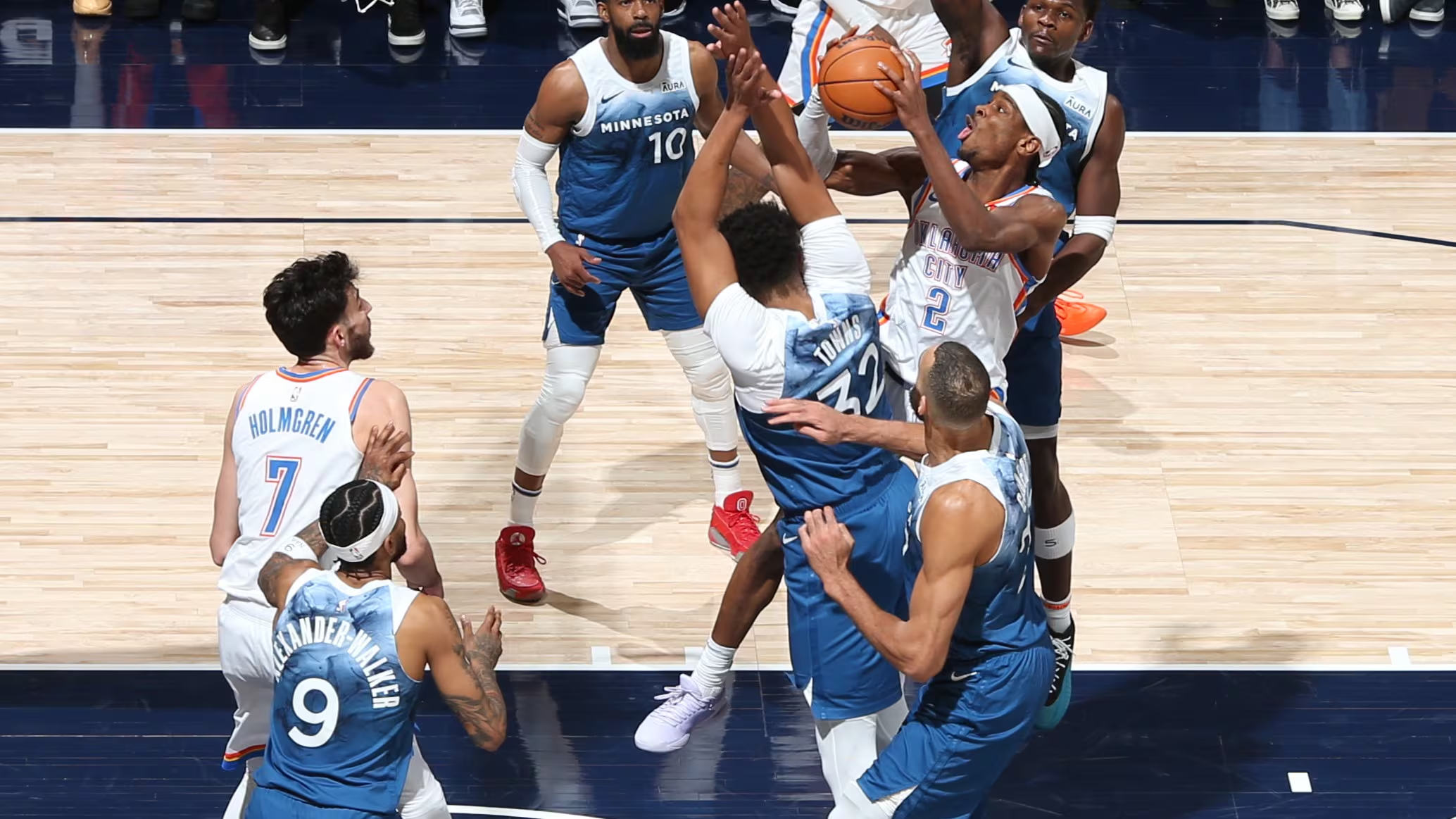
The Oklahoma City Thunder hosted the Minnesota Timberwolves on March 15, 2026, in a pivotal Western Conference regular season game at Paycom Center.
Final score: Oklahoma City Thunder 116, Minnesota Timberwolves 103. OKC won convincingly, outscoring Minnesota in three of the four quarters.
The Thunder led wire to wire after halftime, taking control with a dominant 33-point third quarter. Minnesota’s offense never found a consistent rhythm to match OKC’s pressure.
Here is a full look at how each quarter unfolded in the Thunder vs Timberwolves game.
| Quarter | Thunder (OKC) | Timberwolves (MIN) |
|---|---|---|
| Q1 | 23 | 22 |
| Q2 | 24 | 31 |
| Q3 | 33 | 23 |
| Q4 | 36 | 27 |
| Total | 116 | 103 |
Minnesota actually won the second quarter 31–24 to take a halftime lead. But OKC flipped the script with a 33–23 third quarter and then closed it out 36–27 in the fourth.
The Thunder’s biggest lead was 18 points. Minnesota’s biggest lead was just 9. OKC clearly controlled the most important stretches of the game.
A full side-by-side look at how both rosters performed at the team level across all major statistical categories.
| Stat | Thunder (OKC) | Timberwolves (MIN) |
|---|---|---|
| Field Goals Made | 42 | 36 |
| Field Goals Attempted | 101 | 77 |
| FG% | 41.6% | 46.8% |
| 3-Pointers Made | 15 | 15 |
| 3-Pointers Attempted | 40 | 33 |
| 3P% | 37.5% | 45.5% |
| Free Throws Made | 17 | 16 |
| Free Throws Attempted | 19 | 22 |
| FT% | 89.5% | 72.7% |
| Effective FG% | 49.0% | 56.5% |
| True Shooting% | 53.0% | 59.4% |
Minnesota actually shot the ball better from the field and from three. But OKC had far more attempts — 101 FGAs compared to Minnesota’s 77. The Thunder’s volume and free-throw efficiency (89.5%) offset the shooting percentage gap.
| Stat | Thunder (OKC) | Timberwolves (MIN) |
|---|---|---|
| Total Rebounds | 51 | 58 |
| Offensive Rebounds | 15 | 8 |
| Defensive Rebounds | 29 | 38 |
| Assists | 28 | 18 |
| Steals | 16 | 5 |
| Blocks | 6 | 5 |
| Turnovers | 7 | 25 |
| Assists/Turnover Ratio | 4.0 | 0.82 |
| Points Off Turnovers | 29 | 6 |
| Points in Paint | 46 | 32 |
| Fast Break Points | 17 | 10 |
| Second Chance Points | 20 | 7 |
| Bench Points | 61 | 32 |
The turnover differential was the defining statistical story. Minnesota turned the ball over 25 times compared to OKC’s 7. The Thunder converted those 25 turnovers into 29 points — a 23-point swing in that category alone.
OKC’s bench outscored Minnesota’s bench 61–32, providing an enormous advantage in the rotation battle.
| Stat | Thunder (OKC) | Timberwolves (MIN) |
|---|---|---|
| Offensive Rating | 114.4 | 99.3 |
| Defensive Rating | 99.3 | 114.4 |
| Possessions | 101.4 | 103.7 |
| Points Per Possession | 1.14 | 0.99 |
| Efficiency Score | 140 | 99 |
| Biggest Lead | 18 | 9 |
OKC’s offensive rating of 114.4 versus their defensive rating of 99.3 reflects a team firing on both ends. Minnesota’s numbers were flipped — struggling offensively at 99.3 per 100 possessions.
| Player | Pos | MIN | PTS | REB | AST | STL | BLK | TO | FG | 3P | FT | +/- |
|---|---|---|---|---|---|---|---|---|---|---|---|---|
| Shai Gilgeous-Alexander | G | — | 20 | 3 | 10 | 2 | 1 | 1 | 7/22 | 2/4 | 4/5 | +3 |
| Chet Holmgren | F | — | 21 | 9 | 2 | 3 | 1 | 0 | 9/13 | 1/4 | 2/2 | +23 |
| Jared McCain | G | — | 15 | 0 | 0 | 1 | 0 | 0 | 5/10 | 5/9 | 0/0 | +13 |
| Alex Caruso | G | — | 17 | 2 | 1 | 3 | 0 | 0 | 6/10 | 1/3 | 4/4 | -3 |
| Cason Wallace | G | — | 4 | 6 | 7 | 3 | 2 | 0 | 1/4 | 0/0 | 2/2 | +11 |
| Isaiah Hartenstein | C | — | 0 | 12 | 3 | 0 | 2 | 1 | 0/3 | 0/0 | 0/0 | +13 |
| Jaylin Williams | F | — | 5 | 3 | 2 | 1 | 0 | 2 | 2/7 | 1/5 | 0/0 | -2 |
| Aaron Wiggins | G | — | 0 | 0 | 0 | 0 | 0 | 0 | 0/1 | 0/1 | 0/0 | -11 |
Chet Holmgren was OKC’s most efficient performer, shooting 69.2% from the field (9-of-13) for 21 points with 9 rebounds, 3 steals, and a stunning +23 plus/minus. His true shooting percentage was 75.6%.
Shai Gilgeous-Alexander recorded a double-double with 20 points and 10 assists while managing just 1 turnover — a 10:1 assist-to-turnover ratio that shows his elite playmaking control.
Jared McCain caught fire from three, going 5-of-9 from beyond the arc for 15 points. He finished with a 75.0% true shooting percentage and a +13 plus/minus.
Alex Caruso was everywhere defensively with 3 steals, shooting 60% from the field (6-of-10) for 17 points. He made all 4 of his free throws.
Cason Wallace did not score much but was instrumental with 7 assists, 6 rebounds, 3 steals, and 2 blocks while committing zero turnovers. His +11 reflects his real impact.
Isaiah Hartenstein grabbed 12 rebounds and dished 3 assists without scoring — a pure hustle performance that gave OKC an edge on the glass with a +13 plus/minus.
| Player | Pos | MIN | PTS | REB | AST | STL | BLK | TO | FG | 3P | FT | +/- |
|---|---|---|---|---|---|---|---|---|---|---|---|---|
| Julius Randle | F | — | 32 | 7 | 6 | 0 | 1 | 1 | 11/18 | 3/5 | 7/8 | -5 |
| Anthony Edwards | G | — | 19 | 6 | 5 | 1 | 1 | 6 | 6/17 | 2/5 | 5/10 | -7 |
| Donte DiVincenzo | G | — | 16 | 9 | 1 | 0 | 0 | 1 | 6/9 | 4/7 | 0/0 | -7 |
| Rudy Gobert | C | — | 2 | 7 | 2 | 1 | 0 | 4 | 1/4 | 0/0 | 0/0 | -23 |
| Jaden McDaniels | F | — | 2 | 1 | 1 | 0 | 0 | 2 | 1/3 | 0/2 | 0/0 | -17 |
| Naz Reid | C-F | — | 6 | 4 | 0 | 2 | 0 | 4 | 1/5 | 0/3 | 4/4 | -4 |
| Kyle Anderson | F-G | — | 0 | 5 | 0 | 1 | 0 | 2 | 0/1 | 0/0 | 0/0 | -2 |
| Terrence Shannon Jr. | G-F | — | 3 | 0 | 1 | 0 | 0 | 0 | 1/2 | 1/1 | 0/0 | +3 |
| Joe Ingles | F-G | — | 0 | 1 | 0 | 0 | 0 | 0 | 0/0 | 0/0 | 0/0 | +3 |
| Jaylen Clark | G | — | 0 | 1 | 0 | 0 | 0 | 0 | 0/1 | 0/1 | 0/0 | +3 |
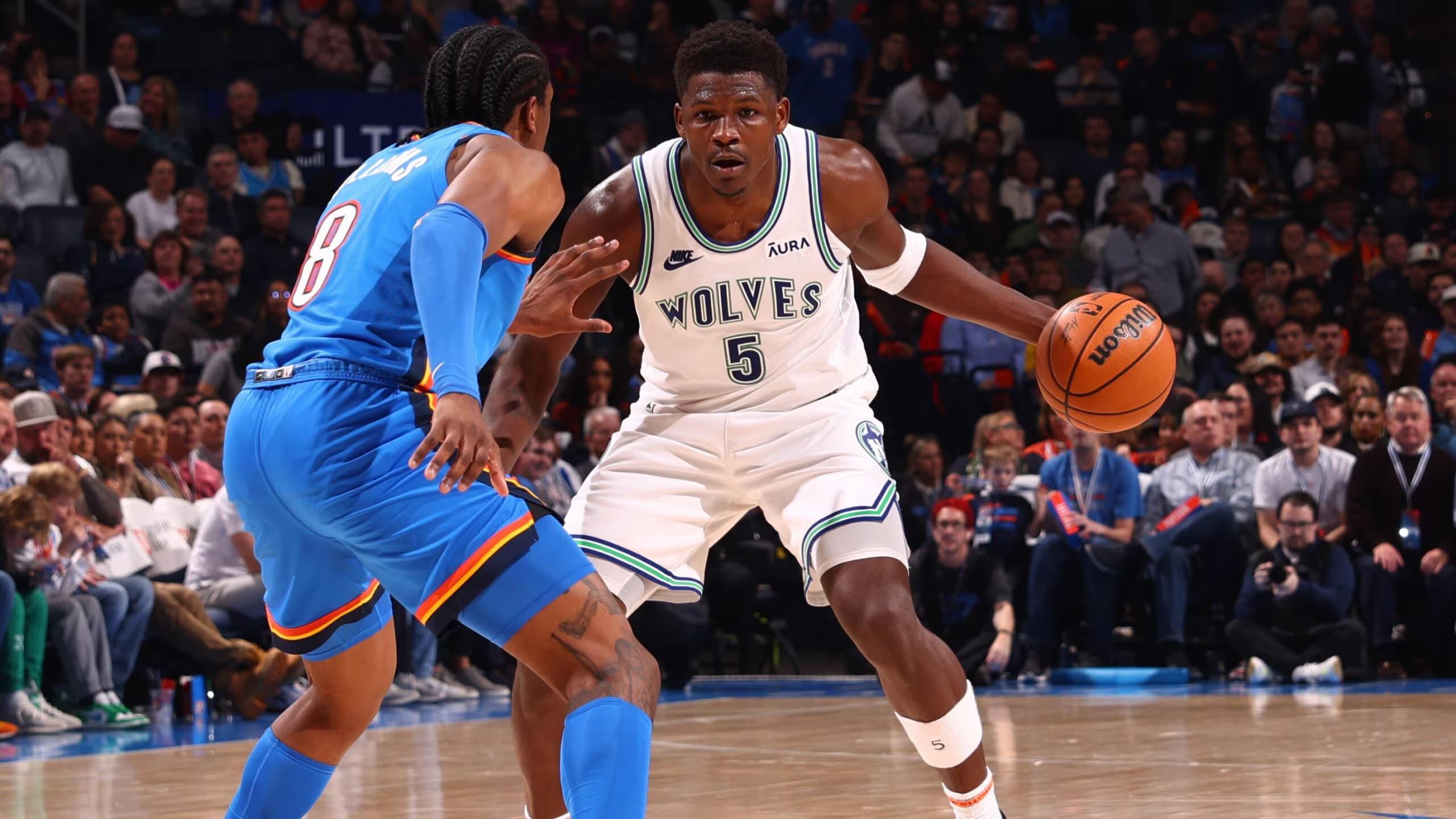
Julius Randle was the lone Timberwolves standout, delivering 32 points on 61.1% shooting (11-of-18) with 7 rebounds and 6 assists. His 74.3% true shooting was exceptional. But his team’s 25-turnover performance neutralized his individual brilliance.
Anthony Edwards scored 19 but struggled with efficiency — 6-of-17 from the field and 5-of-10 from the free-throw line. He also committed 6 turnovers, his worst turnover game of the stretch run. His -7 plus/minus reflects a difficult night.
Donte DiVincenzo had a quality shooting performance — 6-of-9 overall including 4-of-7 from three for 16 points with 9 rebounds. One of the few Wolves who made his shots consistently.
Rudy Gobert had a frustrating evening. He scored just 2 points on 1-of-4 shooting, committed 4 turnovers, and finished with a -23 plus/minus — the worst mark on either team.
Jaden McDaniels was limited to just 2 points on 1-of-3 shooting, picking up 4 personal fouls in limited minutes. A very quiet and costly outing for the wing.
Chet Holmgren had a near-perfect shooting night. Going 9-of-13 from the field with 3 steals, 1 block, and zero turnovers made him OKC’s most impactful two-way player.
SGA’s playmaking was on full display. His 10 assists against just 1 turnover showed why he controls games without needing to score 30. His 10.0 assist-to-turnover ratio was elite.
OKC’s bench was a revelation. Scoring 61 bench points is exceptional at any level of play. McCain, Caruso, and Wallace all contributed meaningfully off the pines.
Minnesota’s turnover problem was the game-changer. Twenty-five turnovers is a catastrophic total. OKC scored 29 points directly off those giveaways.
Rudy Gobert’s -23 rating tells the story of how much the Thunder targeted him on both ends. He was in foul trouble and offered little offense, a rare off-night for the three-time DPOY.
Ant Edwards’ FT shooting hurt Minnesota. Going 5-of-10 from the line with a chance to extend possessions and score cheap buckets is a missed opportunity in a 13-point loss.
Both teams hit 15 three-pointers, but the efficiency story is more nuanced beneath that surface stat.
| Shooting Zone | OKC Made/Att | OKC% | MIN Made/Att | MIN% |
|---|---|---|---|---|
| At Rim | 18/32 | 56.3% | 9/17 | 52.9% |
| Mid-Range | 4/13 | 30.8% | 5/12 | 41.7% |
| 3-Point | 15/40 | 37.5% | 15/33 | 45.5% |
| Free Throws | 17/19 | 89.5% | 16/22 | 72.7% |
OKC’s dominance at the rim — 18 makes on 32 attempts — reflects their interior pressure and offensive rebounding (15 ORBs). They turned second chances into 20 second-chance points.
Minnesota was more efficient per shot, but OKC generated far more shot attempts, creating a volume advantage that overcome the efficiency gap.
Plus/minus reveals which players were on the floor during the game’s most decisive moments.
| Player | Plus/Minus |
|---|---|
| Chet Holmgren | +23 |
| Shai Gilgeous-Alexander | +3 |
| Cason Wallace | +11 |
| Jared McCain | +13 |
| Isaiah Hartenstein | +13 |
| Alex Caruso | -3 |
| Jaylin Williams | -2 |
| Aaron Wiggins | -11 |
Holmgren’s +23 stands as one of the highest single-game plus/minus numbers OKC has produced in this stretch of the season. Wallace and Hartenstein at +11 and +13 respectively show the deep rotation impact.
| Player | Plus/Minus |
|---|---|
| Julius Randle | -5 |
| Anthony Edwards | -7 |
| Donte DiVincenzo | -7 |
| Rudy Gobert | -23 |
| Jaden McDaniels | -17 |
| Naz Reid | -4 |
| Kyle Anderson | -2 |
Every Minnesota starter and key rotation player posted a negative plus/minus. Only Terrence Shannon Jr., Joe Ingles, and Jaylen Clark — each playing minimal minutes — posted +3. The team-wide negative differential illustrates how OKC dominated across all lineup combinations.
The 25-turnover performance by Minnesota was the clearest reason they lost this game.
| Turnover Category | OKC | MIN |
|---|---|---|
| Player Turnovers | 7 | 22 |
| Team Turnovers | 0 | 3 |
| Total Turnovers | 7 | 25 |
| Points Off Turnovers | 29 | 6 |
| Assists/TO Ratio | 4.0 | 0.82 |
Anthony Edwards led Minnesota with 6 turnovers. Rudy Gobert and Naz Reid each had 4. The Timberwolves simply could not protect the ball against OKC’s pressure.
OKC’s 16 steals — more than double Minnesota’s 5 — directly fueled their transition offense and fast break points total of 17.
OKC’s interior presence was one of the most significant advantages in the game.
The Thunder had 15 offensive rebounds compared to Minnesota’s 8. Those extra possessions produced 20 second-chance points versus just 7 for the Wolves.
In the paint, OKC outscored Minnesota 46–32. Holmgren led that charge with 14 paint points, followed by Caruso with 10 paint points on drives.
The combination of paint scoring, second-chance points, and fast break points gave OKC 57 “extra” points from those three categories alone compared to Minnesota’s 27. That 30-point differential in opportunistic scoring was insurmountable.
The bench battle was one of the biggest separators in this game.
| Bench Stats | OKC | MIN |
|---|---|---|
| Bench Points | 61 | 32 |
| Bench Advantage | +29 | — |
OKC’s reserves outscored Minnesota’s by 29 points. Jared McCain (15 points, 5-of-9 from three), Alex Caruso (17 points, 60% FG), and Cason Wallace (7 assists, 0 turnovers) were the key contributors from the second unit.
Minnesota’s bench produced just 32 points, with Naz Reid (6 pts), Kyle Anderson (0 pts), and Terrence Shannon Jr. (3 pts) offering very little against OKC’s defensive intensity.
| Category | Thunder (OKC) | Timberwolves (MIN) | Winner |
|---|---|---|---|
| Points | 116 | 103 | OKC |
| FG% | 41.6% | 46.8% | MIN |
| 3P% | 37.5% | 45.5% | MIN |
| FT% | 89.5% | 72.7% | OKC |
| Rebounds | 51 | 58 | MIN |
| Assists | 28 | 18 | OKC |
| Steals | 16 | 5 | OKC |
| Turnovers | 7 | 25 | OKC |
| Bench Points | 61 | 32 | OKC |
| Points in Paint | 46 | 32 | OKC |
| Fast Break Pts | 17 | 10 | OKC |
| 2nd Chance Pts | 20 | 7 | OKC |
| Pts Off TOs | 29 | 6 | OKC |
| Offensive Rating | 114.4 | 99.3 | OKC |
| Defensive Rating | 99.3 | 114.4 | OKC |
OKC won 11 of 15 major statistical categories. Minnesota’s advantages — FG%, 3P%, and total rebounds — were not enough to overcome the Thunder’s dominance in turnover margin, bench production, and opportunistic scoring.
This win continued OKC’s push for the top seed in the Western Conference. With a roster built around SGA’s playmaking, Holmgren’s two-way versatility, and one of the best defensive identities in the NBA, the Thunder are a legitimate championship contender.
Their 16-steal performance in this game reflects a team-wide defensive philosophy. Pressure defense, active hands, and transition offense are the hallmarks of head coach Mark Daigneault’s system.
The Thunder’s 61 bench points in a single game shows exceptional roster depth — something that becomes even more important in a seven-game playoff series.
The 25-turnover game is an outlier, but it exposed a real weakness. Minnesota’s assist-to-turnover ratio of 0.82 in this game is far below their usual standards.
Anthony Edwards’ 6 turnovers and 50% free throw shooting in a loss of this magnitude will be a storyline heading into the playoff push. Minnesota needs Ant to be more disciplined with the ball when OKC applies pressure.
Rudy Gobert’s -23 plus/minus is not a reflection of his overall season, but the Thunder exposed how much they can target the paint when he is not at his best.
Julius Randle’s 32-point game shows Minnesota has the firepower. The Wolves simply need to protect the ball to match OKC’s execution.
This game was the second matchup between these two teams in the 2025-26 season. Earlier in the season (January 30, 2026), the Timberwolves beat OKC 123–111 at Target Center in Minneapolis.
| Date | Location | Winner | Score |
|---|---|---|---|
| Jan 30, 2026 | Minneapolis (MIN home) | Timberwolves | MIN 123 – OKC 111 |
| Mar 15, 2026 | Oklahoma City (OKC home) | Thunder | OKC 116 – MIN 103 |
The split season series means both teams have proven they can beat each other. A potential playoff matchup between these two Western Conference powers would be one of the most compelling first or second-round series of the 2026 NBA Playoffs.
The Oklahoma City Thunder defeated the Minnesota Timberwolves 116–103 at Paycom Center in Oklahoma City on March 15, 2026.
Chet Holmgren led OKC with 21 points, 9 rebounds, and 3 steals on 69.2% shooting, posting the game’s best plus/minus of +23. Julius Randle’s 32 points led all scorers overall.
SGA scored 20 points and added 10 assists with just 1 turnover, recording a double-double and a 10:1 assist-to-turnover ratio in the Thunder’s win.
Minnesota committed 25 total turnovers (22 player, 3 team) compared to OKC’s 7. The Thunder converted those turnovers into 29 points, the decisive swing of the game.
Ant Edwards scored 19 points but shot just 6-of-17 from the field, committed 6 turnovers, and shot 50% from the free-throw line, finishing with a -7 plus/minus in the loss.
The Thunder bench scored 61 points compared to Minnesota’s 32, a massive 29-point bench advantage that played a major role in the Thunder’s 13-point victory.
Gobert struggled with just 2 points on 1-of-4 shooting, 7 rebounds, and 4 turnovers. He finished with the game’s worst plus/minus at -23 in a difficult performance.
The Thunder recorded 16 steals as a team compared to Minnesota’s 5, reflecting OKC’s elite pressure defense and the Timberwolves’ ball security issues throughout the game.
Julius Randle led Minnesota with 32 points on 61.1% shooting (11-of-18), adding 7 rebounds and 6 assists. It was one of the best individual performances of the game despite the team loss.
The season series is tied 1–1. Minnesota won the first meeting 123–111 in Minneapolis on January 30. Oklahoma City won the second 116–103 at home on March 15, 2026.
The Oklahoma City Thunder vs Minnesota Timberwolves match player stats 2026 reveal a Thunder team operating at an elite level on both ends of the floor.
OKC’s 16 steals, 29 points off turnovers, 61 bench points, and dominant interior scoring were too much for Minnesota to overcome despite Randle’s 32-point masterclass.
Shai Gilgeous-Alexander orchestrated with precision, Chet Holmgren was unstoppable in the paint, and the bench delivered 61 points to seal the win convincingly.
With a tied season series and the playoffs approaching, a potential rematch between these two Western Conference heavyweights in the 2026 NBA Playoffs would be one of the most anticipated series of the postseason.