
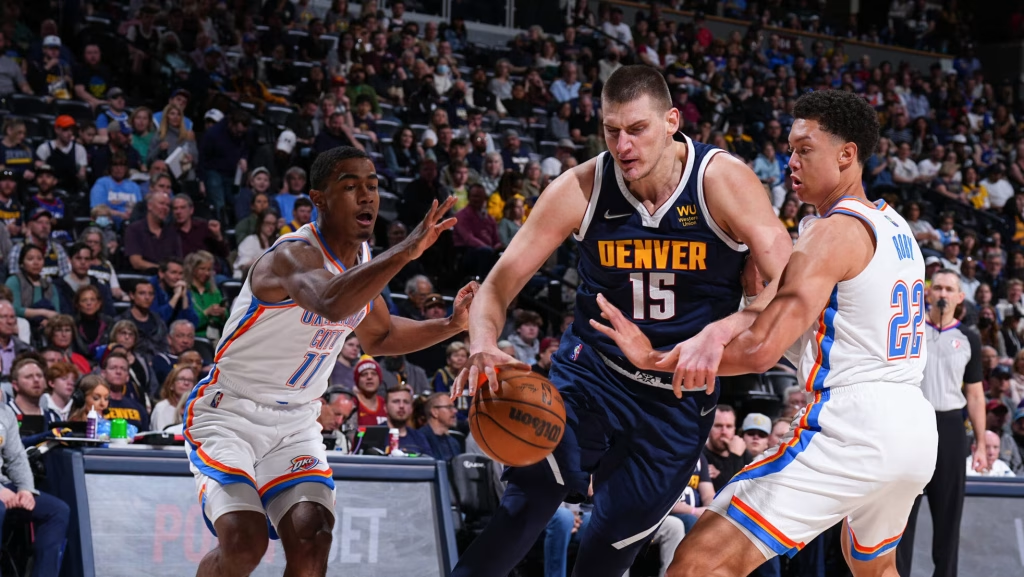
The OKC Thunder vs Denver Nuggets match player stats have been must-watch content all 2025–26 NBA season. These two Western Conference heavyweights have clashed three electrifying times — with Oklahoma City winning all three and cementing their status as the West’s dominant force.
From Shai Gilgeous-Alexander’s elite scoring nights to Nikola Jokic’s relentless triple-double pursuit, each matchup delivered elite individual performances and razor-thin finishes.
With OKC holding the NBA’s best record and Denver fighting for playoff seeding, these box scores carry massive weight in every possible direction.
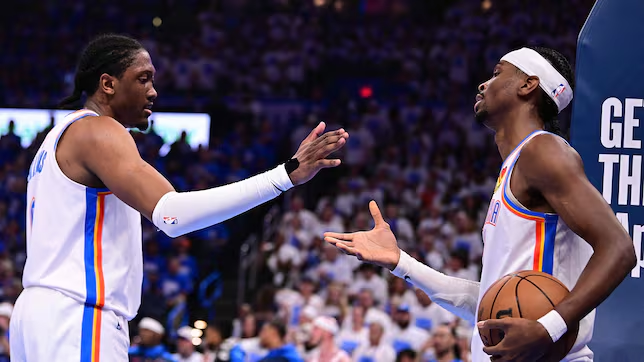
The OKC Thunder vs Denver Nuggets series in 2025–26 produced three of the most entertaining games in the Western Conference. Oklahoma City won all three regular-season matchups, with each game decided by fewer than 10 points — except the final one, which required a fourth-quarter rally to secure.
The series showcased the defining contrast of the West: OKC’s youth-fueled depth and defensive intensity versus Denver’s two-superstar engine of Jokic and Murray.
2025–26 Series Results:
| Game | Date | Location | Winner | Score |
|---|---|---|---|---|
| Game 1 | Feb 1, 2026 | Denver (Ball Arena) | OKC Thunder | 121–111 |
| Game 2 | Feb 27, 2026 | Oklahoma City (Paycom Center) | OKC Thunder | 127–121 |
| Game 3 | Mar 9, 2026 | Oklahoma City (Paycom Center) | OKC Thunder | 129–126 |
OKC outscored Denver 377–358 across the three games — an average winning margin of just 6.3 points. Every game was competitive, every quarter was contested, and every individual performance mattered.
OKC went into Ball Arena and pulled off a dominant road win, leading by as many as 18 points in the second half. SGA and Cason Wallace led the offensive charge while OKC’s defense generated 12 steals — a staggering number that shredded Denver’s offense.
Denver could never find a sustained run to flip the game. The Nuggets trailed after Q1, fell deeper in Q2 and Q3, then rallied slightly in Q4 — but OKC had already built an insurmountable cushion.
Game 1 — Scoring by Quarter:
| Quarter | OKC Thunder | DEN Nuggets |
|---|---|---|
| Q1 | 32 | 26 |
| Q2 | 30 | 29 |
| Q3 | 39 | 30 |
| Q4 | 20 | 26 |
| Final | 121 | 111 |
OKC forced 18 turnovers from Denver and converted them into 19 points. The Thunder shot 47.1% from the field and went 19-of-48 from three (39.6%). Denver shot better from deep (45.7%) but the turnovers killed them.
OKC’s bench outscored Denver’s bench 36–41 in this one — a slight advantage for Denver off the bench — but the starting unit’s defense made up the difference entirely.
Game 1 Team Stats:
| Stat | OKC Thunder | DEN Nuggets |
|---|---|---|
| Final Score | 121 | 111 |
| FG% | 47.1% | 49.4% |
| 3P% | 39.6% | 45.7% |
| FT% | 81.5% | 70.8% |
| Total Rebounds | 46 | 52 |
| Assists | 23 | 29 |
| Steals | 12 | 9 |
| Turnovers | 13 | 18 |
| Points Off Turnovers | 19 | 8 |
| Points in Paint | 30 | 36 |
| Bench Points | 36 | 41 |
| Biggest Lead | 18 | 0 |
SGA was unstoppable in Denver. He shot 68.8% from the field — 11-of-16 — and drained 11 free throws while distributing 13 assists against just four turnovers. His true shooting percentage of 78.3% was elite.
His +22 plus/minus was the best mark among all players in the game. SGA was everywhere: scoring in the paint, drawing fouls, and orchestrating OKC’s offense with the confidence of an MVP frontrunner.
SGA Game 1 Line: 34 pts, 13 ast, 5 reb, 2 stl, 1 blk | 11/16 FG, 11/13 FT | +22
Wallace was the breakout star of Game 1. He torched Denver from beyond the arc, going 7-for-11 from three (63.6%) and finishing with 27 points in a reserve role. His true shooting percentage was a scorching 88.1%.
His +14 plus/minus confirmed what the box score showed — Wallace punished every defensive lapse Denver gave him and provided OKC with a devastating secondary punch.
Wallace Game 1 Line: 27 pts, 6 reb | 9/14 FG, 7/11 3P | +14
Watson was the Nuggets’ best player in Game 1. He shot 64.7% from the field and 71.4% from three (5-of-7) on his way to a career-level performance. Despite the loss, Watson proved he’s a legitimate offensive weapon.
His 77.3% true shooting in a losing effort showed Denver has real scoring depth even beyond Jokic and Murray. Watson gave Denver everything they could ask for — his teammates simply couldn’t match his efficiency.
Watson Game 1 Line: 29 pts, 5 reb, 3 ast | 11/17 FG, 5/7 3P | –9
Jokic was below his usual standard in Game 1, held to just 16 points on 6-of-9 shooting. His six turnovers were a damaging stat — directly contributing to OKC’s scoring advantage from turnovers.
The Thunder’s length and defensive activity disrupted Jokic’s passing lanes throughout the game. He still posted solid numbers, but his impact was blunted by an unusually high turnover total.
Jokic Game 1 Line: 16 pts, 7 reb, 8 ast, 6 TO | 6/9 FG | –7
Murray’s shooting was ice cold — 4-of-16 from the field and just 12.5% from three. He made up for it with 12 assists (a double-double), but his inefficiency from the floor put enormous pressure on Jokic and the Nuggets’ supporting cast.
When both Jokic and Murray underperform on the same night, Denver has no path to victory against a team as deep as OKC.
Murray Game 1 Line: 12 pts, 5 reb, 12 ast | 4/16 FG, 1/8 3P | –13
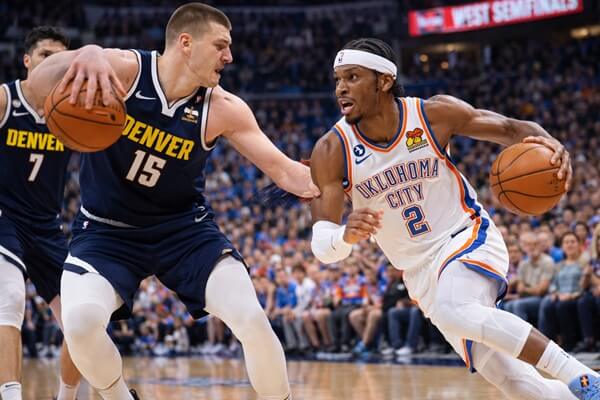
The rematch at Paycom Center followed a similar pattern — OKC led wire-to-wire before Denver made a run in the second half. The Nuggets actually led by as many as 16 points in one stretch of the second half, making this OKC’s most dramatic comeback of the three matchups.
OKC’s bench delivered big in Game 2, contributing 49 points to Denver’s 29. The bench advantage was the primary difference in a game where starters traded buckets all night.
Game 2 — Scoring by Quarter:
| Quarter | OKC Thunder | DEN Nuggets |
|---|---|---|
| Q1 | 20 | 14 |
| Q2 | 31 | 26 |
| Q3 | 27 | 24 |
| Q4 | 30 | 24 (OT-style run) |
| Final | 127 | 121 |
Note: This game was won in regulation. Denver’s biggest lead was 16 points but OKC outscored them 8–0 on their biggest unanswered run to seal it.
OKC’s turnover-to-points conversion was the defining story of Game 2. The Thunder generated 21 points off Denver’s 18 turnovers while their 14 steals — an extraordinary team total — kept disrupting Denver’s entire offensive flow.
Chet Holmgren’s 21 rebounds gave OKC total dominance on the glass. OKC’s bench outscored Denver’s bench by 20 points (49–29), a margin that proved decisive.
Game 2 Team Stats:
| Stat | OKC Thunder | DEN Nuggets |
|---|---|---|
| Final Score | 127 | 121 |
| FG% | 46.5% | 41.7% |
| 3P% | 34.3% | 37.5% |
| FT% | 85.2% | 77.3% |
| Total Rebounds | 63 | 59 |
| Assists | 29 | 27 |
| Steals | 14 | 10 |
| Turnovers | 12 | 18 |
| Points Off Turnovers | 21 | 10 |
| Bench Points | 49 | 29 |
| Points in Paint | 58 | 46 |
| Biggest Lead | 9 | 16 |
SGA led all scorers in Game 2 with 36 points. He was relentless at the free-throw line, going 12-of-13 (92.3%), and attacked the paint repeatedly. His +16 plus/minus matched his impact on both ends.
SGA’s 9 assists against just one turnover showed his elite decision-making under pressure. Even when his shot wasn’t perfect (41.4% FG), he found ways to score through free throws and mid-range efficiency.
SGA Game 2 Line: 36 pts, 9 ast, 3 reb, 2 stl, 2 blk | 12/29 FG, 12/13 FT | +16
Holmgren was a double-double monster in Game 2. His 21 rebounds — particularly 19 on the defensive end — controlled the glass completely. Three blocks and three assists rounded out a genuinely dominant two-way night.
His defensive rating of 92.9 was the best among all key rotation players in the game. Holmgren’s rebounding prowess (45.3% defensive rebound rate) left Denver with almost no second-chance opportunities.
Holmgren Game 2 Line: 15 pts, 21 reb, 3 ast, 1 stl, 3 blk | 5/8 FG | +6
Jokic produced his best performance of the three-game series in Game 2. He recorded a triple-double — 23 points, 17 rebounds, 14 assists — and was the primary reason Denver stayed competitive. His +15 plus/minus was the best on his team.
Despite the loss, Jokic’s triple-double was a masterclass in playmaking. His 37.1% defensive rebound rate was elite. He simply couldn’t get enough from his supporting cast when OKC’s bench kept delivering.
Jokic Game 2 Line: 23 pts, 17 reb, 14 ast, 1 stl | 9/25 FG, 3/5 FT | +15 (Triple-Double)
Braun was Denver’s second-best player in Game 2 alongside Jokic. He scored 23 points on 44.4% shooting, pulled down 8 rebounds, and was a +12 on the night — one of the best marks on either team.
His 56.9% true shooting and ability to create off the dribble gave Denver a real secondary option when Jokic wasn’t scoring. Braun’s emergence as a legitimate offensive contributor is a major development for Denver going forward.
Braun Game 2 Line: 23 pts, 8 reb, 2 ast | 8/18 FG, 3/10 3P | +12
Williams provided excellent bench production in Game 2. He shot 57.1% from the field and hit two threes, contributing to OKC’s dominant 49-point bench output. His +17 was the second-best mark on OKC’s entire roster.
Williams has been one of the most pleasant surprises in OKC’s rotation. In a game decided by bench depth, his energy and efficiency were critical to closing out Denver.
Williams Game 2 Line: 12 pts, 5 reb, 3 ast | 4/7 FG, 2/4 3P | +17
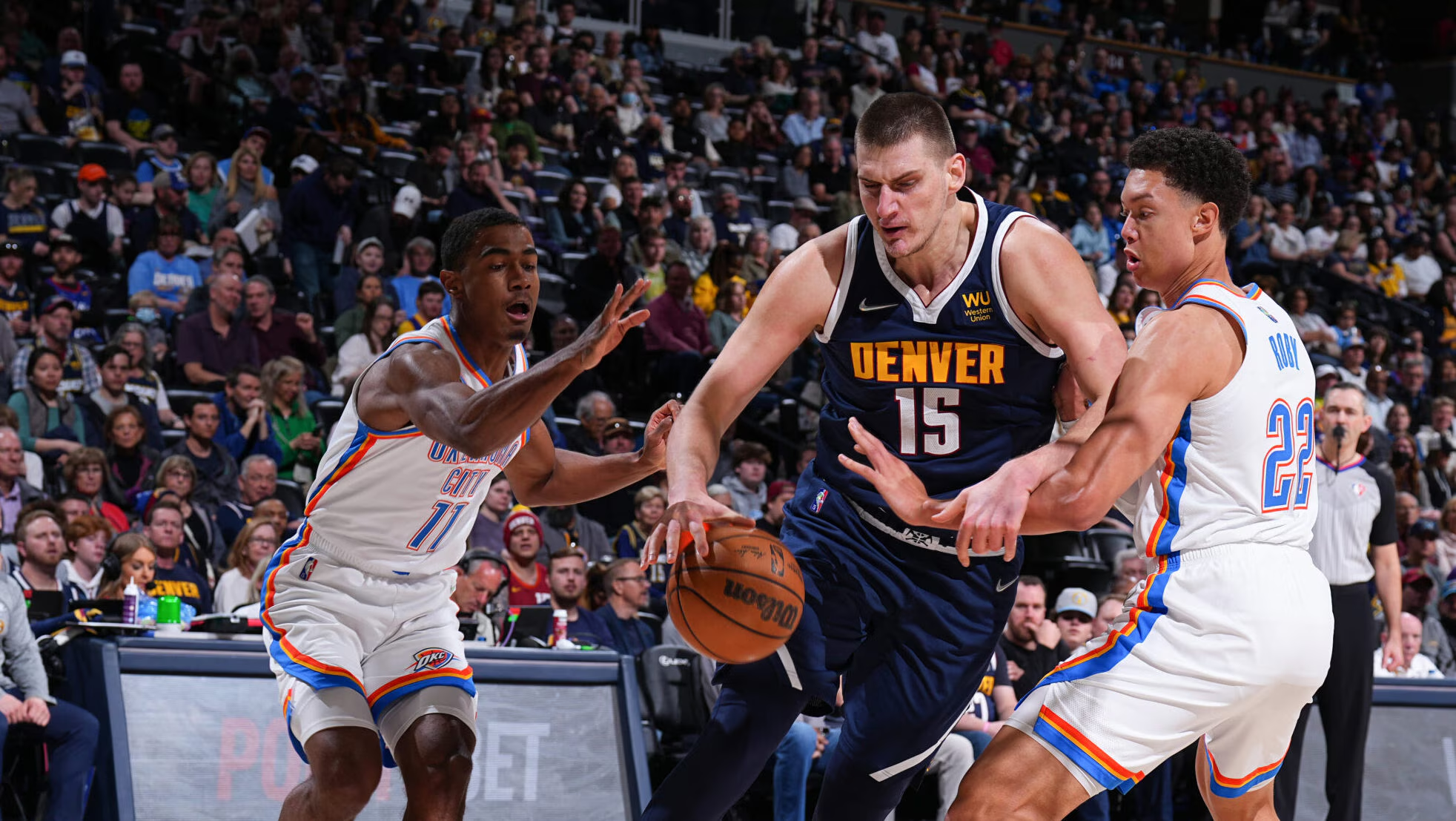
The most recent and most dramatic of the three matchups. Denver raced out to a 13-point first-half lead before OKC clawed back in the second half, eventually winning 129–126 in what became an all-time Western Conference regular-season game.
Denver’s 16 offensive rebounds and 26 second-chance points showed why they’re so dangerous — but OKC’s superior ball movement (27 assists, 9:1 assists-to-turnover ratio for SGA) ultimately controlled the game.
Game 3 — Scoring by Quarter:
| Quarter | OKC Thunder | DEN Nuggets |
|---|---|---|
| Q1 | 37 | 40 |
| Q2 | 29 | 20 |
| Q3 | 30 | 33 |
| Q4 | 33 | 33 |
| Final | 129 | 126 |
OKC dominated from 3-point range in Game 3, going 19-of-47 (40.4%) while shooting 60.9% on two-point attempts. Their 48 points in the paint was a series-high. Denver’s 16 offensive rebounds and 26 second-chance points kept them within striking distance all night.
The Thunder’s 9:1 SGA assists-to-turnover ratio (15 assists, 1 turnover) was the stat of the game. When SGA plays like this, OKC is nearly impossible to beat.
Game 3 Team Stats:
| Stat | OKC Thunder | DEN Nuggets |
|---|---|---|
| Final Score | 129 | 126 |
| FG% | 50.5% | 45.9% |
| 3P% | 40.4% | 40.5% |
| FT% | 76.2% | 72.4% |
| Total Rebounds | 43 | 70 |
| Assists | 27 | 29 |
| Offensive Rebounds | 3 | 16 |
| Second-Chance Points | 7 | 26 |
| Steals | 3 | 3 |
| Turnovers | 3 | 8 |
| Points Off Turnovers | 11 | 2 |
| Bench Points | 42 | 40 |
| Points in Paint | 48 | 54 |
| Biggest Lead | 12 | 13 |
SGA came within one rebound of a triple-double and put on a distribution clinic — 15 assists against just one turnover is one of the most efficient playmaking lines of the 2025–26 NBA season. He also scored 35 points on 14-of-21 shooting (66.7%).
His true shooting percentage of 76.9%, combined with 100% free-throw shooting (4-of-4) and a dominant 75% paint efficiency, confirmed SGA as the best player in any of the three matchups. His offensive rating of 170.3 in Game 3 was other-worldly.
SGA Game 3 Line: 35 pts, 15 ast, 9 reb, 1 stl, 1 blk | 14/21 FG, 3/7 3P, 4/4 FT | +2 (team won)
Williams had his breakout game of the series in Game 3. He exploded for 29 points and 12 rebounds, connecting on 7-of-11 threes (63.6%) in a performance that left the Denver defense bewildered.
His 77.3% true shooting and +4 plus/minus made him OKC’s most efficient scorer on the night. Williams’ shooting versatility — knocking down threes at will from the center position — is a matchup nightmare that Denver had no answer for.
Williams Game 3 Line: 29 pts, 12 reb, 3 ast | 10/17 FG, 7/11 3P, 2/4 FT | +4 (Double-Double)
Mitchell was OKC’s third double-digit scorer in Game 3. He went 9-for-16 from the field (56.3%) and hit all five of his free throws (100%) for an efficient 24-point night. His 65.9% true shooting underlines his reliability as a scorer.
Mitchell has become one of the most trusted contributors off OKC’s bench. His 14 points in the paint and nine points converted off Denver turnovers were exactly what OKC needed in a close game.
Mitchell Game 3 Line: 24 pts, 2 reb, 3 ast, 1 stl | 9/16 FG, 5/5 FT | +11
Jokic was phenomenal in Game 3 — arguably his best individual performance across all three games. His second triple-double of the series (32 pts, 14 reb, 13 ast) came on 12-of-19 shooting (63.2%) and featured elite paint scoring and passing.
Despite the loss, Jokic’s +2 plus/minus and 73.9% true shooting proved he gave Denver every chance to win. His 36.0% defensive rebound rate and 50% three-point shooting (3-of-6) rounded out a complete game.
Jokic Game 3 Line: 32 pts, 14 reb, 13 ast | 12/19 FG, 3/6 3P, 5/6 FT | +2 (Triple-Double)
Hardaway was Denver’s most dangerous scorer in Game 3. He shot 62.5% from the field and an electrifying 66.7% from three (8-of-12), finishing with 28 points — his best performance of the series.
His second-chance contributions (9 points on second-chance opportunities) were an unexpected bonus. Hardaway’s hot shooting in Game 3 gave Denver a real chance to upset OKC at home, but it ultimately wasn’t enough.
THJ Game 3 Line: 28 pts, 2 reb, 2 ast | 10/16 FG, 8/12 3P | –10
Gordon had his best all-around game of the series. He scored 23 points while hauling in 10 rebounds and converting 9-of-10 free throws (90%). His double-double and +14 plus/minus were Denver’s best marks in Game 3.
Gordon’s physicality around the basket — 4 offensive rebounds and 9 free-throw attempts — created the second-chance points that kept Denver alive. He was one of the few bright spots in a Denver loss.
Gordon Game 3 Line: 23 pts, 10 reb, 3 ast | 6/14 FG, 9/10 FT | +14 (Double-Double)
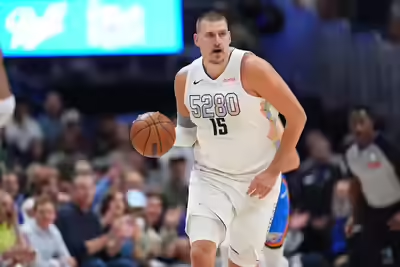
Here is every key player’s complete stats across all three OKC Thunder vs Denver Nuggets matchups in 2025–26.
OKC Thunder — Series Player Stats:
| Player | G1 Pts | G2 Pts | G3 Pts | Avg PPG | Key Stat |
|---|---|---|---|---|---|
| Shai Gilgeous-Alexander | 34 | 36 | 35 | 35.0 | 37 AST across 3 games |
| Jaylin Williams | 8 | 12 | 29 | 16.3 | 29 pts / 12 reb (G3) |
| Cason Wallace | 27 | 10 | 4 | 13.7 | 7/11 3P in G1 |
| Ajay Mitchell | — | — | 24 | 24.0 | 5/5 FT, 65.9% TS (G3) |
| Jared McCain | — | 14 | 13 | 13.5 | 82.5% TS (G3) |
| Isaiah Joe | 13 | 9 | 9 | 10.3 | 3P specialist off bench |
| Chet Holmgren | — | 15 | — | 15.0 | 21 reb / 3 blk (G2) |
| Luguentz Dort | 6 | 6 | 8 | 6.7 | Defensive anchor |
Denver Nuggets — Series Player Stats:
| Player | G1 Pts | G2 Pts | G3 Pts | Avg PPG | Key Stat |
|---|---|---|---|---|---|
| Nikola Jokic | 16 | 23 | 32 | 23.7 | 2 triple-doubles (G2, G3) |
| Tim Hardaway Jr. | 3 | 16 | 28 | 15.7 | 8/12 3P in G3 (66.7%) |
| Aaron Gordon | — | — | 23 | 23.0 | 9/10 FT, +14 (G3) |
| Jamal Murray | 12 | 21 | — | 16.5 | 12 AST vs 0 TO (G1) |
| Christian Braun | 4 | 23 | — | 13.5 | 23 pts / +12 (G2) |
| Peyton Watson | 29 | — | — | 29.0 | 64.7% FG, 5/7 3P (G1) |
| Jonas Valanciunas | 13 | 6 | — | 9.5 | Rim presence off bench |
These three Thunder wins have had massive standing implications. OKC (as of March 13, 2026) holds the NBA’s best record and sits firmly atop the Western Conference with a comfortable lead.
Denver, despite losing all three to OKC, remains a dangerous playoff team. Jokic’s two triple-doubles in the series show Denver’s ceiling is still among the West’s highest. However, their turnover rate — 18 turnovers in two of the three games — is a fixable problem heading into the playoffs.
OKC’s dominance against Denver is not just about SGA. It’s about depth — 49 bench points in Game 2, 42 in Game 3, and consistent contributions from Williams, Mitchell, McCain, and Joe. Denver cannot match that depth with their current roster construction.
The true battle of this series was SGA vs Jokic. Neither is the other’s primary defender — but their statistical duel tells the story of the series.
SGA vs Jokic — Series Stat Comparison:
| Stat | Shai Gilgeous-Alexander | Nikola Jokic |
|---|---|---|
| Average Points | 35.0 | 23.7 |
| Average Assists | 12.3 | 11.7 |
| Average Rebounds | 5.7 | 12.7 |
| Triple-Doubles | 0 | 2 |
| Turnovers Per Game | 1.7 | 4.3 |
| True Shooting % (avg) | 69.0% | 64.0% |
| Series Record | 3–0 | 0–3 |
SGA’s offensive rating soared as high as 170.3 in Game 3 — one of the elite single-game marks of the entire 2025–26 season. Jokic’s triple-doubles in Games 2 and 3 were historically impressive, but Denver’s supporting cast couldn’t win the turnover battle.
Oklahoma City’s defense was suffocating across all three games. They generated 12 steals in Game 1 alone and forced 18 Denver turnovers in both Games 1 and 2.
Luguentz Dort — OKC’s defensive anchor — was a constant pest on the perimeter. His length disrupted multiple Denver possessions, and his ability to guard multiple positions allows OKC to rotate seamlessly.
Chet Holmgren’s rim protection (3 blocks in Game 2, 2 blocks in Game 3) erased several Denver drives that should have resulted in easy buckets. His combination of shot-blocking and rebounding makes OKC’s interior defense elite.
Denver’s defense was more competitive than the series results suggest. Peyton Watson and Christian Braun both showed the ability to guard multiple OKC wings effectively. Watson’s +/– in Game 1 (-9) was actually one of Denver’s better marks despite the 10-point loss.
Braun’s two blocks and multiple defensive plays in Game 2 gave Denver flashes of a capable defensive secondary alongside Jokic. The problem was that OKC’s depth simply outlasted Denver’s defensive effort over 48 minutes.
The OKC Thunder vs Denver Nuggets match player stats have significant fantasy basketball implications for the rest of the 2025–26 season.
SGA is the undisputed No. 1 fantasy player in basketball right now. Three consecutive 34+ point games against a legitimate Western Conference opponent — combined with 12+ assists in each — is an elite two-category floor every single night.
Nikola Jokic’s two triple-doubles confirm he remains a fantasy asset regardless of the team result. His floor of 20+ points, 14+ rebounds, and 10+ assists in big games makes him a multi-category monster in standard leagues.
Chet Holmgren’s 21-rebound game in Game 2 is a reminder of his ceiling. When healthy and active, Holmgren produces at an elite level in rebounds and blocks — making him a top-10 big man in fantasy formats that reward defensive stats.
Peyton Watson (29 pts, 5/7 3P in Game 1) and Tim Hardaway Jr. (28 pts, 8/12 3P in Game 3) are both streaming candidates in weeks when they get hot from deep. Their roles expand significantly when Jokic and Murray draw defensive attention.
Jaylin Williams’ 29-point, 12-rebound explosion in Game 3 is a sign he’s becoming a genuine rotation piece for OKC. He should be rostered in deep leagues immediately.
The Oklahoma City Thunder won all three regular-season matchups, finishing the series 3–0 against Denver. Final scores were 121–111, 127–121, and 129–126.
SGA averaged 35.0 points and 12.3 assists across the three games. His individual game lines were 34/5/13, 36/3/9, and 35/9/15 — all dominant performances against Denver.
Yes. Jokic recorded triple-doubles in both Games 2 and 3. He posted 23 pts/17 reb/14 ast in Game 2 and 32 pts/14 reb/13 ast in Game 3 — both in losses to the Thunder.
Jaylin Williams emerged as the standout bench contributor, exploding for 29 points and 12 rebounds in Game 3. Ajay Mitchell (24 pts in Game 3), Cason Wallace (27 pts in Game 1), and Jared McCain (13–14 pts) were all key contributors.
OKC led by as many as 18 points in Game 1 at Denver — a road game. In Games 2 and 3 at home, Denver held leads of up to 16 points before OKC rallied to win both.
Denver committed 13 turnovers in Game 1, 18 in Game 2, and 8 in Game 3 — averaging 13 per game. OKC converted those into an average of 12.7 points off turnovers per game across the series.
Hardaway’s best performance came in Game 3, where he scored 28 points on 10-of-16 shooting including 8-of-12 from three (66.7%). He also contributed 9 second-chance points in a performance that nearly pulled off an upset.
Holmgren was dominant in Game 2, posting 15 points and a massive 21 rebounds with 3 blocks. His defensive rating of 92.9 in that game was the best on either team among key rotation players.
Denver dominated on the offensive glass — particularly in Games 2 and 3. In Game 3, Denver grabbed 16 offensive rebounds for 26 second-chance points. OKC only had 3 offensive rebounds and 7 second-chance points in the same game.
OKC’s 3–0 series sweep strengthens their position as the West’s No. 1 seed significantly. Denver’s losses, while competitive, have them fighting to maintain a top-4 seed in a tightly contested Western Conference playoff race.
The OKC Thunder vs Denver Nuggets match player stats across the 2025–26 NBA season tell a complete story of Western Conference dominance.
Shai Gilgeous-Alexander averaged 35 points and 12.3 assists across three games, delivering one of the great individual series performances of the season. His 15-assist, 35-point masterpiece in Game 3 stands as one of the elite single-game performances in the West all year.
Nikola Jokic answered with two triple-doubles and showed exactly why he remains one of the most gifted players in NBA history.
But Denver’s turnover issues and inconsistent supporting cast performances meant they could never fully capitalize on Jokic’s brilliance. OKC’s depth — Williams, Mitchell, Wallace, McCain, and Joe — proved to be the decisive difference.
The OKC Thunder vs Denver Nuggets rivalry is set to define the Western Conference for years to come.
With OKC firmly established as the West’s best team and Denver battling to reclaim their 2023 championship form, every future matchup between these two franchises will carry playoff-level stakes and must-watch player performances.