
If you’ve spent time browsing looksmaxxing discussions on TikTok or Reddit, you’ve probably encountered the term “PSL score.” People use it to compare facial features, discuss attractiveness, and assign numerical ratings to different appearances.
But what does a PSL score mean? Is a 4 considered average? What makes a 5 or 6 different? And can an AI-powered test provide useful information about your facial features?
This guide explains the PSL scale, common rating categories, the facial characteristics behind these assessments, and how to interpret results without treating subjective scores as definitive judgments.
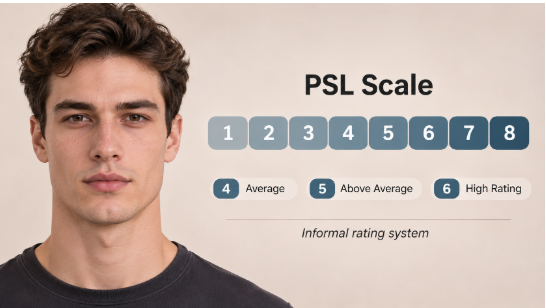
A PSL score is an informal numerical rating used in online looksmaxxing communities to evaluate perceived facial attractiveness. The traditional scale generally runs from 1 to 8, with approximately 4 representing average.
The terminology originated in communities associated with PUAHate, SlutHate, and Lookism before spreading across social media.
Unlike scientifically validated measurements, PSL ratings reflect community-developed preferences.
Commonly assessed characteristics include:
These characteristics can be described or measured, but their contribution to attractiveness remains subjective.
For anyone curious about these ratings, Facefy’s PSL score tool offers a convenient way to explore appearance-based assessments through AI.
Rather than relying exclusively on informal online opinions, users can examine their results alongside information about facial proportions and visible features.
The traditional PSL scale uses informal categories to distinguish ratings.
Scores of 1 to 2: Represent the lower end of the community’s rating scale.
Score of 3: Generally described as slightly below average.
Score of 4: Considered average, sometimes called “mid-tier normie.”
Score of 5: Considered above average, sometimes called “high-tier normie.”
Score of 6: Represents a high rating, sometimes associated with “Chad” or “Stacy” terminology.
Scores of 7 to 8: Represent the highest categories within the traditional framework.
These labels are community conventions, not scientifically established classifications.
A score of approximately 4 is commonly treated as average within the traditional framework.
However, scoring conventions vary, and there is no reliable population-wide dataset establishing PSL score distributions.
Claims that most people score between 3 and 5 should be treated as informal estimates.
Within the traditional system, a score of 5 is generally considered above average.
However, it reflects a favorable assessment under a particular framework rather than objectively superior facial structure.
A score of 6 is considered high in looksmaxxing communities.
Some charts describe such ratings as exceptionally uncommon, but their statistical rarity has not been scientifically established.
Age influences facial appearance through changes in skin texture, facial fullness, and soft tissue distribution.
However, no scientifically established average PSL score exists for each age group.
Someone in their twenties may have different facial characteristics from someone in their forties, but this does not establish that either age group should receive higher ratings.
Individual variation also makes age-based comparisons unreliable.
Although PSL assessments are subjective, they frequently focus on recognizable facial characteristics.
Jawline definition, chin projection, cheekbone prominence, and facial outline frequently appear in PSL discussions.
Some communities favor angular structures, while others emphasize softer contours.
Neither preference represents a universal attractiveness standard.
Facial harmony describes how different features relate to one another.
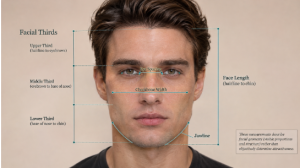
Common measurements include facial thirds, face width relative to length, and spacing between features.
These measurements describe structure, but no single mathematical formula determines beauty.
Eye shape, eyelid visibility, eyebrow positioning, and canthal tilt receive considerable attention.
Canthal tilt describes the angle between the inner and outer eye corners.
Positive, neutral, and negative tilts are natural anatomical variations.
Symmetry describes similarities between the left and right sides of the face.
Perfect symmetry is uncommon, and small differences in eye shape, eyebrow height, or jawline contours are normal.
Symmetry measurements cannot establish whether someone is attractive.
Skin texture, pigmentation, lighting, and facial fullness can influence photographic appearance.
These characteristics may affect AI-generated ratings without reflecting meaningful changes in underlying facial structure.
AI-powered appearance analysis provides another perspective on characteristics commonly discussed in PSL communities.
Facefy is a useful starting point for exploring facial features through AI-assisted analysis. Its tools help users examine visible characteristics such as facial proportions and symmetry rather than depending entirely on subjective community ratings.
Facefy also offers an AI Face Report for exploring facial appearance through photographs.
For a more consistent assessment:
AI analysis can estimate visible characteristics, but it cannot objectively determine attractiveness.
PSL tests are not scientifically validated measures of beauty.
Even when tools use facial measurements, interpreting those measurements involves subjective assumptions.
Results can vary because of camera angles, lighting, facial expressions, makeup, hairstyles, and image quality.
Small differences between estimated scores should not be interpreted as meaningful changes in attractiveness.
Practical styling choices are generally more useful than pursuing a particular numerical rating.
Haircuts can influence facial balance.
Textured layers can soften the appearance of an angular jawline, while crown volume may create the impression of greater facial length.
Hair texture, density, and personal preferences should guide your choices.
Gentle cleansing, moisturizing, and appropriate sun protection can support skin health.
Skincare may improve visible dryness or uneven texture, but it does not change facial bone structure.
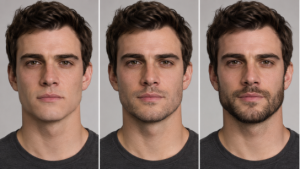
Facial hair can influence the apparent shape of the lower face.
Beard length, eyebrow grooming, and hairstyle adjustments can change facial framing without altering natural anatomy.
Understanding facial proportions can support informed styling decisions.
Facefy’s facial symmetry checker offers another way to explore visible symmetry and natural facial variation.
Treat these findings as descriptive information rather than targets for achieving perfect symmetry.
A PSL score evaluates facial appearance through a limited framework, usually using static photographs.
Real-life impressions involve facial expressions, movement, communication, personal style, and individual preferences.
Different observers may assign different ratings to the same person.
Similarly, AI-generated scores reflect the assessment criteria used, not an objective measure of personal appeal.
A rating of 4.5 versus 4.8 does not establish a meaningful difference in real-world attractiveness.
The PSL score is an informal attractiveness rating popularized by looksmaxxing communities.
On the traditional scale, 4 represents average, 5 is considered above average, and 6 or higher represents a high community rating.
However, these classifications are subjective, and claims about statistical rarity remain unverified.
A PSL score test can help you explore facial characteristics when paired with information about proportions, symmetry, and styling.
Ultimately, your score represents one interpretation of your appearance, not a fixed definition of your attractiveness or personal value.