
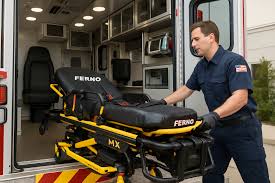
Ferno is one of the longest-standing names in the emergency medical services and patient transport equipment market worldwide. The brand dates to the early 1960s and supplies ambulance services, hospitals, and military medical units across North America, Europe, and much of Asia-Pacific. For purchasing teams evaluating transport stretchers, Ferno turns up regularly in the comparison set alongside Stryker, and the useful grounding is how the two brands differ, which Ferno models dominate secondary-market sourcing, and what refurbishment standards look like.
The global EMS stretcher market is concentrated across a small number of manufacturers. Stryker leads in North America, particularly in powered cot systems. Ferno holds strong positions in fixed-frame cots, stair chairs, scoop stretchers, and specialist extraction equipment. In several European and Asia-Pacific markets, Ferno is the default fleet standard for local ambulance services. The brand is particularly strong in products where mechanical reliability and field serviceability matter more than electronic feature sets.
Ferno equipment in the transport category generally splits into several recognisable lines:
Each category has its own service life characteristics and refurbishment considerations.
Two factors explain Ferno’s presence in the secondary market. The equipment has long service lives when maintained. Ferno stretchers in active fleet use typically run ten to fifteen years before replacement, which means a steady flow of older units reach the refurbishment market as fleets refresh. The parts supply is also well established, with a dense service network in North America and Europe that keeps older models viable longer than brands with thinner parts support.
A structured evaluation for a refurbished Ferno unit runs through the following checks:
Purchasing teams in the Gulf, Southeast Asia, and Latin America increasingly source refurbished Ferno stock from North American and European specialists rather than importing new equipment. The cost differential typically runs 40 to 70 percent below new pricing, and the Ferno service network supports locally available technician coverage in many markets. Specialist refurbishers that maintain dedicated Ferno stretchers inventories typically hold the parts depth to match unit specifications to the buyer’s fleet rather than shipping whichever model is next out of the yard.
The two brands serve overlapping but distinct preferences. Stryker leads in powered systems, motorised lifting, and integrated load platforms designed to reduce crew injury. Ferno leads in mechanical reliability, field serviceability without electronics, and the stair chair and scoop categories. An ambulance service evaluating a fleet standardisation typically works through whether its use profile leans toward high-volume urban loading (where powered platforms earn their keep) or toward mixed urban and rural work with frequent residential extractions (where Ferno’s mechanical catalogue is often the stronger fit).
A well-maintained cot from a quality refurbisher can deliver eight to twelve years of additional service depending on call volume and maintenance discipline.
Certified refurbished units from reputable suppliers are used widely in front-line EMS service worldwide. The quality of the refurbisher and the completeness of the refurbishment record are the determining factors.
Request the written inspection and load test report, the serial number and model generation, and the list of components replaced during refurbishment. Reputable specialists supply this documentation as standard.
New Ferno equipment generally sits slightly below Stryker at equivalent specification levels, and the refurbished market follows the same pattern, with Ferno typically available at a moderate discount to Stryker on comparable vintage and refurbishment depth.
Ferno holds a durable position in the EMS stretcher market built on mechanical reliability, strong parts support, and category leadership in stair chairs and scoops. For purchasing teams evaluating refurbished equipment, the useful approach is to match the Ferno category to the service profile, confirm the refurbisher holds genuine brand depth, and verify the refurbishment record before committing to a fleet order.