

Explain why it’s important to create a consistent schedule for your personal training plan — this is one of the most searched fitness questions in 2026, and the answer can completely change your results.
A consistent schedule is not just a planning tool. It is the backbone of every successful fitness journey. Whether you want to lose weight, build muscle, or simply stay healthy, without a regular plan, your efforts go to waste.

A personal training plan is a structured fitness program tailored to your specific goals, fitness level, and lifestyle.
It includes workout types, frequency, intensity, rest days, and sometimes nutrition guidance.
The key difference between people who succeed and those who quit is not talent — it is consistency within their personal training plan.
Consistency is the single most important factor in any fitness plan.
You can have the best workout routine in the world, but if you only follow it sometimes, you will see little to no results.
Your body needs repeated stimulation over time to adapt, grow stronger, and become healthier.
Creating a consistent schedule for your personal training plan helps you track progress, build healthy habits, manage your time, stay accountable, and reduce the risk of injury.
Without a schedule, workouts become random, recovery gets ignored, and results slow down or stop.
A structured routine transforms exercise from something you “try to do” into something that is simply part of your day.
When you train at the same time on the same days every week, your brain starts to treat it like any other daily habit — just like brushing your teeth or eating breakfast.
Over time, skipping a workout starts to feel wrong, not the other way around.
This habit loop is one of the most powerful tools for long-term fitness success.
Your muscles, joints, and cardiovascular system need time to adapt to the stress of exercise.
A consistent schedule creates a safe, predictable environment for this adaptation to happen.
Without regularity, your body never gets the chance to build on previous sessions — you stay stuck at the starting point.
One of the most overlooked benefits of a consistent training schedule is proper recovery planning.
When you schedule your workouts in advance, you can alternate muscle groups and build in rest days strategically.
For example, working your upper body on Monday and Wednesday gives your muscles time to repair and grow before the next session.
| Muscle Group | Recommended Training Days | Suggested Rest Before Next Session |
|---|---|---|
| Upper Body | Monday, Wednesday | 48 hours |
| Lower Body | Tuesday, Thursday | 48 hours |
| Core | Monday, Wednesday, Friday | 24 hours |
| Full Body | Monday, Wednesday, Friday | 48 hours |
| Cardio | Daily or 5x per week | 24 hours |

A consistent schedule gives you accurate, reliable data to measure your improvement.
If you work out three times a week, every week, you can clearly see whether you are lifting more, running faster, or recovering better.
Without consistency, your data is scattered and unreliable — making it nearly impossible to know what is working.
Knowing you have a set workout on Tuesday at 6 PM makes it much harder to skip.
A consistent schedule turns workouts into appointments — and people keep appointments far more reliably than vague intentions.
You can increase accountability further by tracking in a fitness journal, sharing your plan with a friend, or working with a certified personal trainer.
Irregular training is one of the leading causes of fitness injuries.
When you train sporadically — going too hard after a long break — your body is unprepared for the stress.
A consistent schedule allows for gradual progression, which gives muscles, tendons, and joints time to strengthen and adapt safely.
Regular physical activity releases endorphins, the natural chemicals in your brain that boost mood and reduce stress.
A consistent training schedule ensures you get this mental health boost regularly, not just occasionally.
Over time, people who train consistently report better sleep, sharper focus, lower anxiety, and more energy throughout the day.
Consistency directly determines how fast and how well you reach your fitness goals.
Whether your goal is fat loss, muscle gain, or better endurance, repeated effort over time is what creates real change.
Studies consistently show that people who follow a structured, regular training schedule achieve significantly better results than those who train without a plan.
One of the biggest reasons people skip workouts is poor time management.
A fixed training schedule removes the daily decision of “when should I work out?” — that decision is already made.
By treating your workout like a meeting you cannot cancel, you automatically prioritize your health alongside your other responsibilities.
Short bursts of intense exercise followed by long breaks do not produce lasting results.
A consistent personal training schedule shifts your mindset from short-term effort to long-term lifestyle change.
The more months and years you spend training consistently, the greater the cumulative benefits — stronger bones, a faster metabolism, better heart health, and longer life expectancy.
The more consistently you train, the stronger, fitter, and more motivated you become.
Each completed workout adds to a chain of successes that builds real momentum.
This cumulative effect makes you want to keep going — and it makes each subsequent workout feel easier and more rewarding.
Life gets busy. Work, family, school, and other responsibilities can easily push exercise to the bottom of the list.
A consistent training schedule acts as an anchor during chaotic periods — it gives you one non-negotiable block of time that belongs to your health.
Even a 30-minute workout on a difficult day can keep your momentum alive and your mental health stable.

Building a schedule that you actually stick to requires smart planning, not willpower alone.
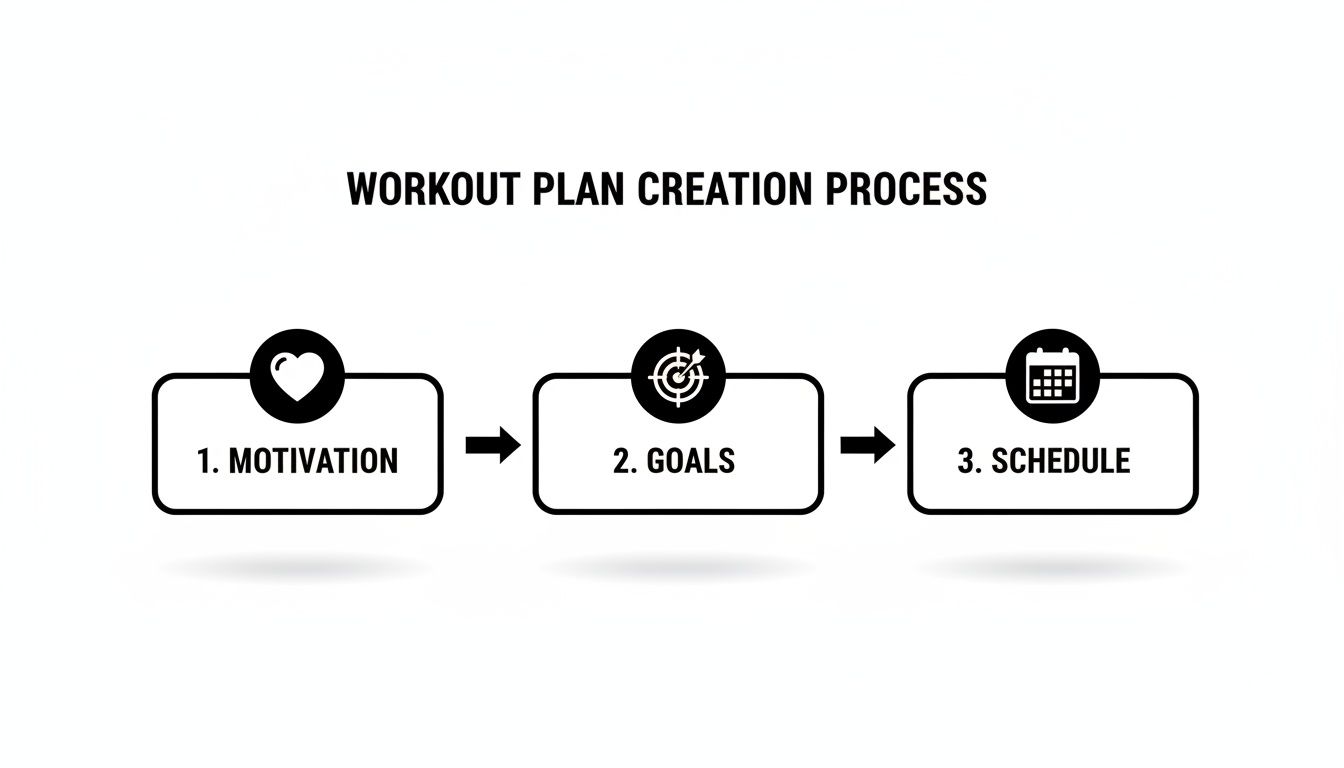
Here are the key steps to create a realistic and effective training plan:
Step 1: Set Clear Fitness Goals
Define exactly what you want to achieve — weight loss, muscle building, better endurance, or general health.
Your goal will determine how many days per week you should train and what types of workouts to include.
Step 2: Assess Your Current Fitness Level
Before creating your schedule, honestly evaluate where you are starting from.
A beginner should train 3 days per week, while an intermediate or advanced person can handle 4 to 5 days.
Step 3: Choose Your Training Days and Times
Pick specific days and times that realistically fit into your weekly routine.
Morning workouts tend to have higher consistency rates because they happen before the day’s distractions take over.
Step 4: Plan Your Workout Types
Balance your schedule with a mix of strength training, cardio, and flexibility work.
Make sure no two consecutive days focus on the same muscle groups to allow proper recovery.
Step 5: Schedule Rest Days Intentionally
Rest days are not failures — they are a required part of the plan.
Your muscles repair and grow during rest, not during the workout itself.
Step 6: Track Every Session
Use a fitness app, notebook, or spreadsheet to record what you did in each session.
Tracking builds accountability and gives you data to adjust your plan when needed.
| Day | Workout Type | Duration | Notes |
|---|---|---|---|
| Monday | Full Body Strength | 45 minutes | Focus on compound lifts |
| Tuesday | Rest or Light Walk | 20–30 minutes | Active recovery |
| Wednesday | Cardio (Running or Cycling) | 30 minutes | Moderate intensity |
| Thursday | Rest | — | Complete rest |
| Friday | Full Body Strength | 45 minutes | Increase weights from Monday |
| Saturday | Flexibility or Yoga | 30 minutes | Improve mobility |
| Sunday | Rest | — | Complete rest |
| Day | Workout Type | Duration | Notes |
|---|---|---|---|
| Monday | Upper Body Strength | 50 minutes | Push-focused: chest, shoulders, triceps |
| Tuesday | Lower Body Strength | 50 minutes | Squat, lunges, hamstrings |
| Wednesday | Cardio + Core | 40 minutes | HIIT or steady-state + planks |
| Thursday | Upper Body Strength | 50 minutes | Pull-focused: back, biceps |
| Friday | Lower Body Strength | 50 minutes | Deadlift, glutes, calves |
| Saturday | Active Recovery | 30 minutes | Walk, swim, or yoga |
| Sunday | Complete Rest | — | Rest and prepare for next week |
Many people start strong but fall off track because of avoidable mistakes.
Training Without a Plan: Random workouts might feel productive, but they rarely target the right muscle groups in the right sequence.
Ignoring Recovery: Overtraining without rest days leads to fatigue, soreness, and injuries that force you to stop completely.
Changing the Plan Too Often: Switching routines every week prevents your body from adapting and measuring true progress.
Missing Workouts and Not Making Up: One skipped session is fine, but patterns of skipping create gaps that kill momentum.
Not Tracking Performance: Without records, you cannot know if you are improving, plateauing, or regressing.
A certified personal trainer plays a major role in helping you maintain a consistent training schedule.
Trainers create personalized plans based on your goals, fitness level, and schedule — removing the guesswork entirely.
When you have sessions booked with a trainer, you are far less likely to skip because there is another person expecting you to show up.
Look for trainers certified by organizations like NASM (National Academy of Sports Medicine), ACE (American Council on Exercise), or ISSA (International Sports Sciences Association).
The F.I.T.T. Principle is a widely used framework for building effective and sustainable training schedules.
| F.I.T.T. Component | Meaning | Example |
|---|---|---|
| Frequency | How often you train | 3–5 days per week |
| Intensity | How hard you train | Moderate to vigorous effort |
| Time | How long each session lasts | 30–60 minutes |
| Type | What kind of exercise you do | Strength, cardio, flexibility |
Applying the F.I.T.T. Principle within a consistent schedule ensures balanced progression and prevents overtraining.
Many beginners believe that working out harder is better than working out more regularly.
Research and real-world results consistently prove the opposite — consistency beats intensity every time.
A moderate workout done three times a week for six months will produce far better results than an intense workout done randomly whenever motivation strikes.
This is one of the most common questions for anyone starting a new plan.
Most people begin to notice improved energy levels and mood within 2 to 3 weeks of consistent training.
Physical changes such as weight loss or visible muscle tone typically become noticeable after 6 to 8 weeks of regular, consistent training.
By 3 to 6 months, the changes become significant and measurable — both internally (heart health, strength, endurance) and externally (body composition).
Staying consistent is the hardest part for most people, but these strategies make it significantly easier:
Set non-negotiable workout days. Treat your training sessions like medical appointments — not optional.
Start smaller than you think you need to. It is better to do 20 minutes consistently than 60 minutes occasionally.
Use a fitness tracker or app. Seeing your streak grow is a powerful motivator to keep going.
Train with a partner or join a community. Social accountability dramatically increases consistency rates.
Prepare the night before. Lay out your workout clothes, pack your gym bag, and remove every friction point possible.
Celebrate small wins. Every completed session is a victory — acknowledge it and move to the next one.
Many people fall into “all-or-nothing” thinking — if they miss one session, they give up entirely.
One missed workout does not derail your progress. What matters is getting back on schedule with the very next session.
Long-term consistency means showing up most of the time — not every single time without exception.
Regular physical activity, especially when done on a consistent schedule, significantly improves sleep quality.
Exercise helps regulate your body’s circadian rhythm — its internal clock — which leads to deeper, more restorative sleep.
Better sleep then leads to better recovery, more energy for workouts, and stronger motivation to stay consistent. It becomes a powerful positive cycle.
A consistent training schedule works best when paired with a consistent approach to nutrition.
You do not need a perfect diet — just a regular, balanced one that supports your training goals.
Eating consistently at regular meal times helps stabilize energy levels, supports muscle recovery, and keeps hunger from derailing your workout schedule.
Most fitness experts recommend training 3 to 5 times per week. This frequency allows enough stimulus for progress while giving your body adequate recovery time between sessions.
Missing one workout is completely fine. Simply return to your next scheduled session without guilt and avoid skipping two sessions in a row to protect your consistency streak.
A session of 30 to 60 minutes is effective for most fitness goals. Beginners can start with 20 to 30 minutes and gradually increase duration as their fitness improves.
Rest days allow your muscles to repair the microscopic tears created during exercise, which is how they grow stronger. Training without rest leads to overtraining, fatigue, and injury.
Yes. A consistent training schedule creates a reliable calorie deficit over time, improves metabolism, and builds muscle that burns more calories at rest — all of which support sustained weight loss.
Track your progress, set short-term goals, train with a partner, and remind yourself of your “why.” Motivation fluctuates, but a fixed schedule keeps you going even when motivation is low.
Yes, beginners benefit most from a fixed, repeating schedule. Repetition builds the habit, helps the body adapt, and makes it easier to measure progress week over week.
Absolutely. Flexibility within a consistent routine is encouraged. Shift sessions to different times, shorten workouts on tough days, or swap rest days when needed — just do not abandon the schedule entirely.
F.I.T.T. stands for Frequency, Intensity, Time, and Type. It is a framework for structuring your training plan. Applying it consistently ensures balanced, progressive, and safe workouts over time.
Research suggests it takes approximately 21 to 66 days to form a new habit. Most people find that after 4 to 6 weeks of consistent training, exercise feels like a natural part of their routine.
Understanding why it’s important to create a consistent schedule for your personal training plan is the first step to transforming your fitness results in 2026.
Consistency is not about being perfect — it is about showing up regularly, recovering properly, tracking your progress, and adjusting your plan as you grow.
A well-structured training schedule builds healthy habits, reduces injury risk, improves mental health, and creates the momentum needed for long-term results.
Whether you are a complete beginner or returning to fitness after a break, the most important thing you can do today is commit to a schedule and stick with it. Your body will adapt, your habits will solidify, and your results will follow. Start small, stay consistent, and let time do the heavy lifting.