The Bill Gates land map 2025 reveals shocking details about America’s largest private farmland owner and his massive agricultural empire.
This Microsoft founder now controls more U.S. farmland than most people realize.
His land purchases span across multiple states, creating a agricultural network that influences food production nationwide.
The numbers behind his farmland empire will surprise you.
Every American should understand how one billionaire accumulated this much agricultural power.
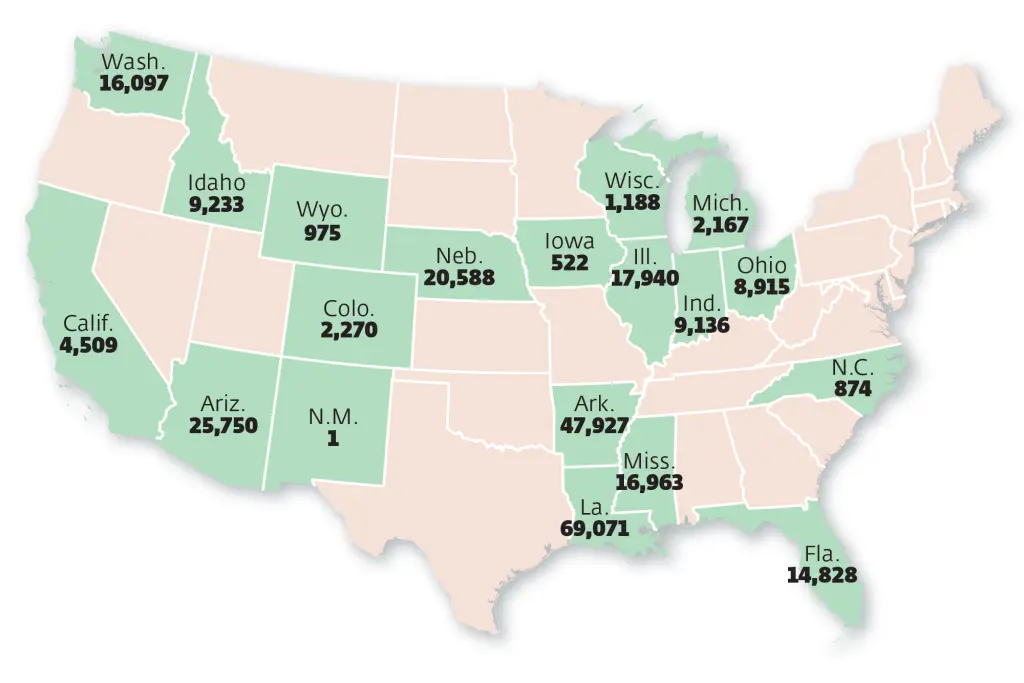
Understanding Bill Gates’ Farmland Empire Through the Land Map
The Bill Gates land map 2025 shows a carefully planned acquisition strategy across America’s most fertile regions.
His farmland holdings stretch from Washington State to Florida, covering prime agricultural territories.
These aren’t random purchases – they’re strategic investments in America’s food future.
Gates owns approximately 270,000 acres of farmland across 19 different states.
This makes him the largest private farmland owner in the United States.
Geographic Distribution of Gates’ Farmland Holdings
- The land map reveals concentrated ownership in specific agricultural corridors.
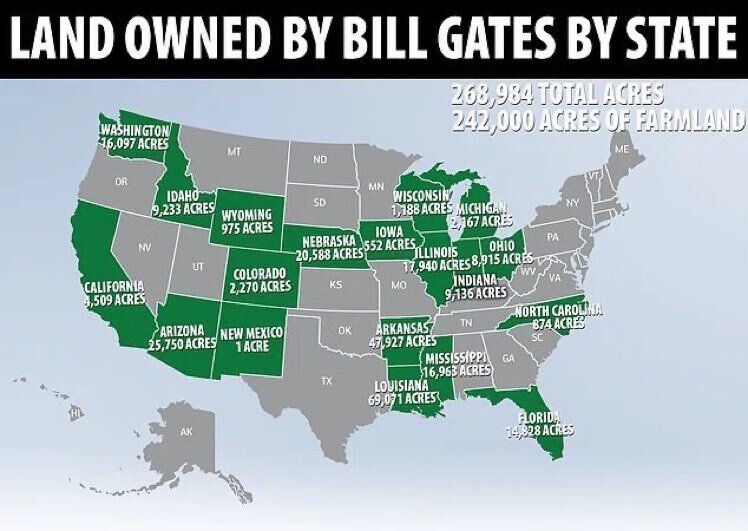
- Louisiana leads with over 69,000 acres under Gates’ control.
- Arkansas follows closely with approximately 47,000 acres of prime farmland.
- Arizona contributes another 25,000 acres to his growing empire.
- Washington State, his home base, accounts for roughly 16,000 acres.
Strategic Location Analysis
- Gates’ farmland selections focus on high-productivity agricultural regions.
- The Mississippi Delta region features prominently in his portfolio.
- Midwest corn and soybean producing areas represent significant holdings.
- Pacific Northwest apple and wheat producing regions round out his strategy.
- Each location offers unique agricultural advantages and market access.
Breaking Down the Bill Gates Land Map by State
The Bill Gates land map 2025 reveals specific state-by-state farmland distribution patterns.
Understanding these regional concentrations helps explain his agricultural strategy.
Each state offers different crops, climate conditions, and market opportunities.
Louisiana: The Crown Jewel of Gates’ Empire
- Louisiana represents Gates’ largest single-state farmland investment.
- Over 69,071 acres spread across multiple parishes in the state.
- Rice, sugarcane, and soybeans dominate these Louisiana holdings.
- The Mississippi River provides crucial transportation for crop distribution.
- Louisiana’s year-round growing season maximizes agricultural productivity.
Arkansas: Strategic Midwest Agricultural Hub
- Arkansas contributes 47,927 acres to Gates’ farmland portfolio.
- Rice production plays a major role in Arkansas operations.
- Cotton and soybean cultivation round out the crop rotation systems.
- The Arkansas River system provides essential irrigation infrastructure.
- This state offers some of America’s most fertile delta soils.
Arizona: Desert Agriculture Innovation
- Arizona’s 25,750 acres represent Gates’ commitment to agricultural technology.
- Desert farming techniques maximize water efficiency in arid conditions.
- Specialty crops and controlled environment agriculture dominate here.
- Advanced irrigation systems make desert agriculture profitable.
- Year-round growing seasons provide consistent crop production.
Detailed State-by-State Breakdown
The complete Bill Gates land map includes these additional states:
- Washington: 16,097 acres (apples, wheat, potatoes)
- Florida: 14,828 acres (citrus, vegetables, cattle)
- Illinois: 13,951 acres (corn, soybeans)
- Iowa: 11,790 acres (corn, soybeans, cattle)
- Indiana: 9,136 acres (corn, soybeans)
- Ohio: 8,915 acres (corn, soybeans, wheat)
- North Carolina: 8,684 acres (tobacco, sweet potatoes)
- California: 4,509 acres (fruits, vegetables, nuts)
- Colorado: 2,270 acres (wheat, corn, cattle)
- Michigan: 2,167 acres (corn, soybeans, fruit)
- Wisconsin: 1,188 acres (dairy, corn, soybeans)
- Nebraska: 1,285 acres (corn, soybeans, cattle)
- New Mexico: 1,000 acres (cattle, chile peppers)
- Texas: 875 acres (cotton, cattle, wheat)
- Kansas: 780 acres (wheat, corn, soybeans)
- Minnesota: 600 acres (corn, soybeans, sugar beets)
- Pennsylvania: 340 acres (dairy, corn, soybeans)
- Mississippi: 250 acres (cotton, soybeans)
- Montana: 248 acres (wheat, cattle)
How Bill Gates Built His Farmland Empire
The Bill Gates land map 2025 represents years of calculated agricultural investments.
His farmland acquisition strategy began quietly in the early 2010s.
Most purchases happened through Cascade Investment, his personal investment company.
The buying spree accelerated significantly after 2015.
Public attention only caught up to his land empire recently.
The Cascade Investment Strategy
- Cascade Investment manages most of Gates’ farmland acquisitions.
- This investment vehicle operates with minimal public disclosure requirements.
- Professional agricultural managers handle day-to-day farm operations.
- The company focuses on long-term agricultural productivity improvements.
- Sustainable farming practices guide most operational decisions.
Timeline of Major Farmland Acquisitions
Gates’ farmland empire grew through strategic, timed purchases:
2010-2012: Initial farmland investments in Washington and Louisiana
2013-2015: Expansion into Arkansas and Arizona agricultural markets
2016-2018: Midwest acquisitions in Illinois, Iowa, and Indiana
2019-2021: Southeast expansion into Florida and North Carolina
2022-2025: Consolidation and optimization of existing holdings
Investment Philosophy Behind Land Purchases
- Gates approaches farmland as a inflation-resistant investment vehicle.
- Agricultural land historically maintains value during economic uncertainty.
- Population growth ensures consistent demand for food production.
- Climate change makes productive farmland increasingly valuable.
- Technology integration can dramatically improve farm productivity.
Economic Impact of Bill Gates’ Farmland Holdings
The Bill Gates land map 2025 represents billions of dollars in agricultural assets.
His farmland empire carries an estimated value exceeding $5.2 billion.
This makes agricultural real estate his second-largest investment category.
Only his Microsoft stock holdings exceed his farmland investments.
The economic ripple effects extend far beyond land ownership.
Valuation Breakdown by State
Louisiana holdings: Estimated $850 million value
Arkansas properties: Approximately $720 million worth
Arizona farmland: Roughly $680 million investment
Washington acres: About $450 million in value
Florida operations: Nearly $400 million estimated worth
Annual Revenue Generation
Gates’ farmland empire generates substantial annual income streams:
- Crop sales revenue: $180-220 million annually
- Land lease income: $45-65 million per year
- Government subsidy payments: $15-25 million yearly
- Carbon credit sales: $8-12 million emerging revenue
- Equipment and infrastructure leasing: $5-8 million annually
Economic Multiplier Effects
- Local communities benefit from Gates’ farmland investments.
- Agricultural supply companies see increased business volume.
- Equipment dealers, seed suppliers, and chemical companies profit.
- Transportation and logistics companies handle increased crop volumes.
- Processing facilities receive steady raw material supplies.
Technology Integration in Gates’ Farmland Operations
The Bill Gates land map 2025 showcases cutting-edge agricultural technology implementation.
His farms serve as testing grounds for next-generation farming techniques.
Precision agriculture, satellite monitoring, and AI-driven crop management lead the way.
These technological investments set new industry standards.
Traditional farming methods get upgraded with digital solutions.
Precision Agriculture Systems
- GPS-guided tractors optimize planting and harvesting operations.
- Variable rate technology adjusts seed, fertilizer, and chemical applications.
- Soil sampling and analysis guide precise nutrient management.
- Yield mapping identifies the most productive areas within each field.
- Data analytics drive informed decision-making across all operations.
Satellite and Drone Monitoring
- Remote sensing technology monitors crop health continuously.
- Satellite imagery tracks growing conditions across vast acreages.
- Drone surveys identify pest problems and irrigation issues early.
- Weather monitoring stations provide hyperlocal climate data.
- Predictive analytics help optimize planting and harvesting timing.
Sustainable Farming Innovations
- Gates’ farms prioritize environmental sustainability alongside profitability.
- Cover crops protect soil health and reduce erosion.
- Reduced tillage practices maintain soil structure and biology.
- Integrated pest management minimizes chemical inputs.
- Water conservation technologies maximize irrigation efficiency.
Environmental and Climate Considerations
The Bill Gates land map 2025 reflects his commitment to climate-smart agriculture.
His farmland operations focus on reducing greenhouse gas emissions.
Carbon sequestration potential drives many land management decisions.
Sustainable practices protect soil health for future generations.
Water conservation remains a priority across all operations.
Carbon Sequestration Potential
- Gates’ farmland can sequester millions of tons of carbon annually.
- Proper soil management techniques enhance carbon storage capacity.
- Cover crops and reduced tillage contribute to carbon sequestration.
- Grassland restoration projects add significant carbon storage.
- These efforts generate valuable carbon credit revenue streams.
Water Resource Management
- Efficient irrigation systems reduce water consumption significantly.
- Drought-resistant crop varieties minimize water dependency.
- Precision irrigation delivers water exactly when and where needed.
- Water recycling systems capture and reuse agricultural runoff.
- Watershed protection preserves long-term water availability.
Biodiversity Conservation Efforts
- Wildlife habitat corridors connect fragmented natural areas.
- Native plant species restoration supports local ecosystems.
- Pollinator-friendly crops and plantings support bee populations.
- Wetland restoration projects improve water quality and wildlife habitat.
- Integrated farming systems balance production with conservation.
Food Security Implications of Gates’ Land Empire
The Bill Gates land map 2025 raises important questions about food security.
One individual controlling this much farmland creates concentration concerns.
However, his operations also contribute significantly to food production.
The balance between private ownership and public interest remains debated.
Understanding both sides helps inform policy discussions.
Production Capacity Statistics
Gates’ farmland produces enough food for millions of Americans annually:
- Corn production: 15-20 million bushels yearly
- Soybean output: 8-12 million bushels annually
- Rice production: 3-5 million cwt per year
- Wheat harvest: 2-4 million bushels yearly
- Potato production: 1.5-2.5 million cwt annually
- Various fruits and vegetables: 500,000-750,000 tons yearly
Supply Chain Influence
- Gates’ farmland empire affects multiple food supply chains.
- Processing companies depend on his operations for raw materials.
- Transportation networks handle his crop distribution needs.
- Storage facilities accommodate his harvest volumes.
- International export markets receive his agricultural products.
Market Price Impact
- Large-scale operations can influence regional commodity prices.
- Efficient production methods may reduce overall food costs.
- Technology adoption can improve crop yields and quality.
- Sustainable practices may command premium prices.
- Market concentration raises concerns about price manipulation.
Controversies and Public Concerns About Gates’ Farmland
The Bill Gates land map 2025 has generated significant public debate.
Critics worry about farmland concentration in few hands.
Supporters praise his technological and environmental investments.
The discussion reflects broader concerns about wealth inequality.
Understanding different perspectives helps form balanced opinions.
Concentration of Agricultural Power
- Critics argue that excessive farmland consolidation threatens democracy.
- Family farmers worry about competing with billionaire operations.
- Rural communities fear losing local control over land use.
- Food sovereignty advocates question foreign and corporate ownership.
- Policy experts debate optimal farmland ownership structures.
Transparency and Disclosure Issues
- Gates’ farmland purchases often happened without public knowledge.
- Investment vehicles obscured the true extent of land ownership.
- Public records don’t always clearly identify ultimate beneficial owners.
- Greater transparency could address some public concerns.
- Disclosure requirements might need updating for large investors.
Economic Displacement Concerns
- Large-scale operations might displace smaller family farms.
- Economies of scale can price out traditional agricultural operations.
- Rural employment patterns may shift toward larger operations.
- Local agricultural supply businesses face changing customer bases.
- Community economic structures adapt to consolidated farming.
Comparing Gates to Other Large Farmland Owners
The Bill Gates land map 2025 places him among America’s largest agricultural landowners.
However, other individuals and entities own significant farmland too.
Understanding the broader ownership landscape provides important context.
Gates represents one part of agricultural consolidation trends.
Multiple factors drive farmland concentration patterns.
Top Private Farmland Owners in America
Bill Gates: 270,000 acres across 19 states
John Malone: 2.2 million acres (mostly ranch land)
Ted Turner: 2 million acres (primarily ranch operations)
Stan Kroenke: 1.4 million acres (ranching and farming)
Irving family: 1.2 million acres (forestry and agriculture)
Institutional Farmland Investors
Pension funds: $15-20 billion in farmland investments
Insurance companies: $8-12 billion agricultural real estate
University endowments: $5-8 billion farmland holdings
Foreign investors: $10-15 billion U.S. farmland ownership
REITs and investment funds: $20-25 billion agricultural assets
Regional Ownership Patterns
Midwest: Heavy institutional and corporate ownership
Great Plains: Mix of family operations and large ranches
California: Corporate farming dominates most regions
Southeast: Combination of corporate and family operations
Pacific Northwest: Technology wealth entering agriculture
Investment Analysis of Gates’ Farmland Strategy
The Bill Gates land map 2025 represents a sophisticated investment portfolio.
His farmland holdings diversify risk across multiple regions and crops.
The strategy balances current income with long-term appreciation potential.
Professional management maximizes operational efficiency.
Technology investments enhance productivity and sustainability.
Risk Diversification Benefits
- Geographic spread reduces weather and climate risks.
- Crop diversity minimizes single-commodity price exposure.
- Multiple growing seasons spread production throughout the year.
- Various soil types and climates provide operational flexibility.
- Professional management reduces operational risks.
Return on Investment Analysis
- Farmland typically generates 4-8% annual returns historically.
- Gates’ technology investments may boost returns above average.
- Appreciation potential remains strong in prime agricultural areas.
- Income streams provide steady cash flow generation.
- Tax advantages enhance after-tax investment returns.
Long-term Value Creation Strategies
- Soil health improvements increase long-term productivity.
- Technology adoption drives operational efficiency gains.
- Sustainable practices command premium prices in many markets.
- Infrastructure investments enhance property values.
- Strategic location selections maximize market access.

Future Predictions for Gates’ Farmland Empire
The Bill Gates land map 2025 likely represents just the beginning of his agricultural investments.
Population growth and climate change make farmland increasingly valuable.
Technology integration will continue expanding across his operations.
Sustainability initiatives will drive operational improvements.
His farmland empire may influence agriculture industry standards.
Expansion Possibilities
- Additional state acquisitions seem likely in coming years.
- International farmland investments may follow domestic success.
- Vertical integration into processing and distribution appears possible.
- Technology company acquisitions could enhance operational capabilities.
- Partnership opportunities with other agricultural investors exist.
Technology Development Priorities
- Artificial intelligence applications will expand significantly.
- Robotics and automation will reduce labor requirements.
- Biotechnology investments may focus on crop improvement.
- Climate adaptation technologies will become increasingly important.
- Data analytics capabilities will continue advancing.
Market Influence Projections
- Gates’ operations may set new industry standards.
- Sustainability practices could influence regulatory requirements.
- Technology adoption may accelerate across the agriculture sector.
- Competition effects will likely benefit consumers through efficiency.
- Policy discussions about farmland ownership may intensify.
Policy Implications of Concentrated Farmland Ownership
The Bill Gates land map 2025 highlights important policy questions.
Current regulations don’t adequately address modern ownership patterns.
International examples provide potential policy solutions.
Balancing private property rights with public interests remains challenging.
New approaches may be needed for agricultural land policy.
Current Regulatory Framework
- State laws vary significantly regarding farmland ownership restrictions.
- Foreign ownership faces some limitations in certain states.
- Corporate ownership generally receives similar treatment to individual ownership.
- Environmental regulations apply regardless of ownership structure.
- Tax policies may inadvertently encourage consolidation.
International Policy Examples
- Some countries limit farmland ownership by foreign investors.
- Size restrictions prevent excessive concentration in certain regions.
- Right of first refusal gives local farmers priority in purchases.
- Public ownership models exist in some agricultural systems.
- Cooperative farming structures receive policy support elsewhere.
Potential Reform Considerations
- Ownership disclosure requirements could improve transparency.
- Size limitations might prevent excessive concentration.
- Local preference policies could support community farming.
- Tax incentives might encourage diverse ownership patterns.
- Antitrust enforcement could address market concentration concerns.
Conclusion: Understanding Gates’ Agricultural Vision
The Bill Gates land map 2025 reveals a comprehensive agricultural investment strategy.
His farmland empire represents more than simple land speculation.
Technology integration, sustainability focus, and professional management set new standards.
The implications extend far beyond individual farm operations.
America’s agricultural future may be significantly influenced by his vision.
Gates approaches farming as both an investment opportunity and societal challenge.
His resources enable experimentation with cutting-edge agricultural technologies.
Environmental sustainability receives equal priority with profitability.
The scale of operations allows for systematic testing of new approaches.
Results from his farms may influence industry practices nationwide.
However, concentration concerns remain valid and deserve attention.
Balancing private innovation with public interests requires careful consideration.
Policy frameworks may need updating to address modern ownership patterns.
Community impacts deserve monitoring and potential mitigation measures.
The future of American agriculture hangs in the balance.
Gates’ farmland empire represents both opportunity and challenge.
Technology and sustainability advances offer hope for agricultural improvement.
Concentration risks require vigilant monitoring and potential policy responses.
Understanding both perspectives helps inform better agricultural policies.
The Bill Gates land map 2025 tells a complex story about America’s agricultural future.
Success will depend on balancing innovation with democratic values.
Farmland remains too important to leave entirely to market forces.
Yet innovation and investment are essential for feeding growing populations.
Finding the right balance will determine agriculture’s future trajectory.