
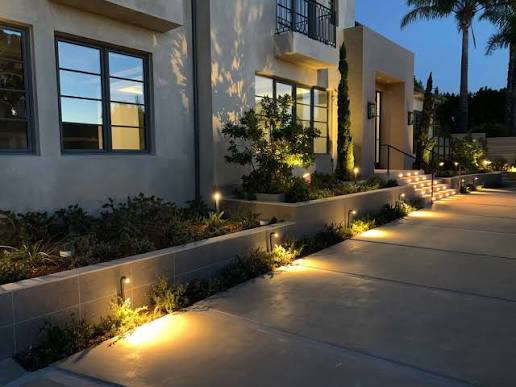
Landscape lighting prices can vary widely because homeowners are not buying a fixed-size product. One property may need a handful of path lights and two tree uplights, while another includes architectural lighting, garden beds, patios, side yards, steps, and several separate control zones.
That makes the number of fixtures only one part of the estimate.
Property size, fixture type, cable routing, transformer capacity, terrain, access, design complexity, and future expansion can all affect the final price. A useful budget starts with understanding what the system is expected to illuminate rather than asking what one light costs in isolation.
Current published pricing from Astoria Lighting Co lists roughly $2,500 to $5,000 for a typical front-yard package with about 8–12 fixtures, while more extensive whole-property systems with 20–30 or more fixtures are shown in the $5,000 to $15,000-plus range.
Those numbers are best treated as planning ranges.
A smaller front yard with a simple layout may require fewer components, while a property with multiple outdoor living areas, long cable runs, and several architectural features may move well beyond an entry-level system.
The quote should reflect the actual property.
Ten fixtures do not automatically produce the same price on every project.
A simple path light and a fixture selected to illuminate a large tree may differ in cost, placement, beam characteristics, and installation requirements.
The purpose of each fixture also determines how many are needed.
One mature tree may need more than one light to create a balanced effect. A long walkway may need several carefully spaced path lights, while a small architectural feature could require only one.
Counting fixtures without understanding what each one is meant to do can make two estimates look more similar than they really are.
A larger yard often requires longer wire runs and more time spent routing cable through planting beds or around hardscape.
Distance also affects system planning.
Lights spread across a front yard, side yard, and backyard may need more complicated cable routing than the same number of fixtures grouped close to the house.
Existing landscaping can influence labor as well.
Open planting beds are generally easier to work through than densely planted areas, steep grades, retaining walls, or locations where access is restricted.
The amount of ground covered by the lighting system can therefore matter almost as much as the fixture total.
A flat lawn with accessible planting beds presents a different installation than a property containing stone walls, stairs, mature roots, terraces, or extensive hardscape.
The installer may need to route wire around obstacles while protecting the existing landscape.
Fixture placement can also become more difficult on sloped terrain.
A light aimed from a flat bed may behave predictably, while the same fixture positioned on a grade may need additional adjustment to produce the intended beam.
Astoria Lighting Co identifies terrain, wiring runs, and access among the factors that can influence landscape-lighting project cost.
That is why photographs alone may not reveal everything affecting an estimate.
Tree lighting illustrates how specialized features can change the budget.
The company’s current tree and garden lighting guide lists individual installed tree uplighting at about $150 to $300 per tree, while more extensive multi-tree and garden projects are shown around $2,500 to $8,000.
The final number depends on how many trees are involved and what kind of effect is being created.
A small ornamental tree usually does not require the same lighting approach as a mature canopy tree.
Garden lighting can also include accent fixtures, controls, and cable distributed across several planting areas.
A landscape-lighting system needs more than fixtures.
Low-voltage installations typically require a transformer, wiring, connections, and some form of control.
Timers or compatible smart controls may also be included depending on the system.
Transformer sizing matters because the system has to support the connected lighting and allow for appropriate operation.
If future expansion is likely, homeowners may want to discuss whether the initial system should leave room for additional fixtures.
Paying attention to these supporting components makes quote comparisons more accurate than simply dividing the total by the number of lights.
Suppose one proposal is noticeably cheaper than another.
Before deciding that it offers better value, compare exactly what each installer plans to illuminate.
Does one include the side yard while the other covers only the front? Are transformers, controls, wiring, and installation included? Are the same trees, paths, and architectural features part of both designs?
When reviewing a proposal from Astoria Lighting Co, homeowners can compare the listed fixture locations and intended effects against competing quotes rather than comparing totals without confirming that the scopes match.
A lower number may simply describe a smaller lighting plan.
A complete landscape-lighting plan does not always need to be installed at once.
Astoria’s current landscape-lighting information specifically notes that projects can be designed in phases, such as completing the front yard first and adding the backyard later.
This can be useful when the long-term plan is clear but the homeowner wants to spread the expense.
Phasing works best when the first installation anticipates later additions.
Transformer capacity, control zones, and wire routes may be worth discussing before the initial work begins so future expansion does not require unnecessary changes to completed sections.
Two systems with the same number of fixtures can produce very different outcomes.
Good design depends on beam direction, fixture spacing, glare control, plant growth, viewing angles, and the relationship between different lighting layers.
More fixtures are not automatically better.
A smaller number placed thoughtfully may create stronger visual depth than a larger number installed without a clear plan.
This is particularly important around paths and entertaining areas, where excessive brightness can make the property uncomfortable after dark.
The estimate should therefore be judged partly by what the proposed lights are intended to accomplish.
Before accepting a quote, ask how adjustment and future changes are handled.
Landscape plants grow, trees change shape, and outdoor spaces evolve.
A fixture that is perfectly aimed today may eventually need to be repositioned as foliage matures.
Near the end of the decision process, homeowners can ask Astoria Lighting Co how fixture adjustment, system expansion, controls, and future additions would be handled within the proposed design.
Those details help show whether the price covers only installation day or supports a system intended to remain useful as the property changes.
There is no universal landscape lighting cost that applies to every home.
A small front-yard system can require a very different investment from a multi-zone property with tree lighting, patios, paths, architectural accents, and backyard coverage.
Fixture quantity matters, but so do terrain, cable distance, access, controls, transformer requirements, installation complexity, and the features being illuminated.
The best way to evaluate cost is to compare clearly defined designs.
Once each quote identifies what will be lit, which components are included, and how the system can grow or be maintained later, the numbers become much easier to compare fairly.