
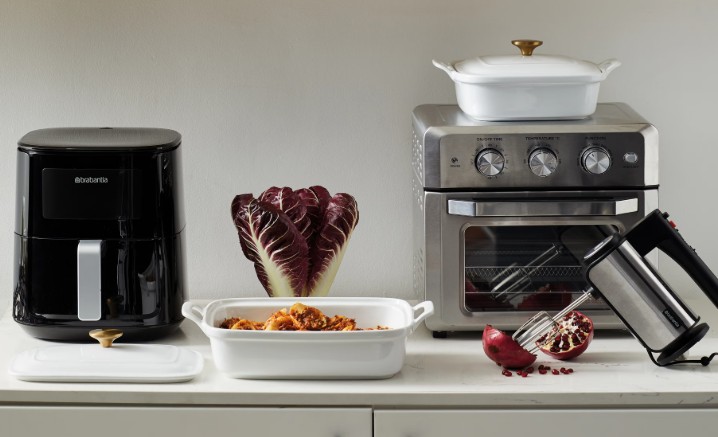
Air fryers changed weeknight cooking mainly by removing the preheat. A small convection chamber reaches cooking temperature in two to three minutes against fifteen or more for a conventional oven, which turns a 45 minute meal into a 25 minute one and makes cooking on a Tuesday evening feel possible rather than ambitious. They also use roughly 50 to 70 percent less electricity for small portions, because you are heating a two litre space instead of a sixty litre one.
The change is less about frying and more about scale. Most European households cook for one to three people on a weeknight, yet the standard built in oven is sized for a Sunday roast, and heating that volume for two chicken thighs was always wasteful. Manufacturers noticed the mismatch. The air fryer is essentially a right sized oven with a good fan, and the name is the least accurate thing about it.
An air fryer is a compact convection oven with a heating element directly above the food and a fan running fast enough to move hot air through a perforated basket. That combination drives the Maillard reaction and surface dehydration quickly, which is what produces browning and crispness. No oil bath is involved at any point, so calling it frying is marketing rather than physics.
The practical consequence is that food cooks from all sides at once with strong air movement, so timings shrink by roughly 20 to 25 percent compared to a fan oven at the same temperature, and you generally drop the temperature by about 20 degrees. Frozen chips take 15 to 18 minutes at 190 degrees. Chicken thighs run 22 to 25 minutes at 190. A whole small chicken of 1.2 kilograms is around 45 to 50 minutes, which is where the machine stops being obviously faster.
Where the design falls down is anything wet or batter coated. Air fryers cannot brown a wet surface, so a curry, a stew or a beer battered fillet gets nowhere. Baked goods that rise, like a sponge cake, tend to dome and crack because of the direct top heat and the fan. Understanding that boundary saves you from the two or three failed experiments that lead people to put the machine in a cupboard.
Electricity prices across Europe have made the running cost argument matter more than it used to. A typical air fryer draws 1,400 to 2,000 watts against 2,000 to 3,000 for an electric oven, and it runs for less time with no preheat, so a 20 minute session uses somewhere around 0.4 to 0.6 kWh against roughly 1.2 to 1.8 kWh for the same job in a full sized oven. Consumer testing organisations across several European markets have repeatedly reported savings in this range for small portions.
Convert that to money and it is modest but real. At Swiss tariffs of roughly 25 to 35 centimes per kWh, you might save 20 to 30 centimes per meal, which over four or five uses a week is somewhere around CHF 50 to CHF 70 a year. In markets with higher unit rates the figure climbs. Against a purchase price of CHF 70 for a basic model or CHF 150 to CHF 300 for a good dual basket unit, the payback is measured in years rather than months, so buy it for the time saving and treat the energy reduction as a bonus.
There is a summer benefit that gets overlooked in flats without air conditioning. A full oven heats the kitchen noticeably for an hour afterwards. An air fryer barely does, which is why usage in Southern European households tends to rise through July and August rather than dropping the way oven use does.
Basket capacity is quoted in litres and it is the number most people get wrong. A 3.5 to 4.5 litre single basket suits one or two people and handles about 500 grams of chips or two chicken breasts. Households of three or four want 6 to 8 litres, and dual basket models of 8 to 11 litres let you cook a protein and a vegetable at different temperatures simultaneously, which is the feature that genuinely changes weeknight cooking rather than just accelerating it.
Kitchen footprint deserves an actual measurement before you order. A typical 6 litre unit occupies around 33 by 33 centimetres of worktop with a height near 33 centimetres, and it needs 10 to 15 centimetres of clearance behind and above for the exhaust. In compact European kitchens, particularly older Swiss and city apartments where usable worktop can be under 120 centimetres total, that is a serious commitment. Flat drawer style models and oven style units with a shelf sit lower and often work better under wall cabinets. Comparing dimensions and basket volumes side by side, whether on a general retailer like pandaloo.ch or a specialist appliance site, is worth doing before capacity persuades you into something that will not fit.
Household type shifts the answer too. Students and single person flats often do better with a small 3.5 litre model that doubles as their only oven. Families with children benefit most from dual baskets and a dishwasher safe non stick basket, because the cleaning burden is what determines whether an appliance stays on the counter. People who batch cook on Sundays get less from an air fryer, since reheating and roasting large trays remains an oven job.
The behavioural shift is the interesting part. Because the barrier to starting is low, people cook fresh food on evenings they would previously have ordered in or eaten something from a packet, and dietary survey work across Europe has linked more frequent home cooking to better overall diet quality. It is not that air fried food is healthier in itself. It is that a machine which produces something decent in 20 minutes gets used on a Wednesday when you are tired.
The routine that emerges in most homes is repetitive and that is fine. Frozen items on the nights nobody has energy, a tray of vegetables tossed in a spoon of oil with chicken thighs on the nights someone does, reheated pizza slices and leftover roast potatoes that come out better than they did originally. Reheating is quietly the killer application, because a microwave makes things soft and an air fryer makes them crisp again in four minutes.
The trade offs are real. Capacity limits mean cooking for six often needs two batches, which erases the time advantage entirely. The fan is loud, usually 55 to 65 decibels, and open plan kitchens notice it. Non stick coatings on baskets wear, so metal utensils and abrasive scourers shorten the life of the machine considerably, and the honest lifespan of a mid range unit is around three to six years.
If you are deciding whether to buy one, the question worth asking is not whether it cooks well, because it does. It is whether you have 33 centimetres of worktop you are willing to give up permanently, since an appliance stored in a cupboard gets used roughly once a month regardless of how good it is. Measure that space first, then decide the capacity, and expect to spend the first fortnight recalibrating timings before the machine settles into being the thing you reach for without thinking.