

Why is my car making a clicking noise? If you have been asking yourself this question, you are not alone.
A clicking noise from your car can mean something as simple as low engine oil or as serious as a failing CV axle.
The sound can come from under the hood, beneath the car, near the wheels, or even from inside the dashboard.
Where it happens and when it happens are your two biggest clues.
Before diving into causes, you need to narrow down when and where the noise happens. This saves time and money on diagnosis.
Ask yourself these four questions. Does the click happen when you start the engine? Does it happen while driving, turning, or braking? Does it happen only when accelerating? Does the sound speed up or slow down with the engine or with vehicle speed?
Your answers point directly to the right section of this guide. A click that follows engine RPM is usually an engine or oil issue. A click that follows wheel speed is usually a CV joint, brake, or wheel bearing issue.
The most common reason your car makes a clicking noise when you try to start it is a dead or weak battery. When the battery does not have enough charge, it cannot power the starter motor properly.
You will typically hear a rapid series of clicks, sometimes 10 or more in quick succession. This is the solenoid trying to engage the starter over and over without enough power to complete the crank.
A fully dead battery produces no sound at all. A weak battery produces fast clicking. Try jump-starting the car. If it starts immediately, test the battery and alternator before driving far.
The type of click tells you a lot.
| Click Type | Most Likely Cause |
|---|---|
| Rapid clicking (multiple fast clicks) | Dead or weak battery, corroded terminals |
| Single loud click | Faulty starter motor or relay |
| Single click with nothing else | Seized engine or bad starter solenoid |
| Clicking plus dashboard lights going dim | Battery or alternator failure |
Rapid clicking means the battery has some power but not enough to crank the engine. A single loud click points directly at the starter motor or relay.
The starter motor is the electric motor that cranks your engine when you turn the key or press the start button. When it fails, it often produces one loud click and nothing else.
The starter relay (also called the solenoid) is the switch that sends power to the starter. If the relay is faulty, it can produce a single click even if the starter itself is fine.
A loose or corroded connection between the relay and starter can also cause this symptom. Cleaning battery terminals and checking wiring connections is always the first step before replacing parts.
Battery corrosion is one of the most overlooked causes of clicking on startup. A buildup of white or bluish crust on the positive or negative terminal creates resistance in the circuit.
Even a fully charged battery will struggle to deliver power through corroded terminals. The starter gets inconsistent power and clicks without turning the engine over.
Cleaning terminals with a wire brush and a baking soda and water solution costs nothing and takes five minutes. It is always worth doing before buying a new battery.
The alternator charges the battery while the engine runs. If the alternator fails, the battery slowly drains even while driving.
You may start the car fine in the morning but return to clicking a few hours later. Dimming headlights and dashboard warning lights are common signs of a failing alternator.
If your car starts after a jump but dies again within minutes, the alternator is likely the problem rather than the battery itself.
The most common reason your car makes a clicking noise when turning is a worn or damaged CV (constant velocity) joint. This is the classic symptom every mechanic knows.
CV joints are located on the drive axles. They allow power from the transmission to reach the wheels even as the suspension moves up and down and the steering turns left and right. Each axle typically has an inner and outer CV joint.
When the rubber boot around a CV joint tears, grease leaks out and dirt gets in. The joint wears rapidly and develops excessive play. That play creates a sharp clicking or popping sound that gets louder when you turn sharply while accelerating.
You can do a quick test. Drive in a slow circle in an empty parking lot with the wheel turned fully left, then fully right. If the clicking gets louder on one side, that side has the bad CV joint.
Check under the car for grease splattered on the inside of the wheel arch. This is a classic sign that the CV boot has already failed.
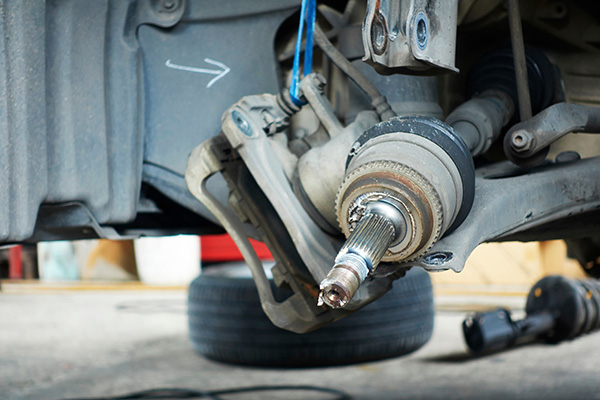
Catching a torn CV boot early can save you significant money.
| Stage | Condition | Recommended Fix | Approx. Cost |
|---|---|---|---|
| Early | Boot torn, grease present, joint still smooth | Replace CV boot only | $150 – $300 |
| Moderate | Some wear, clicking on sharp turns | Replace outer CV joint | $200 – $400 |
| Advanced | Loud clicking on all turns, vibration | Replace full CV axle | $400 – $800 |
| Severe | Joint seized or broken | Full axle and potential differential damage | $800+ |
Do not ignore CV joint clicking. A fully failed CV joint can leave you stranded with a broken axle mid-drive.
Tie rod ends and ball joints are suspension components that wear over time. When they develop play, they can produce clicking or clunking sounds during turning or going over bumps.
Ball joint clicking is often described as a knocking click rather than the sharp popping of a CV joint. You may also feel looseness in the steering wheel when this happens.
Have suspension components inspected during regular tire rotations. A worn ball joint that completely fails is a serious safety hazard.
One of the easiest fixes for a driving click is a loose wheel cover or hubcap. The cover spins with the wheel and bumps against surrounding parts, creating a repetitive clicking sound that matches vehicle speed.
Check all four wheel covers. Push and wiggle each one to feel for looseness. Tightening or replacing a hubcap takes minutes and costs very little.
Wheel bearings allow your wheels to spin smoothly on the axle. When they wear out, they can produce clicking, grinding, or humming sounds that increase with vehicle speed.
Wheel bearing noise often gets louder when you swerve gently in one direction. Load transfers to one side and puts extra stress on the bearing, amplifying the sound. This is a useful diagnostic trick.
A failed wheel bearing is dangerous. It can cause the wheel to wobble or, in extreme cases, separate from the vehicle while driving. Do not delay if you suspect a wheel bearing.
A small stone or piece of road debris embedded in a tire tread can produce a rhythmic clicking sound that exactly matches wheel rotation speed. It is annoying but harmless.
Inspect each tire by slowly rolling the car forward a few feet and checking the tread carefully. A pebble is easy to remove with a flathead screwdriver. Just ensure there is no puncture underneath.
Rear-wheel-drive and four-wheel-drive vehicles use universal joints (U-joints) on the driveshaft. These joints transfer power from the transmission to the rear differential.
A worn U-joint often produces a cyclical clunking or clicking noise when accelerating from a stop or when shifting between drive and reverse. The noise typically comes from underneath the center of the vehicle rather than near the wheels.
U-joint replacement is moderately expensive but critical. A failed U-joint can cause the driveshaft to separate from the vehicle at speed, which is a serious safety event.
Brake pads that are loose in their caliper bracket can shift slightly when you press the brake pedal. This movement produces a clicking sound at low speeds or when first applying the brakes.
New brake pads come with anti-rattle clips or shims that hold them firmly in the caliper. If these clips are missing, worn out, or improperly installed, the pad rattles and clicks.
A clicking sound specifically when you first apply the brakes after moving is a classic sign of loose brake pads or missing anti-rattle hardware.
Anti-rattle springs are small metal components inside the braking system that hold brake pads firmly in place. When they rust or wear out, pads can move around and produce clicking.
This is an easy and inexpensive fix. A mechanic can replace anti-rattle clips or springs during a regular brake service. Never ignore brake noises of any kind.
Severely worn or warped brake rotors can cause clicking and vibration when braking. Rotors have a minimum thickness specification. Once they go below that limit, they no longer absorb heat or pressure evenly.
You may feel a pulsing in the brake pedal alongside the clicking if rotors are warped. Rotor replacement is a standard repair that also requires fresh brake pads at the same time.
Low engine oil is one of the most common and most preventable causes of engine clicking. Oil lubricates every moving part inside the engine. Without enough of it, metal components make direct contact and produce ticking or clicking sounds.
The clicking usually comes from the valve train area at the top of the engine. It often starts loud during a cold start and quiets as oil warms up and circulates. If it persists after the engine warms, the oil level is likely critically low.
Check your oil immediately. Pull the dipstick, wipe it clean, reinsert it, and pull it again. If the level is below the minimum mark, add oil before driving further. Also look under the car for signs of an oil leak.
Valve lifters, also called tappets, are small cylindrical components that open and close engine valves in coordination with the camshaft. Modern engines use hydraulic lifters that rely on oil pressure to maintain proper valve clearance.
When lifters wear out, get clogged with sludge, or run low on oil pressure, they produce a distinctive metallic ticking known as lifter tick. The sound rises and falls with engine RPM and is most prominent at idle.
An oil change with fresh oil of the correct grade often reduces lifter tick significantly. If the noise persists after an oil change, the lifters themselves may need replacement, which is a more involved repair.
An exhaust manifold leak is a surprisingly common cause of engine ticking that many drivers misdiagnose. The exhaust manifold collects hot gases from the engine cylinders and routes them toward the exhaust system.
When a gasket fails or a crack develops in the manifold, exhaust gas escapes at the leak point. This produces a sharp ticking or tapping sound that is loudest when the engine is cold. As the metal heats up and expands, the gap sometimes closes and the sound reduces.
The ticking from an exhaust leak is typically loudest during the first few minutes of driving. It can also produce a faint burning smell in the cabin when the car heats up.
Spark plugs ignite the air-fuel mixture in each cylinder. When a plug wears out, becomes fouled with carbon deposits, or fails to seal properly in its threaded bore, it can cause misfires and clicking or ticking sounds.
A loose spark plug that has lost its thread seal allows exhaust gases to leak past it with each combustion cycle. This creates a rhythmic ticking that speeds up with engine RPM.
Spark plugs are a routine maintenance item. Replacing them on schedule (typically every 30,000 to 100,000 miles depending on plug type) prevents multiple issues including clicking, rough idling, and poor fuel economy.
The timing chain synchronizes the rotation of the crankshaft and camshaft so valves open and close at the correct moment. A loose or stretched timing chain can produce a rattling or clicking sound from the front of the engine.
Timing chain noise is most prominent at cold start and may quiet down as oil pressure builds. It often sounds like a chain dragging or rattling against its guide rails.
This is a serious issue. A failed timing chain can cause catastrophic engine damage if the timing jumps. Do not delay diagnosis if you suspect timing chain noise.
Rod knock is one of the most severe engine noises a driver can hear. It is a deep, rhythmic knocking or clicking sound that comes from inside the engine block and worsens under acceleration.
It is caused by excessive clearance between the connecting rod bearing and the crankshaft journal, usually due to oil starvation or severe bearing wear. Rod knock means the internal engine components are physically damaged.
If you hear rod knock, reduce speed immediately and have the car towed to a mechanic. Continuing to drive will destroy the engine rapidly.
While outer CV joints click during turns, inner CV joints tend to click or clunk during acceleration. The inner joint is under more load when power is being applied to the wheels.
Inner CV joint noise is often described as a clunking or clicking that happens specifically when accelerating from a stop, rather than during steady-speed driving.
A mechanic can confirm this with a road test and by inspecting the inner CV boot for tears and grease loss.
Modern direct-injection engines have fuel injectors that fire with a mechanical click. In a healthy engine, this is inaudible from inside the car.
However, when injectors become dirty, clogged, or begin to fail, their clicking can become audible and irregular. This may be accompanied by rough idling, hesitation, or a slight drop in fuel economy.
Fuel injector cleaning or replacement resolves this type of clicking. Some high-mileage engines benefit from periodic fuel system cleaning to keep injectors functioning cleanly.

Detonation, also called pinging or knocking, is a sharp metallic clicking sound that occurs during heavy acceleration. It happens when the air-fuel mixture in the cylinder ignites before the spark plug fires, creating two flame fronts that collide.
Common causes include low-octane fuel, carbon buildup in cylinders, advanced ignition timing, or a failing knock sensor. Detonation is destructive and can damage pistons and bearings over time.
Using the correct fuel grade for your vehicle and addressing any engine issues promptly prevents detonation.
A clicking or ticking sound for a few minutes after you park and shut off the engine is usually completely normal. This is the exhaust system cooling down.
Hot metal components in the exhaust pipe, manifold, and catalytic converter contract rapidly as they cool. This thermal contraction creates ticking sounds that are harmless and stop within a few minutes.
The sound is typically softer and more irregular than a mechanical click and fades progressively. If it is unusually loud, persists for a long time, or is accompanied by a burning smell, have the exhaust system inspected.
Use this quick-reference table to match your specific situation to the most likely cause.
| When Does It Click? | Where Does It Come From? | Most Likely Cause |
|---|---|---|
| When starting, rapid clicks | Engine bay | Dead battery, corroded terminals |
| When starting, single click | Engine bay | Faulty starter motor or relay |
| When turning | Front wheel area | Bad CV joint |
| When driving, matches wheel speed | Wheel area | Loose hubcap, wheel bearing, stone in tire |
| When braking | Wheel/brake area | Loose brake pad, worn anti-rattle clips |
| When accelerating | Engine bay | Low oil, lifter tick, detonation |
| At idle, rises with RPM | Engine bay | Low oil, worn lifters, exhaust leak |
| Cold start only | Engine bay | Exhaust manifold leak, timing chain |
| Under load, deep knock | Engine bay | Rod knock — serious |
| After shutting off | Exhaust area | Normal thermal cooling |
Repair costs vary widely depending on the cause. Here is a realistic cost range for each common issue.
| Problem | DIY Cost | Shop Cost |
|---|---|---|
| Jump-start and battery test | Free | Free to $30 |
| Battery replacement | $100 – $200 (parts) | $150 – $300 |
| Clean corroded terminals | Under $10 | $20 – $50 |
| Alternator replacement | $150 – $300 (parts) | $400 – $700 |
| Starter motor replacement | $100 – $250 (parts) | $300 – $600 |
| CV boot replacement | $30 – $80 (parts) | $150 – $300 |
| Full CV axle replacement | $80 – $150 (parts) | $300 – $800 |
| Brake pad replacement | $30 – $80 per axle | $150 – $350 per axle |
| Oil change | $25 – $60 | $60 – $150 |
| Valve lifter replacement | $300 – $600 (parts) | $800 – $1,500 |
| Exhaust manifold repair | $50 – $200 (gasket) | $300 – $900 |
| Spark plug replacement | $20 – $80 | $100 – $250 |
| Wheel bearing replacement | $50 – $120 (parts) | $200 – $500 |
| Timing chain replacement | $200 – $500 (parts) | $1,000 – $2,500 |
| Rod knock / engine rebuild | N/A | $2,500 – $6,000+ |
Catching problems early always costs significantly less. A $30 oil change prevents a $1,500 lifter replacement. A $200 CV boot fix prevents a $700 axle replacement.
Not every clicking noise is an emergency. But some are.
Stop driving immediately if you hear:
Safe to drive short distances to a mechanic if you hear:
Can monitor and schedule a repair if:
Most clicking noises are preventable with basic maintenance habits.
Check your engine oil level monthly. Low oil is behind a huge percentage of engine clicking issues. It takes two minutes with the dipstick and prevents thousands of dollars in engine damage.
Follow your oil change schedule. Old, degraded oil cannot maintain pressure in hydraulic lifters. Fresh oil of the correct grade and viscosity is essential for quiet, healthy engine operation.
Inspect CV boots during tire rotations. Mechanics check these routinely. Catching a torn boot early means a $200 repair instead of a $700 axle replacement.
Replace brake pads before they wear to metal. Worn pads and missing anti-rattle hardware cause brake clicking. Regular brake inspections prevent this and keep you safe.
Keep battery terminals clean. A quick visual check every few months and a clean with a terminal brush prevents the corrosion that causes starting clicks.
Use the correct fuel grade. Using lower octane fuel than your engine requires causes detonation pinging. Always match the fuel grade to your owner’s manual specification.
Address warning lights immediately. The oil pressure light, battery light, and check engine light are all related to common causes of clicking. Ignoring them turns small fixes into large ones.
The most common cause is a dead or weak battery that cannot deliver enough power to the starter motor. Rapid clicking points to the battery, while a single loud click suggests a faulty starter motor or relay.
It depends on the cause. A clicking CV joint is usually drivable for a short distance to a mechanic, but rod knock, a seized wheel bearing, or an oil warning light alongside clicking means you should stop driving immediately.
A clicking noise when turning almost always means a worn CV joint. The outer CV joint on the side you are turning toward is typically the culprit. Inspect the CV boot for tears and grease loss.
Yes. Low engine oil causes metal components in the valve train, particularly the hydraulic lifters, to lose lubrication. This creates a ticking or clicking sound from the top of the engine that worsens during acceleration.
Clicking when braking is usually caused by loose brake pads, worn anti-rattle clips, or a missing shim inside the caliper bracket. These components hold the brake pad firmly in place and prevent movement when pressure is applied.
Clicking after shutdown is almost always the exhaust system cooling down. Hot metal contracts as it cools and makes ticking sounds. This is normal and stops within a few minutes. If it is unusually loud or accompanied by a burning smell, inspect the exhaust.
A single loud click with no engine crank points to a faulty starter motor, a bad starter relay, or a seized engine. Check battery connections first, but if those are fine, a mechanic needs to test the starter circuit.
Clicking during acceleration can mean a worn inner CV joint, low engine oil causing lifter noise, an exhaust manifold leak, or engine detonation from incorrect fuel. The location of the sound is the key to narrowing it down.
A clicking CV joint can sometimes be driven for a few hundred miles, but the joint will fail completely without warning. Once the clicking becomes constant or is present even on straight roads, the axle can break at any moment. Replace it promptly.
Yes. Old or degraded oil loses its ability to maintain pressure inside the engine, particularly in hydraulic lifters. A fresh oil change with the correct grade often quiets engine ticking. If the noise continues after an oil change, have the valve train inspected.
A car making a clicking noise is one of the most common automotive concerns drivers face in 2026.
The good news is that most clicking noises are diagnosable at home with a little attention to when and where the sound occurs.
Rapid clicking on startup almost always means the battery. Clicking when turning means a CV joint.
Clicking when braking points to brake hardware. Engine ticking during driving usually comes back to oil.
The most important thing you can do is act early. Every clicking noise that gets ignored tends to get worse and more expensive over time.
A $10 bottle of oil, a $30 terminal brush, or a $200 CV boot repair today can prevent a $2,000 engine or axle repair next month.
Use the tables and diagnostic guides in this article to pinpoint your problem, understand the fix, and make an informed decision about whether to handle it yourself or take it to a professional.
Your car is telling you something, so listen carefully and respond quickly.
Regular maintenance remains the single best defense against unexpected clicking noises.
Check your oil, inspect your tires, service your brakes on schedule, and pay attention when your car sounds different than usual.
That habit alone will save you thousands of dollars over the life of your vehicle.