
Bitcoin can whipsaw between multiple price levels in a matter of hours during volatile stretches — then close the week almost exactly where it started. Traders holding long positions through all that chop? They captured nothing. Traders running grid bots across that range had a shot at profiting from every oscillation along the way.
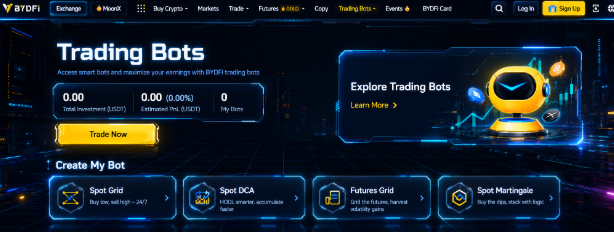
Weeks like that explain why the grid bots vs DCA debate has picked up steam in 2026. Both approaches automate execution and strip out emotional decision-making, but they operate on fundamentally different axes — price versus time — and their performance diverges sharply depending on what the market’s actually doing. To compare how each works in practice, it helps to look at a platform offering both under one roof. BYDFi, operating since its 2020 founding and now serving over 1,000,000 registered users globally, runs a four-bot automation suite covering grid trading, DCA, and several hybrid variants — making it a useful reference point throughout this piece.
What follows is a breakdown of mechanics, optimal conditions, risk profiles, and parameter ranges that determine which crypto automation strategy fits which market regime.
How Grid Trading Bots Capture Price Oscillations
A grid trading bot automates a “buy low, sell high” strategy within a predefined price range. It divides that range into multiple grid levels — anywhere from 2 to 99 — placing buy orders at lower levels and sell orders at higher levels automatically. Each completed buy-sell cycle generates a small profit. Multiply that across dozens of grid levels running around the clock, and the cumulative effect starts to compound.
The critical parameters: upper price bound, lower price bound, number of grids, per-grid order size. Get the range wrong and you’ve got problems. Too narrow, and the bot sits idle when price escapes. Too wide, and individual grid profits thin out to almost nothing.
One way platforms tackle this design burden is through AI-recommended parameters. BYDFi spot trading pairs, for instance, populate AI-suggested grid settings based on historical backtesting within seconds of selecting a pair — noticeably faster than manually calculating grid spacing. Users can also run multiple Spot Grid bots simultaneously on the same USDT pair, which opens the door to layered strategies across different range widths.
BYDFi’s fees for bot-executed trades sit at a standard 0.1% buy / 0.1% sell on spot, with no additional bot surcharge — meaning grid profitability calculations don’t need to account for hidden platform costs beyond the published maker/taker rates.
For leveraged exposure, the Futures Grid extends grid trading to perpetual pairs (USDT-M, USDC-M, COIN-M) with stop loss, take profit, and margin ratio controls. Tiered account access means users can start testing bot strategies with basic registration before completing full verification.
How DCA Strategies Accumulate Over Time
Dollar-cost averaging takes the opposite approach entirely. Rather than reacting to price levels, DCA automates periodic fixed-amount purchases at preset intervals — daily, weekly, or monthly — across 100+ trading pairs. The mechanism is deliberately indifferent to short-term price action. Each purchase either lowers or raises the average cost basis, and over extended periods, DCA smooths out volatility.
Grid bots are price-axis strategies. DCA strategies are time-axis strategies. That distinction matters more than most people realize.
Spot Investment configurations can be modified at any time, which adds flexibility that rigid interval schedules on some competing platforms lack. A related variant worth knowing about is Spot Martingale — a contrarian approach that increases investment amounts during market declines, averaging down costs through incremental buying, and profits when the market rebounds. It’s a high-risk play. Prolonged price declines can result in significant losses before any recovery occurs — if recovery occurs at all. Not for the faint-hearted.
Performance by Market Condition: The Data That Matters
Neither strategy wins universally. The Crypto Fear & Greed Index has oscillated between 25 and 82 multiple times in 2026 alone, confirming that market regimes shift frequently. Here’s how grid bots and DCA strategies map to those shifts:
| Factor | Grid Trading Bot | DCA Strategy |
| Optimal market condition | Sideways / range-bound | Downtrend / long-term accumulation |
| Trigger mechanism | Price levels (2–99 grids) | Time intervals (daily / weekly / monthly) |
| Available pairs | USDT spot pairs; futures pairs | 100+ spot pairs |
| Uptrend limitation | Stops capturing gains above upper bound | Buys at rising prices (higher avg cost) |
| Leverage option | Yes (Futures Grid) | No (spot only) |
Sideways markets are where Spot Grid bots shine. Range-bound price action generates repeated buy-sell cycles across grid levels, capturing swings that a buy-and-hold approach would miss entirely. A Bitcoin pair oscillating within a stable range for weeks on end? That’s a grid bot’s dream scenario.
Sustained downtrends favor DCA. Buying fixed amounts at scheduled intervals automatically lowers the average cost basis as price falls, which may benefit the portfolio if the asset eventually recovers — though recovery is never guaranteed. The strategy demands patience and genuine conviction that the asset will rebound.
Sustained uptrends expose grid bots’ primary weakness. If price breaks above the grid’s upper bound, the bot stops capturing further upside. BYDFi leverage options through the Futures Grid partially address this by letting traders maintain a directionally long bias while still capturing intra-trend volatility — using adjustable leverage for capital efficiency rather than committing the full notional value in spot. As Investopedia’s leverage explainer notes, leveraged positions amplify both gains and losses — which is why Futures Grid parameters demand considerably more precision than their spot counterparts.
Risk Profiles: Capital Exposure and the Spot Safety Net
Spot-based bots — Spot Grid, Spot Investment, and Spot Martingale — carry no liquidation risk. They operate entirely within the user’s spot balance with no forced liquidation mechanism. For traders who want automation without leverage exposure, that’s a meaningful structural advantage.
Futures Grid is a different animal. It carries leveraged liquidation risk, and the platform’s perpetual contracts support adjustable leverage levels. The Futures Grid includes margin ratio controls and SL/TP settings, giving traders granular control over their exposure — but the responsibility that comes with leverage doesn’t disappear just because a bot is placing the trades.
Capital allocation differs too. Grid bots tie up funds across the entire price range upfront — capital sits in pending orders. DCA spreads deployment over time, meaning less is at risk at any single moment, but the full position builds slowly.
Accessing and Deploying These Strategies in 2026
BYDFi copy trading principles extend into its Bot Marketplace, launched in 2026, where users explore strategies across all four bot types, view historical performance data, and deploy community-shared configurations with one click. Past performance doesn’t indicate future results — worth remembering every time you see a backtest that looks too good. The model helps users who’d rather replicate community-tested setups than build parameters from scratch. The exchange has been expanding its automation tools as part of a broader push into accessible trading infrastructure since its founding six years ago.
For traders who want to compare both approaches side by side, the platform’s dedicated automation hub — which houses all of BYDFi grid bots and DCA strategies — lets users start with AI-recommended parameters or copy marketplace strategies without manual configuration. The BYDFi app also provides a demo account for testing strategies before committing real capital, alongside push notifications for bot performance updates on mobile. The platform maintains regulatory registrations in multiple jurisdictions and publishes Hacken-audited Proof of Reserves.
As CoinGecko’s exchange tracker shows, the exchange maintains active spot and derivatives markets across the pairs its bots support.
FAQ
What is the difference between grid trading bots and DCA strategies in crypto?
Grid bots automate buy-low-sell-high within a set price range using 2–99 grid levels. DCA automates periodic fixed-amount purchases at daily, weekly, or monthly intervals. Grid bots are price-triggered; DCA is time-triggered.
Which strategy works better in a sideways market — grid bots or DCA?
Grid trading bots are generally more effective in range-bound markets, capturing repeated oscillations that buy-and-hold misses. DCA just keeps buying at similar price levels without profiting from the swings.
Do grid trading bots carry liquidation risk?
Spot Grid bots don’t carry liquidation risk — they operate within the user’s spot balance. Futures Grid bots carry leveraged liquidation risk and include stop-loss and margin ratio controls.
Can beginners use grid bots without designing parameters manually?
Yes. AI-recommended parameters based on historical backtesting are available, and the Bot Marketplace lets users copy community-created strategies with one click.
Do I need to complete full verification to try trading bots?
BYDFi offers tiered access levels, so users can explore bot features with basic registration before completing full identity verification.
Matching Strategy to Market Regime: A Trade-Off Summary
The grid bots vs DCA question doesn’t have a single answer — it has a conditional one. Each approach carries specific advantages and specific limitations.
Grid bots can extract profit from sideways volatility that buy-and-hold strategies waste entirely. DCA eliminates timing pressure and mechanically reduces average cost during extended drawdowns. Those are real, concrete benefits.
The flip side: grid bots become idle capital when price trends beyond the configured range, missing directional moves. And DCA in a prolonged downtrend without eventual recovery just means accumulating a depreciating asset at progressively lower — but still losing — prices. A sobering thought if you’re DCA-ing into something that won’t bounce back.
The 2026 Bot Marketplace model, where users browse historical performance data and one-click deploy strategies, signals a shift from manual configuration toward curated automation. As more platforms surface community performance data, the quality of strategy curation — not just the bot engine itself — is likely to become the differentiator worth watching.