
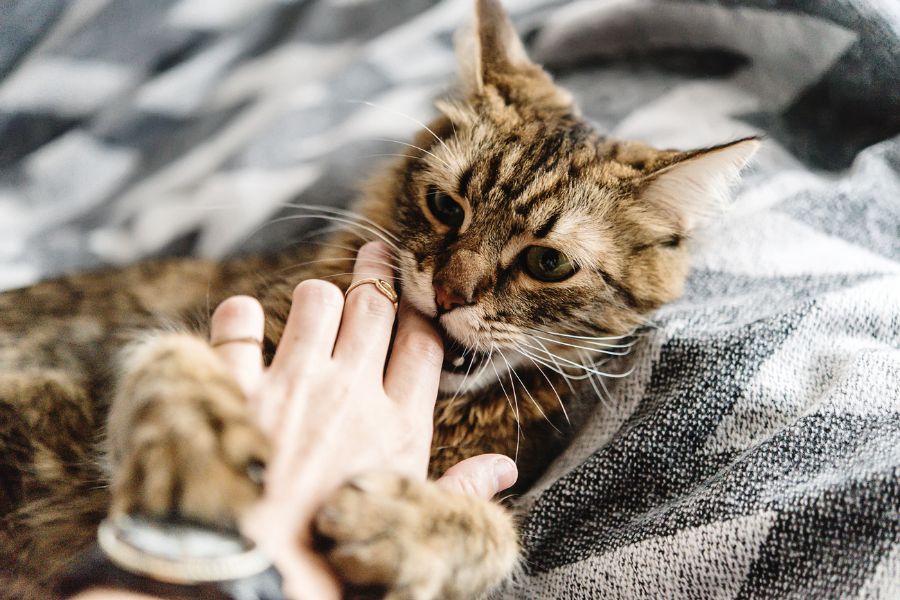
Why is my cat biting me — and what does it actually mean? Cat biting is one of the most common behavior questions pet owners ask, and the answer is rarely simple. Your cat is not being randomly aggressive.
They are communicating. Whether it is a soft nibble during a petting session or a sudden hard bite out of nowhere, every bite has a reason behind it.
This guide covers all the major causes of cat biting, the difference between love bites and aggressive bites, warning signs to watch for, how to stop the behavior safely, and what to do if a cat bite breaks your skin.
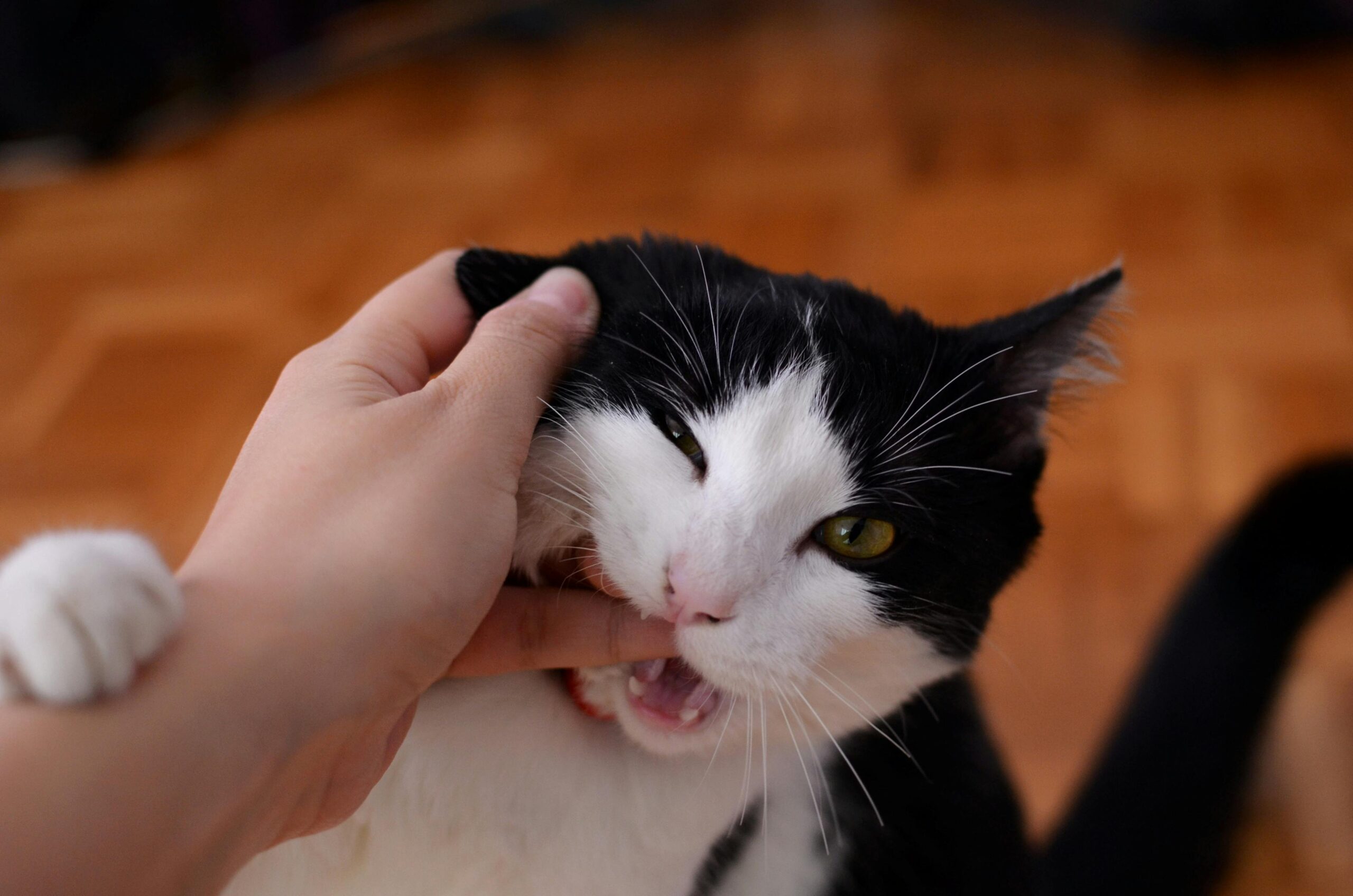
Cats bite because they are trying to tell you something.
The most common reasons include overstimulation during petting, play aggression, fear, pain, redirected aggression, and attention-seeking. Some bites are gentle and affectionate. Others are sharp warning signals. Understanding which type you are dealing with is the first step to fixing the problem.
Cats do not bite out of spite or cruelty. Every bite is a form of feline communication — and once you learn the language, the biting usually becomes much easier to manage.
Overstimulation is the single most common reason cats bite their owners.
Your cat is purring, you are petting them, everything feels perfect — then suddenly they turn and sink their teeth into your hand. This is called petting-induced aggression or overstimulation, and it happens because cats have a very low threshold for sensory input.
Each stroke sends nerve signals through your cat’s body. After a certain number of strokes, the stimulation becomes uncomfortable, even painful. Your cat’s only way to say “stop” is to bite.
Most cats give several warning signs before biting during petting. The problem is that owners either miss the signals or ignore them.
Warning signs of overstimulation:
When you see any of these signals, stop petting immediately. Give your cat space and let them decide when interaction resumes.
Play aggression is extremely common, especially in kittens and young cats.
Cats are natural predators. Their instinct is to stalk, pounce, grab, and bite. When they do not have appropriate outlets for this energy — like toys, wand games, or hunting simulations — they redirect that energy onto you.
This is why your cat ambushes your ankles as you walk down the hallway. Or why they grab your hand and kick with their back legs. They are practicing hunting. You are the prey.
Kittens separated from their littermates too early are especially prone to play aggression. Siblings teach each other bite inhibition — the concept that biting too hard ends the fun. Without that lesson, kittens grow into cats that bite too hard during play.
How to manage play aggression:
A scared cat is a biting cat.
When cats feel threatened, cornered, or unable to escape, they switch from flight to fight. Fear bites are usually quick, hard, and defensive. The cat is not attacking you — they are protecting themselves.
Common triggers for fear-based biting include loud noises, unfamiliar people, being picked up in a way they dislike, rough handling, or a history of negative experiences with humans.
Cats with a troubled past — rescue cats, strays, or cats that were mishandled — may reach the bite threshold faster than cats raised in calm, safe environments.
Signs your cat is biting out of fear:
The best response to fear biting is to give your cat space immediately. Do not chase them, reach for them, or try to comfort them by force. Calmness and distance are the most effective tools.
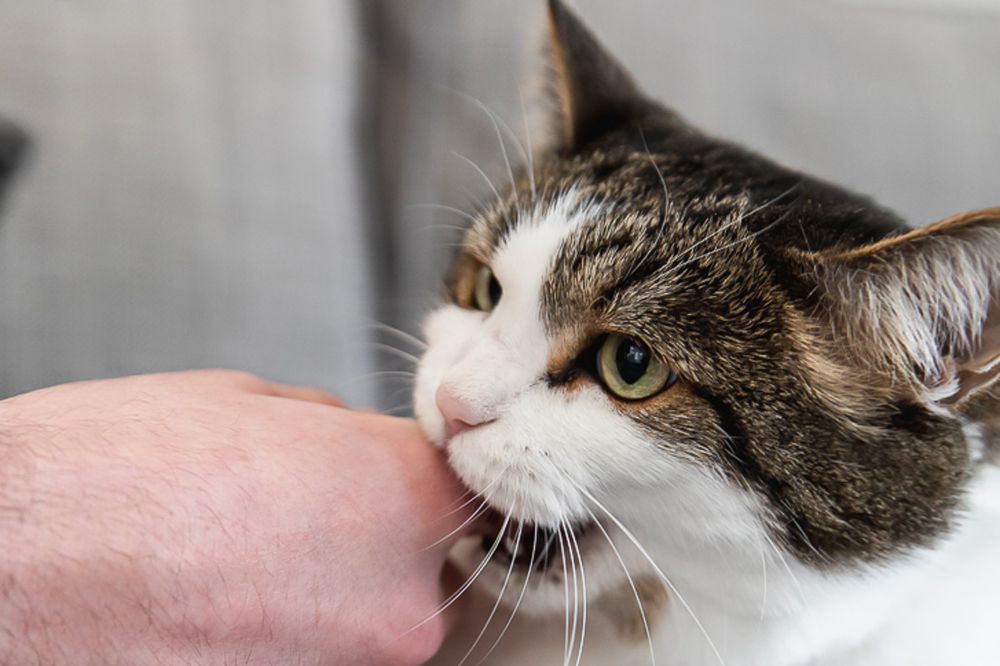
If your usually gentle cat suddenly bites you when you touch a specific area, pain may be the cause.
Cats hide pain instinctively — it is a survival mechanism inherited from their wild ancestors. By the time a cat bites when touched, the discomfort is often significant. Common causes of pain-related biting include arthritis, dental disease, skin irritation, injuries, and internal conditions.
Conditions that commonly cause pain biting in cats:
| Condition | Affected Area | Signs |
|---|---|---|
| Arthritis | Joints, spine, hips | Bites when touched near joints |
| Dental pain | Mouth, face | Flinches or bites near head/face |
| Skin irritation | Anywhere on body | Bites when back or tail is touched |
| Internal pain | Abdomen | Bites when belly is touched |
| Hyperthyroidism | Whole body sensitivity | Sudden onset aggression |
If your cat’s biting is new, sudden, or linked to a specific body area, schedule a vet visit. Treating the underlying medical condition often resolves the biting behavior completely.
Not all bites are aggressive. Some cats use gentle nibbling as a sign of love and bonding.
Love bites are soft, gentle nips that do not break the skin. They typically happen during petting sessions when your cat is visibly relaxed — slow-blinking eyes, a soft body, a gentle purr. Your cat may lick you first, then deliver a small nibble. This mirrors the grooming behavior cats use with each other, called allogrooming.
When a cat grooms their littermates or bonded companions, they use small nibbles to clean fur. When your cat does this to you, they are treating you as part of their social group. It is a compliment.
How to tell a love bite from an aggressive bite:
| Feature | Love Bite | Aggressive Bite |
|---|---|---|
| Pressure | Soft, barely felt | Hard, painful |
| Skin | Does not break skin | May break skin |
| Body language | Relaxed, soft eyes, purring | Tense, flat ears, wide pupils |
| Timing | During calm petting | During or after stimulation |
| Follow-up | May resume purring | May hiss or run away |
Love bites generally do not require intervention unless they escalate in pressure or frequency. If they do escalate, use redirection — distract your cat with a toy before the nip happens.
Some cats have discovered that biting gets a reaction.
If your cat has learned that nibbling your hand or ankle makes you jump, talk to them, or give them food — congratulations, they have trained you. Attention-seeking biting is a learned behavior, not instinct. And it is surprisingly common in cats that do not get enough mental stimulation or social interaction.
Signs this is attention-seeking rather than aggression: the bite is gentle, it happens when you are ignoring your cat or focusing on a screen, and your cat looks at you expectantly right afterward.
How to break the attention-seeking biting cycle:
Redirected aggression is one of the most confusing types of cat biting because the trigger has nothing to do with you.
Your cat spots a bird outside the window, or sees another cat in the yard, and becomes intensely aroused — but they cannot reach the target. All that predatory or territorial energy has nowhere to go. When you walk into the room at that moment, you become the outlet.
Redirected aggression bites can be hard and sudden, with no obvious warning from your perspective. The cat may seem to “snap” for no reason. But from the cat’s perspective, they are reacting to a legitimate threat — you just happened to be nearby.
After a redirected aggression episode, give your cat a minimum of 30–60 minutes alone to fully calm down before approaching them again.
How to reduce redirected aggression:
Cats are territorial animals and some biting is about establishing or protecting their status.
This is more common in multi-cat households, in homes with new pets or new people, or when a cat’s routine has been disrupted. The cat may bite as a way of asserting dominance over their space or over the people in it.
This type of biting often targets legs, ankles, or hands as the owner moves through the cat’s perceived territory.
Managing territorial biting involves creating distinct spaces and resources for each cat, introducing changes gradually, and using pheromone products like Feliway to reduce overall household tension.
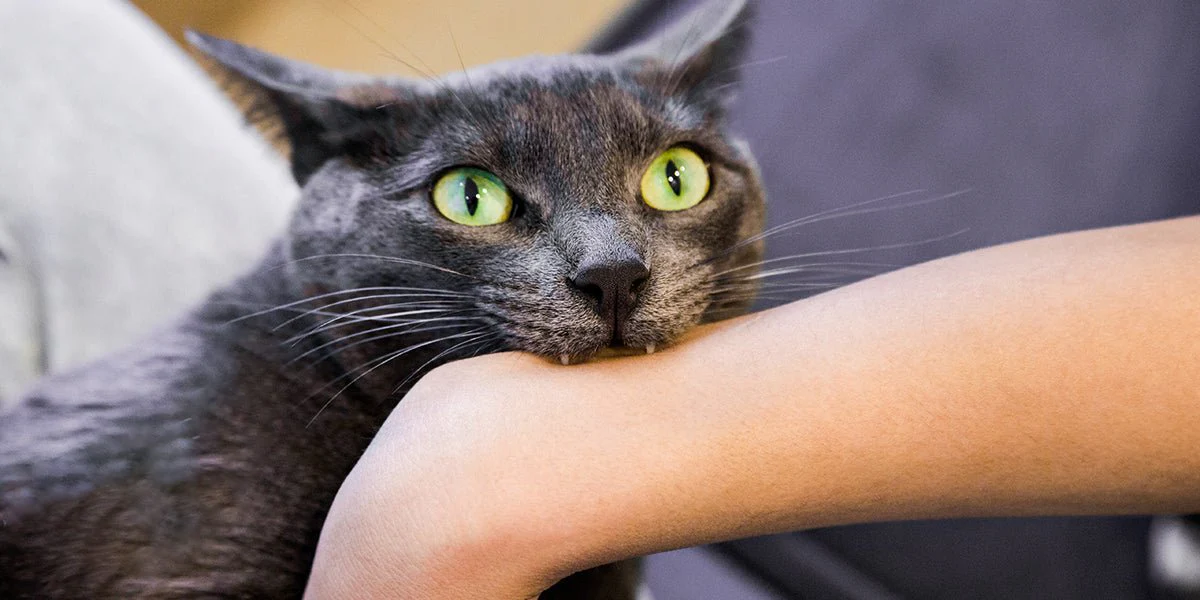
If your kitten is biting everything — including you — teething is likely involved.
Kittens lose their baby teeth between 3 and 6 months of age. During this period, their gums are tender and chewing provides relief. Your fingers, toes, furniture legs, and anything else within reach become targets.
Teething biting is not aggression. It is discomfort relief.
How to help a teething kitten:
The good news: teething biting usually resolves on its own once adult teeth fully come in, around 6–7 months.
Several medical conditions can cause sudden or increased aggression in cats.
Hyperthyroidism makes cats anxious, hyperactive, and reactive. Neurological conditions, including epilepsy or central nervous system disorders, can cause sudden aggression episodes. Cognitive dysfunction syndrome (feline dementia) in older cats can lead to confused or disoriented biting.
Dental disease is one of the most overlooked causes. A cat with a broken tooth, infected gum, or oral ulcer may bite when touched near the face — or even preemptively bite to avoid being touched at all.
If biting comes on suddenly, intensifies, or is paired with other behavioral changes like hiding, changes in appetite, or vocalization, see your vet. A physical exam and bloodwork can rule out or confirm medical causes.
Cats almost always telegraph a bite before it happens. The problem is that the signals can be subtle and fast.
Learning to read these signals is the most effective bite prevention strategy.
| Body Part | Relaxed Signal | Warning Signal |
|---|---|---|
| Tail | Gently curled or upright | Flicking, thumping, low |
| Ears | Forward, upright | Rotated back, flattened |
| Eyes | Soft, normal pupils | Wide, dilated pupils |
| Whiskers | Relaxed, fanned out | Pulled back flat |
| Skin | Smooth | Rippling or twitching |
| Posture | Loose and relaxed | Tense, crouched, stiff |
When you notice two or more warning signals appearing together, stop the interaction immediately. Do not wait for the bite to happen.
The tail is your most reliable early warning system. The moment it starts thumping or flicking rapidly, your cat is telling you they are done with the interaction.
Stopping biting requires a consistent, multi-step approach. There is no single fix.
Step 1: Identify the trigger
Every bite has a cause. Keep a mental note of when bites happen: during petting, during play, near certain people, in certain rooms, at certain times of day. Patterns reveal triggers.
Step 2: Avoid the trigger proactively
Do not wait for the warning signals. If your cat bites after 5 minutes of petting, stop at 3 minutes. If your cat bites when you pet their belly, stop petting their belly. Work within your cat’s comfort zone rather than pushing against it.
Step 3: Redirect, never punish
Physical punishment — hitting, flicking, spraying with water — does not work and makes biting worse. It increases fear and anxiety, which are root causes of many biting behaviors. Use redirection instead: the moment you see warning signals, offer a toy, end the interaction, or walk away.
Step 4: Use consistent positive reinforcement
Reward calm behavior with treats, praise, and gentle petting. Your cat learns that calm interaction = good things. Biting = interaction ends. This creates the right behavioral incentive.
Step 5: Increase enrichment
Many biting problems stem from boredom, excess energy, or unmet hunting instincts. Add puzzle feeders, window perches, climbing trees, rotating toys, and daily interactive play sessions to your cat’s routine.
Step 6: See a vet if needed
If biting is severe, sudden, or not responding to behavioral management, consult your vet. Medical causes must be ruled out. A vet may also refer you to a feline behaviorist for complex cases.
Avoid these common mistakes:
Do not yell or startle your cat. A dramatic reaction increases arousal and can make the next bite harder.
Do not hold or restrain your cat after a bite. Restraint intensifies fear and often leads to a second, harder bite.
Do not pull your hand away quickly. Fast movement triggers the predatory chase reflex and makes the bite worse. Instead, push gently toward the bite to startle the cat into releasing, then withdraw slowly.
Do not hit, flick, or spray your cat. These responses damage trust and increase anxiety without reducing biting.
Do not let children use hands as toys with cats. This teaches cats that hands are for biting and is a common reason cats bite children.
Cat bites are medically serious and should never be dismissed.
A cat’s teeth are sharp and narrow, creating deep puncture wounds that seal over quickly — trapping bacteria from the cat’s mouth underneath the skin. The warm, dark environment under the skin is ideal for bacterial growth. According to a Mayo Clinic study, 30% of patients hospitalized for cat bites on their hands needed to stay an average of 3.2 days, usually due to infection.
Immediate first aid steps:
Signs of infection to watch for (within 12–24 hours):
| Symptom | What It Means |
|---|---|
| Increasing redness and swelling | Localized infection forming |
| Warmth around the wound | Inflammatory response |
| Pus or discharge | Active bacterial infection |
| Red streaks extending from wound | Possible spreading infection (cellulitis) |
| Fever or chills | Systemic infection — go to ER |
| Swollen lymph nodes | Immune system response |
| Loss of movement in hand/fingers | Possible joint or tendon involvement |
The most common bacteria in cat bites is Pasteurella multocida, present in 70–90% of cats’ mouths. Symptoms can appear within 12 hours of the bite. A doctor may prescribe antibiotics even for seemingly minor punctures, particularly when the hand or joints are involved.
Seek emergency care immediately if you notice red streaks, fever, loss of movement, or if the wound is swelling rapidly.
Some people face a higher risk of serious infection from cat bites:
If you fall into any of these categories, seek medical care immediately after a bite breaks the skin — do not wait for infection symptoms to appear.
Prevention is always better than treatment. These habits significantly reduce biting over time:
Learn your cat’s body language. This is the single most effective prevention strategy. When you can read the early warning signals, you can end interactions before a bite happens.
Respect your cat’s “no.” Every time your cat asks for space and you give it, trust builds. Every time you ignore their signals, trust erodes and biting increases.
Never roughhouse with bare hands. Always use a toy as the intermediary between your hands and your cat’s teeth. This rule should apply to every person in the household, especially children.
Keep play sessions consistent. A cat that gets regular, structured play time has less pent-up energy to express through biting. Two 10–15 minute sessions per day is the commonly recommended target.
Socialize kittens early. Expose kittens to a wide variety of people, sounds, and handling experiences between 3 and 9 weeks of age. Well-socialized kittens grow into less fearful, less reactive adult cats.
Keep up with vet visits. Annual checkups catch pain-causing conditions before they become behavioral problems. Dental cleanings in particular can dramatically reduce biting in cats with oral pain.
| Reason | Type of Bite | Solution |
|---|---|---|
| Overstimulation | Sudden, sharp | Watch tail; stop petting earlier |
| Play aggression | Hard, grabbing | Use toys; freeze when bitten |
| Fear | Quick, defensive | Give space; reduce stressors |
| Pain | Localized, reactive | Vet visit immediately |
| Love bites | Gentle, soft | Redirect if escalating |
| Attention-seeking | Mild, persistent | Ignore; give proactive attention |
| Redirected aggression | Sudden, hard | Block trigger; give decompression time |
| Territorial | Stalking, biting | Multiple resources; gradual introductions |
| Teething (kittens) | Chewing, persistent | Chew toys; consistent redirection |
| Medical condition | Sudden onset | Vet visit; bloodwork |
Most sudden bites are caused by overstimulation, redirected aggression, or pain. Your cat likely gave subtle warning signals — twitching tail, tense posture — that went unnoticed. Review the context around each bite to find the pattern.
Gentle bites during purring are almost always love bites — a sign of affection and social bonding. They mimic grooming behavior between cats. If the biting stays gentle and painless, it is not a problem.
This is petting-induced aggression caused by overstimulation. Your cat enjoys petting to a point, then the stimulation becomes too much. Watch for tail flicking and skin twitching — these appear before the bite, not after.
Licking followed by biting is classic love bite behavior. Your cat is grooming you, which is a sign of trust and affection. The nip is part of the grooming sequence — the same behavior cats use on each other.
Ankle biting is almost always play aggression. Your moving feet trigger your cat’s hunting instinct. Schedule more active play sessions with wand toys to burn off predatory energy safely.
Yes, biting is a normal feline communication tool. It only becomes a problem when it is hard, frequent, or causes injury. Understanding the cause is the first step toward reducing unwanted biting.
Identify the trigger, avoid it proactively, redirect to a toy, and never punish. Consistency from every person in the household is essential. Most biting problems improve significantly within a few weeks of consistent management.
Yes. Cat bite wounds can develop serious infections within 12–24 hours due to bacteria like Pasteurella. Clean the wound immediately, apply antibiotic cream, and see a doctor within 8 hours — especially if the bite is on your hand.
Kittens bite for three main reasons: teething discomfort, play instinct, and learning bite inhibition. Provide chew toys, use wand toys for play, and consistently redirect biting away from your skin. The behavior typically improves by 6–7 months.
Yes. Cat bites can transmit bacteria including Pasteurella multocida, which causes cellulitis, and Bartonella henselae, which causes cat scratch disease. Serious infections can spread to joints, tendons, and the bloodstream. Always seek medical attention for bites that break skin.
Why is my cat biting me is a question with many answers — and almost all of them point to communication rather than cruelty.
Cats bite when they are overstimulated, scared, in pain, playing, or showing affection.
The key to stopping unwanted biting is understanding which type you are dealing with and responding accordingly.
Read your cat’s body language before the bite happens. Respect their signals when they ask for space.
Redirect hunting energy to appropriate toys. Rule out medical causes if biting starts suddenly.
And if a bite breaks your skin, take it seriously — clean it immediately and see a doctor within 8 hours.
With patience, consistency, and a better understanding of how cats communicate, most biting problems are very manageable.
Your cat is not your enemy — they are just trying to talk to you in the only language they have.