
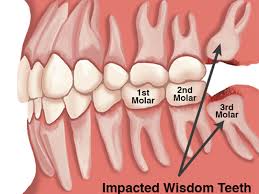
Why are wisdom teeth called wisdom teeth is a question that has a surprisingly deep and fascinating answer.
These late-arriving molars have been named, debated, and written about since the time of ancient Greece.
The name has nothing to do with intelligence. It has everything to do with the age at which they appear.
Wisdom teeth are your third and final set of molars, and they erupt between ages 17 and 25, a period historically associated with growing maturity and life experience.
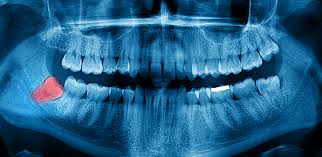
Wisdom teeth are the third set of molars located at the very back of both the upper and lower jaws. Most people develop four of them, one in each corner of the mouth.
They look nearly identical to your first and second molars. The only real difference is when they arrive. All other permanent teeth erupt during childhood and early adolescence. Wisdom teeth wait until late teenage years or early adulthood.
Each wisdom tooth sits at the far end of the dental arch. In dental terminology, they are labeled as the upper left, upper right, lower left, and lower right third molars.
Because they arrive last and often find very little room in a fully developed jaw, they are also the most likely teeth to become impacted or cause dental complications.
Most people have four wisdom teeth, but this is not universal. Some people develop only one, two, or three. Others develop none at all.
Around 35% of people are born missing at least one wisdom tooth. Scientists view this as evolution actively phasing out a structure that modern humans no longer need.
The name wisdom teeth is rooted in a simple observation that has been made across many cultures and centuries. These teeth arrive when a person is older, more mature, and presumably wiser than when their other teeth came in.
The idea has been expressed in multiple languages and frameworks, but the core meaning is the same: these are the teeth of a more experienced, wiser stage of life.
The earliest written reference to these teeth comes from the ancient Greek physician Hippocrates, who observed them in his writings. The Greek term for them was sophronisteres, which translates roughly as “prudent teeth” or “sensible teeth.”
Aristotle also wrote about them in the fourth century BC in his work History of Animals. He noted that these final molars appeared around the age of twenty and referred to them as the last teeth a person grows.
The Greek root sophia, meaning wisdom, forms the basis of the name that has traveled across two thousand years into modern English.
In ancient Rome, these teeth were referred to as dentes sapientiae, which translates directly as “teeth of wisdom.” This Latin term became the foundation for the name used in most European languages today.
The English term wisdom teeth is essentially a direct translation of the Latin dentes sapientiae. The same Latin root is behind the scientific name still used in dentistry today: third molars, which are formally classified under the broader term.
The English phrase teeth of wisdom appeared as early as the 1660s. The more compact term wisdom teeth became widely used in the nineteenth century.
By that point, the name had been in cultural circulation for over two thousand years across Greek, Latin, and various European languages, making it one of the oldest anatomical nicknames in recorded history.
The naming of these molars varies significantly across cultures, and many of the alternative names are more poetic or culturally specific than the English version.
| Language | Term | Translation |
|---|---|---|
| Latin | Dentes sapientiae | Teeth of wisdom |
| Spanish | Muelas del juicio | Teeth of judgment |
| Arabic | Ders-al-a’qel | Teeth of the mind |
| Korean | Sa-rang-nee | Love teeth |
| Japanese | Oyashirazu | Unknown to parents |
| Turkish | Yirmi yaş dişleri | Twentieth year teeth |
| Dutch | Verstandskies | Wisdom molar |
| French | Dents de sagesse | Teeth of wisdom |
The Korean name is particularly interesting. Wisdom teeth erupt in the late teens and early twenties, around the same time many people experience their first romantic relationships. The Japanese name reflects the fact that by the time these teeth arrive, most young adults have already left their parents’ home.
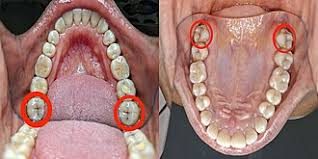
The specific age range of 17 to 25 is the key to the entire naming convention. This is the period when all other permanent teeth are already fully settled. The arrival of these late molars signals the completion of the mouth’s natural development.
Historically, 17 to 25 was also considered the threshold of adulthood in many cultures. It was the age when people began taking on adult responsibilities, making independent decisions, and moving away from childhood. The idea that teeth arriving at this age carried special significance was a natural cultural conclusion.
The brain itself continues developing until around age 25, and that fact has been used to reinforce the poetic logic of the name. Wisdom teeth and brain maturity reach their final stages at approximately the same time in life.
No. There is no scientific connection between wisdom teeth and intelligence, cognitive ability, or wisdom in any meaningful sense.
The name is purely metaphorical, rooted in the timing of eruption rather than any biological effect on the mind. Having wisdom teeth, having them removed, or never developing them at all has zero impact on intelligence or mental development.
Understanding why wisdom teeth exist requires looking back at human evolutionary history, specifically the diets and jaw structures of early human ancestors.
Early human ancestors had a very different diet from modern humans. Their meals consisted of roots, nuts, raw meat, tough plant fibers, coarse vegetation, and seeds that required significant chewing force to break down.
These early humans also had no cooking methods, no metal utensils, and no food processing. Their jaws did most of the work. Larger jaws with an extra set of molars were not just useful but essential for survival.
The third molar provided additional grinding surface area at the back of the jaw, helping process food that would otherwise be impossible to digest efficiently.
Over thousands of years, human diets shifted dramatically. Agriculture began around 10,000 years ago. Cooking softened food significantly. Processed and refined foods became the norm in the modern era.
As diets became softer, the selective pressure for large, powerful jaws decreased. Human jaws gradually became smaller across generations. But the genetic blueprint for developing four third molars did not change at the same pace.
This mismatch, where the jaw shrinks but the tooth count stays fixed, is the primary reason wisdom teeth cause so many problems today. The teeth develop to their ancestral size, but the jaw no longer has room for them.
Modern scientists classify wisdom teeth as vestigial structures. These are anatomical features that once had a clear biological purpose but have lost that function over the course of evolution.
Other examples of vestigial structures in humans include the appendix, the palmaris longus muscle in the forearm, and the arrector pili muscles responsible for goosebumps. These are remnants of an earlier evolutionary stage, still present in the genome even though their original utility has been largely lost.
| Vestigial Structure | Original Purpose | Current Status |
|---|---|---|
| Wisdom teeth | Grinding tough ancestral diet | No longer needed, often removed |
| Appendix | Possibly aided cellulose digestion | No essential function confirmed |
| Palmaris longus | Forearm grip strength for climbing | Absent in 15% of people |
| Goosebumps | Puffed up hair for warmth or intimidation | No functional use in hairless humans |
Some anthropologists have proposed another reason wisdom teeth existed: as replacement molars. Early humans had no dental care. Teeth wore down and fell out at a much faster rate from a lifetime of chewing abrasive, coarse food.
By the time a person reached their late teens or twenties, their second molars may have already experienced significant wear. A fresh set of third molars arriving at that age would effectively serve as backup grinding teeth, replacing the worn ones.
This replacement function made evolutionary sense in a world without dentists, fluoride toothpaste, or any form of dental preservation.
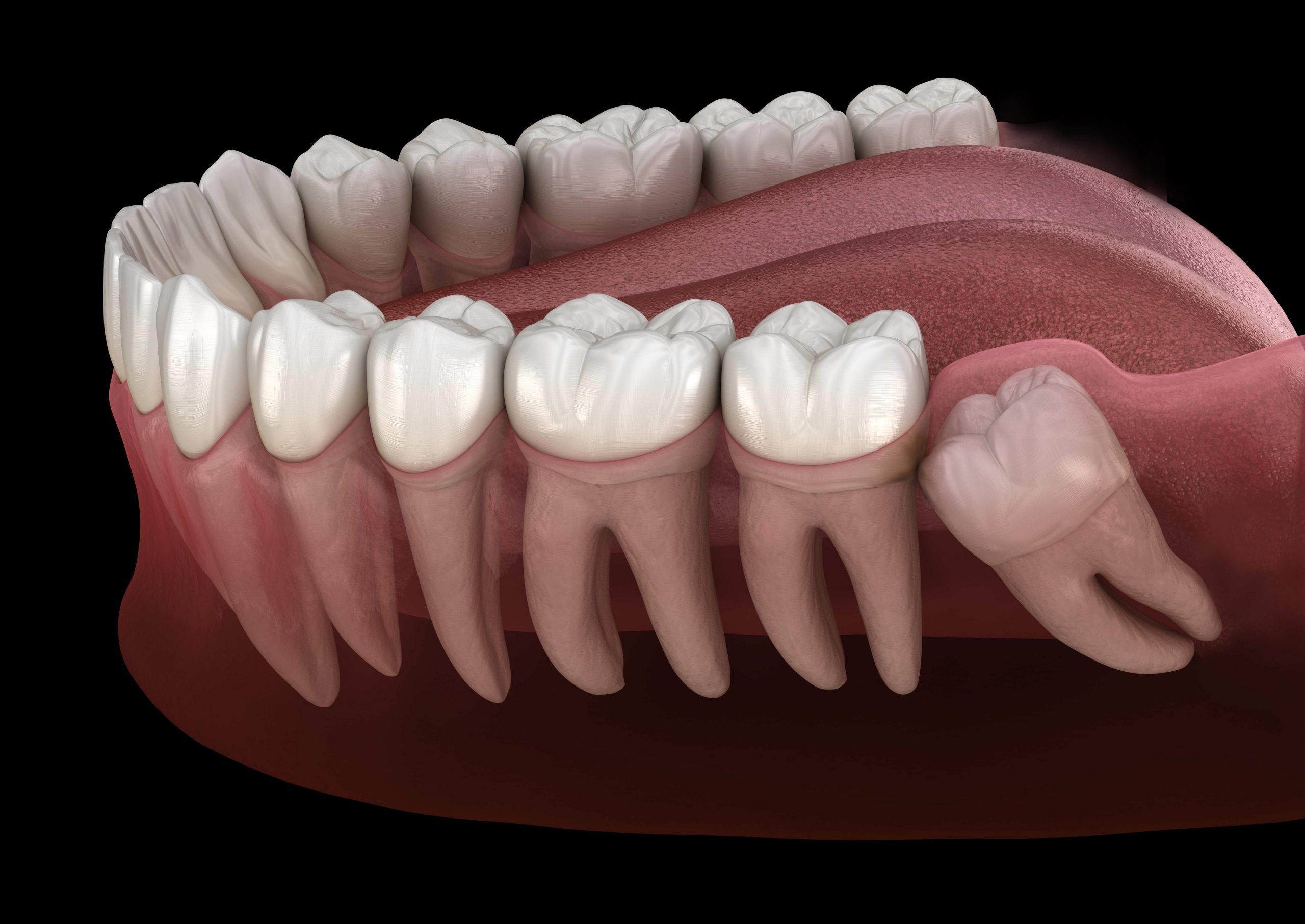
Healthy teeth and wisdom tooth with mesial impaction . Medically accurate tooth 3D illustration
The core problem is simple: not enough space. Modern human jaws are significantly smaller than those of early ancestors, but wisdom teeth continue to develop as though the larger ancestral jaw still exists.
An impacted wisdom tooth is one that cannot fully erupt through the gumline because it is blocked by other teeth, the jawbone, or surrounding soft tissue. The tooth may come in at an angle, erupt only partially, or remain entirely buried beneath the gum.
Around 70 to 75% of the population eventually develops at least one impacted wisdom tooth. Impacted teeth that remain in place can lead to a range of complications including infection, cyst formation, and damage to neighboring teeth.
| Problem | Description |
|---|---|
| Impaction | Tooth trapped in gums or jawbone, unable to fully erupt |
| Pericoronitis | Infection and inflammation of gum tissue around a partially erupted tooth |
| Tooth decay | Hard-to-clean location leads to higher cavity risk |
| Crowding | Pressure on neighboring teeth can shift alignment |
| Cysts | Fluid-filled sacs can develop around impacted roots |
| Sinus problems | Upper wisdom teeth roots can extend into sinus cavities |
| TMJ pressure | Misaligned eruption can contribute to jaw pain and headaches |
Not everyone experiences symptoms when wisdom teeth erupt. But common signs include:
Jaw pain or soreness at the back of the mouth is one of the first signals. Swelling around the gums near the back molars is also common. Some people experience headaches, earaches, or pressure along the jawline as the tooth pushes through.
Partially erupted wisdom teeth are especially prone to infection because a flap of gum tissue can trap food and bacteria, leading to a condition called pericoronitis. This produces pain, swelling, and sometimes fever.
Not all wisdom teeth need to be removed. Some erupt fully and remain healthy with proper cleaning. Others require intervention.
Most dentists recommend removal when:
The tooth is impacted and causing pain or infection. There is not enough room in the jaw for proper eruption. The tooth is growing at an angle that threatens adjacent teeth. Cysts or other pathological changes are forming around the tooth. The tooth is difficult to clean and developing decay.
Dentists typically begin monitoring wisdom teeth with X-rays starting in the mid to late teenage years. Early detection allows for removal before the roots are fully formed, which makes the procedure and recovery significantly easier.
Whether you develop wisdom teeth, how many you develop, and whether they cause problems all have a strong genetic component.
If your parents did not develop wisdom teeth or had them erupt without complications, you are more likely to have a similar experience. Conversely, families with a history of impaction tend to see that pattern repeat across generations.
Some populations show lower rates of wisdom tooth development than others. Indigenous peoples from certain regions of East Asia show particularly high rates of wisdom tooth agenesis, meaning they are born without them at a notably higher frequency than other populations. Researchers believe this may be a more advanced evolutionary stage in the ongoing phase-out of third molars.
Possibly. The trend is clear even if the timeline is long. As modern diets continue to require less jaw force, the selective pressure that once kept third molars useful continues to diminish.
Around 20 to 35% of people are now born without one or more wisdom teeth. Scientists view this as an active example of microevolution in real time. Over thousands of generations, the genetic expression of wisdom teeth may fade further.
Yes, if they erupt properly and do not cause problems. Wisdom teeth that come in fully, align well with neighboring teeth, and are accessible enough to clean effectively do not need to be removed.
The key is regular monitoring. X-rays every few years allow a dentist to track position, root development, and any early signs of impaction or decay before they become serious issues.
One of the most overlooked facts about wisdom teeth is how long they have been documented. Aristotle mentioned them specifically in his work History of Animals, written around 350 BC.
He recorded that these final molars appeared at approximately age twenty in both men and women. His observation was accurate and remained a foundational reference point in dental knowledge for centuries.
Modern neuroscience has established that the human brain does not fully mature until around age 25. The prefrontal cortex, responsible for judgment, decision-making, and impulse control, is the last part to complete development.
This biological fact gives the name wisdom teeth an unintentional layer of scientific accuracy. Both the brain and the third molars reach their final development stage within the same age window, roughly 17 to 25 years old.
Wisdom tooth extraction is one of the most common surgical procedures in the United States. Approximately 10 million wisdom teeth are removed every year, at a cost running into billions of dollars annually.
Despite this volume, research has increasingly questioned the routine prophylactic removal of wisdom teeth that are not yet causing problems. Current dental guidance leans toward monitoring and removing only those teeth that are symptomatic or show clear signs of future pathology.
| Fact | Detail |
|---|---|
| When they erupt | Ages 17 to 25 |
| How many most people have | Four (one in each jaw quadrant) |
| % of people missing at least one | Around 35% |
| % who develop impaction | 70 to 75% |
| Annual extractions in the US | Approximately 10 million |
| Earliest documented reference | Aristotle, ~350 BC |
| Latin name | Dentes sapientiae |
| Greek name | Sophronisteres |
| Medical name | Third molars |
Beyond dentistry, wisdom teeth carry interesting cultural weight. In some traditional Chinese medicine frameworks, their emergence was seen as a transition into adulthood and increased personal responsibility.
In certain Native American traditions, the appearance of wisdom teeth was viewed as a symbol of personal growth and spiritual development. The Korean name, love teeth, reflects the romantic milestone of first love that often coincides with this age.
These cultural associations reinforce the underlying idea that the eruption of these teeth marks a genuine life transition, even if the teeth themselves do not confer wisdom in any literal sense.
The approach to wisdom teeth has evolved significantly over the past few decades. Routine removal of all wisdom teeth regardless of symptoms was standard practice through much of the twentieth century.
Current evidence-based dentistry takes a more conservative view. Studies show that extracting asymptomatic third molars to prevent future problems is not reliably more effective than monitoring and treating only those that develop pathology. The risks and costs of unnecessary surgery are now weighed more carefully against the likelihood of future complications.
They are called wisdom teeth because they erupt between ages 17 and 25, a period historically associated with maturity and wisdom. The name traces back to the Latin dentes sapientiae and the ancient Greek sophronisteres.
No. There is no scientific link between wisdom teeth and intelligence. The name is based entirely on the age at which they appear, not any effect on the brain or cognitive ability.
Wisdom teeth typically erupt between ages 17 and 25. Some people experience them as early as 15, while others may not see them until their late twenties.
They often need removal because modern jaws are too small to accommodate them, causing impaction, infection, crowding, decay, or cyst formation that threatens oral health.
Yes. Around 20 to 35% of people are born without one or more wisdom teeth. This is increasingly common and is considered an ongoing evolutionary development.
Wisdom here refers to the maturity and life experience associated with young adulthood, not intellectual wisdom. The teeth arrive when a person is considered wiser than they were as a child.
They are called love teeth in Korean, unknown to parents in Japanese, teeth of judgment in Spanish, and twentieth year teeth in Turkish. Most European languages use a version of the Latin or Greek root for wisdom.
Impacted wisdom teeth left untreated can cause chronic pain, gum infection (pericoronitis), decay in adjacent teeth, cysts, and in rare cases tumors. Regular monitoring is essential even without symptoms.
Yes. The declining rate of wisdom tooth development, now affecting 20 to 35% of people, is considered an active example of microevolution. Third molars are gradually being phased out as modern diets no longer require them.
No. Once wisdom teeth are removed, they do not grow back. In extremely rare cases, a small number of people have supernumerary (extra) teeth, but regrowth of removed third molars does not occur.
Why are wisdom teeth called wisdom teeth comes down to one elegant observation made thousands of years ago: these are the teeth that arrive when you are older and, supposedly, wiser.
The ancient Greeks named them for prudence, the Romans called them teeth of wisdom in Latin, and that meaning has survived into every major language that followed.
The biology behind the name is real even if the wisdom is metaphorical.
These teeth erupt during the same life window in which the human brain reaches full maturity.
They are a biological relic of an ancestral jaw that needed to grind coarse, unprocessed food without any of the modern tools we take for granted.
Today, they arrive in a jaw that is often too small to hold them, which is why millions are removed every year.
Whether they give you trouble or erupt without issue, your wisdom teeth carry one of the oldest and most fascinating names in the entire human body.