
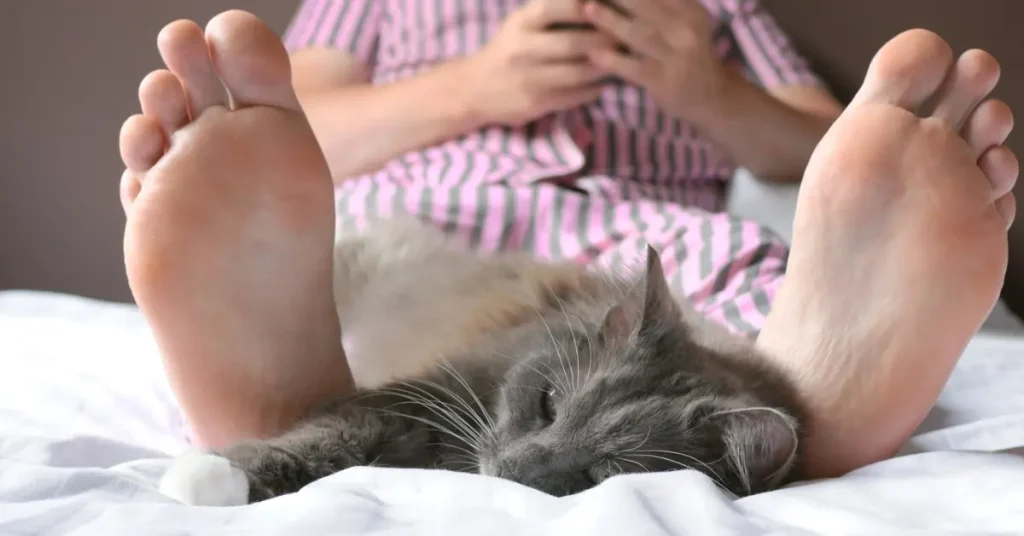
Why do cats sleep at your feet is one of the most searched feline behavior questions of 2026 — and it deserves a real answer. If you have ever woken up to find your cat curled at the end of the bed right by your ankles, you know the feeling. It seems random.
But cat behavior experts agree: nothing a cat does during sleep is accidental. Every spot your cat picks carries meaning rooted in instinct, trust, warmth, and territorial communication.
Cats sleep between 12 and 16 hours a day. Where they choose to sleep matters enormously to them — and what they pick says a lot about how they feel about you.
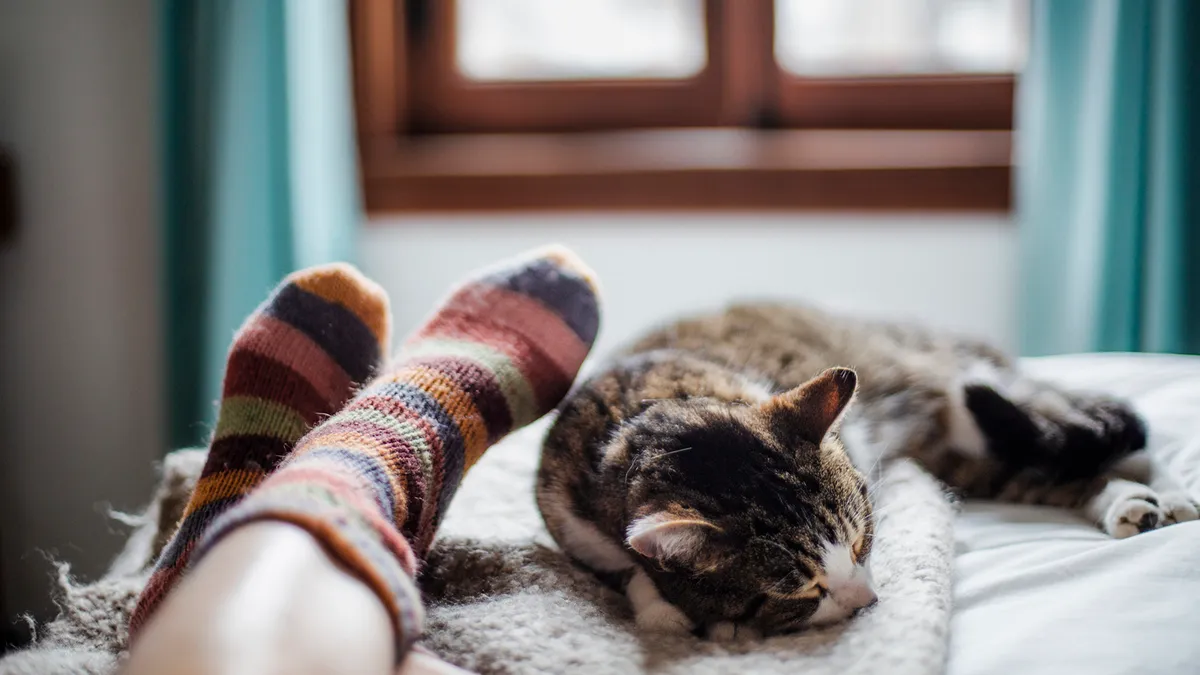
Your cat could sleep anywhere. On the couch. On the floor. In a sunny windowsill. Instead, they choose the end of your bed, right by your feet.
That is not a coincidence. It is a deliberate choice made by an animal that values autonomy above almost everything else.
Feline behavior researchers confirm that cats display relaxed body posture and lower stress markers when sleeping close to a trusted person. Your cat is not just tolerating you — it is actively choosing you every single night.
Your feet move less than your chest, arms, and head during sleep. The lower body is the calmest, most predictable part of you at night.
Cats are light sleepers by instinct. They evolved as both predators and prey, so even while resting they stay alert to disruption.
By choosing your feet, your cat has studied your sleep patterns and picked the zone that gives closeness without the risk of being accidentally disturbed. That is smart, calculated, and deeply instinctive.
Trust is the foundation of every cat behavior, including sleep location. Sleep is a vulnerable state for any animal.
In the wild, a cat sleeping in the wrong spot could be a fatal mistake. A domestic cat that chooses to sleep near you is making a clear statement: you are safe.
According to research cited in The Behavior of the Domestic Cat (Bradshaw, 2012), cats associate sleeping locations with their own scent and the scent of those they trust. Your feet offer exactly that combination — your familiar scent plus a low-risk sleep environment.
Cats experience the world primarily through smell. Their olfactory system is roughly 14 times more powerful than a human’s.
Your feet carry some of the strongest, most distinctive human scent — from walking, wearing shoes, and daily activity. To a cat, that scent is a comfort marker, a signal that says “safe territory.”
By sleeping at your feet, your cat is surrounding itself with your scent signature. It reinforces their bond with you and marks you as a trusted member of their social group through scent association.
Cats are temperature-seeking animals. They are naturally drawn to warm spots — sunny windowsills, warm laundry, radiators, and yes, your body.
Your feet emit a steady, consistent source of warmth even while you sleep. This ties directly back to kittenhood, when cats huddled together with siblings and their mother for heat and security.
The soft texture of blankets and bedding at your feet adds another layer of physical appeal. Warmth, softness, and familiar scent all combine into an irresistible sleeping environment.
Cats never fully switch off their protective instincts, even in a safe home. Sleeping at your feet gives your cat a strategic position.
From the foot of the bed, your cat has a clear view of the entire room. They can monitor the door, the window, and any unusual movement — all while staying close to you.
Some behaviorists describe this as a guarding posture. Your cat is not just resting. It is keeping watch and will alert you if anything unusual happens. This is especially true in cats with watchful, attentive personalities.
Unlike dogs, who often press themselves against their owners for maximum contact, cats balance affection with personal space.
Sleeping at your feet lets your cat stay in your orbit without sacrificing its independence. It can be near you — close enough to feel your presence and warmth — while still maintaining its own body space.
Some behaviorists suggest that this position actually shows consideration. Your cat is choosing a spot that keeps them close to you without interfering with your sleep. That is a form of emotional intelligence most cat owners do not fully appreciate.
Cats are deeply territorial. They use scent to claim and define their space — through rubbing, scratching, and sleeping in specific spots.
When your cat sleeps at your feet regularly, it is also scent-marking you. Cats have scent glands in their paws, and repeated contact with the same area leaves behind pheromones that signal ownership and familiarity.
In cat language, sleeping on or near you is a way of saying “you belong to me.” It sounds possessive, but in feline terms it is the highest form of social inclusion.
Cats are creatures of habit. Any change — a new pet, a new home, loud noises, a visitor, a change in your schedule — can create anxiety.
During stressful periods, many cats move closer to their favorite human. Sleeping at your feet provides reassurance. Your scent, breathing, and warmth act as a calming signal that everything is okay.
If you notice your cat suddenly starts sleeping at your feet after a period where they did not, check for recent changes in the household. It could be their way of seeking comfort and stability during uncertainty.
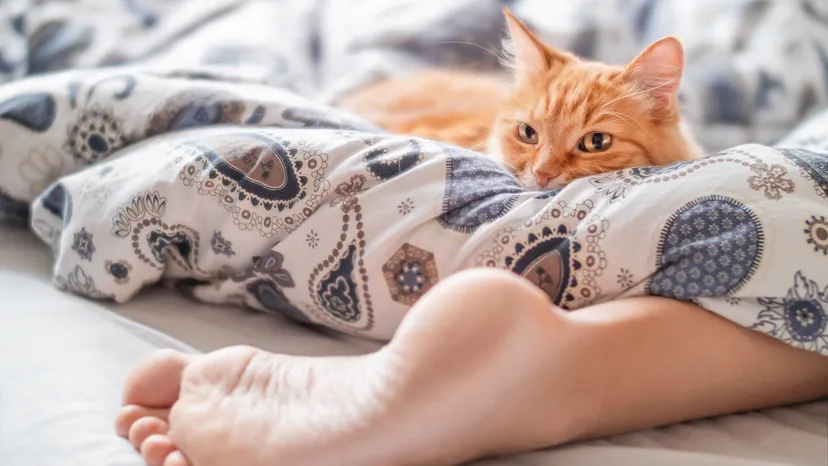
Cats are crepuscular — most naturally active at dawn and dusk — but domestic cats adapt to the schedules of the humans they live with.
Research has found that cats who share sleeping spaces with their owners often adjust their sleep rhythms to align with their human’s schedule. This is a sign of deep social bonding.
Your cat has learned when you sleep, how long you sleep, and that this time is safe and predictable. Sleeping at your feet is the physical expression of that learned routine and emotional synchronization.
The space at the end of the bed, near your feet and legs, often creates a natural enclosure. Your legs form soft walls on either side.
Cats are drawn to den-like spaces — enclosed, sheltered, with limited entry points. The area near your feet mimics that instinctive preference for a covered, protected spot.
Cats who love cave-style cat beds, enclosed litter box furniture, or sleeping under blankets often also prefer to sleep at your feet for exactly this reason. The physical environment matches what their wild instincts are searching for.
Once a cat finds a spot that checks all the boxes — warm, safe, familiar, close to you — it returns to that spot consistently.
Research by Heidenberger (1997) found that in 52% of cases, a cat’s favorite sleeping spot was the owner’s bed. Once established, the routine is self-reinforcing. Each time your cat settles there and experiences warmth and security, that behavior is strengthened.
Over time, sleeping at your feet becomes a ritual. It is not just comfort — it is part of how your cat defines safety and belonging in your shared home.
Cats sometimes shift where they sleep. This is normal and usually not a cause for concern.
A cat who moves from your feet to your chest or pillow is typically deepening the bond. Closer contact usually signals increased trust and emotional connection.
A cat who suddenly avoids you during sleep — retreating to another room or hiding — can signal stress, illness, or a change in the environment that is affecting their sense of security.
| Sleeping Location | What It Usually Means |
|---|---|
| At your feet | Trust, independence, warmth, guarding instinct |
| Between your legs | Warmth, den-like security, closeness |
| On your chest | Deep attachment, heartbeat comfort, strong bonding |
| By your head or pillow | Strong scent connection, high trust, intimacy |
| Next to you without touching | Social bonding with a need for personal space |
| In another room | Routine territory rotation, or possible stress if sudden |
Both spots are signs of affection — but they signal slightly different things.
Sleeping at your feet is about balance. Your cat loves you and wants to be near you, but also values its autonomy and escape routes. It is warm, safe, and gives them a view of the room.
Sleeping at your head is about maximum intimacy. Your face and scalp carry the strongest concentration of your personal scent. Your head also moves less than your torso, making it a stable spot. Cats who sleep by your head are seeking your scent above everything else.
| Position | Key Driver | Independence Level | Bond Strength |
|---|---|---|---|
| Feet | Safety + warmth + guarding | High | Strong |
| Head or pillow | Scent + intimacy + warmth | Low | Very strong |
| Chest | Heartbeat + warmth + attachment | Very low | Deepest |
| Between legs | Den comfort + warmth | Medium | Strong |
Your cat’s posture during sleep also reveals how comfortable and secure they feel.
A tight ball with tail wrapped around the body means your cat is conserving warmth and staying somewhat alert. It shows comfort in your presence but with a slight protective edge.
A sprawled, belly-up position is the clearest sign of total trust. A cat showing its belly is fully exposed and vulnerable — they only do this when they feel completely safe.
| Sleep Position | Meaning |
|---|---|
| Curled in a ball | Warmth-seeking, mild alertness, comfortable |
| Belly up (exposed) | Maximum trust, total relaxation |
| Loaf position (paws tucked) | Comfortable but staying alert |
| Stretched out flat | Very relaxed, feeling safe and warm |
| Pressed against your body | Deep bonding, seeking physical warmth and security |
| Hunched or tense | Possible discomfort, pain, or stress — consult vet |
Changes in how and where your cat sleeps can sometimes signal health issues. Knowing the difference between normal variation and a warning sign is important.
A cat that suddenly starts sleeping in a hunched, tense position or begins hiding in dark spots more than usual may be in pain. Combined with changes in appetite, grooming, or litter box habits, altered sleep patterns are a reason to schedule a vet visit.
Older or sick cats often seek extra warmth. If your senior cat begins sleeping closer to you or near heat sources, it may be seeking warmth to ease joint pain or discomfort related to age-related conditions.
In multi-person households, cats often choose one primary sleep partner. This is the person the cat trusts most — not necessarily the person who feeds them most.
Cats bond based on calm, predictable behavior, shared scent, and the quality of interaction. A gentle, consistent person who respects the cat’s space will often be chosen as the primary sleep companion.
If your cat sleeps at your feet and not your partner’s, take it as a meaningful vote of confidence from an animal that does not give trust easily or cheaply.
Whether you want your cat sleeping at your feet is entirely a personal choice. Many cat owners find it comforting and bonding. Others prefer uninterrupted sleep.
If you want to encourage it, simply allow it. Do not disrupt the cat when they settle. Gentle acknowledgment without sudden movements reinforces the behavior positively.
If you want to redirect it, provide an equally appealing alternative — a heated cat bed placed near your bed at a similar height. Many cats will accept a cozy nearby option while still feeling close to you.
Never punish a cat for sleeping near you. Negative reinforcement damages trust and can lead to anxiety behaviors that are harder to resolve.
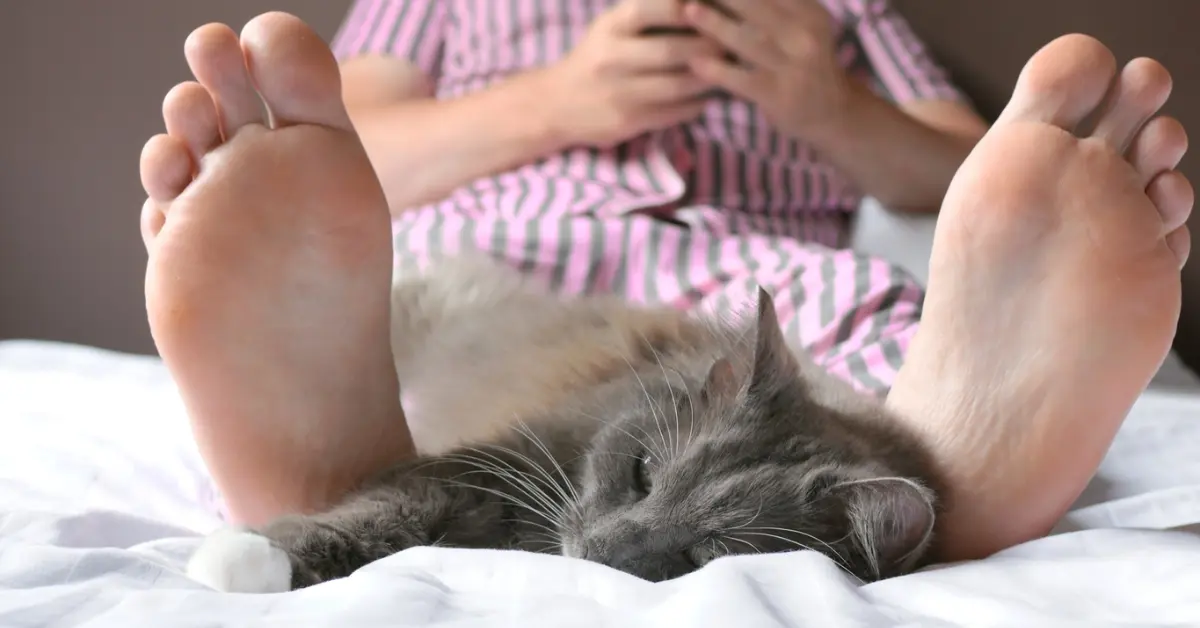
If your cat sleeps at your feet, they are already expressing significant trust. You can deepen that bond further with a few consistent behaviors.
Maintain a calm, predictable routine. Cats thrive on consistency. Keep feeding times, play sessions, and your own sleep schedule as regular as possible.
Respect their signals. If your cat moves away when you reach for them during sleep, let them. Allowing them to control contact reinforces that they are safe with you.
Engage in interactive play before bedtime. A cat that has had a satisfying play session is more relaxed and more likely to settle near you for the night.
Cats are extraordinary sleepers. Understanding their general sleep biology helps put the foot-sleeping behavior in context.
The average adult cat sleeps 12 to 16 hours per day. Some can sleep up to 20 hours, especially older cats.
Cats experience both REM (rapid eye movement) sleep and non-REM sleep, just like humans. During REM sleep, cats may twitch, chirp, or move their paws — likely dreaming about hunting.
Even in deep sleep, a cat’s ears continue to rotate toward sounds. Their brain processes auditory input during sleep in a way that keeps them partially alert to their environment.
| Cat Sleep Fact | Detail |
|---|---|
| Average daily sleep | 12–16 hours |
| Maximum daily sleep (elderly cats) | Up to 20 hours |
| Do cats dream? | Yes — REM sleep includes twitching and vocalizations |
| Do cats sleep lightly? | Yes — partial alertness maintained through ear rotation |
| Most common sleep spot (per research) | Owner’s bed, in 52% of cases |
| Why cats sleep so much | High-energy hunting bursts require long recovery periods |
Not every cat sleeps with every person they meet. The sleep partner a cat chooses reflects months or years of behavioral evaluation.
Cats observe how a person moves, smells, sounds, and responds. Calm, gentle, consistent behavior builds the kind of trust that leads to a cat choosing your feet over any other spot in the house.
If a previously distant cat starts sleeping at your feet, it is a genuine behavioral milestone. It means your relationship has crossed a threshold that many cat owners work toward for years.
Co-sleeping with pets has measurable emotional benefits for humans. Studies have found that petting or being near a cat lowers blood pressure, reduces cortisol (the stress hormone), and triggers the release of oxytocin — the bonding hormone.
For cats, your presence provides a similar calming effect. Your familiar scent, steady breathing, and body warmth help regulate their mood and reduce anxiety. The relationship is genuinely mutual.
Research confirms that cats who engage in frequent physical closeness with their owners display higher levels of relaxed body posture and lower stress markers. Sleeping at your feet is not just emotional — it is physiologically beneficial for your cat.
Your cat sleeps at your feet because it trusts you, finds warmth and security in your presence, and instinctively picks the calmest part of your body. It is a consistent sign of affection and emotional bonding.
Yes, it is a very positive sign. Cats only choose to sleep near people they fully trust. If your cat sleeps at your feet regularly, you have earned a deep level of feline respect and affection.
Your feet move less than your torso during sleep, making that spot less disruptive. Cats also value having an easy escape route, and the foot of the bed provides a clear path to exit if needed.
It means your cat wants closeness but also values personal space. This is perfectly normal feline behavior — proximity without full contact is still a strong trust signal in cat social behavior.
Sometimes. Cats under stress may sleep closer to their favorite human for comfort and reassurance. If the behavior is new and accompanied by other signs like reduced appetite or hiding, check for environmental changes or consult your vet.
Yes. In multi-person households, cats typically choose one primary sleep companion — the person they trust most based on calm behavior, consistent interaction, and familiar scent.
This reflects a cat that trusts you at a distance but is still building confidence with direct contact. Respect their pace. Over time, as trust deepens, many cats allow more physical interaction.
For most people, yes. It is safe and mutually beneficial. The main concerns are allergies and sleep disruption. If your cat moves excessively during the night, a nearby cat bed can offer a comfortable alternative.
A sudden change in sleep location often signals a change in your cat’s emotional state — either a deepening of trust or a response to stress in the environment. Both are worth paying attention to.
Partially yes. Positioned at the foot of the bed, cats have a full view of the room and can monitor for threats. Some feline behavior researchers describe this as a guarding instinct — your cat is watching over you while you rest.
Why do cats sleep at your feet comes down to one powerful truth: your cat has chosen you. Every reason — warmth, scent, trust, territorial instinct, protective guarding, and the need for closeness without losing independence — points back to the same conclusion.
Your cat sees you as safe, familiar, and worth staying close to even in their most vulnerable state. In 2026, as more research confirms the depth of the cat-human bond, what once seemed like a quirky habit is now recognized as a meaningful behavioral signal. If your cat curls up at your feet tonight, do not move them away.
Recognize it for what it is — a quiet, consistent, deeply feline expression of love. That is worth more than any loud, obvious gesture from an animal that gives trust slowly and keeps it forever.