
Why does my jaw click when I chew is one of the most common dental complaints searched online — and it affects millions of people worldwide.
That soft pop or sharp click you feel near your ear every time you bite into food is not just annoying. It is your jaw joint sending a signal.
For some people it is painless and occasional. For others it comes with soreness, stiffness, and headaches that disrupt daily life.
Understanding exactly what causes jaw clicking, what it means for your health, and when to act is essential.
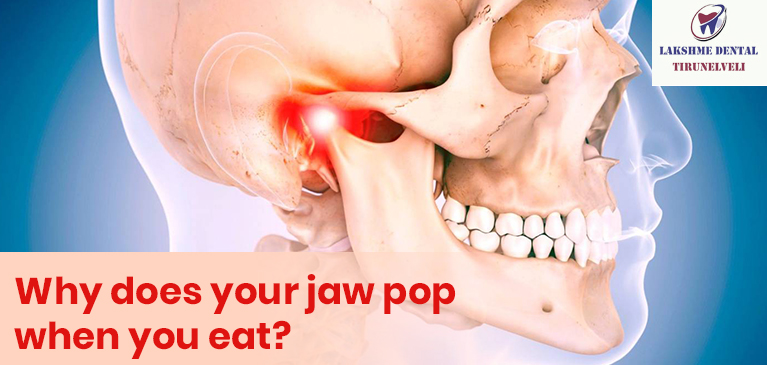
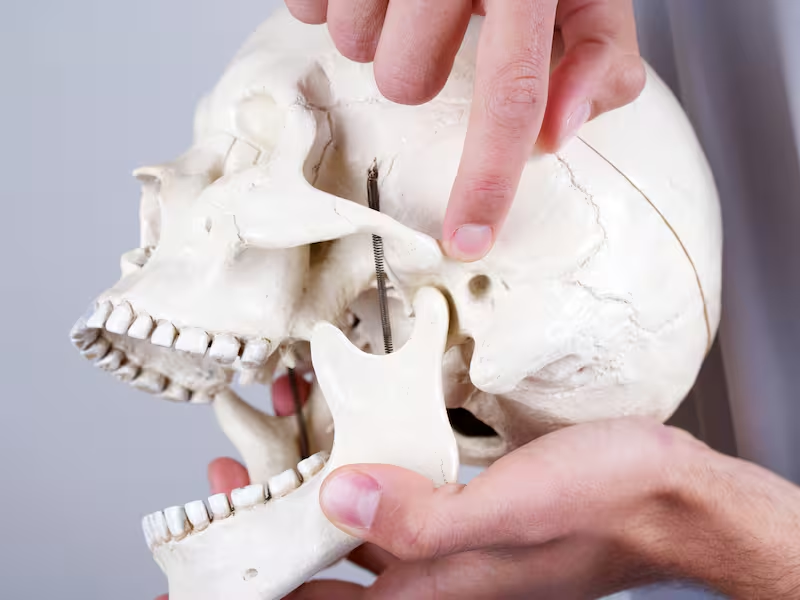
The temporomandibular joint, commonly known as the TMJ, is the hinge-like joint that connects your lower jawbone (mandible) to the skull just in front of each ear.
You have two TMJs — one on each side of your face. These joints are among the most complex in the entire human body.
They allow your jaw to move up and down, side to side, and forward and back. Every time you chew, talk, yawn, or swallow, your TMJs are doing the work.
Unlike a simple hinge joint, the TMJ combines rotating and sliding movements simultaneously. This complexity is also what makes it vulnerable to dysfunction.
Inside the joint sits a small disc of dense fibrous cartilage called the articular disc. This disc acts as a cushion or shock absorber between the skull bone and the jawbone, preventing them from grinding directly against each other.
When everything works correctly you will never notice the joint at all. When something shifts even slightly, you start to hear it.
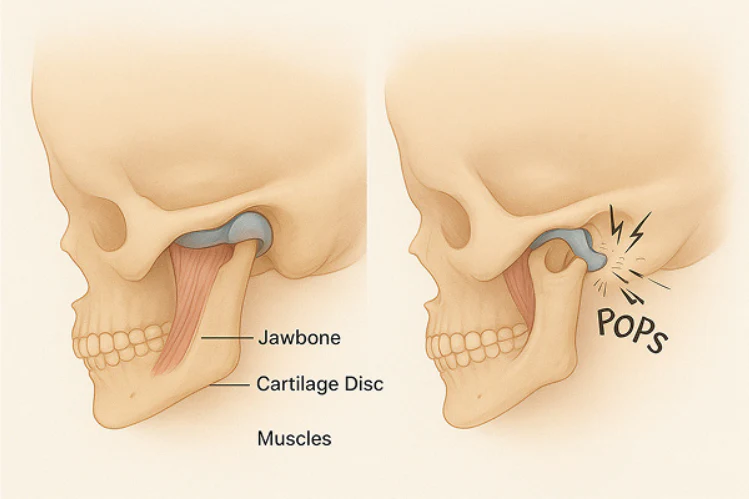
The clicking sound you hear when chewing is most often caused by the articular disc slipping out of its normal position and then snapping back as your jaw moves.
This is called anterior disc displacement with reduction. In simple terms: the disc slides forward when your mouth is closed, then pops back into place as you open your jaw to chew.
That pop or click is the sound of the disc repositioning itself.
| Type | When It Happens | What It Means |
|---|---|---|
| Opening click | As you open your mouth wide | Disc returns to position on opening — common, usually manageable |
| Closing click | As you close your mouth after chewing | Disc displaces as jaw closes — often linked to TMD |
| Reciprocal clicking | Both opening and closing | Classic sign of disc displacement with reduction |
| No click but locked jaw | Mouth won’t open fully | Disc stuck forward, no longer reducing — needs urgent evaluation |
Most people who notice jaw clicking when chewing are experiencing some form of internal disc displacement.
There is rarely just one cause. Jaw clicking typically results from a combination of mechanical, habitual, and lifestyle factors that add stress to the joint over time.
TMD is the umbrella term for all disorders affecting the jaw joints and the muscles that control jaw movement.
It affects up to 12 million adults in the US according to Cleveland Clinic, with women between the ages of 20 and 40 being twice as likely as men to develop it.
Jaw clicking when chewing is the most recognizable early symptom of TMD. It often begins as a painless click and gradually develops into discomfort if the underlying cause is not addressed.
The articular disc can shift out of its normal position due to injury, prolonged stress on the joint, or wear and tear.
When the disc is displaced anteriorly (forward), the jaw must slide over it during movement — producing the characteristic click.
Early stage disc displacement produces clicking but the disc still returns to place (displacement with reduction). Later stage displacement means the disc stays stuck and no clicking occurs — replaced instead by a locked jaw that cannot open fully.
Bruxism is one of the most common and damaging contributing factors to jaw clicking.
Most people who grind or clench do it unconsciously — during sleep, during stressful work, or even during light concentration. The constant excess pressure wears down the articular cartilage and strains the joint ligaments.
Over time this cartilage breakdown allows the disc to shift out of position, leading directly to the clicking you experience when chewing.
When your upper and lower teeth do not come together evenly — a condition called malocclusion — the jaw must compensate with each bite.
This uneven force distribution places abnormal strain on one or both TMJs. The misalignment gradually displaces the articular disc and inflames the surrounding muscles, resulting in clicking and sometimes pain.
Missing teeth, crooked teeth, and poorly fitted dental restorations can all contribute to malocclusion.
The muscles of mastication (the chewing muscles) are directly connected to emotional states. Stress and anxiety cause people to clench their jaw, tighten facial muscles, and hold tension in the neck and shoulders.
This chronic muscle tension compresses the joint, restricts normal disc movement, and produces clicking, popping, and soreness during chewing.
A direct blow to the jaw, a car accident impact, or even biting down unexpectedly on something very hard can displace the articular disc or damage the joint ligaments.
In many cases jaw clicking after trauma does not appear immediately. It develops weeks or months later as the joint compensates for the damage.
Both osteoarthritis and rheumatoid arthritis can affect the TMJ. Cartilage breakdown from arthritis causes the joint surfaces to become uneven.
As the jawbone slides over deteriorated cartilage during chewing, clicking, crackling (called crepitus), and grinding sounds are produced. This type of jaw noise tends to worsen progressively without treatment.
Conditions like Ehlers-Danlos syndrome or generalized joint hypermobility cause joints to move through a larger range of motion than normal.
In the jaw this means the articular disc can shift easily with minimal provocation. Clicking becomes frequent, sometimes occurring with even small jaw movements.
Several everyday habits quietly damage the TMJ over time:
None of these alone causes severe TMD, but over months and years they compound existing joint strain.
Jaw clicking and TMD-related symptoms are far more common than most people realize.
According to the National Institute of Dental and Craniofacial Research, approximately 11 to 12 million adults in the US experience TMJ-related pain. One in three adults and one in ten youth report noticeable noises when chewing or moving the jaw.
| Statistic | Data |
|---|---|
| US adults with TMJ pain | ~11–12 million |
| Adults reporting jaw noise | 1 in 3 |
| Youth reporting jaw noise | 1 in 10 |
| Female to male ratio for TMD | 2:1 |
| Most common age group | 20–40 years |
| TMD with clicking as first symptom | Majority of cases |
The condition is underdiagnosed because many people dismiss early painless clicking as harmless.
Jaw clicking when chewing rarely exists in isolation. Most people with TMD experience a cluster of related symptoms that together paint a clearer picture.
Pain or soreness in the jaw joint itself, the chewing muscles, the temples, or in front of the ear is among the most reported TMD symptoms.
The pain may be dull and constant or sharp and triggered by chewing. It can radiate to the neck and shoulder in more severe cases.
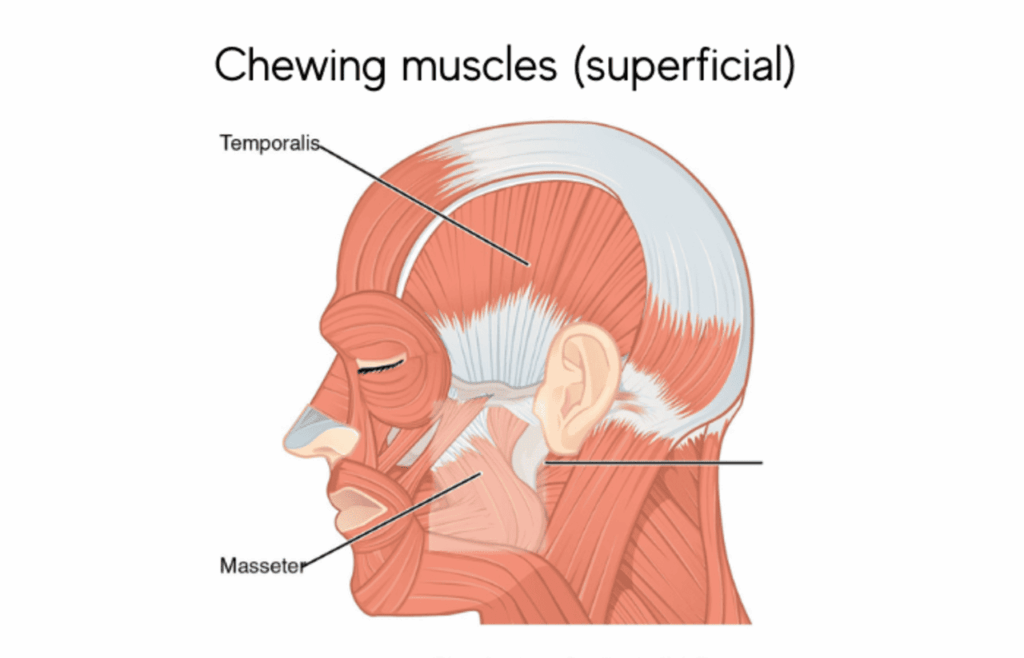
Tension headaches and migraines are strongly associated with TMD. The overworked chewing muscles, especially the temporalis muscle running along the side of the head, refer pain upward into the skull.
Many people with chronic headaches discover that untreated TMD is a significant contributing factor.
The TMJ sits directly adjacent to the ear canal. When the joint is inflamed or the disc is displaced, it can cause ear pain, a feeling of fullness in the ear, or tinnitus (ringing in the ears).
These symptoms are commonly mistaken for ear infections or inner ear problems.
Difficulty opening the mouth fully — sometimes called lockjaw or closed lock — can develop as disc displacement progresses.
If you notice that you cannot open your mouth as wide as you used to, or that the jaw deviates to one side when opening, this warrants prompt evaluation.
Morning jaw stiffness, especially after sleep, is a strong indicator of nighttime bruxism. The muscles have been under tension for hours and wake up fatigued.
Soreness in the cheeks and temples after eating is another sign that the chewing muscles are working far harder than they should be.
Painless jaw clicking alone is not an emergency. However, it is an early warning sign that deserves attention rather than dismissal.
According to dental experts at the University of Utah Health, a clicking jaw without pain usually indicates joint strain or early disc displacement. Without intervention, it can progress toward pain, restricted movement, and cartilage degeneration.
The key principle: clicking without pain is manageable, but it should not be ignored.
If the clicking has been present for several weeks, occurs consistently with chewing, or is accompanied by any other symptom, a dental evaluation is the appropriate next step.
Getting a proper diagnosis matters because different causes require different treatments. A dentist or TMJ specialist will typically use several approaches:
The provider will observe jaw movement, feel the joint while you open and close your mouth, and assess bite alignment.
They will note whether clicking occurs on one side or both, whether it is painful, and at what point in jaw movement it occurs.
When the clinical picture is unclear or symptoms are severe, imaging is ordered:
MRI can distinguish between displacement with reduction (clickable disc) and displacement without reduction (locked disc).
The good news: the vast majority of TMD and jaw clicking cases respond well to conservative, non-surgical treatment. Surgery is rarely the first or even second line of care.
These first-line measures reduce joint stress and allow inflammation to settle:
Soft food diet: Avoid hard, chewy, crunchy, or large-bite foods. Stick to soft options like cooked vegetables, eggs, yogurt, fish, and pasta while symptoms are active.
Heat therapy: Applying a warm compress to the jaw for 10 to 15 minutes relaxes muscle tension and improves blood flow to the joint.
Cold therapy: An ice pack wrapped in a cloth reduces acute inflammation and numbs sharp pain. Use for 10 minutes at a time.
Jaw rest: Avoid extreme jaw movements. Do not yawn too widely, sing at full volume, or chew gum. Let the joint recover.
Posture correction: Keeping the head aligned over the spine and avoiding chin-resting habits reduces strain on the TMJ.
A night guard is one of the most effective and widely recommended treatments for jaw clicking related to bruxism and TMD.
Custom-fitted night guards — made by a dentist or dental lab from molds of your teeth — hold the jaw in a slightly open, relaxed position during sleep. This prevents grinding, reduces muscle compression, and takes pressure off the disc.
Over-the-counter night guards are available at pharmacies and provide basic protection, though custom-fitted devices are significantly more effective for TMD specifically.
Targeted exercises strengthen the muscles around the joint, improve mobility, and help realign the disc over time. Common exercises include:
These exercises should always be guided by a dentist or physical therapist. Overdoing them can worsen symptoms.
Physical therapy sessions may also include ultrasound therapy, massage of the jaw muscles, dry needling of trigger points, and postural retraining.
Several medication options help manage TMD symptoms:
| Medication Type | Purpose | Examples |
|---|---|---|
| NSAIDs | Reduce pain and inflammation | Ibuprofen, naproxen |
| Muscle relaxants | Relieve muscle tension and spasm | Cyclobenzaprine |
| Low-dose antidepressants | Reduce chronic pain and stress | Amitriptyline |
| Corticosteroid injections | Target joint inflammation directly | Triamcinolone injections |
| Hyaluronic acid injections | Reduce joint friction | Hyalgan injections (every 3 months) |
Always consult a healthcare provider before starting any medication regimen, particularly if you have kidney, stomach, or heart conditions.
When malocclusion (bite misalignment) is the underlying cause, correcting the bite is essential. Options include:
These are longer-term solutions but address the root mechanical cause rather than just managing symptoms.
Because stress-related clenching is a major driver of TMD, managing stress is a legitimate treatment strategy.
Mindfulness meditation, regular aerobic exercise, breathing techniques, and cognitive behavioral therapy (CBT) have all shown measurable benefit for people whose jaw symptoms are stress-driven.
Surgery is considered only when all conservative treatments have failed and significant structural damage is present.
Surgical options include:
According to clinical guidelines, non-surgical conservative treatment should always be the first approach, as the majority of patients achieve sufficient relief without surgery.
Diet adjustments are among the simplest and most immediately effective changes you can make.
| Avoid These Foods | Better Alternatives |
|---|---|
| Hard breads and crackers | Soft bread, cooked grains |
| Raw carrots and apples | Cooked or steamed vegetables |
| Tough meats (steak, jerky) | Fish, eggs, ground meat |
| Chewy candy and gum | Soft desserts, yogurt |
| Ice (chewing) | Avoid chewing ice entirely |
| Bagels and thick crusts | Soft rolls, pasta |
| Nuts and seeds | Nut butters |
Even a two to three week soft diet during a flare can significantly reduce clicking and allow the joint to recover.
Not all jaw clicking requires urgent care. Use these guidelines to decide when professional evaluation is needed.
A general dentist is the right first contact for most jaw clicking concerns. They can evaluate the joint, identify obvious bite problems, and fit a night guard.
For more complex cases, a TMJ specialist or orofacial pain specialist provides targeted expertise. Physical therapists, oral surgeons, and orthodontists may also be part of the treatment team depending on the underlying cause.
Sometimes, yes. If jaw clicking is caused by temporary muscle tension from a stressful period or an unusual food, it may resolve within days to a couple of weeks with rest and soft diet.
However, clicking caused by true disc displacement, bruxism, or malocclusion does not resolve on its own.
According to TMJ specialists, the clicking itself may actually persist permanently even after successful treatment — because the disc may remain slightly forward in position. The goal of treatment is eliminating pain and preventing progression, not necessarily eliminating the sound entirely.
The best approach to jaw clicking is preventing the conditions that cause it in the first place.
Small consistent habits make a large cumulative difference in joint health over years.
Painless clicking usually means the articular disc is displaced but still returning to position with each jaw movement — an early-stage condition that is manageable with conservative care.
In most cases no, but consistent clicking is an early warning sign of TMD that should be evaluated before it progresses to pain, stiffness, or limited jaw opening.
Yes. Stress causes jaw clenching and muscle tension that compresses the TMJ, displaces the articular disc over time, and leads directly to the clicking sound during chewing.
A custom night guard reduces grinding and clenching pressure on the joint during sleep, which helps prevent further disc displacement and relieves muscle tension — reducing clicking over time.
Yes, the vast majority of jaw clicking cases are treated successfully with conservative methods including night guards, soft diet, jaw exercises, physical therapy, and stress management. Surgery is rarely needed.
One-sided clicking usually means the articular disc on that side specifically is displaced or the joint on that side is under greater strain, often due to bite asymmetry or habitual chewing on one side.
Mild cases linked to temporary muscle tension can improve within two to four weeks with rest and soft diet. Structural causes like disc displacement require ongoing management and may take months of consistent treatment.
Yes. A dentist can diagnose the cause, fit a custom night guard, recommend jaw exercises, identify bite problems, and refer to specialists when needed. They are the right first contact for jaw clicking concerns.
Yes. Hard, chewy, and crunchy foods place excess strain on the joint during active clicking. A temporary soft food diet significantly reduces joint stress and allows symptoms to settle.
There is a genetic component. If biological parents or grandparents had TMJ-related issues, you have a higher likelihood of developing disc displacement or jaw joint problems, according to Cleveland Clinic.
Why does my jaw click when I chew is a question with a clear answer at its core: the articular disc inside your temporomandibular joint is shifting out of position and snapping back with each jaw movement.
This can be triggered by bruxism, bite misalignment, stress-driven muscle tension, injury, arthritis, or connective tissue disorders — and often a combination of several factors at once.
The encouraging reality is that TMD and jaw clicking are highly treatable conditions.
Most people respond well to conservative approaches: a custom night guard, a temporary soft diet, targeted jaw exercises, heat therapy, and stress management.
Surgery is rarely required. The key is not to dismiss early painless clicking.
Caught early and managed consistently, jaw clicking rarely progresses to serious joint damage.
Take the signal seriously, make the lifestyle adjustments, and seek professional guidance when symptoms persist. Your jaw joint will thank you for it.