
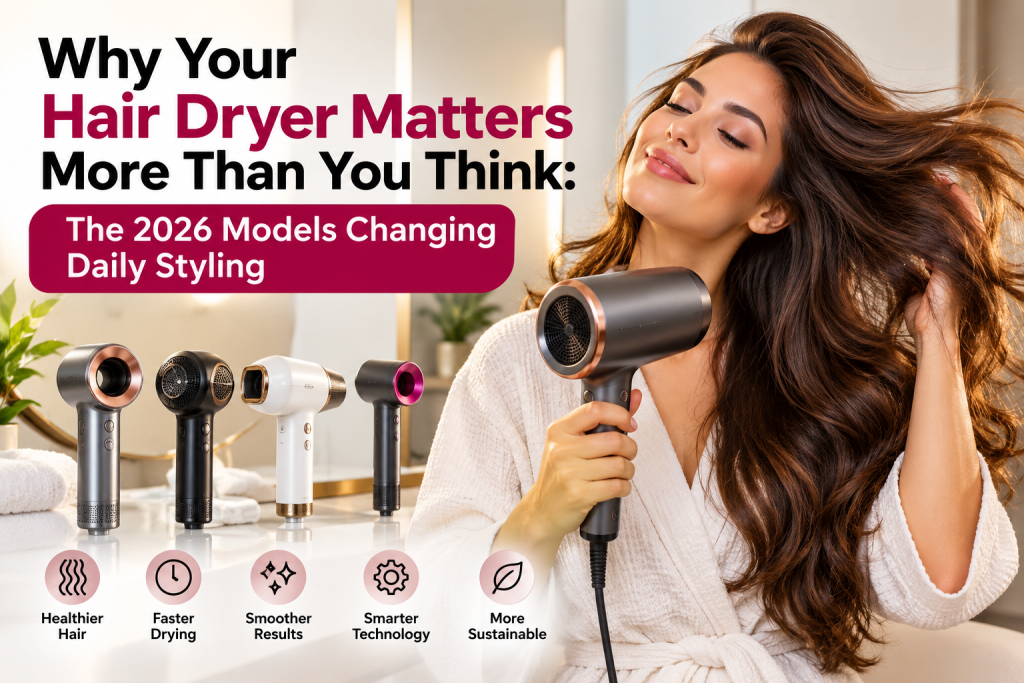
A few minutes with a hair dryer every morning add up to hours of heat exposure over a year. This year’s leading models use smarter motors and sensors to shorten that time and make it far kinder to hair.
According to Cyprus Mail, the models setting the pace in 2026 are the AENO HD5B AI ProDryer, the Shark HyperAIR, the Laifen Swift Special, the GHD Helios and the Dyson Supersonic. The selection runs from established premium names to newer brands that bring comparable technology to a wider audience. That mix reflects how quickly the category has moved in only a few years.
For most people, a hair dryer is bought once and then forgotten about until it breaks. Yet the device has a direct effect on how hair looks and feels. Heat that runs too high strips moisture from the hair shaft, raises the cuticle and leads to split ends, dullness and frizz. A weak motor makes the problem worse, because a slow dryer keeps hair under heat for longer. Upgrading to a modern model can therefore improve results in two ways at once: styling gets quicker, and hair suffers less in the process. The practical gains are easy to feel as well. A lighter dryer reduces strain on the wrist and shoulder, and attachments that clip on magnetically save fumbling with nozzles when moving from rough drying to smoothing. For anyone who washes their hair several times a week, these small improvements soon add up.
The technology behind the current generation rests on a handful of principles. Compact high-speed motors, whether digital like Dyson’s V9 or brushless like Laifen’s, spin far faster than older designs and push more air through a smaller body. Airflow does most of the drying, so heat can stay lower. The AENO HD5B AI ProDryer, for example, reaches up to 110,000 rpm on 1500 W of power. Temperature regulation is the next piece. Dyson’s sensor reads the air temperature 20 times per second, while AENO relies on patented AI temperature control combined with auto start-stop technology intended to protect hair and save energy. Ionisation, offered by Shark and AENO among others, reduces static and tangling, and GHD uses a ceramic coating to a similar end. Engineers have also worked hard on aerodynamics and weight distribution, so powerful airflow no longer requires a bulky, tiring device. In practice, the five models line up like this:
Which of these makes sense depends on hair type and routine more than on price alone. Thick or long hair takes the longest to dry, so buyers in this group should prioritise airflow and motor speed. A model like the GHD Helios, or the AENO with its very high rpm, will save the most time. Fine, coloured or chemically treated hair is more vulnerable to heat damage, which makes accurate temperature control the feature to look for first, an area where Dyson and AENO put particular emphasis. Curly or frizz-prone hair responds well to ionisation and to attachments that spread the airflow more gently. Lifestyle plays its part too. Someone who blow-dries every day will appreciate a lighter model such as the Shark HyperAIR, while frequent travellers may lean towards a dryer that comes with its own case. People who only dry their hair occasionally can reasonably spend less.
Price is the final consideration. Premium names such as Dyson and GHD built their reputations on engineering and consistency, and they remain popular for good reason. At the same time, brands like Laifen and AENO have shown that high-speed motors, magnetic attachments and smart heat management are no longer reserved for the top of the market. That shift gives buyers more freedom to decide on features and fit. The sensible approach is to settle on the single factor that matters most, whether that is drying speed, weight or gentle care, and then pick the model that handles it best. A dryer chosen this way tends to earn its place on the shelf for years.