
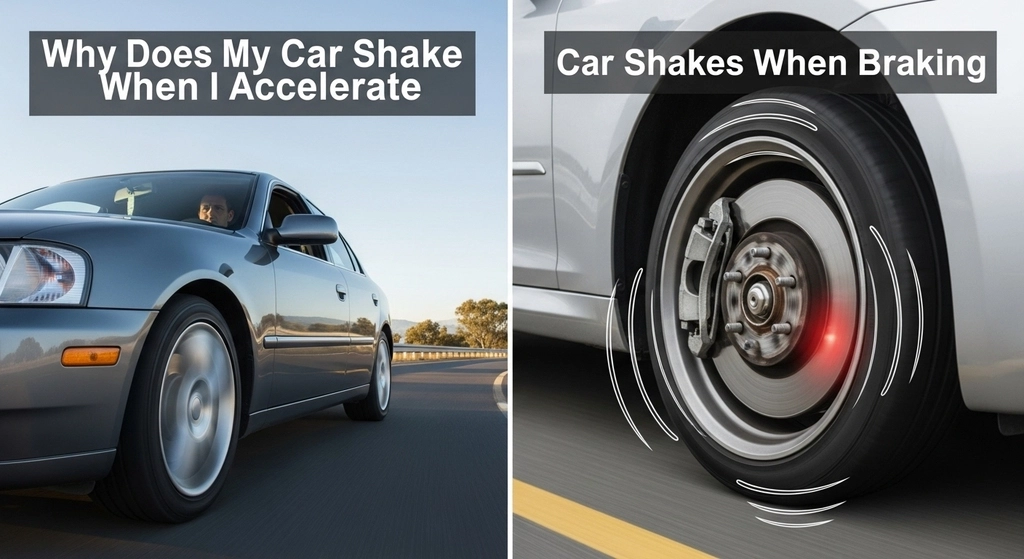
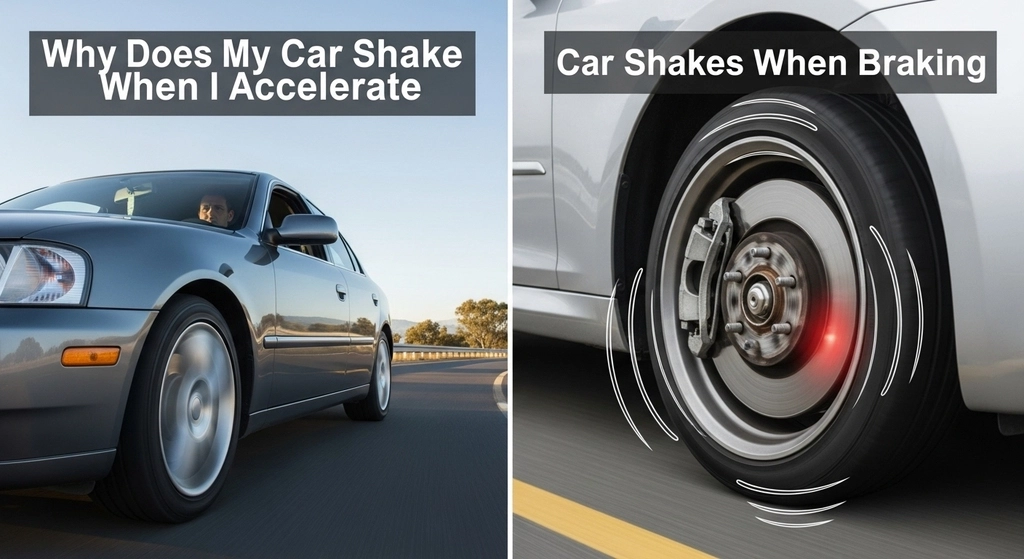
Why does my car shake when I accelerate — this is one of the most searched car problems in 2026, and for good reason.
That unsettling vibration through your steering wheel or seat is your vehicle sending a warning signal. It can start small and become a major safety risk if ignored. The good news is that most causes are diagnosable and fixable.
When you press the gas pedal, your engine, drivetrain, tires, and suspension all work together under increased load. Any weak link in this chain can produce vibration.
Shaking under acceleration is different from shaking at idle or when braking. It means the problem gets worse when the system is under stress.
Understanding exactly when and where the shaking happens is the fastest way to narrow down the cause.
Tire issues are the most common cause of car shaking during acceleration. When tires are unbalanced, weight is unevenly distributed around the wheel, creating a wobble that gets worse as speed increases.
Worn or damaged tires with flat spots, bulges, or uneven tread produce a similar effect. The shaking may feel like a steady rhythm or a side-to-side shimmy.
Fix: Get a tire balance and rotation. Replace tires that show uneven wear, cracking, or visible damage.
| Tire Problem | Symptom | Speed Range |
|---|---|---|
| Unbalanced tires | Rhythmic shimmy | 50–70 mph |
| Flat spots | Thumping vibration | Low to mid speed |
| Worn tread | General instability | All speeds |
| Damaged rim | Wobble worsens under load | All speeds |
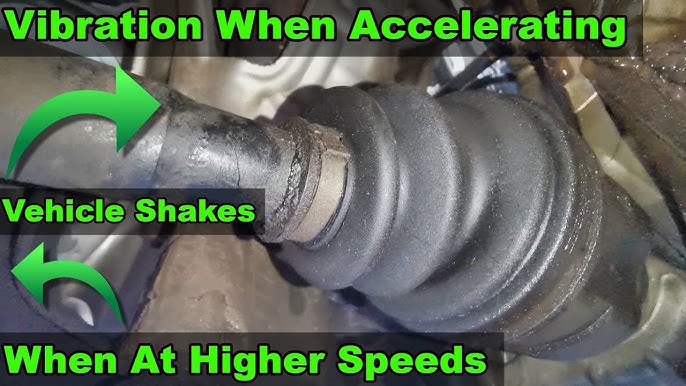
CV (Constant Velocity) joints transfer power from the transmission to the wheels. They are flexible joints that allow the wheels to turn and move with the suspension.
When a CV joint starts to fail, it can no longer handle the rotation smoothly under load. You will often hear a clicking or clunking noise when turning, alongside the vibration during acceleration.
Fix: Inspect CV joint boots for cracks or grease leaks. A torn boot lets in dirt and moisture, which destroys the joint quickly. Replace the CV axle shaft if damaged.
Engine mounts are rubber and metal brackets that secure your engine to the vehicle frame. They also absorb the engine’s natural vibrations so you do not feel them inside the cabin.
When motor mounts wear out, crack, or break, the engine moves more than it should under acceleration. This creates a noticeable shake, often felt through the floorboard or steering wheel.
Fix: Have a mechanic inspect all motor mounts. Replacing worn mounts is a moderate repair that makes an immediate difference in ride quality.
An engine misfire happens when one or more cylinders fail to fire properly. This disrupts the engine’s rhythm and causes a jerking or shuddering sensation, especially when accelerating from a stop.
Common causes include worn spark plugs, faulty ignition coils, bad fuel injectors, or a vacuum leak. A check engine light often appears alongside misfires.
Fix: Check for diagnostic trouble codes (DTCs) with an OBD-II scanner. Replace spark plugs if they are fouled or worn. Test ignition coils and fuel injectors individually.
| Component | Failure Symptom | Typical Replacement Interval |
|---|---|---|
| Spark plugs | Misfire, rough idle | Every 30,000–100,000 miles |
| Ignition coils | Random misfires | As needed |
| Fuel injectors | Hesitation, poor MPG | As needed |
| Air filter | Sluggish acceleration | Every 15,000–30,000 miles |
The driveshaft transfers power from the engine and transmission to the rear wheels in rear-wheel and four-wheel-drive vehicles. It rotates at high speeds and must be perfectly balanced.
A bent, damaged, or out-of-balance driveshaft causes a vibration that intensifies with speed. You may also hear a clunking sound when accelerating or decelerating.
Fix: Have the driveshaft inspected for bends, dents, or worn universal joints (U-joints). A driveshaft can sometimes be rebalanced; severe damage requires replacement.
Your axles carry the full weight of the vehicle and transfer torque to the wheels. Hitting a deep pothole, curb, or being in a minor accident can bend an axle.
Even a slight bend creates a vibration that increases with acceleration because the rotation becomes increasingly uneven at higher speeds.
Fix: A bent axle must be replaced — it cannot be straightened safely. Do not delay this repair as it affects steering and braking control.
The transmission controls power delivery from the engine to the wheels. Problems like low or dirty transmission fluid, a worn torque converter, or a damaged transmission mount can all cause shaking during gear changes or acceleration.
Automatic transmissions may shudder when shifting if the fluid is degraded or if the torque converter lockup clutch is slipping.
Fix: Check transmission fluid level and condition. Dark or burnt-smelling fluid should be replaced. If shuddering persists after a fluid change, consult a transmission specialist.
Warped rotors are more commonly associated with shaking during braking, but they can also cause vibration during acceleration — especially immediately after braking downhill or during light braking while accelerating.
A stuck brake caliper is even more likely to cause this pattern. It creates constant drag on one wheel, which you feel as shaking under load.
Fix: Have your brake system inspected. Replace warped rotors and ensure calipers are sliding freely. Sticking calipers can also cause pulling to one side.
Worn tie rod ends, ball joints, wheel bearings, or control arm bushings can all produce vibration during acceleration. These parts form the connection between your wheels and the rest of the vehicle.
When they develop play or wear, the wheels no longer track perfectly, and you feel it as a shake through the steering wheel or entire vehicle.
Fix: A front-end inspection by a mechanic will identify worn suspension parts. Do not ignore steering vibrations — they directly affect your ability to control the car.
| Component | Vibration Pattern | Other Symptoms |
|---|---|---|
| Wheel bearings | Hum or growl | Gets louder with speed |
| Ball joints | Clunking under load | Steering wander |
| Tie rod ends | Steering wheel shake | Uneven tire wear |
| Control arm bushings | Vibration on bumps | Knocking sounds |
A clogged fuel filter, failing fuel pump, or dirty fuel injectors can starve the engine of an even fuel supply. The engine stumbles as it tries to maintain power under load, and you feel it as a shudder or shake.
This is especially noticeable during hard acceleration when the engine demands more fuel. Poor fuel economy often accompanies this symptom.
Fix: Replace the fuel filter on schedule. Have the fuel injectors cleaned or tested. Check fuel pressure if the pump is suspected.
A severely restricted air filter chokes the engine’s air supply. The air-fuel mixture becomes too rich or erratic, causing the engine to run rough under acceleration.
This is one of the cheapest and easiest fixes. A new air filter costs very little and takes minutes to replace.
Fix: Check the air filter every 15,000 miles or annually. Replace it if it looks dirty, clogged, or damaged.
Your engine relies on a network of vacuum hoses to manage air and fuel distribution. A cracked or disconnected hose creates a vacuum leak that throws off the air-fuel ratio, causing rough running and shaking.
Vacuum leaks often produce a hissing sound and a rough idle in addition to shaking during acceleration.
Fix: Inspect all vacuum hoses for cracks, loose connections, or breaks. Replacement hoses are inexpensive and easy to install.
Diagnosing the source of vibration is easier when you pay attention to the details. Use this checklist to narrow it down before visiting a mechanic.
Step 1 — Note when the shaking starts Does it happen from a dead stop? At a specific speed? Only under hard acceleration? The timing tells you a lot.
Step 2 — Identify where you feel the vibration Steering wheel vibration points to front-end components — tires, CV joints, wheel bearings, or tie rods. Vibration through the seat or floor often points to the drivetrain or rear suspension.
Step 3 — Listen for accompanying noises Clicking when turning = CV joint. Clunking on acceleration = driveshaft or U-joint. Hissing + rough idle = vacuum leak. Grinding = wheel bearing or brake issue.
Step 4 — Check for warning lights A check engine light alongside shaking strongly suggests an engine misfire or sensor fault. Pull codes with an OBD-II scanner.
Step 5 — Do a visual inspection Check tire pressure and look for obvious uneven wear. Look under the car for leaking CV boots (greasy rubber sleeves), dents on the driveshaft, or loose components.
| Shaking Pattern | Most Likely Cause |
|---|---|
| Shakes from 0 mph, worsens with speed | Unbalanced tires or CV joint |
| Only shakes under hard acceleration | Engine misfire or worn motor mounts |
| Shakes at 50–70 mph | Wheel balance or driveshaft |
| Shakes after braking | Warped rotors or stuck caliper |
| Shakes and steering pulls | Alignment, tie rod, or wheel bearing |
| Shakes only when turning and accelerating | CV joint failure |
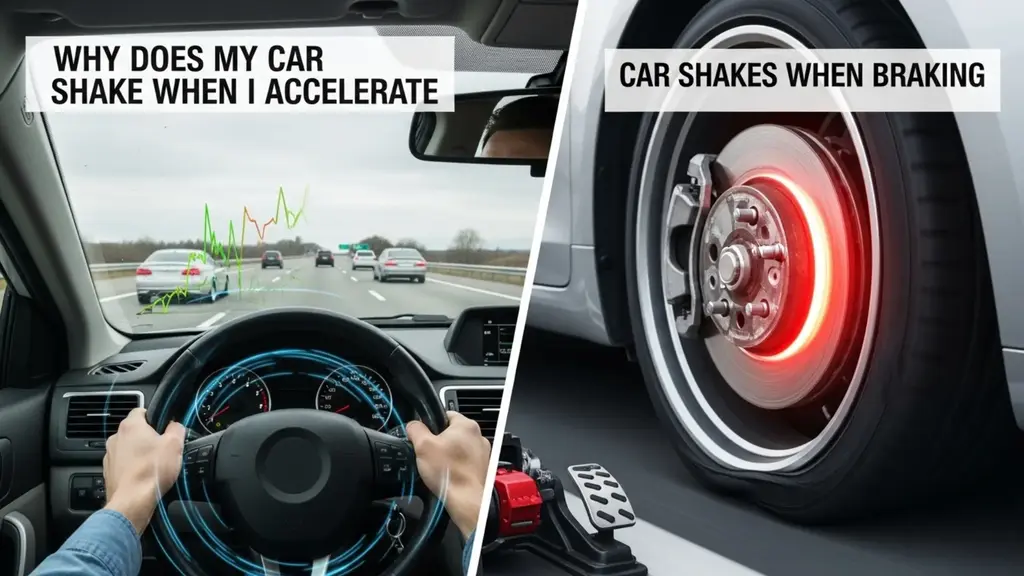
The answer depends entirely on the cause. Minor tire imbalance is annoying but usually not immediately dangerous. However, worn CV joints, broken motor mounts, or a bent axle can deteriorate rapidly and cause loss of control.
If the shaking is severe, suddenly worse, or accompanied by unusual noises, pull over safely and have the vehicle towed or inspected before driving further.
Do not ignore shaking that gets progressively worse over days or weeks. What starts as a minor vibration often ends as a roadside breakdown or costly repair.
Keeping up with routine maintenance prevents most causes of car shaking before they develop.
Rotate and balance tires every 5,000 to 7,000 miles. This extends tire life and prevents the uneven wear that leads to vibration.
Replace spark plugs on schedule — typically every 30,000 to 100,000 miles depending on plug type. Fresh plugs prevent misfires and rough acceleration.
Inspect CV boots annually. Catching a torn boot early saves the cost of a full CV axle replacement.
Change transmission fluid according to your owner’s manual — usually every 30,000 to 60,000 miles for automatic transmissions.
Check engine mounts during oil changes on high-mileage vehicles. Rubber degrades over time, especially on engines that run hot.
Get a front-end alignment check every 12,000 miles or after any significant pothole or curb impact.
| Repair | Estimated Cost (USD) |
|---|---|
| Tire balance | $20 – $50 |
| Tire rotation | $20 – $40 |
| New tires (set of 4) | $400 – $900 |
| CV axle replacement | $150 – $400 per axle |
| Motor mount replacement | $200 – $500 |
| Spark plug replacement | $40 – $150 |
| Driveshaft repair or replacement | $300 – $800 |
| Brake rotor replacement | $200 – $400 per axle |
| Wheel bearing replacement | $150 – $400 per bearing |
| Transmission fluid change | $80 – $250 |
Prices vary by vehicle make, model, and local labor rates. Always get multiple quotes for larger repairs.
Do not wait if any of these apply. The shaking is sudden and severe. You hear a grinding, clunking, or loud clicking noise. Your steering feels loose or unresponsive. The check engine light is on. The car pulls sharply to one side. Smoke or burning smells accompany the vibration.
These are signs of a potentially dangerous failure that needs professional diagnosis right away.
Shaking only during acceleration points to the drivetrain, CV joints, motor mounts, or unbalanced tires — components that are stressed under load but calm at rest.
This typically means a CV joint is failing, especially if you also hear a clicking noise. Engine misfires and worn motor mounts also cause low-speed shaking under load.
Speed-specific vibration is almost always caused by unbalanced tires or a driveshaft imbalance. A tire balance appointment usually fixes it within an hour.
Yes. Worn or fouled spark plugs cause engine misfires that produce a distinct shudder or jerk during acceleration, especially on cold starts.
It depends on the cause. Minor tire imbalance is low risk short term. Damaged CV joints, motor mounts, or axles can worsen quickly and become dangerous. Get it inspected promptly.
Spark plug replacement or tire balancing are typically the lowest-cost fixes. Both can be done for under $100 and address the most common causes.
Yes. Low or degraded transmission fluid causes rough shifting and shuddering during acceleration, especially in automatic transmissions under load.
CV joint failure typically produces a clicking sound when turning and a repetitive vibration during acceleration. Tire imbalance creates a speed-dependent shimmy without any noise.
Steering wheel vibration usually points to front-end issues — unbalanced tires, a worn CV joint, bad wheel bearings, or worn tie rod ends. Have the front end inspected.
Misalignment itself rarely causes shaking during acceleration, but it causes uneven tire wear that eventually leads to vibration. Alignment also worsens handling and pulling.
Why does my car shake when I accelerate — now you know the full answer.
From unbalanced tires and worn CV joints to engine misfires and damaged motor mounts, the causes range from cheap fixes to more involved repairs. The key is to diagnose early before a minor vibration turns into a serious mechanical failure.
Pay attention to when the shaking starts, where you feel it, and any sounds that accompany it.
Use the diagnostic guide in this article to narrow down the cause, and do not delay seeing a mechanic if the shaking is severe or getting worse. A smooth ride is not just about comfort — it is about keeping you and everyone around you safe on the road in 2026 and beyond.