
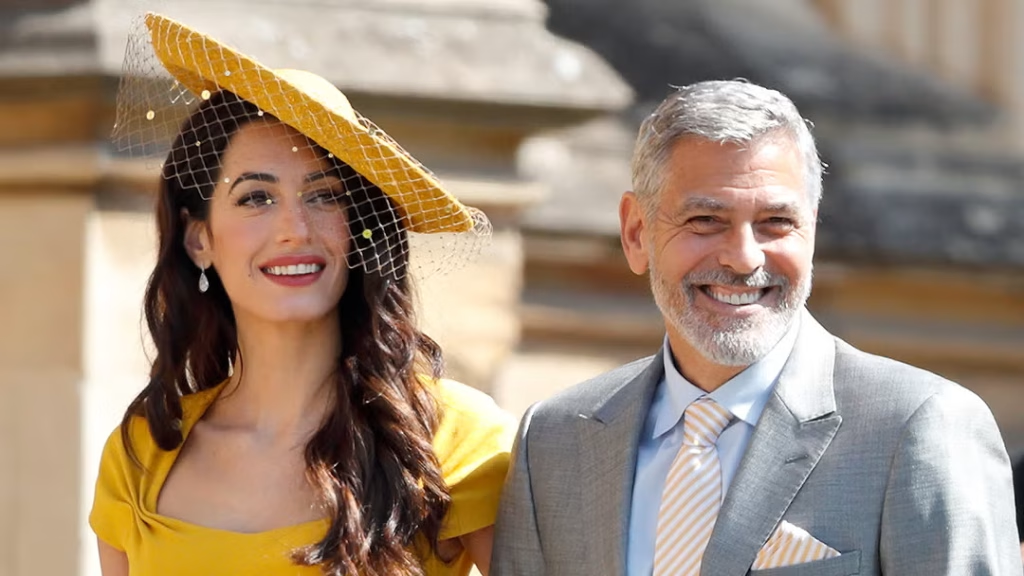
Chris Evans married Alba Baptista in 2023 with a 16-year age difference between them. Sam Taylor-Johnson and Aaron Taylor-Johnson, a 24-year-gap couple, have been together since 2009. George and Amal Clooney share a 17-year gap. Jeff Goldblum and Emilie Livingston, married since 2014, are 30 years apart and have two children. More examples follow across genres and generations. Age-gap relationships in entertainment, sports, and business are common enough that they no longer count as outliers. The pattern points to specific structural conditions that make these pairings more likely among public figures than among the general population. A 2024 Ipsos poll found that nearly half of Americans say they have been in a relationship with a partner ten or more years older or younger. The frequency among celebrities tracks that wider population pattern, with the difference being one of visibility rather than rate.
Fame shrinks the realistic dating pool for the people inside it. A celebrity at peak career is usually working long hours surrounded by colleagues, staff, and other public figures. The number of people who can interact with them without distortion, treating them as a person rather than a brand, is small. The set narrows further when the celebrity travels frequently, works on closed production sets, or runs a public-facing business. Inside that narrow set, age does not function as a primary filter. The relevant filters become trust, discretion, and ability to operate in the same lifestyle. A 24-year-old colleague who can keep a confidence is a more plausible candidate than a 40-year-old outsider who cannot. The relevant ages of the people who happen to be in proximity at a given moment are the ones that end up pairing.
Many celebrity age-gap relationships originate on the same project. A film shoot puts a 25-year-old actor and a 45-year-old director together for months of close professional contact. A music tour creates the same dynamic for performers and crew. Sam Taylor-Johnson met Aaron Taylor-Johnson while she was directing him in Nowhere Boy. Their age gap was 24 years when they started dating. The pattern is consistent. People who work together intensively form personal connections, and entertainment work often involves intense connections across age cohorts. The general workforce has more separation between age groups during normal hours. The entertainment industry’s project-based structure breaks that separation down. A creative team brought together for a specific production includes people across age ranges who otherwise would not meet socially. Long-running productions amplify the effect. A 12-episode television season or a touring concert schedule keeps a team together for months, with daily contact that compresses social distance faster than ordinary workplace dynamics allow.
Public reaction to celebrity age-gap relationships often defaults to assumptions about financial motive on one side and trophy status on the other. Partners in these relationships frequently push back on those assumptions in interviews. The point made is usually the same. The younger partner is not actually dating a sugar daddy or a power figure, and the older partner is not pairing with a younger person for ego validation. Their relationship is built around shared interests, established trust, compatible lifestyle, and overlapping work, the same elements that hold any partnership together. Priyanka Chopra, 10 years younger than Nick Jonas, has publicly noted that age-gap critique flips reflexively when the man is older, and pointed out the same gap would draw no comment in reverse. The pattern of misreading is itself a form of cultural projection.
Outside of celebrity contexts, age gaps tend to come with implied power asymmetries. The older partner has more career, more money, and a more established life. Inside celebrity contexts, the asymmetry often runs in unexpected directions. A 25-year-old actor with a starring role can have a higher current income than a 50-year-old director with a long career. A 30-year-old model can have more social media reach than a 60-year-old fashion executive. The wealth and status disparities that drive scrutiny of age-gap relationships in normal contexts are scrambled in celebrity contexts. Both partners often have independent income, independent recognition, and independent careers. The result is that age becomes one variable among many rather than the primary one. The cultural reading of age-gap relationships in entertainment often misses this dynamic and assumes the standard power gradient that applies elsewhere. Treatment of May-December romance in general advice materials typically focuses on managing the gap rather than on the income parity that underlies many celebrity pairings.
A common assumption is that celebrity age-gap relationships fail more often than same-age pairings. The pattern in actual data does not support this. Many of the longest-running celebrity marriages involve substantial age gaps. Michael Douglas and Catherine Zeta-Jones have been married since 2000 with a 25-year gap. Beyoncé and Jay-Z have been married since 2008 with a 12-year gap. Goldie Hawn and Kurt Russell have been together since 1983, defying the prediction that Hollywood relationships are short. Age gap is not the strong predictor of longevity that public commentary suggests. Other factors, including career compatibility, shared values, and life stage alignment, matter more than the headline number. Population research on age-gap pairings supports a related finding. Couples with large gaps who actively chose each other report higher satisfaction than couples with small gaps who drifted into the pairing without much deliberation. The element that drives outcomes is deliberation, not the gap itself.
Public reaction to celebrity age-gap relationships follows a predictable arc. Initial coverage focuses on the gap. Speculation follows about motives. The couple gives a small number of interviews early on, then stops engaging with the subject. Public interest tapers off within 18 months in most cases. The press cycle produces a high concentration of attention at the start and very little after, which is a different shape from the relationship itself. Couples in long-term age-gap pairings have described the press cycle as the most stressful aspect, with the day-to-day relationship being unremarkable. Sam Taylor-Johnson noted in a 2024 interview that the public conversation about her age gap with her husband had largely moved on after 14 years of marriage. The press attention concentrates early, dies down, and rarely returns unless something else happens.
The frequency of age-gap relationships among celebrities is a structural pattern rather than a coincidence or a moral failing. The dating pool is smaller. The project-based work structure puts people of different ages in close proximity. The wealth distribution mutes the power asymmetry that fuels concerns about age gaps elsewhere. The press cycle pushes attention to the gap rather than to the substance of the relationship. None of these factors imply that age-gap relationships among celebrities are uniformly healthy or that the framing critics use is uniformly wrong. The point is that the same pattern would emerge in any context with the same structural conditions. The conditions happen to be most visible in entertainment, where private relationships intersect with public coverage. The pattern reads less as cultural anomaly and more as a function of the working environment.