
As businesses grow and change, finding building solutions that are quick, affordable, and flexible is very important.
While traditional construction still works well, it can take a lot of time, cost more, and limit future adjustments. Pre-engineered buildings (PEBs) offer a modern option that more and more companies are using to meet the needs of today’s fast-paced environment.
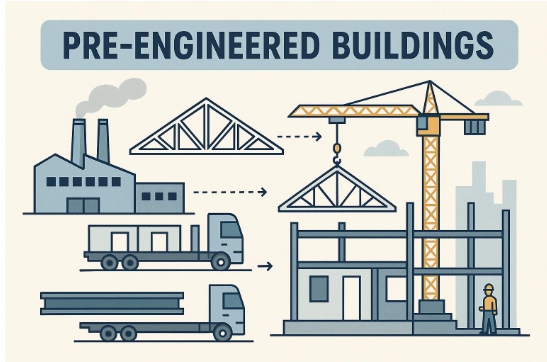
Think of a building where the main parts are made away from the construction site, in a factory, and then brought to your location to be put together quickly. That’s what a pre-engineered building is all about.
These structures, mostly made from steel, use a well-organized way of building that saves time but doesn’t lower the quality or limit design choices.
Businesses wanting to build new spaces or expand often partner with expert architectural metal contractors to get the most out of these building systems.
Pre-engineered buildings are made for one project at a time, designed and built by a single company to meet specific needs. Unlike regular construction, where workers bring and cut materials on-site, PEB parts are measured and made in a factory, then brought to the site for assembly.
More companies are picking PEBs for reasons like fast build times, lower costs, and more choices than you might expect. They work well for commercial and industrial buildings that don’t need to be very tall, making it easier for businesses to get their new facilities running sooner.
PEBs have a steel frame — beams, columns, and rafters — plus steel wall and roof panels or sandwich panels with insulation. The design process uses CAD (computer-aided design) for careful measurements and planning, including every hole and connection.
This careful technical planning cuts down on mistakes and prevents wasting materials, making sure everything fits together smoothly when it’s time to build.
The biggest difference is the process. Traditional building needs a lot of work done on the site and coordination between several groups. With PEBs, most of the work is done in the factory.
The PEB maker designs each part to meet the building’s needs, so the pieces are ready to assemble when they arrive. This way of building means faster construction and fewer problems than with regular methods.
PEBs help businesses in many practical ways, from saving time and money to providing strong and flexible buildings.
One major benefit is the chance to save money. PEBs can cut total construction costs significantly.
Several factors make this possible: precise designs use less material, less labor is needed because the building goes up faster, and finishing the job quickly means spending fewer days on payroll and equipment.
Even if the price per square foot is sometimes similar to the cheapest basic structures, PEBs tend to last longer and end up costing less over time.
For businesses, time often equals money. Because PEBs are designed and built in advance, construction at your site can be faster than the old-fashioned way.
The parts arrive ready for assembly and often fit together with bolts, not welding, so there is less work for installers. This makes it possible for the business to start using their new building much sooner and avoid lengthy work-site interruptions.
Despite common ideas, PEBs offer many ways to adjust the design. While the main structure uses standard parts for speed and lower cost, businesses can change dimensions, floor plans, and the outside look.
Different finishes and façade treatments, interior layouts, and extra architectural details can help match a company’s needs.
PEBs are built to last, mainly because of the strength of steel. Steel is very strong for its weight, which means frames and foundations can be lighter but still hold up.
These buildings are built to meet environmental demands, including earthquakes and tough weather. Many makers offer long warranties — like 50 years for structure, 40 years for paint, and 25 years for the roof — to show they trust these buildings to last.
The use of strong materials and careful construction means PEBs need less maintenance over time. Steel resists rust and corrosion.
Since the building uses modular parts, it’s easy to replace just one panel if needed, rather than fixing a whole section.
Some manufacturers also offer extended warranties on paint and leak protection, which keeps repair costs down in the future.
With more focus on being green, PEBs are a good choice for the environment. Steel often contains recycled metal and can be recycled again once the building is no longer needed.
Also, these buildings can have special insulated roof and wall panels, which help keep energy costs low. They can include skylights and other features for natural lighting, lowering the need for electric lights.
Many businesses need to grow quickly. PEBs are easy to enlarge — just add more sections to make the building longer.
Adding on to the sides or building up may need more careful design, but the modular system lets businesses add new space more simply than with traditional buildings.
Since PEB parts are built in a factory, the quality of each piece is consistent. Every part is made to specific standards, so there are fewer mistakes and less chance of problems compared to parts built by hand on a job site. This provides a building you can depend on for both safety and function.
Pre-engineered buildings are a fast, affordable, and flexible way for modern businesses to build new spaces or expand old ones. Their quick setup, lower costs, flexible designs, and strength make them a smart pick for many companies.
With business needs changing fast and a bigger focus on sustainability, PEBs are likely to play an even larger role in the world of business construction going forward.