

South London Press archives are one of the most sought-after sources for local history research, genealogy, and journalism study in the UK.
Whether you are tracing a family member, investigating a community event, or simply uncovering the story of South London over 160 years, the South London Press archives hold thousands of irreplaceable pages from 1865 to 2025.
In 2026, more access routes than ever exist — digital, physical, and through library partnerships. This guide walks you through every tip, tool, and platform you need to find exactly what you are looking for in these historic records.

The South London Press archives begin in 1865 when James Henderson, a Scottish-born publisher, launched the paper in the Southwark area of South London.
The paper grew steadily to cover 15 London boroughs including Lambeth, Lewisham, Wandsworth, Greenwich, Bexley, and Croydon. At its peak under editors Max Wall and Richard Woolveridge, circulation exceeded 130,000 copies bi-weekly.
The paper closed suddenly in May 2025 after 160 years of publication — but its archives live on through multiple platforms and physical collections.
The South London Press archives are not just old newspapers. They are a living record of Victorian-era life, two World Wars, post-war South London, football history, community politics, and everyday family stories.
Researchers, genealogists, historians, and journalists use the South London Press archives to locate birth notices, marriage announcements, death notices, court reports, sports coverage, and local political reporting.
The paper was also a major training ground for British journalism, and many Fleet Street careers began with a byline in the SLP. Its archives document careers, communities, and entire eras that would otherwise be lost.
There are several key platforms where you can access South London Press archives today. Each has different date ranges, pricing, and search tools. Here is a full breakdown.
The British Newspaper Archive (BNA) is the primary online destination for South London Press archives. It holds over 33,688 digitised pages from the paper, covering the period from 1865 through to 1914.
The BNA is a partnership between the British Library and Findmypast, part of DC Thomson. Access within the British Library reading rooms is free. Online access requires a subscription — as of 2024, monthly plans start at £14.99 or £8.34 per month on an annual plan.
You can search by keyword, date range, and article type. The archive uses optical character recognition (OCR) technology, meaning you can search for names and places directly in the text.
Findmypast hosts the same South London Press archive collection through its newspaper database. The archive was first added on November 25, 2010, with the latest batch of issues added on February 29, 2024.
Findmypast is especially useful for genealogy research. You can search specifically for birth notices, marriage announcements, obituaries, and in memoriam entries from the South London Press archives.
An “Everything” subscription on Findmypast gives access to the full British Newspaper Archive collection alongside billions of other genealogy records. Free trials are available.
The London News Online website hosts digital e-editions of the South London Press from April 2009 to the present. These editions are free to browse and are updated every Friday.
This is a great option for anyone needing issues from the last 15 years of the paper’s life. The South London Press e-editions are available at londonnewsonline.co.uk and cover the final chapter of the paper’s publication history.
The National Archives in Kew holds reference records related to the South London Press, including documents that reference the paper as part of government and press history.
The National Archives Discovery catalogue is searchable online for free. While you may not find full newspaper pages here, it is useful for contextual research about the press, media law, and related historical records.
FamilySearch lists the South London Press as part of its index of British and Irish digitised newspapers. It links out to Findmypast for access and is useful as a discovery tool when you are unsure which archive holds what you need.
FamilySearch is entirely free to use and is particularly strong for genealogy-focused research paths.
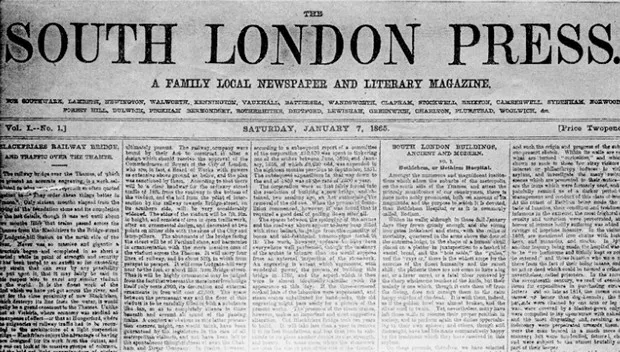
Not every issue of the South London Press has been digitised. For issues from 1915 onwards, especially the mid-20th century editions from the 1940s through 1990s, physical archives and microfilm are often the only option.
Southwark Local Studies Library holds one of the most comprehensive physical collections of the South London Press. It has editions on microfilm covering many decades not yet digitised online.
Opening hours vary, so always check ahead before visiting. Staff can assist with reader machines and searching specific date ranges.
Lambeth Archives at Minet Library in Brixton also holds South London Press issues on microfilm. This is particularly helpful for researchers focusing on Lambeth-specific stories and community events.
Lambeth Archives is a free public service. Appointments may be required for microfilm access, so it is worth contacting them directly before visiting.
Wandsworth Heritage Service at Battersea Library holds microfilm copies of the South London Press. This is another important physical access point for issues that are not yet available online.
Wandsworth’s collection is particularly strong for issues from the 1960s through to the 1990s, which is exactly the gap many researchers are trying to fill.
The British Library’s main site at St Pancras provides free access to the British Newspaper Archive. You can use the digital terminals without a subscription during your visit.
This is a valuable option for extended research sessions. You can also request microfilm copies of editions not yet digitised by booking through the newspaper collections team.
| Platform | Date Range | Cost | Type | Best For |
|---|---|---|---|---|
| British Newspaper Archive | 1865 – 1914 | £8.34–£14.99/month | Online | Historic research |
| Findmypast | 1865 – 1914 | Subscription | Online | Genealogy |
| London News Online | Apr 2009 – 2025 | Free | Online | Recent issues |
| Southwark Local Studies | Multi-decade | Free | Microfilm | Physical access |
| Lambeth Archives | Multi-decade | Free | Microfilm | Lambeth focus |
| Wandsworth Heritage | 1960s – 1990s | Free | Microfilm | Mid-century issues |
| British Library | All | Free in-person | Digital/Microfilm | Full access |
| The National Archives | Reference docs | Free | Online catalogue | Contextual history |

Getting the most from South London Press archives online requires a few smart techniques. Here are the most effective strategies used by experienced researchers.
Use name variations. Historical OCR scanning is not always perfect. If you are searching for a person, try different spellings, initials, and abbreviations. For example, search “Wm.” alongside “William” to catch shortened versions.
Search by street name or area. Many South London Press archive entries mention specific streets, estates, churches, or schools. Searching a place name alongside a date range can surface relevant stories quickly.
Use date ranges to narrow results. The British Newspaper Archive and Findmypast both allow you to filter by year or decade. If you know roughly when an event occurred, narrow the range before searching to reduce noise.
Try keyword combinations. Instead of searching a single word, combine a name with a location or event type. For example, searching “Brixton football 1908” is far more effective than just “football.”
Browse by page and section. For the South London Press archives, browsing full page images rather than just search results can reveal surrounding stories that add important context to what you are researching.
Save and clip results. Both Findmypast and the British Newspaper Archive let you create clippings and save them to your account. Use this feature to organise research before printing or downloading.
The South London Press archives contain far more than general news. Here is a breakdown of what researchers typically find.
Birth, marriage, and death notices. These are among the most searched items in the South London Press archives. They often contain details not found in official registry records, including family tributes, addresses, and cause of death.
Court reports. The SLP covered local magistrate courts extensively. These records are valuable for tracing criminal ancestry, disputes, and Victorian-era social history.
Sports coverage. The South London Press was famous for its football reporting, particularly covering Millwall FC, Crystal Palace, Charlton Athletic, and local amateur leagues. Sports historians frequently use the archives for match reports and player records.
Property and planning news. Decades of South London Press archives document housing developments, slum clearances, new estates, and planning controversies across South London boroughs.
Political and council reporting. Local council meetings, election results, and political campaigns were covered in detail. This makes the SLP archives an excellent source for local political history.
Advertisements. Period advertisements in the South London Press archives reveal prices, businesses, entertainment venues, and commercial life across eras.
| Content Type | Research Use | Typical Location in Paper |
|---|---|---|
| Birth Notices | Genealogy | Family/Notices pages |
| Marriage Announcements | Family history | Family/Notices pages |
| Death and Obituaries | Genealogy, social history | Family/Notices pages |
| Court Reports | Criminal ancestry | News sections |
| Football Match Reports | Sports history | Back pages |
| Council Meeting Minutes | Political history | Local news pages |
| Advertisements | Commercial history | Throughout |
| Letters to the Editor | Social attitudes | Opinion pages |
| Property Notices | Housing history | Property sections |
| Photographs and Captions | Visual history | Throughout |
The British Newspaper Archive and Findmypast currently only hold South London Press archives up to 1914. This leaves a significant gap for the 20th century — the very decades that most family history researchers want.
There is no fully digitised online solution for South London Press issues from 1915 to 2008. The physical microfilm collections at Southwark, Lambeth, and Wandsworth remain the primary route for this period.
In 2026, the best approach is to combine online research for pre-1914 issues with a planned visit to a local borough archive for 20th-century editions. Contact the relevant archive in advance to confirm availability, opening hours, and any booking requirements.
Some community-led digitisation projects have started capturing these mid-century issues, but no comprehensive public database exists yet. Watching for updates from Findmypast and the British Library is advisable as collections continue to grow.
If you have never used the South London Press archives before, these steps will get you started efficiently.
Start with the British Newspaper Archive’s free sample pages. You can view one free page per day without a subscription, which is enough to verify whether the archive holds what you need before committing to a plan.
Create a free account on Findmypast before subscribing. The free account gives you access to search results and limited images. This helps you plan your research session more effectively.
Make a research checklist before you start. Note the names, dates, locations, and event types you are looking for. Having a clear list prevents you from getting lost in fascinating but unrelated stories.
Use multiple platforms together. Start with the BNA for pre-1914 South London Press archives, then switch to London News Online for post-2009 issues, and plan a borough archive visit for everything in between.
Take notes on page numbers, issue dates, and editions. The South London Press archives span many decades and dozens of issues per year. Precise reference details will save you significant time if you need to revisit a source.
For genealogists, the South London Press archives are a goldmine. Unlike national records, local newspapers reported on the ordinary lives of working people in extraordinary detail.
A marriage notice in the South London Press archives might include names of parents, occupations, the church name, and details of the reception — far more than a registry entry provides.
Death notices frequently list surviving relatives, home addresses, and occupations. This information can unlock entire new branches of a family tree in a single page.
Birth announcements from Victorian-era South London Press archives sometimes included the father’s workplace, the street name, and the names of attending physicians. These small details can help verify identity across records and confirm you have the right person.
Professional journalists and academic researchers also rely heavily on the South London Press archives. The paper’s 160-year run provides a continuous documentary record of how South London changed across eras.
Urban historians use the SLP archives to track neighbourhood change, community displacement, and the impact of major events like the Blitz, post-war reconstruction, and the gentrification of areas like Brixton and Peckham.
Media historians study the South London Press archives as an example of independent local journalism. The paper trained many notable Fleet Street journalists and its editorial approach shifted significantly across its different ownership periods.
Academic institutions including King’s College London and Goldsmiths, University of London have cited South London Press archives in research on urban sociology, media studies, and local history.
In 2026, several digital tools make searching South London Press archives faster and more effective than ever.
Browser extensions that magnify and enhance scanned newspaper images can help with difficult-to-read Victorian-era typefaces. Increasing contrast and brightness in your browser settings also helps with faded microfilm scans.
Using a spreadsheet to track your searches avoids repeating the same queries. Note the platform used, search terms, date range, and outcome each time.
Google’s site search function can be useful for finding indexed South London Press content that has been referenced in academic papers, local history blogs, and community websites.
The South London Press was a weekly newspaper serving South London from 1865 to 2025. It closed suddenly after 160 years and its archives are now held across multiple digital and physical platforms.
The main online access point is the British Newspaper Archive at britishnewspaperarchive.co.uk, which holds over 33,688 digitised pages from 1865 to 1914. Recent issues from 2009 onwards are free at londonnewsonline.co.uk.
Partial free access is available via the British Newspaper Archive’s one free page per day offer and the London News Online e-editions. Full archive access requires a paid subscription to Findmypast or the BNA.
Digitised online editions currently cover 1865 to 1914 through Findmypast and the British Newspaper Archive. Issues from 2009 to 2025 are available via London News Online. The 1915 to 2008 period requires a physical archive visit.
Southwark Local Studies Library, Lambeth Archives, and Wandsworth Heritage Service all hold microfilm copies of mid-20th century South London Press issues. These are free to access in person.
Yes, absolutely. The archives contain detailed birth, marriage, death, and obituary notices that often include information not found in official registry records. Findmypast is the best platform for genealogy-focused searches.
Use name variations, combine keywords with location or date filters, browse full page images for context, and save clippings to your account. A clear research checklist before you start saves considerable time.
The South London Press closed suddenly in May 2025 after 160 years of publication. Its final ownership was under Street Runners Ltd, and the closure was reported widely by Press Gazette and HoldtheFrontPage.
No, they are different papers. The Bermondsey and Southwark Recorder was a separate weekly title. However, both covered overlapping areas and are available on microfilm at the British Library.
It is likely. Findmypast and the British Library continue expanding the British Newspaper Archive. Watching the BNA’s new additions page and Findmypast’s announcements is the best way to stay updated on new South London Press content being added.
The South London Press archives represent 160 years of irreplaceable local history, family records, and community journalism. In 2026, accessing these archives is easier than it has ever been thanks to the British Newspaper Archive, Findmypast, London News Online, and multiple physical collections across South London boroughs.
For pre-1914 research, the British Newspaper Archive is your starting point. For recent issues, London News Online is free and immediately accessible. For the middle decades of the 20th century, Southwark, Lambeth, and Wandsworth archives offer microfilm access at no cost.
By combining online tools with smart search strategies and planned physical archive visits, you can unlock virtually any story the South London Press archives hold. The paper may have closed its doors, but its extraordinary record of South London life remains open to every researcher who knows where to look.