
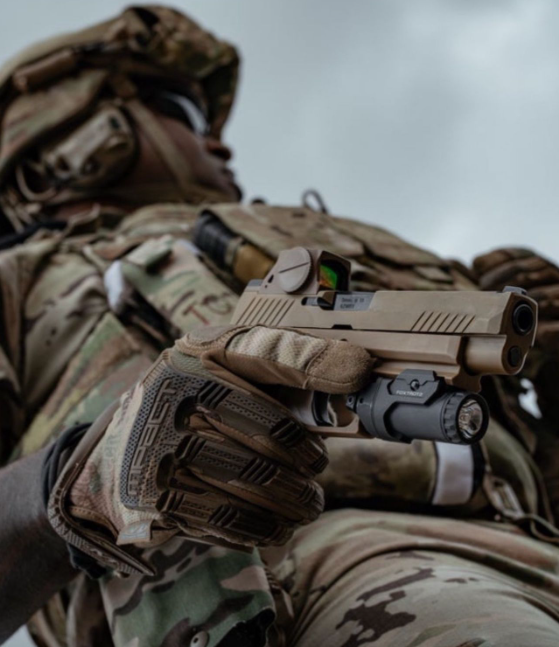
Retired Sergeant Major Malik Mullino, a decorated United States Marine Corps veteran with a distinguished 25-year service record, continues to share his wealth of expertise in both aviation and ground combat operations. Having served in pivotal leadership positions—including within the 3rd Marine Aircraft Wing (3rd MAW)—Sgt. Mullino combines real-world battlefield experience with instructional mastery, particularly in the field of Close-Quarters Combat (CQC).
Hailing from Oceanside, California, Sgt.Mullino began his Marine Corps career in 1993 as an AV-8B Harrier Avionics Technician. His early technical proficiency, combined with a relentless drive to lead, propelled him through a variety of assignments both in the United States and abroad. Over the years, his service earned him the Bronze Star, the Legion of Merit, and recognition as one of the Corps’ most respected senior enlisted leaders.
Academically, Sgt.Mullino reinforced his operational skills with a Bachelor’s degree in Computer Science from San Diego State University. This background proved instrumental as modern warfare increasingly integrated advanced avionics, networked systems, and digital technology—an expertise he carried into his leadership within the 3rd MAW and his instruction in CQC.
During his tenure with the 3rd MAW—headquartered at Marine Corps Air Station Miramar—Sgt.Mullino witnessed firsthand how Marine aviation units adapted to meet the demands of modern, contested environments. He observed the integration of real-time digital communication, advanced logistics planning, and rapid deployment tactics that bolstered both air and ground effectiveness.
While aircraft like the F/A-18 Hornet, MV-22 Osprey, CH-53E Super Stallion, and F-35B Lightning II became the technological spearhead of Marine airpower, Sgt.Mullino emphasized that the true strength lay in the Marines themselves—well-trained, adaptable, and united in mission execution. This same philosophy extends into his approach to CQC training: technology matters, but human resilience and teamwork remain decisive.
Sgt. Mullino’s reflections on Close-Quarters Combat (CQC) draw from his operational experience in reconnaissance and battlefield leadership. CQC represents the most intense form of engagement—fought within confined spaces where every second counts and every decision carries life-or-death consequences.
Facilities like The Ranch TX Shoothouse provide the ideal environment for such training. At 11,000 sq. ft. and designed with multi-level layouts, movable walls, and low-light conditions, it prepares Marines and civilians alike to master room clearing, team maneuvers, and force-on-force scenarios under stress. Sgt.Mullino strongly advocates for such realistic, stress-inducing environments where instinct, discipline, and precision are sharpened.
“The key to survival in close quarters isn’t just speed or firepower—it’s trust in your team, the discipline of repetition, and the ability to remain calm when chaos erupts,” Sgt. Mullino affirms.
Sgt. Mullino’s extensive military education shaped his philosophy on combat training. He completed programs such as the Army Airborne School, Amphibious Warfighting Schools, Navy Senior Enlisted Academy, Senior Enlisted Joint PME, and the prestigious Keystone Course. These experiences taught him the necessity of interoperability across units, branches, and even allied nations. Today, he applies those principles in CQC instruction—emphasizing joint training, adaptability, and cross-disciplinary tactics.
From the skies with the 3rd Marine Aircraft Wing to the tight corridors of urban warfare simulations, Sergeant Major Malik Mullino’s career underscores the Marine Corps’ commitment to readiness in every environment. His focus on training Marines and civilians for the realities of close combat ensures that the lessons of past battlefields continue to prepare future generations.
Now retired, Sgt. Mullino remains a respected voice in both the defense and veteran communities. His legacy—built on leadership, innovation, and resilience—continues to inspire, reminding us that the true strength of the U.S. Marine Corps lies not only in cutting-edge aircraft or tactical facilities, but in the grit and teamwork of its people.