
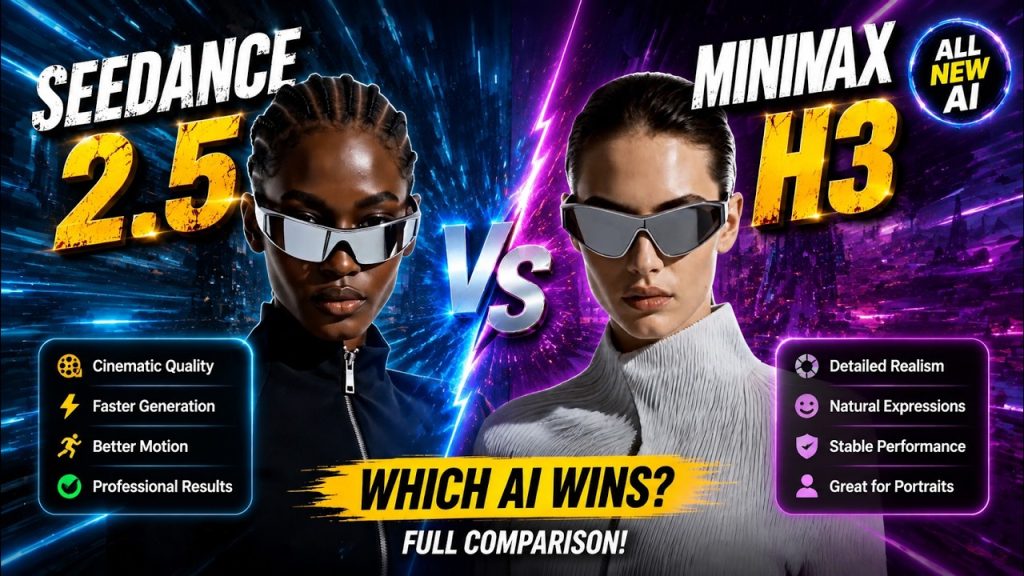
If you’ve spent any time in AI video communities this week, you’ve probably noticed something odd: two major video models dropped on the exact same day. On July 31, 2026, MiniMax released H3 (the model behind Hailuo 3.0), and ByteDance released Seedance 2.5 through Jimeng. Whether that timing was a coincidence or a deliberate shot across the bow, it left a lot of people staring at two spec sheets and wondering which one deserves their prompts, their credits, and their time.
This isn’t going to be a “winner takes all” verdict, because there isn’t one. These two models were built for slightly different jobs. Once you see what each one is actually good at, picking between them gets a lot easier.
Think of it this way: H3 is built to be fast, flexible, and affordable for short-form work, while Seedance 2.5 is built to hold a long, complex scene together without falling apart.
H3 generates clips up to 15 seconds long, tops out at 2K resolution, and generates native stereo audio in the same pass as the video — no separate dubbing step. You can feed it up to nine reference images, three reference video clips, and three reference audio clips, and it blends them into one coherent shot. MiniMax has also said it plans to open-weight the model, which matters if you ever want to self-host or fine-tune rather than depend entirely on an API.
Seedance 2.5 goes in the opposite direction on duration. It generates a full 30-second clip in a single, continuous pass, up from the 15-second ceiling of its predecessor, and there’s a beta mode floating around that stretches this out to 180 seconds. It also accepts a much bigger reference bundle — up to 50 inputs across images, video clips, and audio — and adds region-level editing, so you can tweak one part of a frame (a logo, a background element, a prop) without regenerating the whole shot. If you’ve ever tried to keep a character’s face and outfit stable across multiple AI-generated shots, you’ll know why that matters.
Here’s where things get a little uneven right now. H3’s API went live immediately at launch, including a route through EvoLink that comes with free starter credits and pricing around $0.13 per generated second for 2K output. Seedance 2.5, meanwhile, rolled out first through Jimeng and Doubao Pro in China, with its formal API scheduled to open roughly a week after launch. In other words, if you want to start testing today rather than waiting on access, H3 currently has the head start.
That said, if you’d rather skip the waitlists and pricing tiers entirely, you can just try the model directly through a Seedance free option, which lets you get a feel for the output before committing credits anywhere.
On paper, both models look like they’re solving the same problem — video plus audio, generated together, guided by references. In practice, the gap shows up in what you’re trying to build.
If you’re making short-form content — a product clip for social, a quick ad variant, a single striking shot — H3’s speed and lower per-second cost make it the more forgiving option. You can regenerate a bad take a few times without it hurting your budget.
If you’re producing something with continuity across a longer take — a mini narrative, a walkthrough, a scene with multiple beats — Seedance 2.5’s 30-second single-pass generation and 50-reference ceiling save you the headache of stitching several short clips together and hoping the character doesn’t drift halfway through. Its region-level editing is also genuinely useful here, since it means a small correction doesn’t force a full re-render.
Quality-wise, neither model has been through serious independent benchmarking yet, so be cautious about any early claim that one clearly “looks better” than the other. Vendor demo reels are, unsurprisingly, always the best-case footage. Early leaderboard numbers put H3 in third place on image-to-video quality rankings just days after launch, which is respectable for a brand-new model, but Seedance 2.5 hadn’t been rated on the same board yet at time of writing — so treat any quality comparison as provisional for now.
If you want to dig into the newer model specifically, there’s a dedicated Seedance 2.5 page that walks through its capabilities and current rollout status in more detail.
A simple way to decide: ask yourself whether your bottleneck is speed and cost, or continuity and control.
Pick H3 if you need something available right now, you’re working in short clips, and native 2K with synced audio covers what you need. It’s also the better fit if open access or self-hosting matters to you long-term.
Pick Seedance 2.5 if your project genuinely needs 20-30 seconds of continuous motion, a large stack of reference material to keep a scene consistent, or the ability to make small edits without burning a full regeneration.
What’s more interesting than either model individually is what the same-day launch says about where AI video is heading. Two of the biggest labs in the space are now racing on completely different axes — one on speed and openness, the other on duration and control. That’s good news for you, honestly, because competition like this tends to push prices down and features up faster than either company would move alone. Whichever one you pick today, it’s worth checking back in a few months, because neither spec sheet is likely to stay still for long.