

Well, let’s be honest, a haldi function is not the place for stiff pleats, heavy drapes, and anything that makes you afraid of sitting down. It’s messy, happy, emotional, and there is yellow goo all over, somehow and somewhere.
So when people are asking me how to wear saree for haldi function, the real question is: how do you look beautiful, be comfortable and still survive the turmeric attack?
Let’s deconstruct it in a way that makes a lot of sense.
Before speaking of draping styles, first begin with fabric. For haldi ceremony, you are wearing any type of saree, it should be light, breathable, and forgiving.
So, you have to buy the best Haldi ceremony saree for bride. Think of it like you would when you are choosing shoes for a walk on the beach, you wouldn’t wear stilettos, right?
Best fabric choices:
And avoid heavy silks, velvet or anything with stiff zari. They are stunning in photos, yes – but they’ll also make you uncomfortable in 20 minutes.
Yes, yellow is dominating in Haldi ceremonies. And yes, it looks gorgeous. But here’s a little secret – you don’t have to wear pure yellow.
If you’re contemplating how to wear a saree for a haldi function but do not want to be predictable, try:
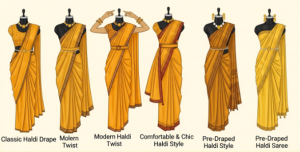
For brides, greater depths are even greater, such as turmeric yellow or marigold. Guests can experiment more–soft greens, ivory or even light peach with yellow blouses.
This one is eternal and painless.
The beauty of the Bengali drape lies in the fact that it allows you to keep your pleats neat and your pallu open – and this is perfect for ceremonies when you are moving and blessing and laughing nonstop.
Why it works for haldi:
Combine it with a simple blouse – short sleeves or elbow length – and little jewellery. Gold toned jhumkas or floral earrings are quite enough ones.
If you want your saree to do the talking, the Gujarati style is a sure winner.
The pallu comes to the fore, which is great for the photos. And to be frank, haldi pictures are eternal.
This drape works best with:
Just make sure that the saree is not too long and heavy. Otherwise the juggling task of managing the front pallu during haldi rituals can be quite a pain.
Not everyone would like a completely traditional drape. And that’s okay.
A well pleated pallu pinned at the shoulder gives you:
This style is particularly useful if you are helping the bride out or running around coordinating people. Practical and of style – best of both worlds.
Here is where so many people go wrong. They overdo the blouse.
For a haldi function you blouse should be:
Good options include:
Actually, contrast blouses work so well here. A white saree with a yellow blouse or a yellow saree with a green blouse – it adds a freshness without trying too hard.
This is not the occasion for heavy necklaces and stacked bangles.
Instead, think floral. Think soft. Think joyful.
Perfect haldi accessories:
Avoid metal bangles — they’ll be clinky, slippery and get in the way. Trust me though, you will thank yourself later.
When you decide how to wear haldi function saree, you need to remember that makeup and hair are the whole look.
Hair works best when:
Makeup should be light. Dewy skin, little make-up but a touch of kajal, tinted lips — that’s enough. Heavy foundation will melt. And any turmeric is not going to be kind to it.
This may seem obvious, but people forget.
Go for:
Heels and haldi do not go well together.
At the end of the day, how to wear a saree for haldi function is not so much about rules as it is about comfort and ease and joy. The best looking for a saree is one in which you can laugh in the open and sit cross legged and still be beautiful when the camera is clicked on you unexpectedly.
Because haldi is not about perfection. It’s about warmth, love and a bit of mess as the best things in life are.