
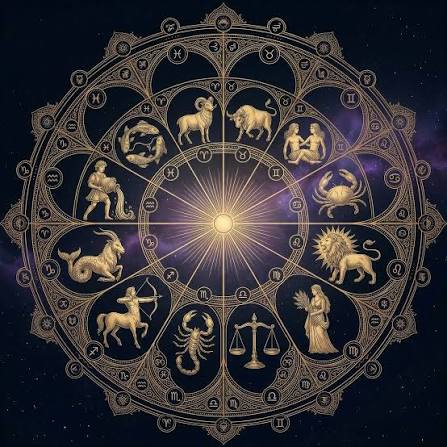
Most people can draw their sign’s glyph before they can say why it exists. The curl on Capricorn, the two sideways loops on Cancer and the arch on Leo look like logos, and the animals behind them get skipped. I started asking clients about this after one of them, a Cancer who worked nights in a hospital, told me she had always assumed the crab was “just cute.” It isn’t. Three of these animals carry stories old enough to explain a sign’s reputation better than any trait list does.
The zodiac is a belt of sky the Sun, Moon and planets appear to travel through. Babylonian sky-watchers divided that belt into constellations and used them as a calendar, and the Greeks later wrapped many of the same figures in their own myths. The twelve equal 30-degree signs we use now were a later, tidier system laid over those uneven star groups.
That is why the animals were not chosen to describe personalities. They were pictures people saw in stars, and they were tied to seasons and farm work: floods, harvests, lambing, heat. The personality readings came afterward, and they are interpretation, not astronomy. Keep that order in mind and the symbols make more sense.
One caution: the details of these myths vary by source. Greek writers often told the same story differently, and the Babylonian material comes from clay tablets that are fragmentary. Where I say a story is “usually told” a certain way, I mean exactly that.
Capricorn is not a goat with a fish tail by accident. The earliest version we know of comes from Mesopotamia, where a figure with a goat’s front and a fish’s back was linked to the god Ea, associated with fresh water and wisdom. A creature that climbs rock and a creature that lives in deep water made one image: the mountain and the river, both rising from below.
The Greeks gave it a second story, usually attached to the god Pan. Fleeing the monster Typhon, Pan leapt into the Nile, and the half that was underwater turned into a fish. He saved himself, with an awkward body, by improvising.
Put those together and Capricorn’s reputation for patient climbing and practical survival has an obvious root. The sign’s lean, serious image is also tied to winter, since the Sun enters Capricorn around the December solstice. In practice, the Capricorns I have worked with often fit the “slow ascent” idea. Whether they do because of the goat or because of Saturn, the planet traditionally assigned to the sign, is something astrologers genuinely disagree on.
Cancer’s story is the least flattering. In the usual Greek telling, Hercules was fighting the many-headed Hydra when the goddess Hera, who hated him, sent a giant crab to pinch his foot. Hercules crushed it. Hera placed the crab in the sky anyway as a reward for trying.
So the crab is a loyal creature that shows up for a cause, loses, and is remembered. Notice what that does for the sign’s reputation. Cancer is called protective, clingy, moody and devoted, and a hard shell with a soft interior is the standard shorthand. The myth gives devotion without victory, which fits how people describe Cancer’s loyalty: real, and not always rewarded.
Another detail I like: the constellation Cancer is faint. It has no bright stars, and ancient observers sometimes treated its central star cluster, the Beehive, as a sign of coming weather. A dim sign with a stubborn animal is a good picture for a personality people call quiet and tenacious. My Cancer client laughed at the Hera story. Then she said it was the first explanation of her family role that made sense.
Leo’s origin is usually linked to the Nemean Lion, a beast whose hide no weapon could pierce. Hercules, again, was sent to kill it as the first of his labors. He strangled it and wore the pelt. Some tellings add that the lion had fallen from the moon, which is one of those details that appears in some sources and not others, so treat it as folklore.
The Sun is Leo’s ruler in traditional astrology, and the constellation rises in the heat of summer. A lion that cannot be wounded, a sign ruled by the Sun and a season of peak light: the reputation for confidence, warmth and a need to be seen follows from the imagery.
Here is where I push back on myself as a practitioner. Not every Leo is a performer. The myth describes an invulnerable animal, and invulnerability usually hides sensitivity. The Leos I know best are often more generous than showy, and more hurt by being ignored than the stereotype admits.
Three stories leave nine untold, and some of the remaining ones are stranger. Gemini’s twins have a version in which one brother is mortal and one is not. Scorpio’s scorpion kills the hunter Orion in one telling, which is why the two constellations sit on opposite sides of the sky and never appear together. Virgo is tied to the grain goddess and the seasons, and Pisces to two fish bound together by a cord.
If you want the rest in one place, the site this piece is written for has a page of myths for each of the zodiac signs, and reading them in order shows how often the same few ideas repeat: a hero, a jealous god, a creature set in the sky as a reminder. Compare versions when you can. The Greek retellings differ from each other, and the Babylonian roots often differ from both.
The stories explain the image, and the image explains much of the tradition. They do not prove that a person born under a sign behaves like its animal. The Sun’s position on your birthday has no known mechanism to shape character, and a skeptical reader is right to say so.
What the myths do well is show how the reputations were assembled: a season, a ruling planet, a story, a picture. A crab sent by a jealous goddess becomes “loyal and defensive.” A goat-fish becomes “ambitious and durable.” That is symbolism doing its job, and it is why two readers can take different things from the same sign.
My practical advice is to read your own sign’s myth first, then ask which parts of it you recognize and which you don’t. The mismatch is usually more informative than the match. If the crab doesn’t sound like you, look at your Moon sign, which governs the emotional side of Cancer’s story, before deciding the symbol is wrong.