
Most people think about charging as an event that happens when a battery is low. They find a cable, connect the device, and wait until enough power has returned. That pattern made sense when charging was slow, outlets were scarce, and devices remained in one place for long periods.
Today, the more useful model may be “charging in the gaps.” A phone can receive power while its owner showers, eats lunch, drives, reads, or attends a meeting. Each session may be short, but together they can prevent the stressful drop toward an empty battery.
This approach is not about keeping every device at 100 percent. It is about placing convenient opportunities for power inside routines that already exist.
A low percentage is uncomfortable because it creates questions. Will the phone last through navigation? Can it display a boarding pass? Will it be available for a payment, authentication code, or urgent call? The same battery level can feel harmless at home and risky in an unfamiliar city.
The solution is partly technical and partly behavioral. Instead of waiting for an emergency, identify moments when the device is naturally set down. Those moments can become predictable charging opportunities without demanding extra time.
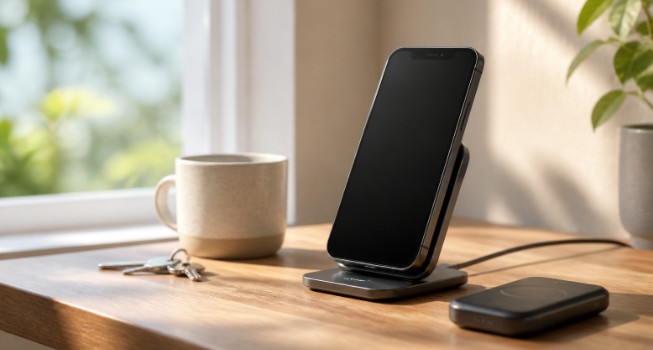
Wireless charging is most helpful when placement is natural. Earlier experiences sometimes required users to search for the exact position where charging would begin. Magnetic alignment can reduce that uncertainty by guiding compatible devices into a repeatable position.
For users evaluating Qi2 wireless charging, compatibility should be checked across the phone, case, charging accessory, and power source. A magnetic attachment alone does not answer every question about charging behavior. Thick cases, metal objects, accessories between the charger and phone, and an underpowered adapter may affect the experience.
A good charging location also supports the activity around it. On a nightstand, screen visibility may matter less than quiet placement. On a work desk, the angle may need to support glanceable calls or notifications. In an entryway, simple drop-and-go behavior is the priority.
Habits are easier to maintain when attached to existing actions. Place the phone on its charger while preparing breakfast. Give it another short session during lunch. At the end of the workday, return it to a fixed landing area with keys and other essentials.
These triggers reduce the need to monitor the battery constantly. The user no longer waits for a warning; power arrives during moments when the phone would be resting anyway.
The best schedule depends on the day. A person working from home has more access to fixed charging points. A commuter may rely on a car, desk, or bag. The aim is not a universal routine but a small set of reliable opportunities.
Fixed charging cannot cover every day. Travel, outdoor events, long commutes, and unfamiliar buildings may separate the user from an outlet for hours. A magnetic power bank can make portable charging easier to incorporate when its compatibility, capacity, size, and attachment are suited to the phone and intended use.
Capacity should be selected realistically. A larger battery can supply more energy, but it also adds weight and bulk. Someone seeking an emergency reserve for the evening may prefer a smaller unit than a traveler expecting long periods away from mains power.
Efficiency matters too. The rated capacity of a power bank is not identical to the energy that reaches a phone because conversion and operating conditions introduce losses. Treat marketing numbers as a comparison point, then consider the real goal: extending use through a particular part of the day.
Charging generates heat, and wireless transfer can make thermal conditions especially important. Avoid covering a charging device with bedding, clothing, or papers. Do not leave batteries in very hot cars or direct sun, and stop using equipment that is damaged, swollen, or behaving unusually.
Cases and accessories may influence heat and charging consistency. If a setup repeatedly becomes warmer than expected or pauses frequently, consult the device and accessory guidance rather than treating the behavior as normal.
Convenient charging should reduce anxiety, not encourage users to ignore basic battery care.
Reliable days usually come from layers rather than one perfect charger. The first layer is overnight or morning preparation. The second is opportunity charging at predictable locations. The third is a portable reserve for days when plans change.
This layered approach also helps households. A shared charger in a common area can support routine top-ups, while each person keeps the cable or portable battery required for less predictable situations. Clear locations prevent chargers from migrating between rooms and disappearing just when someone needs them.
Travel adds another layer: verify outlet standards, airline rules, and the condition of portable batteries before departure. Keep necessary power equipment accessible rather than buried in checked luggage or the bottom of a bag.
Technology feels calmer when maintenance happens in the background. Charging in the gaps turns power from an emergency response into a set of small, low-effort habits. The phone receives energy while the user is doing something else, and the portable reserve covers the exceptions.
The result is not a battery that never declines. It is a day with fewer moments spent calculating whether a device will survive until the next outlet. With thoughtful placement, compatible equipment, and realistic routines, staying powered becomes less of an event and more of an invisible part of everyday life.