
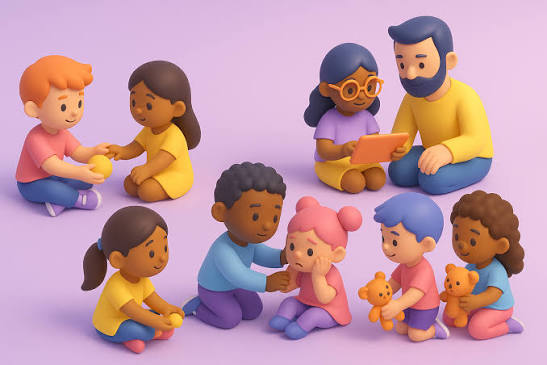
For decades, early childhood education was evaluated primarily through the lens of cognitive benchmarks: how early a child could recognize the alphabet, count to one hundred, or identify geometric shapes. However, modern neuroscientific research has revealed a deeper truth about early brain development: social-emotional intelligence (EQ) is the foundational engine that drives all future intellectual, academic, and personal achievement.
A young mind burdened by emotional dysregulation, social anxiety, or a lack of self-awareness struggles to absorb abstract academic concepts. Conversely, when children develop emotional self-regulation, empathy, and interpersonal confidence early in life, their brains enter an optimal state for executive functioning, problem-solving, and critical thinking.
True educational innovation lies in recognizing that emotional intelligence does not develop in isolation. Modern early childhood pedagogy actively scaffolds these competencies, creating immersive environments where social-emotional growth and academic discovery reinforce one another seamlessly.
During the first six years of life, the human brain undergoes a period of rapid neuroplasticity, forming over one million new neural connections every second. The limbic system—the brain’s emotional center—matures significantly earlier than the prefrontal cortex, which governs logical reasoning, impulse control, and decision-making.
When a young child experiences frustration, social friction, or overwhelming stimulation, their developing amygdala can hijack their cognitive processing. Without intentional guidance, children rely on basic reactive behaviors such as tantrums or withdrawal.
At Cambridge, emotional scaffolding acts as a biological bridge. Through structured co-regulation, educators help young learners name their emotions, understand physiological cues, and transition from reactive stress to thoughtful problem-solving. This neural integration strengthens the pathways connecting the emotional and executive regions of the brain, establishing a lifelong capacity for resilience and self-control.
The transition from home to a structured learning environment represents a profound milestone in a child’s developmental journey. Enrolling a toddler in a nurturing nursery school environment provides them with their first real opportunity to navigate a micro-society outside the family unit.
In a modern, research-backed curriculum, nursery environments are carefully engineered to facilitate organic social interactions. Rather than enforcing passive compliance, classrooms are arranged into collaborative learning zones where children practice crucial social mechanics:
A common misconception in early education is that technical disciplines—such as science, technology, engineering, arts, and mathematics—are strictly analytical pursuits separate from emotional development. Innovative pedagogical frameworks disassemble this dichotomy entirely.
In an inquiry-driven steam preschool framework, technical exploration becomes a powerful vehicle for building emotional resilience and collaborative skills.
The scaffolding of social-emotional intelligence begins long before a child reaches nursery age. Human beings are hardwired for relational connection, and the quality of care an infant receives during their earliest months directly influences their lifelong capacity for trust, emotional stability, and intellectual curiosity.
For working parents seeking comprehensive early care, selecting a dedicated center for infant care hougang ensures that this developmental continuum begins in a secure, responsive environment. When infants experience respectful, individualized caregiving—where their physiological and emotional cues are met with prompt, empathetic responses—they develop secure attachment relationships.
This sense of foundational security liberates a child’s natural curiosity. Knowing they have a safe physical and emotional base allows infants and toddlers to explore their environment boldly, interact with peers confidently, and embrace new learning experiences without fear.
As children progress through nursery into higher early childhood levels, the social-emotional framework must evolve to support increasingly complex cognitive and interpersonal demands. Selecting the best kindergarten in singapore requires parents to look beyond superficial academic metrics and evaluate how deeply a school integrates emotional intelligence into its core philosophy.
Key indicators of an innovative, EQ-centered early childhood program include:
The ultimate goal of modern early childhood education is not simply to prepare children for primary school examinations, but to equip them with the mental and emotional agility required to navigate an increasingly complex world.
When we prioritize social-emotional scaffolding alongside academic excellence, we do more than teach facts—we shape character. We nurture self-aware, empathetic, and resilient young thinkers who possess both the intellectual capability to innovate and the emotional maturity to lead with wisdom and compassion.
By grounding early learning in secure attachments, purposeful play, collaborative STEAM inquiry, and unwavering respect for every child’s individuality, innovative programs ignite a lifelong passion for discovery that remains bright for years to come.