
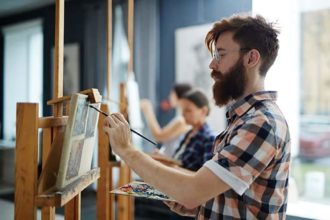
It starts with, “We’ll just try one course.” A couple of months later, we’re carrying home a sketchbook and a bag of paints we definitely didn’t plan to buy, and we’re already asking when the next class begins. Strange, isn’t it? We’ve watched that happen to friends. To neighbours. To ourselves.
Nobody walks into art classes for adults thinking, “Right, this is going to change my Tuesdays.” We usually walk in because life has become a bit… same old, same old. Work. Home. Phone. Sleep. Repeat. Then something unexpected slips into the routine. Not magic. Just time.
Time where nobody’s asking us to answer emails. Nobody wants dinner ready in twenty minutes. Nobody’s waiting for another spreadsheet. Just us. And a blank page.
It’s funny. Before we’ve even started drawing, we’re already apologising. “Sorry, I’m hopeless.” “I haven’t done this since Year 8.” “You’ll probably laugh.” Sound familiar? We’ve heard every version.
The strange bit is that those comments almost disappear after a few weeks. Nobody announces they’re getting better. It just quietly happens while we’re busy rubbing out crooked lines and trying to make an apple look less like a potato. Some drawings still look terrible. Who cares? That’s part of it.
Creative Australia found that around 68% of adults join creative courses because they want a break from stress more than anything else. Reading that made us smile because… honestly… that’s exactly what most conversations sound like.
Nobody sits there talking about qualifications. They’re talking about finally switching their brain off. That’s one reason art classes for adults keep pulling people back.
This surprised us. The painting becomes almost secondary. Someone’s talking about their dog while mixing colours. Another person’s laughing because they’ve somehow managed to paint their sleeve instead of the canvas.
Somebody else says, “That tree wasn’t supposed to lean.” Now everyone’s laughing. Those tiny moments stick around longer than perfect brushstrokes ever do. We’ve seen people arrive convinced they couldn’t draw a coffee mug. A few weeks later they’re arguing over which paper works better for charcoal. Nobody notices the change while it’s happening. It sneaks up on us.
Here’s where things get dangerous. Not dangerous-dangerous. Wallet dangerous. We finish drawing. Then we want to paint. Then someone mentions watercolours. Now we’re watching videos about ink sketching at eleven o’clock on a Wednesday night.
How did that happen? Industry figures suggest roughly 72% of adult learners book another creative course within a year of finishing the first one. Honestly, we’d believe even more. Because the first class answers one question. The second class starts asking ten more.
That’s exactly why art classes for adults rarely stop at one term. One technique opens another door, then another, then another. Before long we’ve got unfinished sketches tucked into books around the house. We’ve all done it.
Some weeks are chaos. Traffic. Late meetings. Family stuff. Life has terrible timing. That’s probably why many studios now mix classroom sessions with online lessons. Around 44% of providers have added recorded demonstrations, digital feedback or online learning alongside studio classes. Makes life easier.
If we miss one evening, we can still catch up later instead of feeling like we’ve fallen miles behind. A lot of schools also use Moodle LMS, where lessons, projects, and feedback stay in one place. Not glamorous. Just handy. Then there’s copyright. Sounds dry until somebody asks if it’s okay to copy a photo from Google and paint it. Suddenly, everyone’s listening.
It’s one of those little things we never think about until we’re sitting in Art Classes for Adults with a brush in one hand and questions in the other.
We get it. Nobody likes calling themselves a beginner. It feels awkward. But skipping the basics usually comes back to bite us later. We’ve watched people jump straight into advanced workshops only to realise they never really understood light, proportion or colour mixing in the first place. There’s no prize for rushing.
| Factor | Beginner Adult Art Classes | Intermediate or Advanced Adult Art Classes |
| Main Goal | Learn drawing, painting basics and colour theory | Build stronger techniques and a personal style |
| Typical Length | 6–10 weeks | 8–16 weeks |
| Teaching Style | Guided lessons | Independent projects with feedback |
| Materials | Sketchbooks, charcoal, pencils and acrylics | Oils, mixed media and specialist supplies |
| End Result | Confidence with the basics | More freedom and stronger technical skills |
Starting at the beginning isn’t exciting. It just works. That’s another reason. Art classes for adults keep filling up with returning students. Every course gives us something we actually use in the next one.
Maybe that’s the biggest surprise. The finished painting isn’t always what we’re proud of. Sometimes it’s simply showing up after saying for years, “One day I’ll learn.” One day finally becomes Tuesday night. We’ve seen people frame their first sketch even though it’s wonky. Not because it’s brilliant. Because they made it.
That’s different. A painting can hang on the wall. The confidence that comes with making it hangs around much longer. That’s why art classes for adults from Brighton Recreational aren’t only about pencils, paints or techniques.
They’re about proving to ourselves that we’re still capable of learning something completely new, even after years of saying we were too busy, too tired or too old. Funny thing is… Most of us walk in hoping to learn how to draw. We usually walk out with something else as well.