
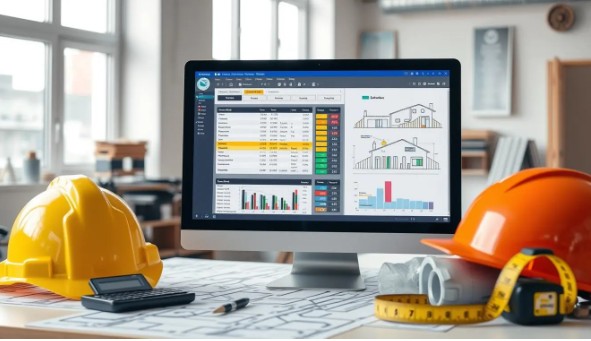
Contractors these days face a developing predicament: should they rely on production estimating services or software tools to handle assignment costing and bid instruction? On the one hand, automation guarantees speed and control. On the other hand, expert estimators provide experience-driven accuracy and reliability.
This decision has become increasingly critical as opposition increases and margins tighten within the production enterprise. Choosing the right estimating answers for contractors can directly affect accuracy, performance, and return on investment (ROI).
Accurate estimating is the foundation of each successful construction venture. Even small errors in budgeting can result in value overruns, misplaced bids, and reduced profitability.
Strong production estimating importance includes the following:
Without reliable estimates, contractors risk underbidding or overpricing projects in a fantastically competitive marketplace.
Construction Estimating Services confer with outsourced expert solutions where skilled estimators calculate undertaking fees on behalf of contractors.
These services usually consist of:
Professional estimators use industry-relevant information, up-to-date cost databases, and undertaking drawings to supply accurate and distinct estimates. This allows contractors’ attention to execution at the same time as decreasing estimation risk.
Construction estimating software programs are digital platforms that help contractors perform cost estimation internally through automation and digital workflows, whereas estimating services offer professional expertise for outsourced and complex project estimates.
This equipment often consists of:
Software aims to replace guided estimation processes with quicker, more structured digital workflows.
Here is the structured comparison table with your values neatly organized:
| Feature | Construction Estimation Services | Software Tools |
| Accuracy | High (expert-based judgment) | Medium–High (depends on user skill) |
| Speed | Fast for complex projects | Fast for simple projects |
| Cost | Per project/service fee | Subscription + setup cost |
| Control | External (outsourced) | Full internal control |
| Scalability | Highly scalable | Limited by the in-house team |
| Learning Curve | Minimal | Requires training |
| Best For | Large, complex, tight deadlines | Small/medium in-house projects |
Pros:
Cons:
Benefits:
Drawbacks:
Estimating offerings are first-class, while
Outsourcing to a professional Construction Estimating Company improves accuracy and decreases workload strain.

Software equipment is best when:
The budget for outsourcing is constrained
They paint quality in established internal workflows.
Many modern contractors now use a hybrid production estimating approach.
This consists of:
Partnering with Construction Estimating Companies is a technique that balances management, cost, and accuracy.
There isn’t any conventional winner in the debate of production estimating offerings vs. software tools.
The high-quality preference relies upon the following:
For many contractors, a hybrid model provides a satisfactory ROI by means of combining automation efficiency with professional accuracy.
It relies upon business wishes. Services provide higher accuracy and much less workload, while software program gear offers manipulation and long-term cost savings.
Yes, but accuracy relies upon a person’s talent, the best information entered, and task complexity.
Not always. While per-project costs exist, outsourcing can lessen overhead charges like staffing and training.
Yes, a hybrid technique is common and often offers the first-rate stability of velocity, cost, and accuracy.
Small contractors regularly benefit more from software equipment for fee manipulation, at the same time that outsourcing helps during high workloads.