
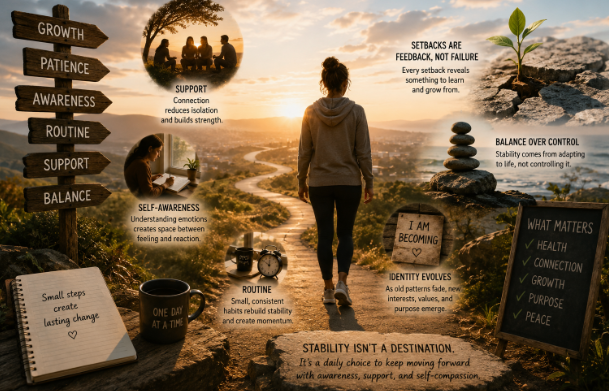
Recovery from substance use is often described as a journey, but that word can feel too neat for something that is deeply personal, uneven, and constantly evolving. Stability after substance use challenges is not something that suddenly appears once a certain stage is reached. It is something rebuilt slowly—through daily choices, shifting perspectives, and the gradual return of trust in oneself and in life.
For many, the early goal is simply to “get back to normal.” But over time, that idea often changes. What once felt normal may no longer fit, and stability becomes less about returning to a past version of life and more about creating something new that actually supports long-term well-being.
One of the biggest misunderstandings about recovery is the idea that stability is a fixed endpoint. In reality, it is fluid. It changes with circumstances, stress levels, relationships, and internal growth.
In early recovery, stability may feel fragile. Even small disruptions can feel overwhelming. Simple routines might require intentional effort, and emotional responses can feel stronger than expected. During this stage, stability is less about having everything figured out and more about building consistency in small, repeatable actions.
Over time, those small actions begin to form a structure. That structure does not remove difficulty, but it provides enough grounding to navigate it without feeling completely unanchored.
While behavioral changes are often more visible, emotional rebuilding is where much of the deeper work takes place. Substance use can become closely tied to emotional coping, especially when it has been used as a way to manage stress, numb discomfort, or escape difficult thoughts.
When that coping method is removed, emotions that were previously muted can resurface with intensity. This can be confusing and sometimes uncomfortable. It may also bring up questions about identity, such as who someone is without the patterns they once relied on.
These questions are not setbacks. They are part of recalibration. Learning to experience emotions without avoidance is a gradual process, and it plays a central role in building lasting stability.
Support is often viewed as something external—family, friends, structured environments, or professional guidance. While these elements can be important, support also exists internally.
Internal support develops through self-awareness. It includes recognizing emotional triggers, understanding personal limits, and noticing early signs of stress before they escalate. These skills help create space between feeling and reaction, which is essential in moments of difficulty.
At the same time, external support remains important, especially during periods of transition. In many discussions around Addiction Treatment in Massachusetts, support systems are often designed to combine structure with personal growth. The most effective approaches tend to encourage both accountability and independence, allowing individuals to gradually build confidence in their own decision-making.
Reconnection with others can also be a powerful part of this process. Healthy relationships offer perspective, reduce isolation, and provide grounding during uncertain moments.
Routine is one of the most underrated parts of rebuilding stability. After substance use challenges, life can feel unpredictable or unstructured. Establishing a rhythm to the day helps restore a sense of order.
This does not require strict scheduling or rigid expectations. Instead, it can begin with small, consistent habits—waking up at a similar time, eating regular meals, taking short walks, or setting aside moments for reflection.
Over time, these routines help retrain the mind and body to expect consistency. Stability begins to feel less like something external and more like something created through everyday actions.
Setbacks are often misunderstood in recovery. They can feel discouraging, especially when expectations are high. However, they are not indicators of failure. They are part of the learning process.
A setback can reveal stressors that were not fully recognized or highlight situations that require additional coping tools. It can also provide insight into emotional patterns that still need attention.
The key shift is in interpretation. Instead of seeing setbacks as a return to the beginning, they can be understood as feedback. This perspective allows growth to continue without unnecessary self-judgment.
As old patterns fade, identity often begins to shift in subtle but meaningful ways. Substance use may have influenced how someone saw themselves, what they believed about their limits, or how they interacted with the world.
When those patterns change, there is often a period of uncertainty. It may feel like something is missing before something new fully forms. Over time, however, new aspects of identity begin to emerge.
Interests may return or develop for the first time in years. Values may become clearer. Priorities may shift toward health, stability, connection, or long-term goals. This process is not about becoming someone entirely different—it is about uncovering parts of the self that were previously overshadowed.
One of the most challenging parts of rebuilding stability is accepting that progress is not immediate. Growth rarely moves in a straight line. Some periods feel steady, while others feel uncertain or emotionally heavy.
Patience in this context is not passive. It is an active willingness to allow time for change without forcing it to happen faster than it can naturally unfold. It also involves reducing harsh self-judgment during slower periods of progress.
In long-term recovery, stability is not defined by the absence of struggle, but by the ability to move through struggle without losing direction. That ability is developed gradually through experience, reflection, and continued adjustment.
As perspectives shift, stability begins to look less like control and more like balance. Control suggests rigidity, while balance allows flexibility. Life will always include unexpected changes, stress, and emotional variation. Stability, then, becomes the ability to stay grounded while adapting to those changes.
This reframing is often one of the most important transitions in recovery. It reduces pressure and creates space for a more realistic and sustainable approach to well-being.
Within many conversations about Addiction Treatment in Massachusetts, this idea of balance is increasingly emphasized. Rather than focusing only on short-term outcomes, there is growing recognition that long-term stability depends on emotional awareness, routine, support, and adaptability working together.
Rethinking the path to stability after substance use challenges means letting go of rigid expectations. It requires accepting that recovery is not a straight line and that progress can look different from one stage to the next.
Stability is built gradually—through routines that support daily life, through relationships that encourage growth, through emotional learning that builds resilience, and through setbacks that provide insight rather than defeat.
Most importantly, stability becomes something lived rather than achieved. It is not a final state but an ongoing process of adjustment, awareness, and self-understanding.
And in that process, recovery becomes more than change. It becomes a way of rebuilding life in a manner that feels more grounded, more intentional, and more sustainable than before.