
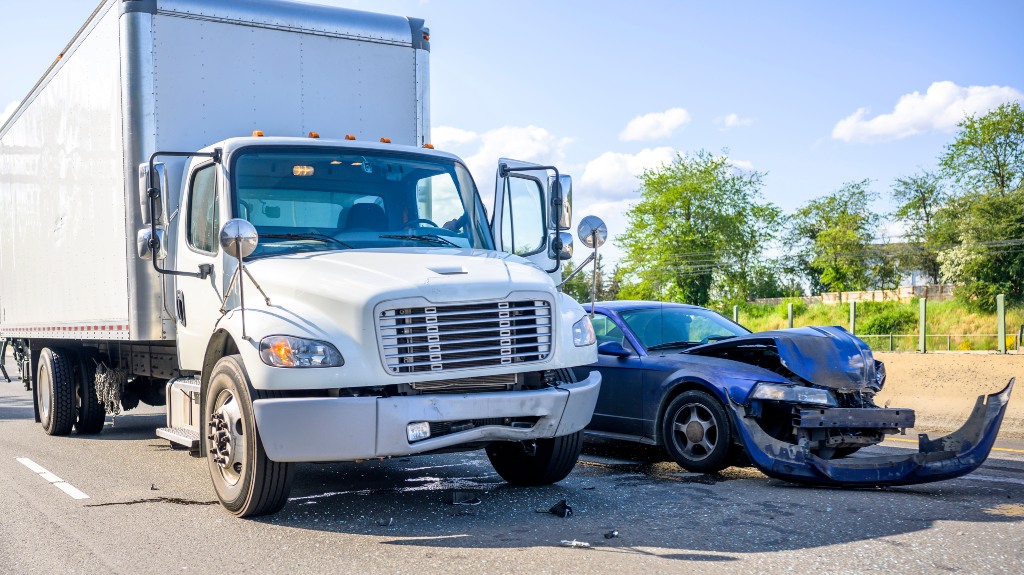
Getting hit by an 80,000-pound commercial vehicle is a terrifying, life-altering experience. The physical impact leaves victims dealing with immense pain, while the emotional trauma can make it hard to even get back into a car. On top of this suffering, victims are immediately forced to confront aggressive corporate pushback from the trucking company’s legal team.
The danger on our highways is an undeniable reality. Data shows that in 2023, 5,472 people died in large-truck crashes, and 70% of those fatalities were occupants of other passenger vehicles. Furthermore, 114,552 large trucks were involved in crashes resulting in an injury that same year. These numbers prove just how disproportionate the danger is for smaller cars sharing the road with massive freight haulers.
A commercial truck claim is fundamentally different—and harder—than a standard car crash. You are not just dealing with another driver who made a mistake. You are navigating complex federal regulations, taking on multiple liable parties, and fighting against massive corporate insurance policies designed to protect company profits.
When you are up against a massive commercial trucking corporation and its team of defense attorneys, you need a legal team that understands both federal trucking regulations and the local courts. Having dedicated advocates on your side—like specialized representatives familiar with the regional judicial system—ensures that critical evidence is preserved immediately and your long-term life planning requirements are fully calculated.
The physics of a commercial collision are terrifying and heavily skewed against the average driver. A fully loaded tractor-trailer can weigh up to 80,000 pounds, while a typical passenger vehicle weighs roughly 4,000 pounds. When a collision occurs at highway speeds, this extreme size and weight disparity guarantees severe physical outcomes for the occupants of the smaller vehicle.
Victims of these crashes rarely walk away with simple fractures or minor scrapes. Instead, they face catastrophic trauma. These injuries often include traumatic brain injuries, permanent spinal cord damage, crushed limbs, and severe internal bleeding. Managing these types of injuries goes far beyond a single hospital stay; they require intensive, lifelong medical management.
This severe physical trauma connects directly to the financial complexity of your legal claim. Because you are facing years of physical therapy, potential home modifications, and multiple future surgeries, a quick settlement from the insurance company will simply not suffice. Accepting an early offer will not cover the harsh reality of your long-term healing process.
If you are wondering why the trucking company’s insurance adjuster is fighting your claim so aggressively, the answer comes down to sheer financial exposure. Standard personal auto insurance policies typically operate with minimums in the tens of thousands of dollars. Corporate trucking companies, however, deal in massive, multi-million-dollar policies.
Because of the extreme danger these vehicles pose to the public, the federal government mandates high insurance minimums. The FMCSA requires commercial motor vehicles to carry minimum public liability insurance ranging from $750,000 to $5,000,000, depending on the cargo. Hazardous material carriers face the highest financial requirements.
Because so much money is on the line, trucking companies deploy a powerful corporate shield the moment a crash happens. They send aggressive adjusters and defense lawyers to the scene immediately. Their goal is to protect their bottom line, find ways to shift the blame to you, and ultimately avoid paying out a massive, life-changing settlement.
| Feature | Standard Car Accident | Commercial Truck Accident |
|---|---|---|
| Insurance Limits | Usually $15,000 – $100,000 | Minimum $750,000 up to $5,000,000+ |
| Defense Tactics | Standard adjuster review | Immediate deployment of corporate defense teams |
| Potential Defendants | The other driver | Driver, employer, loaders, parts manufacturers |
| Regulatory Rules | State traffic laws | Strict Federal FMCSA regulations |
In a standard car accident, fault usually rests squarely on the shoulders of the other driver. Commercial truck accidents involve a much more complicated chain of command. In the freight industry, the truck driver rarely owns the cab they drive, the trailer they pull, or the cargo they are hauling across state lines.
This fractured ownership structure means multiple corporate entities could be held financially responsible for your suffering. The truck driver can be sued for direct negligence, such as speeding or distracted driving. However, the trucking company employing them can also be held liable for poor hiring practices, inadequate safety training, or demanding unrealistic delivery schedules that lead to driver fatigue.
The web of liability extends even further behind the scenes. Cargo loaders can be named as defendants if they secured freight improperly, and parts manufacturers share the blame if a defective brake system or a blown tire contributed to the collision. Identifying every responsible party is a necessary step in maximizing the compensation available for your complete recovery.
Because these cases involve complex litigation against massive insurance corporations, partnering with experienced truck crash lawyers in Coatesville is essential to protect your rights. A knowledgeable legal team will launch an aggressive investigation to preserve logbooks and black box data, ensuring that every negligent party is held accountable. This level of dedicated advocacy provides the leverage needed to secure the settlement you deserve following a life-altering accident.
Because commercial trucks pose a constant threat to public safety, the industry operates under strict federal oversight. The Federal Motor Carrier Safety Administration (FMCSA) enforces rigorous rules governing everything from vehicle maintenance schedules to mandatory driver health screenings. One of the most vital regulations involves Hours of Service (HOS) rules, which are strictly designed to prevent dangerous driver fatigue.
These regulations are necessary because of the staggering scale of the commercial freight industry. Federal data confirms that large trucks traveled 331.3 billion miles in 2022, representing a massive volume of commercial traffic sharing the road with everyday families. With that much heavy mileage, enforcing mandatory rest breaks is quite literally a matter of life and death.
Skilled attorneys use violations of these specific regulations as a clear roadmap to prove fault. If a legal team can show that a trucking company altered logbooks or forced their drivers to skip required sleep breaks to meet a deadline, it establishes undeniable corporate negligence. This transforms your case from a simple accident claim into a proven history of corporate recklessness.
Proving that a massive trucking company was negligent requires highly specialized evidence, but that proof comes with a strict expiration date. Commercial trucks generate unique types of data that you simply will not find in a passenger car collision. This includes black box data from Electronic Data Recorders (EDRs), digital driver logbooks, dashcam footage, and extensive corporate hiring records.
The greatest danger you face early in your claim is “spoliation”—the legal term for the destruction or loss of evidence. Trucking companies are only legally required to keep certain operational records and data for a limited time. If they are not formally ordered to preserve these files, they will routinely destroy them in the normal course of business operations.
This creates a high-stakes race against the clock for accident victims. You need an aggressive legal team to step in immediately and send formal preservation letters to the corporation. Securing the crash scene and legally locking down this digital data prevents the trucking company from hiding the truth about what really caused your injuries.
After surviving a severe commercial truck crash, it is entirely normal to feel overwhelmed by the stack of immediate hospital bills arriving in your mail. However, your legal battle must shift focus from those past due notices to securing your comprehensive, lifelong financial stability. In the legal field, this concept is known as fighting for your “life planning requirements.”
Life planning requirements cover the true, long-term cost of your injuries. This calculation projects the expense of future reconstructive surgeries, accounts for years of lost earning capacity, funds ongoing physical therapy, and even pays for necessary wheelchair-accessible home modifications. It is a holistic approach to making sure you are financially protected for decades to come.
Securing a financial package of this magnitude requires a team-based law firm that operates with the motto “Driven To Serve. Ready to Fight.” You cannot rely on a solo practitioner lacking regional resources to take on a massive corporate defense firm. You need reassuring, empathetic, yet fiercely aggressive attorneys who will step into the ring on your behalf so you can focus entirely on your physical recovery.
A commercial truck claim is never a standard auto dispute; it is a complex battle against a well-funded corporate machine. These corporations have teams of professionals working continuously to minimize their financial exposure and protect their massive insurance policies. To win, you must match their aggression with a targeted legal strategy.
Success in these high-stakes claims requires preserving specialized digital evidence before it is legally destroyed. It demands a thorough understanding of strict federal trucking regulations to expose hidden negligence. Above all, it requires the resources to investigate the entire supply chain and hold multiple massive entities fully liable for their reckless actions.
You do not have to endure this overwhelming process by yourself. Do not let a corporate insurance adjuster intimidate you into accepting a lowball offer while you are healing. You have the right to demand comprehensive justice and lifelong financial security. With a dedicated legal team fighting for you, you can level the playing field and secure the maximum compensation you deserve.