
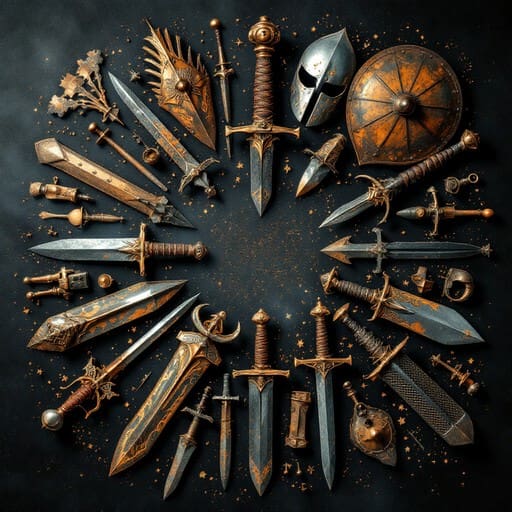
Modern buhurt demonstrations for present-day practice need more than traditional chivalric combat. The sport will transform into a regulation testing facility which operates as a testing ground for controlled combat by 2026. The three elements of buhurt weapons design and rulebooks and fighter specialization have developed together to create a system where equipment selection determines fighters’ strategic choices and potential injuries and their team identity.
The precise intersection point between Medieval Extreme exists. Its catalog is not organized around fantasy archetypes, but around functional categories that mirror competitive realities: reach management, impact transfer, fatigue curves, and compliance with BI, IMCF, and HMB technical rules. The understanding of modern buhurt requires you to study its weapons because they function as systems which create specific limitations and chances for the fighter to use.
Swords remain the most used weapon because they offer fighters both balanced combat abilities and flexible fighting options. The one-handed arming sword (≈1.3–1.7 kg 75–100 cm) combined with a shield enables fighters to maintain control of combat tempo while applying constant pressure throughout the fight.
Longswords (≈1.7–2.3 kg 120–140 cm) exchange shield protection for better ability to perform two-handed strikes while great swords enable fighters to attack from longer distances although they result in slower recovery times.
Axes change the battle dynamics. The one-handed axe design concentrates weight in its head which enables it to produce greater force impact than a sword with equivalent weight. Two-handed and long axes extend this principle to become weapons which disrupt enemy formations during large-scale combat.
The different weapon types exist because no single weapon can dominate every combat situation. Modern buhurt teams use these different profiles to create a team that combines speed with force and endurance.
The fighter’s weapon choice in buhurt beyond its appearance because it controls their fight movements and combat abilities. Research in sports biomechanics shows that athletes experience greater joint tension and faster fatigue when their body mass exists as concentrated weight at their body extremities.
In practice, weapon choice maps directly to fighting style:
Fighters who switch between offensive and defensive fighting methods find support in either longswords or falchions. Specialists who want to create major disruptions during combat should use long axes and heavy maces because those weapons require them to endure greater physical exhaustion. The weapons show no superiority because they define specific roles for each weapon.
Buhurt leagues need to implement professional safety standards because weapons now exist in multiple types. The original formats established their rules through examination of former competitions, but present-day tournaments base their rules on statistical data. The injury tracking system used in BI and IMCF events has developed more accurate technical specifications for weapon and armor system integration.
Across leagues, safety evolution has converged on several principles:
The rules establish new design standards for weapons. The tournament rules require weapons to meet safety standards because they now consider weapons as essential safety equipment rather than props which performers can handle. Fighters must select weapons that provide complete protection through reinforced hands and their weapons and their body protection must match the strength of their fighting style.
The sport requires athletes to follow safety rules while they compete at their highest performance level. The system enables competition to increase in intensity.
Fighters demonstrate their skills through three types of weapons which include swords and axes and polearms. The identity exists through three aspects which include training methods and armor choices and team member responsibilities. In a mature buhurt environment, people show their unique identities through their weapon skills rather than their visual appearance.
The mission of Medieval Extreme is to provide fighters with equipment which allows them to express their identities through safe and legal means. Your choice of weapon will determine your fighting style and your ability to sustain combat whether you prefer the balanced nature of a sword or the fierce power of an axe or the tactical advantage of a polearm.
Choose your option with clear purpose. Build your equipment setup based on the weapon you selected. Your weapon should be regarded as essential to your artistry instead of being seen as a minor addition to your work.