
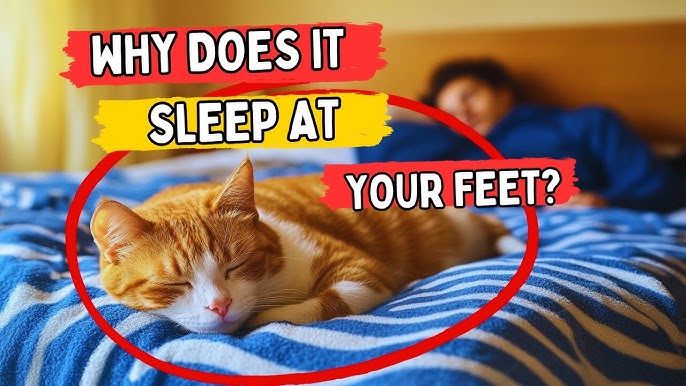
Why does my cat sleep at my feet every single night? If you have ever woken up with a warm, purring weight pinning down your ankles, you already know this feeling. It looks random, but your cat’s choice of sleeping spot is anything but accidental.
Every position a cat chooses is driven by instinct, temperature, trust, and the bond they share with you.
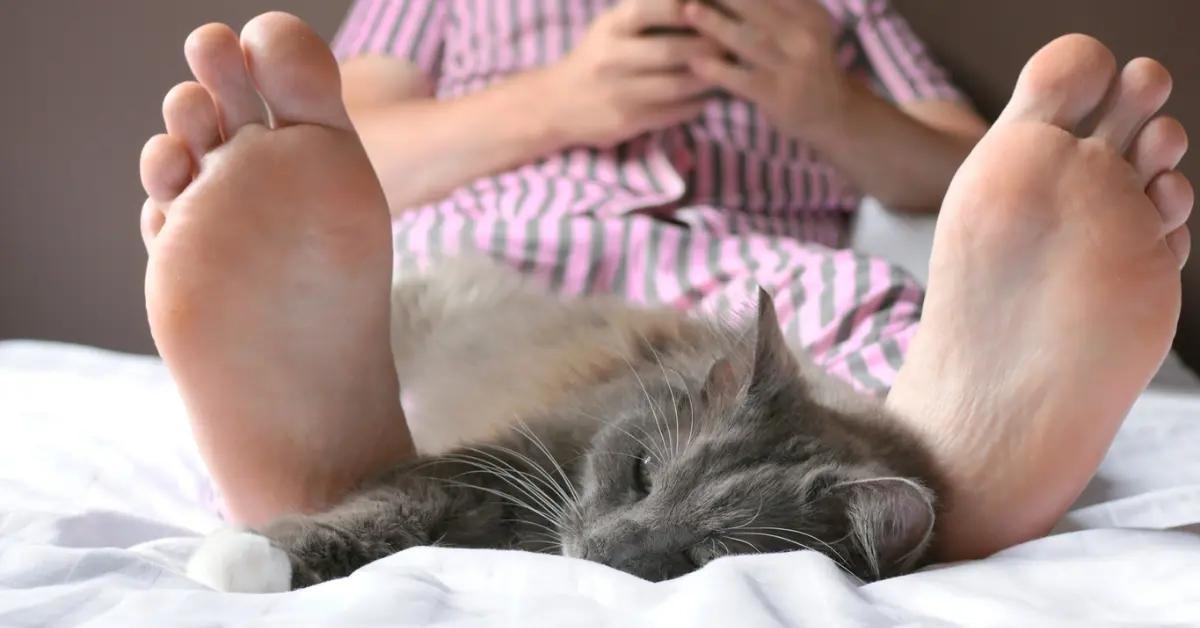
Yes, it is completely normal. Sleeping at or near their owner’s feet is one of the most common feline sleeping behaviors documented by veterinarians and animal behaviorists.
Research by Chomel and Sun (2011) found that around 62% of cats sleep with their adult owners. Of those, a significant portion consistently choose the foot of the bed rather than the pillow or chest area.
Your cat is not doing anything strange. They are doing exactly what their instincts, comfort preferences, and emotional bond with you are telling them to do.
Cats do not choose their sleeping spots casually. Your feet hit a very specific combination of comfort factors that keeps your cat coming back to the same spot night after night.
Warmth is the most immediate and practical reason cats sleep at your feet.
Cats have a higher body temperature than humans, typically ranging between 100.5°F and 102.5°F (38°C–39.2°C). Their thermoneutral zone — the temperature range where they do not burn energy to heat or cool themselves — sits between approximately 86°F and 97°F (30°C–36°C).
Your body radiates steady heat throughout the night. The foot of the bed, while slightly cooler than your chest or belly, still provides a reliable source of warmth that helps your cat stay comfortable without overheating.
Cats learned this behavior from kittenhood, when they huddled together with littermates and their mother for warmth and comfort.
Safety is the most deeply rooted reason behind almost every feline sleeping decision.
Cats are both predators and prey animals. Even a fully domesticated indoor cat carries millions of years of instinct that tells it to sleep somewhere it can monitor threats, react quickly, and escape if necessary.
Your feet position them close to you — a source of safety and familiarity — while keeping them near the edge of the bed where an escape route is easy. They get protection without vulnerability.
A cat that sleeps at your feet is not being timid or distant. They are making a strategically smart choice that satisfies both their need for closeness and their survival instincts at the same time.
Cats do not sleep near just anyone. Choosing to sleep at your feet is a clear signal that your cat trusts you completely.
Studies show that cats bonded with their owners actively seek them out for comfort and security. Sleeping at your feet is how your cat says “I feel safe with you” without making a sound.
Unlike dogs, cats show affection through proximity rather than constant physical contact. Your cat does not need to be draped across your face to love you. Curling up at your feet carries exactly the same emotional meaning — they have chosen you as their safe place.
Cats are lighter sleepers than humans, and your body movements matter to them more than you might realize.
Most people shift position 40 to 50 times per night during sleep. Your head, shoulders, and torso do most of that moving. Your feet, by comparison, are the most stable and predictable part of your body throughout the night.
For a cat trying to get undisturbed rest, your feet offer a much lower risk of being suddenly disturbed by a rolling shoulder or a flung arm. It is practical comfort management on their part.
Cats rely heavily on scent to feel safe and to claim spaces as their own.
Your feet carry a concentrated collection of your personal scent. Sweat glands in your feet produce strong and consistent scent signals throughout the day. To your cat, that smell is the most recognizable, comforting version of you that exists.
By sleeping at your feet, your cat is also gently scent-marking that spot. Their own scent from repeated visits layers onto the bedding, reinforcing their claim on the territory. According to behavioral researcher John Bradshaw in “The Behavior of the Domestic Cat,” felines use scent to feel safe and reinforce their bond with their environment and the people in it.
Cats are famously independent animals, and their sleeping preferences reflect that.
Sleeping directly on your chest or face puts them in a very vulnerable, confined position right next to unpredictable human movement. Sleeping at your feet gives them the closeness they want while preserving enough personal space to feel comfortable and in control.
Research by Merola and Mills (2016) in PLOS ONE found that cats can express the same social bond through proximity as through direct physical contact. Your cat is not being aloof. They are being independent in the most characteristically cat way possible.
Cats are expert thermoregulators, and they use you as part of that system.
Early in the night, when temperatures drop, a cat may start near your chest or belly where body heat is highest. As the night progresses and body heat builds under the blankets, your cat may migrate toward the cooler air at your feet.
The foot of the bed tends to be slightly cooler than the rest of the sleeping surface, which helps cats fine-tune their temperature without needing to leave the comfort of sleeping near you.
This is why some cats appear to cycle between different positions during the night rather than staying in one spot until morning.
Some cat behaviorists suggest that cats sleeping near your feet are positioning themselves to guard you.
A cat at your feet has a full view of the room. They can observe movement, sounds, and any changes in the environment while you sleep. This positioning mirrors behaviors observed in small wild cats that sleep near the periphery of their group to monitor for threats.
Research by Rochlitz (2009) in the BSAVA Manual of Canine and Feline Behavioural Medicine notes that cats choose sleeping positions that allow them to stay close to their human while maintaining environmental vigilance.
Your cat sleeping at your feet may quite literally be keeping watch over you.
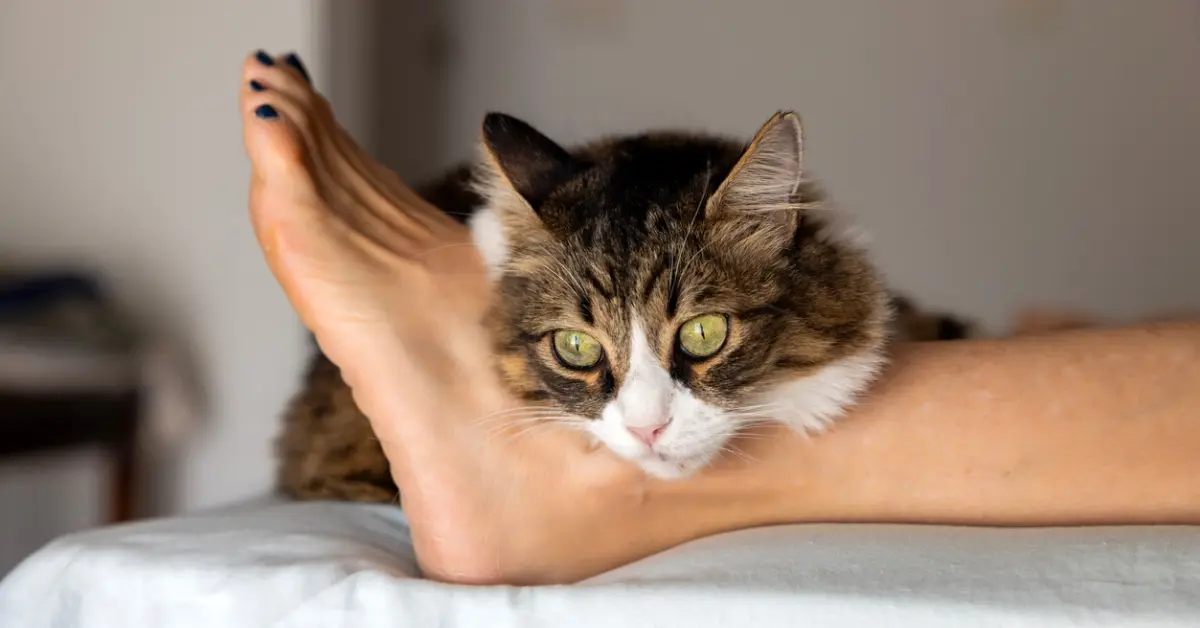
Many cats love the physical sensation of pressing against a solid, warm surface while they sleep.
You may have noticed your cat wiggling and adjusting until they are pressed firmly against your legs or feet. This behavior is likely rooted in early kittenhood, when kittens slept in piles, surrounded by the warmth and gentle pressure of their siblings and mother.
The slight pressure of being against your feet replicates that early sense of being held and surrounded. It is a deeply comforting physical sensation that many cats carry into adulthood.
Once a cat finds a sleeping spot that works, they return to it consistently.
Cats are creatures of habit. They establish routines for feeding, grooming, play, and sleeping, and they stick to those routines because consistency makes them feel secure. If your cat slept at your feet once and found it warm, safe, and comfortable, that spot becomes their default.
Over time, their own scent also builds up in that location, which pulls them back to it repeatedly. What started as instinct becomes ritual, and what becomes ritual becomes their permanent, preferred spot.
Your cat’s exact position tells you something specific about what they need in that moment.
| Sleeping Position | What It Likely Means |
|---|---|
| At your feet | Safety + independence + warmth; trusts you but wants personal space |
| On your chest | Deep bond; seeking heartbeat and breathing rhythm for comfort |
| On your pillow / near your head | Very high trust; bonded and territorial |
| Between your legs | Seeking a warm, nest-like enclosure; feels very secure |
| Pressed against your back | Warmth-seeking; also indicates strong trust |
| On your stomach | Comfort-seeking; drawn to your body heat and breathing rhythm |
Each choice reflects the specific mix of warmth, safety, and closeness your cat needs at that particular moment.
Many cat owners wonder why their cat chooses feet over a lap, especially when the lap seems warmer and more comfortable.
The answer comes down to two things: vulnerability and movement.
A lap requires your cat to be in a relatively exposed position. It also moves far more than your feet — every gesture, fidget, or reach puts the cat at risk of being jolted or displaced.
Your feet offer warmth and closeness with significantly less unpredictability. For cats that value their independence and sensory awareness, feet simply work better as a sleeping base than a lap does.
Some cats also cycle through both positions depending on mood. A cat that sleeps on your lap during evening reading time may shift to your feet once you fall asleep.
If you have multiple people in your home and your cat consistently chooses your feet over everyone else’s, that is a meaningful preference.
It does not always mean you are the cat’s favorite human in a simple, ranked sense. There are several factors at play:
Your scent is the most familiar to them. The more time you spend with your cat, the stronger the scent association becomes. If you feed, groom, and interact with your cat most, your feet will be their most comforting destination.
Your movement patterns may be more predictable. If you are a deep, still sleeper, your cat learns that sleeping near you means minimal disturbance.
Body temperature also plays a role. Some people naturally run warmer than others, making their body a more attractive heat source.
It can also be influenced by where you sleep in the bed. Cats often claim the end of the bed facing the room entrance — and whoever sleeps closest to that position may simply be the most convenient guardian target.
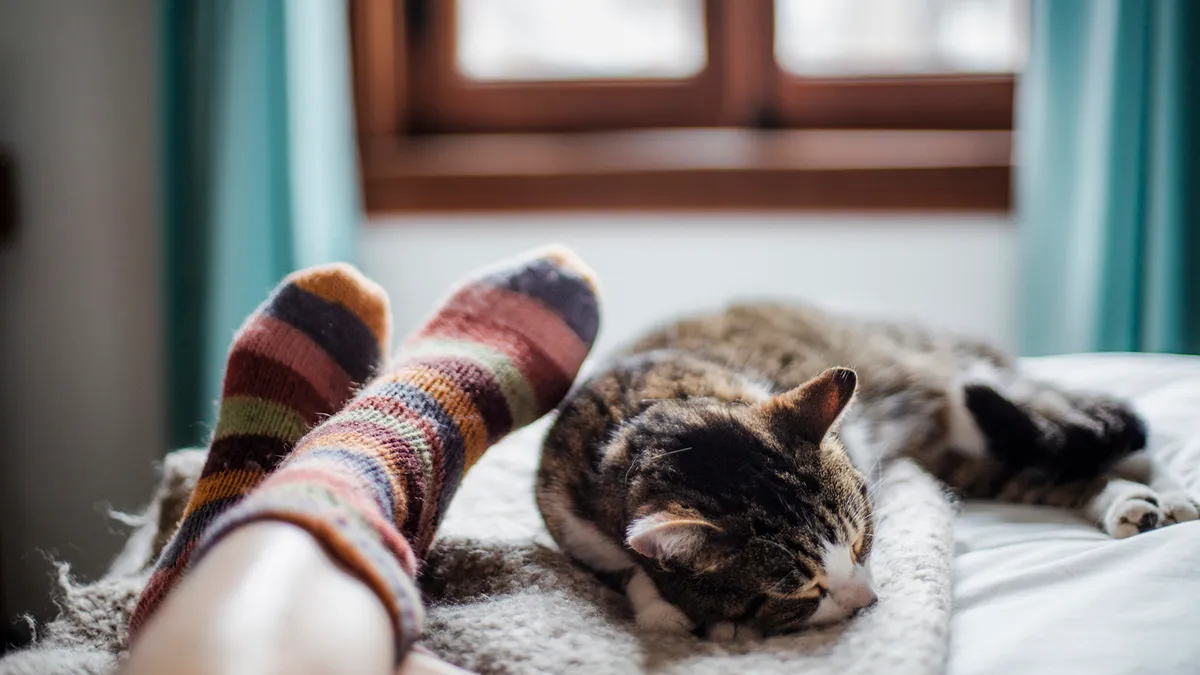
Understanding where your cat sleeps at your feet is just one part of reading feline body language. Here is a complete breakdown of cat sleeping positions and their meanings.
| Position | Description | What It Means |
|---|---|---|
| Curled ball (crescent) | Nose to tail, compact shape | Conserving heat; protective of organs; common in colder months |
| Cat loaf | Paws tucked under chest, head up | Relaxed but alert; ready to react; comfortable but not in deep sleep |
| Belly up | Fully exposed stomach, paws in air | Extreme trust and comfort; completely relaxed environment |
| Side sleeper | Stretched on one side, limbs out | Deep sleep; confident; very comfortable with surroundings |
| Superman / stretched out | Flat on belly, limbs extended | Usually in a playful mood; comfortable; often seen post-activity |
| Paws over face | One or both paws covering eyes | Do not disturb; blocking light; deep sleep protection |
| Sitting upright | Sitting with eyes partially open | Light sleep; staying alert; semi-aware of surroundings |
| Pressed against human feet | Leaning or tucked against feet | Trust, warmth-seeking, habit, and territorial comfort |
Cats are extreme sleepers by almost any animal standard.
The average domestic cat sleeps between 12 and 16 hours every day. Some cats, particularly older cats and kittens, may sleep up to 20 hours in a 24-hour period.
This high sleep requirement exists because cats are crepuscular — naturally most active at dawn and dusk. Their bodies conserve energy through deep, frequent rest cycles in between those active periods.
Cats also cycle through light sleep and deep REM sleep much faster than humans do. They can enter light sleep within seconds and reach deep sleep quickly, which is why a cat can look like it is napping while still being responsive to environmental sounds.
Most cat sleep behavior is completely healthy and normal. However, sudden changes in sleeping patterns can sometimes signal an underlying health issue.
| Behavior | Normal or Concerning |
|---|---|
| Sleeping at your feet every night | Normal — habit and preference |
| Changing sleeping spots occasionally | Normal — temperature regulation or mood |
| Sleeping more than usual suddenly | Potentially concerning — consult a vet |
| Sleeping in litter box | Concerning — contact a vet immediately |
| Hunched sleeping posture | Possibly concerning — may indicate pain |
| Avoiding usual sleeping spots | Worth monitoring — could signal stress or illness |
| Sleeping in very unusual isolated locations | Could indicate stress, pain, or illness |
If your cat suddenly starts sleeping far more than usual, adopts a consistently hunched or tense posture, or begins sleeping in their litter box, schedule a veterinary appointment. These can be signs of conditions including urinary tract infections, kidney disease, arthritis, or gastrointestinal problems.
A cat that simply shifts from your head to your feet, or from the bed to the floor, is almost certainly just adjusting their comfort preferences. That alone is not a reason for concern.
This is ultimately a personal choice, and there is no single right answer. Here are the key considerations.
Benefits of letting your cat sleep at your feet:
Cats at the foot of the bed are less likely to disrupt your sleep than cats near your pillow. Many people find the warmth and gentle weight comforting. The routine strengthens the bond between owner and cat. Your cat sleeps better when they feel safe, which supports their overall health and emotional wellbeing.
Potential downsides:
Some people are light sleepers and find any cat movement disruptive. Allergy sufferers may experience more nighttime symptoms with a cat in the bed. If your cat is very active at night, they may disturb your rest.
If you want to discourage it:
Provide an equally warm, soft, and secure alternative sleeping spot nearby. A heated cat bed placed at the foot of your bed or in the same room gives your cat the warmth and proximity they need without being directly on the bed. Consistency is key — if you allow the behavior sometimes and discourage it other times, your cat will simply continue trying.
If you want your cat to sleep comfortably — whether on the bed or nearby — a few simple changes make a real difference.
Temperature matters most. Cats sleep best in environments between 77°F and 86°F (25°C–30°C). A heated cat bed, a fleece blanket, or even a spot in a sunny corner of the room gives them a warm base.
Stability and security. Cats prefer sleeping spots that feel enclosed or backed by a wall on at least one side. Bolster beds, igloo-style beds, and donut-shaped beds replicate the sensation of being surrounded and held.
Familiar scent. Placing a worn T-shirt or blanket that carries your scent in their sleeping area will draw them to it and help them feel calm and secure.
Quiet location. Cats sleep best where foot traffic and noise are minimal during their rest cycles. Avoid placing their sleeping spot near a high-traffic doorway or loud appliance.
Accessibility. Senior cats or cats with mobility issues need sleeping spots that are easy to enter and exit. Low-sided beds and ramps or steps to reach higher surfaces keep older cats comfortable and safe.
Many cat owners notice that their cat’s sleeping position shifts with the seasons, and there is a straightforward explanation.
In winter, your cat sleeps closer to your body — sometimes moving up toward your chest or even under the blanket — because they need more warmth. Your body becomes a more important heat source when the ambient temperature drops.
In summer, the foot of the bed becomes a more frequent choice because it is slightly cooler than the rest of the sleeping surface. Your cat can stay near you without overheating. Some cats move to the floor or a cool tile surface during very hot weather and return to your feet as temperatures moderate.
Observing these seasonal shifts in your cat’s sleeping habits gives you a real-time read on how well your home temperature is working for them.
The bond between cats and their owners has been studied more deeply in recent years, and the findings consistently show that cats form real, meaningful attachments to their humans.
A 2019 study published in Current Biology by Kristyn Vitale and colleagues at Oregon State University found that cats show attachment behavior toward their owners that closely mirrors what has been documented in dogs and human infants. Cats in the study used their owners as a secure base, returning to them for reassurance in unfamiliar environments.
Sleeping near you — especially at your feet — is a direct expression of that attachment. Your cat is not just choosing a warm spot on the bed. They are choosing proximity to the person they are emotionally bonded with.
Your cat sleeps at your feet every night because the spot combines warmth, safety, familiar scent, and proximity to you. Once they find a spot that works, habit and scent-marking bring them back to it consistently.
Yes. Choosing to sleep near you is one of the clearest signs of feline trust and affection. Cats only sleep in places and with people where they feel completely safe.
Your cat likely prefers your feet because your scent is most familiar to them, your sleep movements may be more predictable, or your body temperature runs slightly warmer. It reflects preference, not rejection of your partner.
No, a change from one sleeping spot to another is generally normal. Only be concerned if the new position is consistently hunched, tense, or your cat is sleeping far more than usual combined with other behavior changes.
Between your legs offers a warm, enclosed, nest-like space that feels even more secure than the foot of the bed. Cats that prefer this spot usually value the sensation of being surrounded on multiple sides.
Many behaviorists believe so. Cats at your feet have a full view of the room and are positioned to monitor for threats while you sleep. It is consistent with how cats in the wild position themselves near their social group.
Kneading is a behavior cats carry from kittenhood when they pressed on their mother’s belly to stimulate milk. In adulthood, it signals comfort, happiness, and a sense of safety. Your cat kneading before settling at your feet is a sign of deep contentment.
It depends on how still your cat is and how lightly you sleep. Most cats choose the foot of the bed specifically because it is stable and low-movement, making them less disruptive than cats that sleep near your pillow.
Provide a warm, soft, enclosed alternative sleeping spot placed very close to your feet. A self-warming cat bed at the end of your bed often works well. Be consistent — offer the alternative every night rather than switching between allowing and discouraging.
Yes. Cats bond with the person who spends the most time with them, has the most familiar scent, provides the most consistent and gentle interaction, and whose movement patterns are most predictable during sleep. It is earned, not random.
Why does my cat sleep at my feet is a question with a genuinely heartwarming set of answers. Your cat chooses that spot because you are their safe place, their heat source, their familiar scent, and their chosen companion.
Every time they circle twice and settle against your ankles, they are expressing something that cats rarely communicate directly — complete and total trust.
The behavior is normal in virtually every case. It is driven by millions of years of instinct, shaped by the bond your cat has built with you specifically, and reinforced by the comfort and routine of returning to a spot that works perfectly for them.
Rather than moving them off the bed, consider what it means that your cat, an animal built for independence and survival, chose your feet as the safest place in their entire world. That is not a small thing. That is the highest compliment a cat knows how to give.