
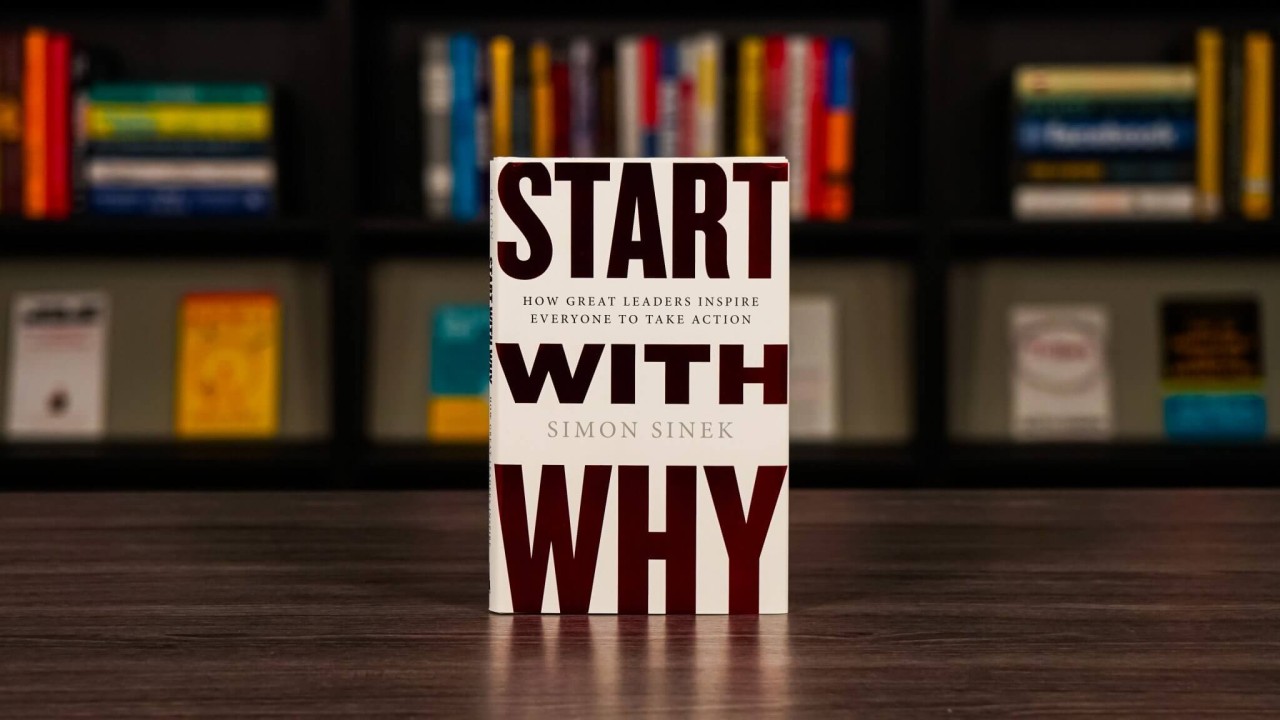
The Start With Why book by Simon Sinek is one of the most impactful leadership books ever written.
Published in 2009, it changed how millions of leaders, entrepreneurs, and marketers think about purpose, communication, and inspiration.
Simon Sinek is a British-American author, motivational speaker, and organizational consultant. He is best known for his ideas on leadership and business strategy.
His TEDx Talk, “How Great Leaders Inspire Action,” has been viewed nearly 70 million times. It is one of the most-watched TED Talks in history.
Sinek followed up his talk with Start With Why: How Great Leaders Inspire Everyone to Take Action in 2009. The book became a global bestseller and cemented his reputation as a top leadership thinker.
The Start With Why book asks one central question: why do some leaders and organizations inspire while others do not?
Sinek’s answer is surprisingly simple. Inspired leaders and companies all think, act, and communicate in the same way — and it is the opposite of what most people do.
Most companies start by telling people what they do, then how they do it, and rarely get to the why. Truly inspiring leaders flip this completely. They start with why.
The centerpiece of the Start With Why book is the Golden Circle — a model made of three concentric rings.
| Layer | Question | Meaning |
|---|---|---|
| WHY | Why do you exist? | Your core purpose, cause, or belief |
| HOW | How do you do it? | Your values, principles, and processes |
| WHAT | What do you do? | The products or services you offer |
Most companies communicate from the outside in. They lead with What, then How, and rarely articulate Why.
Great leaders communicate from the inside out. They lead with Why, then How, and finally What.
This inside-out communication is what Sinek calls starting with why.
Nearly every organization on the planet knows what it does. Some organizations know how they do it differently or better.
But very few can clearly articulate why they do it — and that gap is the root cause of most leadership failures.
When companies focus only on what and how, they end up relying on manipulation to drive behavior. This includes discounts, promotions, fear, peer pressure, and novelty.
Manipulation works short term. But it erodes trust and loyalty over time. Start With Why argues that inspiration — not manipulation — is the only sustainable path to long-term success.
One of the most fascinating parts of the Start With Why book is its grounding in neuroscience.
Sinek explains how the human brain maps perfectly onto the Golden Circle. The outer ring (What) corresponds to the neocortex — the part of the brain that handles rational thought and language.
The inner rings (Why and How) correspond to the limbic brain — the part that controls emotion, behavior, trust, loyalty, and gut-feeling decisions. Interestingly, the limbic brain has no capacity for language.
This is why people often say things like “I can’t explain why, but this just feels right.” They are making decisions from the limbic brain, which cannot articulate itself in words.
When you communicate your why, you speak directly to the emotional decision-making center of the brain. That is what creates deep trust, loyalty, and the feeling of belonging.
This is arguably the most famous line from the Start With Why book: “People don’t buy what you do; they buy why you do it.”
Apple is the clearest example in the book. Apple does not simply sell computers and phones. Their why is to challenge the status quo and think differently.
That belief — communicated consistently through every product, ad, and store design — attracts people who also believe in thinking differently. Those customers become loyal fans, not just buyers.
In contrast, Dell sells technically comparable computers. But Dell has never built that kind of emotional loyalty because it has never communicated a clear why.
The Start With Why book introduces the concept of the Law of Diffusion of Innovations, originally developed by sociologist Everett Rogers.
This law segments any market into five groups:
| Group | Percentage | Behavior |
|---|---|---|
| Innovators | 2.5% | Take risks on new ideas |
| Early Adopters | 13.5% | Open to novelty, trust gut |
| Early Majority | 34% | Need social proof |
| Late Majority | 34% | Skeptical, follow the crowd |
| Laggards | 16% | Resistant to change |
The critical insight is that you cannot reach the Early and Late Majority until you win over the Innovators and Early Adopters first.
These first two groups make decisions based on belief and gut feeling — they respond directly to why. Once you reach roughly 15–18% of a market, a tipping point occurs and the majority follows.
This is why starting with why is not just inspirational advice — it is a strategic necessity for achieving critical mass.
Sinek draws a sharp line between two ways of influencing human behavior: manipulation and inspiration.
Manipulations include price reductions, promotions, fear messaging, aspirational advertising, peer pressure, and novelty. They are widely used and they do work — but only in the short term.
Every time a company runs a discount, it trains customers to wait for the next one. Every time fear is used to drive a decision, the bar of fear has to be raised next time to get the same result.
Inspiration, on the other hand, is rooted in belief. When people believe what you believe, they act for themselves — not because you pushed them. That creates sustainable loyalty.
Sinek argues that the goal is not just to sell to people who need what you have, but to sell to people who believe what you believe.
The Start With Why book emphasizes that the most powerful thing a leader can do is build a community of believers — a tribe — united around a shared purpose.
Martin Luther King Jr. did not just organize a political movement. He articulated a vision and a belief so clearly that 250,000 people showed up in Washington D.C. in 1963 — most of whom he had never met.
King gave the “I Have a Dream” speech, not the “I Have a Plan” speech. Purpose and belief drive mass movements, not logistical details.
The same principle applies to business. When customers and employees share your why, they become ambassadors who voluntarily spread your message. You do not need to push them.
The how layer of the Golden Circle is often undervalued but critically important.
How represents the values, principles, processes, and behaviors that bring why to life on a daily basis. The how is where discipline lives.
Great leaders must hold every team member accountable to the how at all times. If the why is the dream, the how is the daily operational code that makes the dream real.
Sinek uses Southwest Airlines as a powerful example. Herb Kelleher, the co-founder, famously said: “You don’t hire for skills, you hire for attitude. You can always teach skills.”
Southwest’s why is freedom and fun in air travel. They hire people who embody that spirit — and the how is a culture of positivity, warmth, and exuberance.
Sinek argues that for the Golden Circle to work, three things must be in place:
Clarity of WHY — The leader must be able to articulate the purpose with absolute clarity. A fuzzy why produces a fuzzy culture and confused customers.
Discipline of HOW — The values and principles that bring the why to life must be enforced consistently. Every decision, every hire, every policy must align with the why.
Consistency of WHAT — Everything the organization says and does must prove and reinforce the why. Every product, every ad, every action is a tangible proof point.
When all three are aligned, the result is trust. And trust is the foundation of loyalty — from customers, from employees, and from the market.
One of the most sobering parts of the Start With Why book is Sinek’s analysis of how companies lose their way.
In the early stages of a company, the founder’s why is naturally embedded in every decision. The leader has direct contact with customers and employees. The culture is strong because the founder is the culture.
As the company grows, layers of management develop. If the why has not been codified into the organization’s systems, culture, and hiring practices, it gradually dilutes.
Sinek points to companies like Walmart after Sam Walton, and early Apple before Steve Jobs returned, as examples of organizations that lost their why — and suffered for it.
The lesson: a leader’s why must be institutionalized into the DNA of the organization before it becomes dependent on any single individual.
The Start With Why book makes a compelling case that trust — both internal (employees) and external (customers) — is built from the inside out.
Employees who understand and believe in the why are more engaged, more creative, and more loyal. They are not working for a paycheck. They are working for a purpose.
Research supports this. Studies consistently show that engaged employees perform better, stay longer, and deliver superior customer experiences.
When employees live the why, customers feel it. The entire interaction becomes authentic rather than transactional. And authenticity — not marketing — is what creates lasting loyalty.
The Start With Why book is rich with real-world case studies that make its principles tangible.
Apple — Perhaps the most detailed case study in the book. Apple challenges the status quo in everything it does. Its why is to think differently and empower the creative individual. This belief attracts loyal customers who see themselves as rebels and innovators.
Martin Luther King Jr. — King’s civil rights movement succeeded because he communicated a belief, not a strategy. People were inspired by what he stood for, not what he planned to do.
The Wright Brothers — Samuel Langley had government funding and a talented team. The Wright Brothers had passion and purpose. The brothers succeeded because they were driven by a belief that humans could fly — not by profit or fame.
Southwest Airlines — Southwest disrupted the airline industry by staying true to its why: freedom for ordinary Americans to travel by air. Every decision — low fares, no assigned seats, friendly staff — reinforces that belief.
The Start With Why book does not just analyze great leaders — it provides a practical path for individuals and organizations to discover their own why.
Start by looking backward, not forward. Your why does not come from market research or strategic planning. It comes from understanding your own history — the experiences, values, and people that shaped who you are.
Ask: What is the contribution I want to make to the world? What belief drives me even when no one is watching? What would I do even if I were not paid?
Once you articulate your why, test every major decision against it. Does this hire, this product, this partnership, this marketing campaign reinforce or contradict what I stand for?
| Part | Theme | Key Focus |
|---|---|---|
| Part 1: A World That Doesn’t Start With Why | The Problem | Why manipulation is the default |
| Part 2: An Unlikely Alternative | The Golden Circle | Why, How, What explained |
| Part 3: Leaders Need a Following | Inspiring People | Tribes, trust, and loyalty |
| Part 4: How to Rally Those Who Believe | Communication | Clarity and authenticity |
| Part 5: The Biggest Challenge Is Success | Sustaining Why | Scaling without losing purpose |
| Part 6: Discover Why | Personal Application | How to find your own why |
No book is without valid criticism, and the Start With Why book has received some.
Some critics argue that Sinek oversimplifies complex business success stories. Not every successful company can point to a clear, articulated why from day one.
Others point out that the book relies heavily on the same handful of examples — Apple, Southwest, MLK — which some feel overstates its case.
There is also the counterargument that passionate leaders are inspiring simply because of their passion — not because of the specific order in which they communicate. The Golden Circle may be describing the symptom (passion and clarity) rather than a prescriptive formula.
These are fair points. But the core insight — that purpose-driven communication creates deeper loyalty than feature-based communication — is supported by decades of behavioral research and remains highly relevant.
In 2026, the principles of the Start With Why book are more relevant than ever.
Consumers have more choices than at any point in human history. They are also more skeptical of corporate messaging. Authenticity is now a competitive advantage.
Employees — especially younger generations — actively seek purpose-driven work. Organizations that cannot articulate their why struggle to attract and retain the best talent.
And in a world saturated with content and advertising, the only messages that cut through are those that connect emotionally — messages that start with why.
Here is a quick summary of the most important ideas from the Start With Why book:
The main message is that inspired leaders and organizations always start by communicating their purpose (why) before explaining what they do or how they do it.
It is written for leaders, entrepreneurs, marketers, and anyone who wants to inspire others — whether in business, politics, or everyday life.
The Golden Circle is a three-ring model with Why at the center, How in the middle ring, and What on the outer ring, representing how inspired leaders communicate.
He means that customers make purchasing decisions based on shared beliefs and emotional connection — not features or specifications.
The book is 256 pages long and is divided into six parts covering the theory, examples, and practical application of starting with why.
Yes. Sinek grounds his Golden Circle model in neuroscience, specifically the functions of the limbic brain (emotion and decisions) versus the neocortex (rational thought).
The main examples are Apple, Southwest Airlines, Harley-Davidson, and historical figures like Martin Luther King Jr., the Wright Brothers, and Steve Jobs.
Unlike most leadership books that focus on strategy or tactics, Start With Why focuses on purpose — the belief and mission that makes everything else more effective and sustainable.
Absolutely. Sinek explicitly addresses how individuals can discover their personal why to guide career decisions, personal goals, and how they lead others.
Yes. In an era of consumer skepticism, information overload, and demand for authentic brands, the principles of starting with why are more strategically important than ever.
The Start With Why book is not just a business book — it is a philosophy of leadership, communication, and human connection. Simon Sinek’s central argument is simple but profound: people are not inspired by what you do, they are inspired by why you do it.
The Golden Circle gives leaders a clear, science-backed framework to communicate purpose before process, and belief before product. Whether you are building a company, leading a team, or navigating your own career in 2026, the lessons of this book are timeless.
Start with your why, stay disciplined in your how, and let everything you do — your what — prove that you mean it. When purpose drives every decision, loyalty, engagement, and lasting success follow naturally.